
Sports
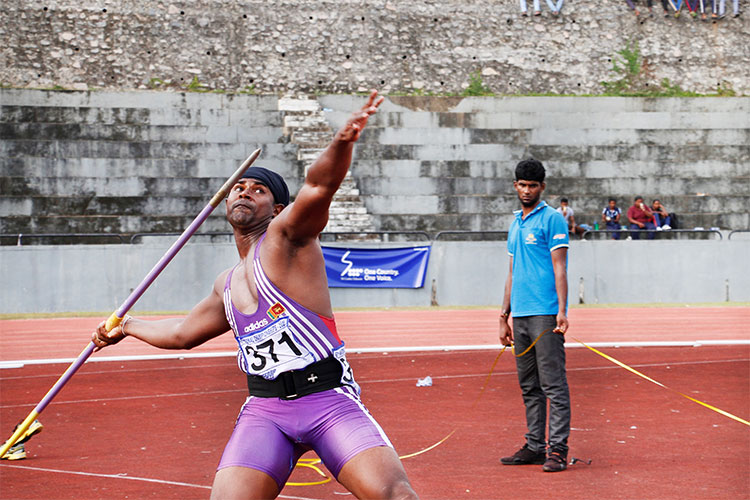
Waruna to make his swan song today

By Reemus Fernando
One of only three Sri Lankans to have cleared the 80 metres mark in the men’s javelin throw and probably the only SL thrower to have performed better than current Olympic and World Champion Niraj Chopra at regional level in the latter’s formative years, Waruna Lakshan Dayaratne is set to deliver his swan song at the Sri Lanka Army Volunteer Force Inter Regiment Athletics Championships at Diyagama today.
The first Sri Lankan to break the 75 metres barrier in the men’s javelin throw, the former national record holder is retiring probably without reaching his full potential thanks to country’s underperforming sports hierarchy which miserably failed to understand the golden opportunity that was presented during the last decade.
Sachith Maduranga, Dayaratne, current national record holder Sumeda Ranasinghe and Sampath Ranasinghe elevated the once forgotten field event to new heights with stellar performances during the last decade. Their impressive marks, however, were not loud enough to awaken the sports hierarchy from their deep slumber.
However, it was an entirely different story across the Polk Strait where the budding thrower Chopra received the required assistance to become the formidable thrower he is today. When Dayaratne finished just outside the podium (4th place) with a throw of 76.75 metres at the Asian Athletics Championships in 2015, Chopra was failing even to reach the top eight. But two years later the Indians were occupying at least two places on the javelin throw podium with Chopra on top in the Asian arena.
In 2013 Sachith Maduranga won a silver medal in the javelin throw at the Asian Athletics Championships. That was enough proof that Sri Lanka could excel at international level if proper guidance was given. The athlete trained by A.J. Rodrigo junior had a training stint in Europe prior to his impressive performances. The former Anandian improved the national record four times between 2011 and 2013. But country’s sports hierarchy including the Sports Ministry failed to recognise the achievement of the Asian medallist forcing him to make a premature retirement.
2015 was a landmark year in the men’s javelin throw as the likes of Sumeda Ranasinghe and Dayaratne kept the event among Sri Lanka’s top disciplines in track and field. While Dayaratne was placed fourth at the Asian Athletics Championships, Ranasinghe produced a massive throw of 83.04 metres to create a new national record at a local competition.
It is doubtful whether these two champion athletes received the required backing to reach their true potential. True, Dayaratne received the the Sports Ministry backing to train in Europe but that came as compensation for a blunder caused by the Sports Ministry. In 2017 Dayaratne was left stranded in an airport in China enroute to Taipei to compete in the final leg of the Asian Grand Prix. The Sports Ministry had failed to arrange for him to take his javelin to Taipei. He missed the final leg. The then sports minister compensated by providing funds to train in Europe. But by the time the arrangements were made it was winter and Dayaratne could only complete basic training before his visa expired.
He was one of only four Asian javelin throwers alongside Chopra to compete at the World Championships in 2017 but could not deliver after his training regimen went awry. But to date he is the only Sri Lankan male javelin thrower to have competed at a World Championship.
Currently a Captain in the Sri Lanka Army’s Light Infantry Regiment, Dayaratne retires as a six-time national champion (2009, 2010, 2012, 2014, 2016 and 2021). He also bagged four silver medals at the National Championships (2011, 2015, 2019, 2020). Dayaratne also has three titles to his credit at the National Sports Festival.
Incidentally, the former Dhammissara National School, Nattandiya athlete was one of the very few student sportsmen to have had given up cricket for track and field and had his first success in the (Under 17) 400 metres at the All-Island Schools Games before switching to javelin.



The Rose Bowl, which has been awarded to the winner of ODI series between the women’s teams of Australia and New Zealand since 1985, has now been expanded to include T20Is as well.
New Zealand’s three match T20I tour of Australia, which begins on Sunday at the North Sydney Oval, will be the first T20I edition of the Rose Bowl. The teams will get to face off again for the trophy in March 2027 when they meet again for three ODIs, also in Australia.
For Rose Bowl series that include matches in both white-ball formats, the trophy will go to the team with the most wins overall. In case of a drawn series, the current holder will retain the trophy.
“The Rose Bowl is a prestigious trophy that holds a lot of meaning to current and past players, and it’s a series we’ve always taken a lot of pride in competing in,”Catherine Campbell, NZC’s chief cricket operations officer and a former New Zealand player, said. “With so much T20I cricket now being played, this is a brilliant opportunity to keep the Rose Bowl relevant and to build on the history between us and our Australian rivals.”
New Zealand captain Melie Kerr was excited by the broadening of opportunities to compete for the Rose Bowl.
“We’re all aware of what the Rose Bowl represents and the importance it holds in the White Ferns whakapapa [genealogy],” said Kerr. “Great players and teams have fought for it over the years and we’d love the opportunity to claim our own piece of that history.”
Australia have held the Rose Bowl continuously since wresting it back from New Zealand in 2000. Since that 3-0 win, Australia have won 18 times with one series – in 2008-09 – shared 2-2. Overall, Australia have won 26 of the 31 ODI series played for the Rose Bowl, with New Zealand winning three times and three series drawn.
North Sydney will host all three T20Is of the upcoming Rose Bowl series, on October 18, 20 and 22.
[Cricinfo]

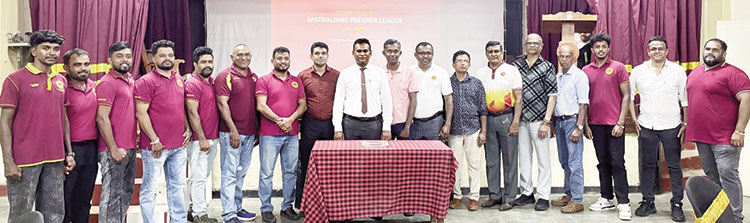
The inaugural Sastralian Premier League (SPL), a T10 cricket tournament aimed at strengthening the cricketing fortunes of Ananda Shasthralaya National School, Matugama, will get underway next month, bringing together eight teams.
Organised by the Old Sastralians Cricket Association in collaboration with the school, the tournament is designed to provide a platform for emerging talent while generating much needed financial support for the school’s cricket development programme.
Each franchise will be required to assemble a squad of 16 players, excluding the captain, with the competition featuring a unique set of regulations aimed at encouraging participation across different age groups.
Cricketers from other schools in the Matugama area will also have an opportunity to showcase their skills under the ‘Guest Players’ category. Each team can recruit up to six guest players, with four required to feature in the playing XI.
In a move designed to nurture the next generation, every team must include two current school cricketers in its squad, with at least one guaranteed a place in the playing XI.
The tournament will also accommodate experienced campaigners, with teams permitted to select five players over the age of 20 and three over 40. The provision to use an ‘Impact Player’ is another feature of the competition.
The eight teams have been divided into two groups. Group A comprises JSD Challengers, Jagath Express, Liveka Power Lions and Rexhill Warriors, while JPI Royals, Five Star Heroes, Marine Titans and Finnk Falcons make up Group B.
A total of 16 matches will be played across November 7, 8 and 15, with November 16 set aside as a reserve day.
Beyond the action on the field, organisers hope the tournament will provide a financial boost to school cricket while forging stronger ties between past and present cricketers.
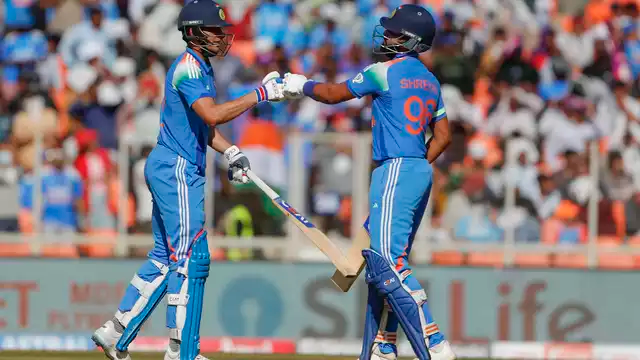
Squad for the first three ODIs: Shubman Gill [C], Rohit Sharma, Virat Kohli, Shreyas Iyer [VC], KL Rahul [WK], Nitish Kumar Reddy, Axar Patel, Naman Dhir, Anshul Kamboj, Gurnoor Brar, Ruturaj Gaikwad, Arshdeep Singh, Ishan Kishan [WK], Mohammed Siraj, Prasidh Krishna*, Kuldeep Yadav
Squad for fourth and fifth ODIs: Shreyas Iyer [C], Rohit Sharma, Virat Kohli, Tilak Varma, Ishan Kishan [WK, VC], Nitish Kumar Reddy, Axar Patel, Naman Dhir, Auqib Nabi, Gurnoor Brar, Ruturaj Gaikwad, Arshdeep Singh, Kumar Kushagra [WK], Mohammed Siraj, Yash Thakur, Kuldeep Yadav
[Cricbuzz]

Review of progress in reforms and modernisation of key state revenue-collecting institutions

Rose Bowl expanded to include Australia vs New Zealand T20Is

Trump claims US Navy blockade stops Iranian ships in Hormuz

Showers above 75 mm are likely at some places in the Western, Sabaragamuwa, Central and North-central provinces and in Trincomalee and Mullaitivu districts

Cut power bills by 3-5%, don’t hike them, consumers demand

Asgiri Mahanayake calls for immediate release of Gnanasara Thera

‘Dates have the highest sugar content to fight Coronavirus’

Sunday Island 27 December – Headlines

#SundayIsland 17th December – Headlines

Sunday Island – 28th March

Sunday Island Headlines – 21 March

Sunday Island – 21st February – Headlines
-

 News6 days ago
Sri Lanka escalates anti-graft drive with Shiranthi’s jailing
-

 News6 days ago
Iranian ships stranded, Lanka fears US sanctions
-

 Latest News5 days ago
Farhan and Sadaqat help Pakistan seal series in style
-

 Latest News4 days ago
Nissanka’s return headlines Sri Lanka’s Test squad against Pakistan
-

 Features5 days ago
Intake 16: 45 years of duty and honour
-
 News5 days ago
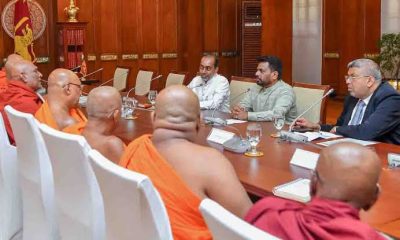
Malwathu Chapter issues statement on talks with President over Gnanasara Thera’s robes
-
 News6 days ago
Navi Pillay’s Lankan affairs in focus as she wins 2026 Nobel Peace Prize
-
 News5 days ago
CP alleges NPP has taken the blame for illegal US sanctions on Iranian vessels