
Midweek Review
Village tank cascades, great river quartet and Cyclone Ditwah

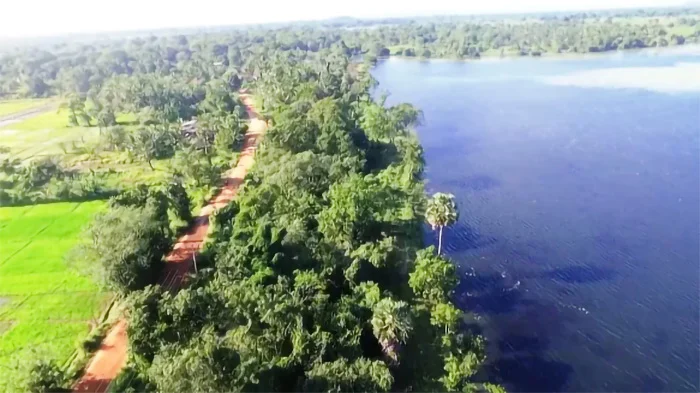
This past November and December Ditwah showed us how dark, eerie and haunting catastrophes cyclones can be. Past generations have suffered as shown in 1911, the Canberra Times reporting the great flood of Ceylon on December 30 of that year. It killed 200 people and left over 300,000 homeless. Half century later, on December 25, 1957, a nameless cyclone brought severe rain to the North Central Province (NCP), and the Nachchaduwa reservoir breached, unloading its full power of volume into Malwatu Oya, a mid-level river flowing through the city of Anuradhapura, nearly washing away its colonial-era bridge near the Lion Tower. A cyclone paid a visit to the Eastern Coast of Sri Lanka on November 17-23, 1978.
Half a century later, Ditwah came with swagger.
Quartet of Rivers
Cyclone Ditwah unleashed disaster and tragedy, terrorising every breath of hundreds of thousands of people. These cyclones come spaced by a generation or two. How the Great River Quartet of Mahaweli, Kelani, Kalu, and Walawe, and their attendant mid-level streams, behaved before Ditwah masks the reality that they are not the loving and smiling beauties poets claim them to be. During the Ditwah visit, our river Quartet showed its true colours in plain sight when wave after wave of chocolate rage pushed uprooted forests creasing islands of floating debris and crashed onto bridges, shattering their potency into pieces. These rivers are nothing more than a bunch of evil reincarnations cloaked in ruinous intentions.
The River Quartet and its mates woke up to the first thunder of Ditwah. They carried away villages, people, property, herds of cattle, and wild elephants to the depths of the Indian Ocean. While we continue to dig out the dead buried in muddy mountainsides, dislodged from their moorings during this flood of biblical proportions, how our rivers, streams, and, particularly, the village tanks handled the pressure on their own will be the core of many future discussions.
The destruction and tragedy caused by this water hurt all of us in many ways. But we all wish they were only a fleeting dream. Sadly, though, the real-life sight of the pulverised railway bridge at Peradeniya is not a dream. This section of the rail line was stripped of its modesty and laid bare. It hung in the air, literally, like strands of an abandoned spider’s web on a wet Kandyan morning. It was a reminder to us that running water is a masked devil and should not be considered inviting. It can unleash the misery with a chilling ending no one wants to experience in a lifetime.
Tank Cascade Systems (TCS)
Although the Ditwah cyclone covered Sri Lanka from top to bottom with equal fury, the mountainous areas and floodplains of our River Quartet surrendered soon. However, the village tanks in the Dry Zone – Northern, North Central, Northeast, and Eastern provinces – weathered that onslaught, sustaining only manageable damage. They collectively mitigated the damage caused by over 200 mm of rain that fell across the catchment areas they represented. Thus, the tank, the precious possession of the village, deserves to be titled as a real beauty.
Let me introduce the village tanks systems our engineering ancestors built with sophistication and ingenuity, a force like Ditwah hardly made a dent in groups of these tanks called Tank Cascade Systems (TDS). Many of the village tanks in the Dry Zone, covering 60% of Sri Lanka’s land area, stand in groups of TDS, separated as individual bodies of water but sharing water from one or more dedicated ephemeral streams. R.W. Ievers, the Government agent for North Central Province in the 1890s, noted that these tanks were the result of “one thousand years of experiment and experience,” and “ancient tank builders took advantage of the flat and undulating topography of the NCP to make chains of tanks in the valleys.” Colonial Irrigation Engineers of the early 20th century also recognised this uniqueness. Still, they could not connect the dots to provide a comprehensive definition for this major appurtenance of the village.
Although these tanks appear to be segregated ecosystems, a closer look at the peneplain topographic map of Sri Lanka shows that each stream feeding them ultimately flows into a larger reservoir or river, jointly or independently influencing the mechanics of regional water use and debouching patterns. This character is the spirit of the dictum of King Parakramabahu centuries earlier: “let not a single drop of water go to waste into the sea without being used by people.” Villagers knew that each tank in their meso-catchment area was related to other tanks on the stream it was in ensuring maximised use of water.
With their embodied wisdom, our ancestors centuries ago configured the placement of individual tanks that shared water from a catchment area. But not until 1985, following a careful autopsy of the pattern of these small tanks in the Dry Zone, Professor Madduma Bandara noticed a distinctive intrinsic relationship within each group of tanks. He called a group of such tanks a Cascade of Tanks. He wrote, “a (tank) cascade is a connected series of tanks organized within a micro-catchment of the Dry Zone landscape, storing, conveying, and utilising water from an ephemeral rivulet.” In short, it is a “series of tanks located in succession one below the other.” Dr. M.U.A. Tennakoon shared the names of the villagers in Nuwarakalaviya used for this configuration of tanks: Ellangawa. On a map, these tanks appear as hanging on a string. Thus, Ellangawa can be a portmanteau, a blend, of these two words.
There are over 475 such cascading tank groups in the Dry Zone. On average, each cascade typically supports four tanks. One cascade, Toruwewa, near Kekirawa, has 12 tanks. According to Professor Madduma Bandara, a cascade of tanks held about 20-30% of the water falling on its catchment area. As I will show later in this essay, the tank cascades behave like buddies in good times and bad times. By undertaking to build a vascular structure to collect, conserve, and share water with communities along the stream path, our ancestors forewarned of the consequences of failing to undertake such micro-projects where they chose to live. The following are a villager’s thoughts on how to retool this concept to mitigate the potential for damage from excess water flow in a larger river system.
To villagers, their tank is royalty. Its water is their lapis lazuli. Therefore, they often embroidered the title of the village with the suffix wewa (tank) or kulam (tank, in Tamil), indicating the close connection between the two. It is the village’s foremost provider and is interdependent. That is why we have the saying, “the village is the tank, and the tank is the village.”
A study in 1954/55 found that there were 16,000 tanks in Sri Lanka, of which over 12,500 were operational. Out-of-commission tanks were those that fell into disuse after the original settlers abandoned them for a host of reasons, such as a breach in the bund, fear of plague or disease, or superstition. Collectively, they supply water to an area larger than the combined area of the fields served by the major irrigation reservoirs in the country at the time.
In some villages, an additional tank called olagama, with its own acreage of fields, receives water from the same stream or from another feeder stream which joins the principal stream above or below the main tank. In the event the main tank is disabled, often the olagama tank can serve as the alternate water source for their fields.
Cultural and Engineering
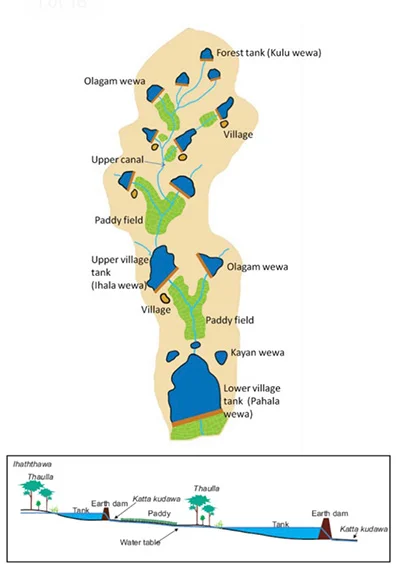
A graphical representation of the tank cascade system. Image courtesy of IUCN Sri Lanka.
A tank cascade is also an engineering undertaking. But village tank builders were not engineers with gold-trimmed diplomas. They were ordinary folks, endowed with generations of collective wisdom, including titbits on the physics of water, its speed, and its cruelty. Village pioneers responsible for starting the construction of the tank bund, gam bendeema, placed the first lump of earth after marking off home sites, not immediately below the future bund, but slightly towards one end of it, in the area called gammedda, or the elevated area the bund links to, gamgoda.
Engineering of a tank cascade has a cultural underpinning. It is founded on the feeling of solidarity among the villages along an ephemeral stream. In practice, it was a wholesome area with small communities of kin below each tank sorting out their own affairs without much intervention of the ruling class. For example, during heavy rains, each village in the chain communicated with the villages below the volume in its tank and the projected flow of the stream. When the tank reached its capacity and water began to spill over the spillway, the village below must take measures to protect its tank bund. If it breached, villagers up and down the cascade helped each other repair it.
They were aware that an earthen dam was susceptible to failure, so they used their own town-planning ideas. They avoided building residential zones directly under the stream’s path, generally at the midpoint of the dam. Instead, they built their triumvirate of life – tank, field, and dagoba (stupa) – keeping safety and practicality in mind. Dagoba was always on a higher ground, never supported by beams on a stream bank like what Ditwah revealed recently. We now know what happens to dagobas built on sagging beams by deceptively serenading riverbanks when thunder waters and unworldly debris came down hand in hand.
From top to bottom, the Tank Cascade showed the engineering instinct of the builders and accessory parts that helped its smooth functioning. There was the Olagama and Kulu Wewa associated with a system. Tank builders had an idea of the volume of water a given stream would bring in a year. In conjunction with this, the bunds of the Olagama and Kulu Wewa are built small. In contrast, the bunds of the tanks that formed the lower rung of the cascade are relatively larger. The idea behind this was that, in the event of a breach in an upstream tank, the downstream tanks could withstand an unexpected influx of water.
During the Ditwah’s death dance, the Mahaweli River did not have this luxury as it marched downstream from Kotmale dam. There were not enough dams to tame this river, and its beastly nature was allowed to run wild until it was too late for many.
The embodied imprints of experience inherited from their ancestors’ helped villagers design the tank’s physical attributes. In general, a tank supplied by this stream had a dam of a size proportional to the amount of water it could store for the fields. Later, as the village added families and field acreage increased, villagers raised the bund and the spillway to meet increased storage capacity. This simple practice guarded against eventualities like uncontrollable floods between villages. Excess water was allowed to flow through the sluice gate and the spillway, reducing the pressure on the bund. Had we applied this fundamental practice on a proportional scale to a large stream, i.e., oya or river, it would have lessened the destruction during a major rainstorm, ilk of which Ditwah brought.
With my experience living in a village with its tank, part of a TCS of five tanks, I wish large rivers like the Mahaweli had a few small-scale dams or partial diversions mimicking a rudimentary TCS so that the Railway Bridge at Peradeniya could have avoided the wrath of hell and high-water bringing muck and debris along its 46 km descent from Kotmale, where its lone dam is. I am glad I have company here. Professor Madduma Bandara noted 40 years ago, “much water flows through drainage lines due mainly to the absence of a village tank-type storage system.” Mahaweli turned out to be that drainage line this past November, holding hands, sadly, though, jubilantly, with the designs of Ditwah. Recently, former Head of Geo-Engineering at Peradeniya University, Udeni Bandara Amarasinghe, highlighted the importance of building reservoirs on other rivers to control floods like those we experienced recently.
Check Dams & Macroscopic Control
Within the TCS, the check dams, Kulu Wewa or Kele Wewa – forest tanks above a working tank held back sediments generated by upstream denudation. They controlled the volume and water entering the main tank. Kulu Wewa provided water for wild animals and checked their tendency to raid crops below the main tank. The difference between Kulu Wewa and Olagama was that, because of its topographical location, Kulu Wewa was occasionally used as a source of water for crops when the main tank below it became inoperable due to a breach or was undergoing repairs or used up its water early.
Based on these definitions, each working tank in the TCS also acted like a check dam for the one below it. Furthermore, if a tank in the cascade ran out of water, other tanks in the cascade stepped in. They linked up with the tanks above through temporary canals made by extending an existing minor canal, wella, or the wagala, excess water pan, of an upstream field.
The tank bund tamed and kept in check the three attributes of a stream – water velocity, volume, and its destructive power. By damming the stream, the villagers broke fueling momentum of it. They rerouted it via the spillway at the end of the bund, a form of recycling. Water from some spillways is diverted along a large niyara-like (field ridge) lesser dam, built along the wanatha (flanks) of the field, until it empties into the atrophied stream below the field.
Simultaneously, by controlling the release of water through two sluice gates on the bund, goda and mada horowwa, and directing it to the two flanks of the field, ihala and pahala wanatha, villagers succeeded in tamping down the pressure on the bund. Water from the neutered stream is thus redirected from all three exit points. It must now continue its journey along the wagala, to which field units (liyadi) also empty their excess water. This water is called wel pahu wathura.
After going through this process, the momentum of the ephemeral stream water is passive by the time it reaches the tanks in the lower parts of the cascade, often a kilometer or two downstream. This way, a line of tanks along the stream’s axis now shares the responsibility of holding back its full potential, limiting its ability to cause damage.
Such a break of momentum was lacking in the Four Great River Quartet and their lesser cousins. For the long-term solution to prevent damage from future cousins of Ditwah, we must consider this ingenious water-control method for rivers on a macroscopical scale.
Reservoirs
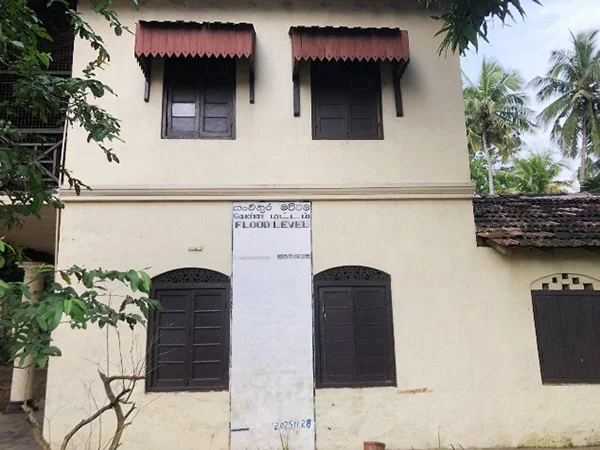
1957 and 2025 Cyclones Flood Marks written above window and below on the wall of a house by the banks of the Malwatu Oya in Anuradhapura.
As Ditwah-type floods occurred in 1911, 1957, 1978, and 2025, with a bit of luck, we can expect to have a few more decades of recess to work on cascading edifices along rivers, such as dams or diversions, before the next flood comes with roguish intentions. The Accelerated Mahaweli Diversion Program (AMDP), started in 1978, took 30 years to complete and now has over a dozen reservoirs between Kandy and the Dry Zone coastal belt, holding back its might. These reservoirs held their ground while Ditwah rained hell, so consulting the TCS’s ingenuity, though seems antiquated, is a good investment.
As soon as Cyclone Ditwah began to make noise, word spread that releasing water from a few of them on the Mahaweli and Kelani rivers could have made a difference. The problem with the Kelani River basin in Western Province and the Mahaweli basin in Central Province above Kandy is that, despite their combined population being nine times that of the NCP, they only have six reservoirs. On the contrary, the NCP has twice as much in the lower Mahaweli River basin, built under the AMDP. Furthermore, the NCP also has many ancient reservoirs it inherited from our ancestors. A string (cascade) of large reservoirs or minor dams in the hill country could have helped break the river’s energy which it accumulated along the way. G.T. Dharmasena, an irrigation engineer, had already raised the idea of “reorienting the operational approach of major reservoirs operators under extreme events, where flood control becomes a vital function.”
Unique Epitaphs for the Cyclones
The processes discussed above could have prevented the destruction of the railway track at the Peradeniya bridge, the image of which now stands like a pictorial epitaph to the malicious visit of the Ditwah and a reminder to us, “what if…?” or “what next…?”
As mentioned at the beginning of this essay, when the 1957 Cyclone dropped heavy rain on the NCP, a Railway Department employee at Anuradhapura made an exceptional effort to keep the memory of that saga for posterity with an epitaph still visible 70 years later. This person memorialised his near escape from the Malwatu Oya flood. As the river roared past over the railing of the bridge near the Lion Pillar roundabout, this employee, probably trapped in his two-storied house near the roundabout, day-stamped the visit of the flood with a red line on the wall of his house to mark the height it reached to trap him.
Three meters from the ground, right between two archtop windows facing the road to Sri Maha Bodhi, he wrote, “Flood level” in Sinhala, Tamil, and English. Right below it, at the end of the faded line, he added, “1957-12-25.”
As Cyclone Ditwah came along, the current resident of the house was not going to break this seven-decade-old tradition. After the flood receded this time, this duty-bound resident drew a line in blue ink and wrote at its end, ‘2025-11-28’, his contributing epitaph reminding us of infamous day Ditwah showed her might by driving the river off its banks. (See picture)
He added a coda to his epitaph – the numeral “8” in 28 is written in bold!
Lokubanda Tillakaratne is the author of Rata Sabhawa of Nuwarakalaviya: Judicature in a Princely Province – An Ethnographical and Historical Reading (2023).
by LOKUBANDA
TILLAKARATNE

The country is in deepening turmoil over the theft of USD 2.5 mn from the Treasury. The Treasury affair has placed the arrogant NPP in an embarrassing position. The controversial release of 323 red-flagged containers from the Colombo Port, in addition to two carrying narcotics and the coal scam that forced Energy Minister Kumara Jayakody to resign, has eroded public confidence though the NPP pretends otherwise.
Suspicious deaths of a Finance Ministry official, suspended over the Treasury heist of USD 2.5 million, and ex-SriLankan Airlines CEO Kapila Chandrasena shouldn’t distract the government and the Opposition from marking victory over terrorism.
But, the country, under any circumstances, shouldn’t forget to celebrate Sri Lanka’s greatest post-independence achievement. Dinesh Udugamsooriya, a keen follower of conflict and post-Aragalaya issues, insists that those who cherish the peace achieved should raise the national flag in honour of the armed forces.
The armed forces paid a huge price to preserve the country’s unitary status. Those who represent Parliament and outside waiting for an opportunity to return to Parliament must keep in their minds, unitary status is non-negotiable, under any circumstances, and such efforts would be in vain.
By Shamindra Ferdinando
Sri Lanka celebrates, next week, the eradication of the bloodthirsty separatist Liberation Tigers of Tamil Eelam (LTTE) as a conventional threat to the survival of this nation, at least in our hearts, even if the authorities dampen any celebrations. The armed forces brought the war to a successful conclusion on 18 May, 2009. The body of undisputed leader of the LTTE, Velupillai Prabhakaran, was found on the banks of the Nanthikadal lagoon, on the morning of 19 May, less than 24 hours after the ground forces declared the end of operations in the Vanni theatre.
The LTTE’s annihilation is Sri Lanka’s greatest post-independence achievement. Whatever various interested parties, pursuing different agendas say, the vast majority of people accept the eradication of the LTTE’s conventional military capacity as the armed forces’ highest achievement.
Sri Lanka’s triumph cannot be discussed without taking into consideration how the Indian-trained LTTE, who also went on to fight the New Delhi’s Army deployed here, in terms of the Indo-Lanka Peace Accord, signed in July, 1987, giving it an unforgettable hiding. The Indian misadventure here cost them the lives of nearly 1,500 officers and men. Just over a year after the Indian pullout, in March, 1990, the LTTE assassinated Rajiv Gandhi who, in his capacity as the Prime Minister, deployed the Indian Army here. But India launched the Sri Lanka destabilisation project during Indira Gandhi’s premiership.
Western powers, the now decimated United National Party (UNP), Janatha Vimukthi Peramuna (JVP), and an influential section of the media, propagated the lie that the LTTE couldn’t be defeated. But, the United People’s Freedom Party (UPFA), under President Mahinda Rajapaksa’s resolute leadership, sustained a nearly three-year long genuine sustained offensive that brought the entire Northern and Eastern regions back under government control.
The UNP relentlessly hindered the war against the LTTE. UNP leader Ranil Wickremesinghe, hell-bent on undermining the military campaign, had no qualms in questioning the military strategy. The former Prime Minister went to the extent of sarcastically questioning the culmination of the military campaign in the East with the capture of Thoppigala (Baron’s cap) in the second week of July, 2007, calling it just a rock outcrop with no significance. Believing the military lacked the strength to continue with the campaign, Wickremesinghe publicly ridiculed the Thoppigala success. The then Brigadier Chagie Gallage, the pint-sized human dynamo, provided critical leadership to the highly successful Eastern campaign that deprived the LTTE the opportunity to compel the armed forces to commit far larger strength to the region. We clearly recall how he went to announce the prized capture from his forward base, that afternoon, driving his own jeep, dressed as a soldier wearing a cap, with his second in command seated by his side, obviously not to fall victim to any sniper hiding in the surrounding jungles.
The likes of Ravi Karunanayaka, Lakshman Kiriella, Dr. Rajitha Senaratna and the late Mangala Samaraweera demeaned such successes by contributing to a vicious political campaign that dented public confidence in the armed forces. Then Lt. General Sarath Fonseka’s Army needed a massive boost, not only to sustain the relentless advance into the enemy territory, but to hold onto and stabilise areas brought under government control. But the viciousness of these critics were such that Samaraweera had the gall to say that Fonseka was not even fit to lead the Salvation Army.
The Opposition campaign was meant to deter the stepped up recruitment campaign that enabled the Army to increase its strength from 116,000 to over 205,000 at the end of the campaign. In spite of disgraceful Opposition attempts to cause doubts, regarding the military campaign among the public, with backing from Western vultures, who were all for LTTE success, the Rajapaksa government maintained the momentum.
President Rajapaksa had a superb team that ensured the government confidently met the daunting challenge. That team included Defence Secretary Gotabaya Rajapaksa, Vice Admiral Wasantha Karannagoda, Lt. General Sarath Fonseka, Air Marshal Roshan Goonetileke and the then Chief of National Intelligence (CNI) Maj. General Kapila Hendawitharana. There were also the likes of Rear Admiral Sarath Weerasekera, who returned from retirement to transform the once ragtag Home Guards into a worthy back-up to the military, as the Civil Defence Force, at critical places/junctures.
The then Governor of the Central Bank, Ajith Nivard Cabraal, played a significant role in overall government response to the challenge. The then presidential advisor MP Basil Rajapaksa’s role, too, should be appreciated and Prof. Rajiva Wijesinghe as well as Minister Mahinda Samarasinghe contributed to counter the false propaganda campaigns directed at the country. Whatever the shortcomings of the Mahinda Rajapaksa-led UPFA may have had, the armed forces couldn’t have succeeded if the resolute political leadership he provided, with his team of brothers, failed both in and outside Parliament. That is the undeniable truth.
During the 2006-2009 campaign, the UNP twice tried to defeat the UPFA Budget, thereby hoping to bring the war to an abrupt end. Th utterly contemptible move to defeat the UPFA Budget ultimately caused a split in the JVP with a section of the party switching its allegiance to President Rajapaksa to save the day.
Amidst political turmoil and both overt and covert Western interventions, the armed forces pressed ahead with the offensive. It would be pertinent to mention that the Vanni campaign began in March, 2007, a couple of months before the armed forces brought the eastern campaign to an end.
Vanni campaign
The Army launched the Vanni campaign in March, 2007. The 57 Division that had been tasked with taking Madhu, and then proceeding to Kilinochchi, faced fierce resistance. The principal fighting Division suffered significant casualties and progress was slow. An irate Fonseka brought in Maj. Gen. Jagath Dias as General Officer Commanding (GoC) of the 57 Division to advance and consolidate areas brought under control.
The Army expanded the Vanni campaign in September, 2007. The Task Force 1 (later 58 Division) launched operations from the Mannar ‘rice bowl’. Fonseka placed Gallage in command of that fighting formation but was replaced by the then Brigadier Shavendra Silva, as a result of a medical emergency.
The Army gradually took the upper hand in the Vanni west while the LTTE faced a new threat in the Vanni east with the newly created 59 Division, under Brigadier Nandana Udawatta, launching offensive action in January, 2008. Having launched its first major action in the Weli Oya region, that Division fought its way towards Mullaitivu, an LTTE stronghold since 1996.
The 53 (Maj. Gen. Kamal Gunaratne) and 55 (Brig. Prasanna Silva) Divisions, deployed in the Jaffna peninsula, joined the Vanni offensive, in late 2008, as the TF 1 fought its way to Pooneryn, turned right towards Paranthan, captured that area and then hit Elephant Pass and rapidly advanced towards Kilinochchi. The TF 1 and 57 Division met in Kilinochchi and the rest is history.
Once the Army brought Kilinochchi under its control, in January, 2009, the LTTE lost the war. The raising of the Lion flag over Kilinochchi meant that the entire area, west of the Kandy-Jaffna A9 road, had been brought under government control. By then the LTTE had lost the sea supply route, between Tamil Nadu and Mannar region. The LTTE was surrounded by several fighting formations in the Vanni east while the Navy made an unprecedented achievement by cordoning off the Mullaitivu coast that effectively cut them off on all sides.
During the final phase of the naval action, they captured Sea Tiger leader Soosai’s wife, Sathyadevi, and her children Sivanesan Mani Arasu and Sivanesan Sindhu. Spearheaded by the elite Fourth Fast Attack Flotilla, the Navy conducted a sustained campaign, with spectacular success in the high seas, and, by late 2008, the Navy dominated the waters around the country.
The sinking of floating LTTE warehouses, with the intelligence provided by the Directorate of Military Intelligence (DMI) and the US Pacific Command, after the Americans decided to speed up the inevitable, and a campaign, directed at operations across the Palk Strait, weakened the LTTE. By early January, 2009, the LTTE had lost its capacity to carry out mid-sea transfers, and the use of Tamil Nadu fishing trawlers to bring in supplies, and it was only a matter of time before the group surrendered or faced the consequences.
Although Tamil Diaspora still believed in the LTTE launching a massive counter attack on the Vanni east front and the Tamil National Alliance (TNA), under the leadership of the late R. Sampanthan, worked hard to halt the offensive, President Rajapaksa declared that the offensive wouldn’t be called off. President Rajapaksa had the strength to resist the combined pressure brought on him by the West and the UN until the armed forces delivered the final blow.
The despicable efforts made by US Secretary of State Hillary Clinton to block IMF funding for Sri Lanka is in the public domain. Clinton was obviously trying to please the Tamil Diaspora. The US made that attempt as the ground offensive was on the last phase against the backdrop of the international community suspending relief supply ships to Puthumathalan.
The IMF provided the much required funding to Sri Lanka, regardless of Clinton’s intervention.
A targeted assassination
The Air Force conducted a strategic campaign against the LTTE while providing support to both the Army and the Navy. Despite limited resources, the Air Force pulverised the enemy and high profile target assassination of S.P. Thamilselvan, in his Kilinochchi hideout, in early November, 2007, shook the LTTE leadership. The deployment of a pair of jets (Kafir and MiG 27), on the basis of intelligence provided by the DMI and backed by UAV footage, to carry out a meticulous strike on Thamilselvan’s Kilinochchi hideout, caused unprecedented fear among the LTTE.
Current Defence Secretary, Sampath Thuyakontha, in his capacity as the Commanding Officer of No 09 Squadron, played a vital role in action against the LTTE. Thuyakontha earned the respect of all for landing behind enemy lines in support of LRRP (Long Range Reconnaissance Patrol).
As the Army advanced on the Vanni east front, thousands of LTTE cadres gave up their weapons, threw away their trade mark cyanide capsules and surrendered. Their defences crumbled and even hardcore cadres surrendered, regardless of the warning issued by Prabhakaran. By the time the armed forces concluded clearing operations, over 12,000 LTTE cadres were in government custody. Although those who couldn’t stomach Sri Lanka’s victory over the LTTE propagated lies regarding the rehabilitation programme, the ordinary Tamil people appreciated the project.
C.V. Wigneswaran, in his capacity as the Chief Minister of the Northern Province, called for a US investigation into the death of ex-LTTE cadres in government custody. The retired Supreme Court judge sought to consolidate his political power by alleging the Army executed surrendered men by injecting them with poison. The then Yahapalana government failed to take action against Wigneswaran who claimed over 100 deaths among ex-combatants.
Instead of initiating legal action, the war-winning Rajapaksa government rehabilitated them. Even after the change of government, in 2015, the rehabilitation project continued. Almost all of them had been released and, since the end of war, the members of the defeated LTTE never tried to reorganise, though some Diaspora elements made an attempt.
The LTTE’s demise brought an end to the use of child soldiers. Those who demand justice for Tamils, killed during the war, conveniently forget that forcible recruitment of children, by the LTTE, also ended in May, 2009. Struggling to overcome severe manpower shortage, amidst mounting battlefield losses, the LTTE abducted Tamil children, from the early ’90s, to be press-ganged into their cadre.
Although the UN and ICRC sought a consensus with the LTTE, way back during Chandrika Bandaranaike Kumaratunga’s tenure as the President, to cease forced recruitment of children, they couldn’t achieve the desired results. The much publicised UN-ICRC projects failed. The LTTE continued with its despicable abduction of children. The LTTE never stopped child recruitment and, depending on the ground situation, it carried out forced recruitment drives. The signing of the Norwegian arranged Ceasefire Agreement (CFA), too, failed to halt forced child recruitment.
The Darusman report that accused the military of killing over 40,000 civilians during the last phase of the war revealed that the LTTE tried to recruit children as it was about to collapse.
The TNA, or any other like-minded group here or abroad, never urged the LTTE to give up civilian shields and stop recruiting children, though they realised Prabhakaran could no longer change the outcome of the war. Norway, and those who still believed in a negotiated ‘settlement’ in a bid to prevent the annihilation of the group, desperately tried to convince Prabhakaran to give up civilian shields.
A note, dated February 16, 2009, sent to Basil Rajapaksa, by Norwegian Ambassador Tore Hattrem, expressed concern over the fate of those who had been trapped in the Vanni east. Hattrem’s note to Basil Rajapaksa revealed Norway’s serious concern over the LTTE’s refusal to release the civilians.
The following is the Norwegian note, headlined ‘Offer/Proposal to the LTTE’, personally signed by Ambassador Hattrem: “I refer to our telephone conversation today. The proposal to the LTTE on how to release the civilian population, now trapped in the LTTE controlled area, has been transmitted to the LTTE through several channels. So far, there has been, regrettably, no response from the LTTE and it doesn’t seem to be likely that the LTTE will agree with this in the near future.”
In the aftermath of the Anandapuram debacle in the first week of April, 2009, the LTTE lost its fighting capacity to a large extent. The loss of over 600 cadres marked the collapse of the organisation’s conventional fighting capacity.
The LTTE sought an arrangement in which it could retain its remaining weapons and start rebuilding the group again. President Rajapaksa emphasised that only an unconditional surrender could save the group’s remaining cadre. The President refused to recognise an area under the LTTE’s control. The CFA, signed by Wickremesinghe and Prabhakaran, in February, 2002, recognised a vast area under the LTTE control. The CFA gave unparalleled recognition to the terrorist group and that was exploited by them to the hilt.
NPP’s dilemma
During his controversial May Day address this year, President Anura Kumara Dissanayake declared that only the armed forces and police could carry arms. Dissanayake warned that no one else could retain weapons.
President Dissanayake’s declaration is of pivotal importance as the armed forces and police twice crushed JVP-led insurgencies, in 1971 and 1987-1990. Dissanayake is the leader of the JVP and the NPP, two political parties recognised by the Election Commission.
Dissanayake, who is also the Minister of Defence and Commander-in-Chief of the armed forces, caused controversy last year when the government announced that the President wouldn’t attend the 16th annual war heroes’ commemoration ceremony at War Heroes’ Memorial, in Sri Jayawardenepura Kotte.
That announcement triggered massive backlash. The government rescinded its earlier decision. Having received an unprecedented endorsement from the northern and eastern electorates, both at presidential and parliamentary polls in September and November, 2024, respectively, President Dissanayake seemed to have been somewhat reluctant to join the national celebration.
Yahapalana leaders President Maithripala Sirisena and Prime Minister Ranil Wickremesinghe succumbed to Tamil Diaspora and Western pressures to do away with the 2016 annual armed forces Victory Day parade. That treacherous move followed them betraying the war-winning armed forces at the Geneva-based United Nations Human Rights Council (UNHRC) in October, 2015.
They co-sponsored accountability resolution, introduced by the US in terms of an understanding with the LTTE’s sidekick. Sirisena and Wickremesinghe forgot that the TNA recognised the LTTE as the sole representative of the Tamil speaking people, in 2001, thereby setting the stage for Eelam War IV. Sampanthan’s outfit, the Illankai Thamil Arasu Kadchi (ITAK)-led TNA, showed its true colours when it joined the UNP-JVP led initiative to defeat Mahinda Rajapaksa. Having accused the war-winning Army Commander, Sarath Fonseka, of unpardonable war crimes, the TNA, along with the UNP-JVP combine, backed Fonseka at the 2010 presidential election. The South rejected Fonseka and he lost the race by a staggering 1.8 mn votes which late JVP leader Somawansa Amarasinghe foolishly called a computer ‘jilmart’, a newly coined word of our fake Marxists. Fonseka’s indefensible declaration, in the run-up to the 2010 presidential election that the celebrated 58 Division executed surrendered LTTE cadres, didn’t do him any good. President Rajapaksa never explained why the US’ unofficial contradiction of Fonseka’s claim was never used cleverly to counter unsubstantiated war crimes allegations, along with Lord Naseby disclosures made in October, 2017.
Sri Lanka’s failure to properly defend the armed forces is nothing but an insult to them. They saved the country from the JVP twice, and Indian trained over half a dozen terrorist groups, finally bringing the largest and the deadliest of them, the LTTE, down to its knees, on the banks of the Nanthikadal lagoon.
The armed forces shouldn’t hesitate to remember their glorious victory over terrorism. Since the change of government in September, 2024, the armed forces refrained from at least mentioning their battlefield achievements. At the last Independence Day, the armed forces shockingly mentioned their role in the Ditwah cyclone recovery efforts as their main achievement, to please the political masters, who themselves have been lackeys of the West, while outwardly professing to be Marxists, the latter line they have already conveniently dropped for all purposes. The armed forces shouldn’t play NPP politics but explain the situation to the current dispensation. The failure on the part of armed forces to erase their proud achievements against terrorism, out of their press releases/narratives, look rather stupid.

Drawing a Thread through Loss and Creativity in Shakespeare’s Life
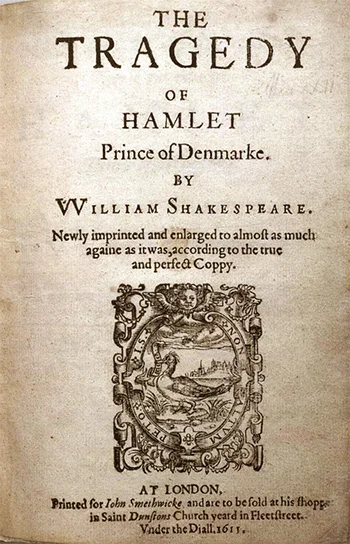
William Shakespeare [1556-1616] is generally regarded as the greatest playwright and poet in the English language. Notwithstanding the universal appeal and the timelessness of his work, very little is known about his inner-self. Despite his profound understanding of the human condition, evident in his remarkable works of drama and poetry, the origin of his psychological insights – formed long before formal theories of the mind emerged – remain unknown, often loosely ascribed to an innate gift. The thematic and philosophical dimensions of his work are often said to be influenced by the classics of the ‘ancient world’ such as Ovid’s Metamorphosis.
The bestselling novel, Hamnet, by Maggie O’Farrell is a confluence of fact and fiction. The award-winning movie, by the same name, is an adaptation of the novel, its screenplay co-written by Maggie O’Farrell and Chloe Zhao, the director. The central theme of the novel and the movie is the devastating impact of the death of Shakespeare’s son, Hamnet, in 1596, at an early age of eleven, and the sensitive portrayal of the grieving process of the family, inviting the audience to reflect on the proposition that Shakespeare channelled his personal grief into writing Hamlet, the play, four years later.
Mourning and melancholy take centre stage in Hamlet prompting a probable link between William Shakespeare’s own emotional world and his artistic imagination. Interestingly, the names Hamnet and Hamlet were used interchangeably during the Elizabethan era, adding weight to the speculation.
The movie matches the imaginative and descriptive brilliance of the novel. The narrative unfolds against the backdrop of Stratford-upon-Avon and its environs and its inhabitants of Elizabethan England, finally shifting to London and the Globe Theatre. The film won eight nominations at the 98th Academy Awards, including best picture, best director for Zhao, and best actress for Jessie Buckley, who immortalises Anne Hathaway, [‘Agnes’] Shakespeare’s wife, through whom the real face of family grief is portrayed. Shakespeare [nameless] remains ‘silent’ and virtually ‘back-stage’ in London preoccupied with the playhouse, the players and the plays.
Many Shakespeare scholars have speculated about a probable link between the death of Hamnet Shakespeare and the writing of Hamlet, his Magnum Opus:
“No one can say for certain how the death of Shakespeare’s son affected him, but it is hard not to notice that in the years following Hamnet’s death Shakespeare wrote a play obsessed with fathers and sons, grief, and the persistence of the dead.” [James Shapiro]
“Hamnet’s death must have been a devastating blow…..and the shadow of that loss may well lie behind the profound meditations on mortality in Hamlet.” [Park Honan]
“The death of Hamnet is the most plausible personal event to have touched Shakespeare deeply in these years, and it is tempting to hear an echo of that loss in the grief that permeates Hamlet.” [Germaine Greer]
That echo is clearly heard in Act 4, scene 5 in Hamlet:
He is dead and gone, lady,
He is dead and gone;
At his head a grass-green turf,
At his heels a stone.
Yet, in the play, a son loses his father, and the circumstance of the loss is different. Hamlet mourns the sudden death of his father, king Hamlet, he idolised. The young prince is faced with a complex emotional challenge as the late king’s brother, Claudius, usurper to the throne, marries the widowed queen, denying the young prince of his lawful right to sovereignty. The process of mourning is weighed down by the profound significance of the personal loss to the prince and being bereft of any trusting relationships to share his grief – mourning turning to melancholy.
Shakespeare’s greatest tragedy, Hamlet, has gained unremitting interest of audiences, universally over four hundred years, and has been open to divergent appraisal. Any commentary on the play without an exploration of the psyche of its protagonist, prince Hamlet, would be as the popular cliché goes, ‘like Hamlet without the prince of Denmark!’ Hamlet is the longest of all Shakespearean plays, with the least amount of action, but with the most amount of spoken word, mainly by prince Hamlet, which includes his soliloquies [solo locution: self-discourse] that opens the door to his inner self, inviting in by Hamlet himself: “pluck out the heart of my mystery”.
In the first of his soliloquies, Hamlet reveals his affliction with melancholy. He describes the world as worthless, wishes he is dead, contemplates suicide but regrets that God does not sanction such self-destruction. “O, that this too too solid flesh would melt/ Thaw and resolve itself into dew/ O, that the Everlasting had not fixed/ His cannon ‘gainst self-slaughter. O, God, God/ Seem to me all the uses of this world!’
Hamlet’s anguish is expressed as: ‘This goodly frame, the earth’ is no more than a ‘Sterile promontory’; ‘this majestical roof fretted with golden fire’; the heavens, ‘a foul and pestilent congregation of vapours’; and man, ‘the paragon of animals’, a quintessence of dust’, his mind ‘an unweeded garden/ That grows to seed.’ – Hamlet’s melancholic thought with depressive and nihilistic content expressed in philosophical terms.
But his anguish is best depicted in his fourth soliloquy [Act 3, Scene1] arguably, the most quoted piece of verse in all Shakespeare: ‘To be, or not to be’ – about life and death. He questions, ‘whether ‘tis nobler in the mind to suffer/ The slings and arrows of outrageous fortune/ Or take arms against a sea of troubles/ and by opposing, end them’. What happens after death? Is it a peaceful sleep or nightmare? Do we end our miseries by putting ourselves to the ‘quietus’ with a dagger, and enter that ‘undiscovered country’ from which ‘no traveller returns’, or put up with our problems? ‘Conscience makes cowards of us all’ and make us procrastinate.
In his soliloquies Hamlet reveals his affliction with melancholy. He wishes that his body would melt away, describes the world as worthless and contemplates suicide – negative cognitions about the self, the environment and the future, characteristic of severe mood disturbance – but regrets that God does not sanction such self-destruction.
********
 Grief is a universal human experience following loss, characterised by sadness, at times mixed with anger and guilt, and frequently transient in nature. Depending on the perceived significance [‘meaningfulness’] of the loss and the absence of a sharing or confiding relationship, grief may become prolonged, with a potential to become pathological.
In a seminal paper published in 1917, Sigmund Freud [1856 – 1939], argued that there are two different responses to loss – ‘Mourning and Melancholia’. His contribution remains the basis for understanding unconscious grief in psychoanalytic thought.
Freud describes mourning as a natural way to respond to losing something or someone significant. It is a transitory process, potentially transforming, albeit painful. In mourning the loss of a loved one, the bereaved gradually withdraws the emotional energy – ‘libido’ – from ‘the lost object’, and the emotional investment is redirected to an ‘alternate object’ or pursuit. Throughout this process the ‘self’ remains intact, allowing the person to heal by integrating the loss into life. In psychology, this process in which a person unconsciously redirects unacceptable or distressing impulses into socially acceptable or constructive activities is called sublimation – a concept introduced by Sigmund Freud and later developed further by his daughter Anna Freud. Instead of expressing the impulse directly, the energy behind it is transformed into something positive or productive – an ‘ego defence’.
On the other hand, Freud described melancholia as a persistent state that stays within the ‘unconscious’ – the repressed aspect of the mind, while the person feels trapped in unresolved emotions which jeopardises their mental and physical well-being.
Shakespeare lost a child, the only son, Hamnet, still in his formative years. The playwright had no option but to leave his family in his birthplace of Stratford-upon-Avon, and return to London after burying his son to continue his work at the playhouse. The significance of the loss to the father would, no doubt, have been profound, as the Greek historian Herodotus fittingly proclaimed, “No one that has lost a child knows what it is to lose a child”.
In the novel, and as depicted in the movie, Agnes [Anne Hathaway] travels to London to meet her husband. Unknown to him she stands with the audience at the Globe Theatre to watch Hamlet, the play, while Shakespeare remains backstage. As O’Farrell poignantly writes in her novel, “Hamlet, here on this stage, is two people, the young man alive, and the father dead. He is both alive and dead. Her husband [Shakespeare] has brought him back to life, in the only way he can”. “She stretches out a hand as if to acknowledge them, as if to feel the air between the three of them, as if to pierce the boundary between audience and players, between real life and play”.
Many literary scholars speculate that Shakespeare in mourning gave voice to his grief through Hamlet, the play’s introspective protagonist, who takes to the stage with melancholic expression. There are others who dispute this view, arguing that Hamlet is a product of his creative genius that transcends any autobiographical explanation. While Hamnet, the novel, and its film adaptation do not assert a direct historical link, they suggest an association between the playwright’s personal loss and his artistic creation. The notion that Shakespeare sublimated his grief into creating the iconic stage work remains suggestive, yet unprovable, but reveals an important ‘therapeutic strategy’ [sublimation] in dealing with loss. Nevertheless, through Hamlet, he gives enduring expression to a universal human condition – grief – that resonates across time.
Moreover, from an aesthetic point of view, a work of art can truly be called Art – whether encountered on the page, the screen, or the stage – when it invites reflection or evokes emotion. The thread that runs through the novel, the movie and the play tend to reinforce that notion.
By Dr. Siri Galhenage, Psychiatrist [Retd]
sirigalhenage@gmail.com
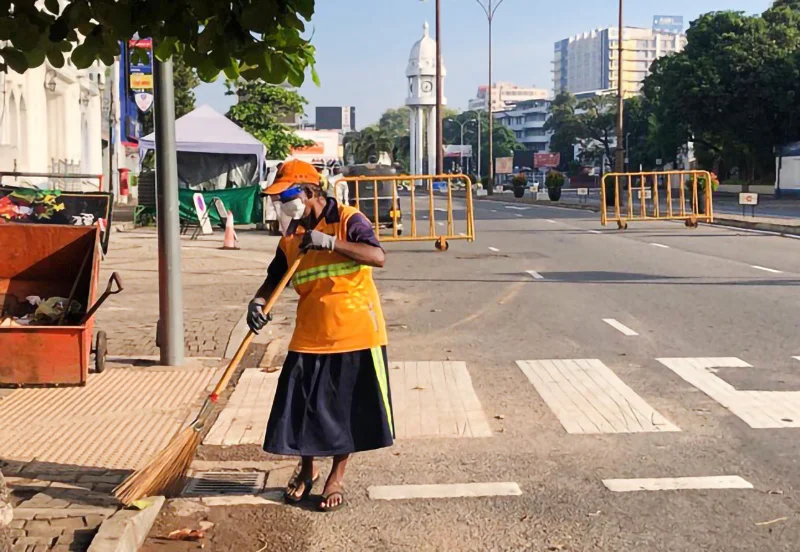
You’ve been at it these long hours,
Sweeping the sidewalks of the big city,
And scrubbing floors of public toilets,
All the while wiping the sweat off your brow,
And waiting eagerly for departure time,
To get to your comfy nest in the teeming slum,
And see the eyes of your waiting kids,
Light up with love at your sight,
Their hands searching you for sweets,
And such moments of family joy,
Are for you and other women of dignity,
What is seriously meant by Liberation,
But this is lost on grandstanding rulers,
Who know not the spirit of shared living,
Nor the difference between a home and a house.
By Lynn Ockersz

Complete all projects funded under the LKR. 500 bllion allocation for Ditwah within this year – President

Development projects should be carried out in line with the practical needs of the people – PM

Ayesha Zafar’s rapid ton crushes Zimbabwe

Donald Trump lands in China for high-stakes meeting with Xi Jinping

Gujarat Titans go No.1 after Rabada and Holder rout Sunrisers Hyderabad

Showers will occur in the Western, Sabaragamuwa, Central, North-western and Northern provinces and in Anuradhapura, Trincomalee, Galle and Matara districts

‘Dates have the highest sugar content to fight Coronavirus’

Sunday Island 27 December – Headlines

#SundayIsland 17th December – Headlines

Sunday Island – 28th March

Sunday Island Headlines – 21 March

Sunday Island – 21st February – Headlines
-

 News7 days ago
MIT expert warns of catastrophic consequences of USD 2.5 mn Treasury heist
-

 News4 days ago
Lanka Port City officials to meet investors in Dubai
-
 News18 hours ago
Ex-SriLankan CEO’s death: Controversy surrounds execution of bail bond
-

 Editorial7 days ago
Clean Sri Lanka and dirty politics
-

 Editorial6 days ago
The Vijay factor
-
 News5 days ago
SLPP expresses concern over death of former SriLankan CEO
-
 News5 days ago
Police inform Fort Magistrate’s Court of finding ex-CEO of SriLankan dead under suspicious circumstances
-
Features2 days ago
High Stakes in Pursuing corruption cases