
News
USD 3.7 bn H’tota refinery: China won’t launch project without bigger local market share


China has declared that China Petroleum and Chemical Corporation (SINOPEC) will not proceed with the USD 3.7 bn Hambantota oil refinery project unless a consensus could be reached on the percentage of the output that could be sold in the local market.
China has informed the NPP government that SINOPECwill not be able to sustain the project in terms of the original agreement that stipulated that 80% of the output be exported and 20 % sold in the Sri Lankan market, according to sources familiar with the issue.
Once fully operational, the strategic facility will be able to process 200,000 barrels of crude oil a day. The proposed facility, together with the Hambantota International port, which was taken over by China in 2017 on a 99-year lease, emphasise significant Chinese presence in the country.
SINOPEC with about 12% market share is among the foreign companies engaged in fuel distribution in Sri Lanka at the moment. Other foreign players are Lanka India Oil Company (LIOC) and joint venture by Shell Brands International AG (Shell) and RM Parks (Private) Limited, the latter being the latest entrant.
LIOC entered the market way back in 2003 during Ranil Wickremesinghe’s tenure as the Prime Minister. LIOC holds the second biggest market share with 211 fuel stations with SINOPEC being third and joint Shell Brands International AG (Shell) and RM Parks (Private) Limited in fourth place. CPC remains the market leader with some 800 odd fuel stations countrywide.
Sources said that whatever the Chinese and Sri Lankan government representatives said in public the launch of the project primarily would depend on a new formula. The Island learns that the Chinese expect to sell 30% of the output here. “The Chinese are of the view that 20% share is not sufficient to sustain the project,” sources said.
Sri Lanka and China in January 2025 announced plans for the SINOPEC project dubbed the largest single Chinese direct investment here following President Anura Kumara Dissanayake’s three-day state visit to Beijing. Dissanayake’s delegation included Minister of Foreign Affairs, Employment and Tourism Vijitha Herath, Minister of Transport, Highways, Ports and Civil Aviation Bimal Rathnayake, and Sri Lankan Ambassador to China, Majintha Jayesinghe. Outspoken Chinese Ambassador to Sri Lanka Qi Zhenhong was also present at all key meetings with representatives of China Petrochemical Corporation (SINOPEC Group), China Communications Construction Company Ltd (CCCC), China Merchants Group (CMG), Huawei, and BYD Auto, a leading company in the automobile manufacturing sector.
Pointing out that Sri Lanka and China hadn’t been able to resolve the knotty problem for about 15 months, sources said that Sri Lanka was also under pressure from India to expedite the Trincomalee oil tank farm development project. Sri Lanka finalized an agreement with India and United Arab Emirates (UAE) in early April 2025 to develop Trincomalee as an energy hub.
Sources said that in line with the overall plans involving China as well as India-UAE, Sri Lanka was required to enhance the fuel storage facilities as soon as possible. The ongoing West Asia conflict underscored the responsibility on the part of the incumbent dispensation to take tangible measures to enhance storage facilities.
The Trincomalee and Hambantota projects could be on a collision course, sources said. The likelihood of Indo-Lanka agreements in respect of WW two era oil tank farms in Trincomalee, particularly the one negotiated during Gotabaya Rajapaksa’s presidency having animpact on the Hambantota oil refinery couldn’t be ruled out, sources said.
President Dissanayake during his May Day address disclosed the crisis faced by his government in ensuring uninterrupted oil supplies. Dissanayake said that the government had no option but to increase fuel quotas given to various categories in view of the arrival of fuel ships in Colombo as Sri Lanka lacked storage facilities.
Sources said that energy insecurity was at stake due to the continuing instability in the global markets caused by US actions in Hormuz Strait.
Newly-appointed Energy Minister Anura Karunathilake is believed to be engaged in consultations with relevant parties. Earlier Punyakumara Dissanayake who resigned recently over the coal scam handled the Hambantota refinery matter.
by Shamindra Ferdinando







More than 1,600 students sat this year’s Russian Classical Ballet Examination, the largest number ever to take part in the examination in Sri Lanka. Exams were held in Colombo from 5, to 18, October and in Galle on 10 October.
Students aged four and above came from across the island, including Colombo, Galle, Gampaha, Negombo, Matara, Kelaniya, Panadura, Wattala, Kiribathgoda, Ratnapura, Kandy, Kurunegala, Bandarawela and Badulla. They are taught by 15 dedicated teachers trained in the Vaganova method, the renowned Russian system of classical ballet training.
They were examined by Dr. Oxana Karnovich of the Moscow State Academy of Choreography, a distinguished academic and curator.
The Russian School of Ballet and Dancing was established in 2001 by Michael Ustinov, Buddhapriya Ramanayake and Mrs Chandi Aluvihare, with Mrs Galina Pleshakova as its founding instructor. Today the School is led by Director Madam Maria Popova, Counsellor of the Embassy of the Russian Federation in Sri Lanka.

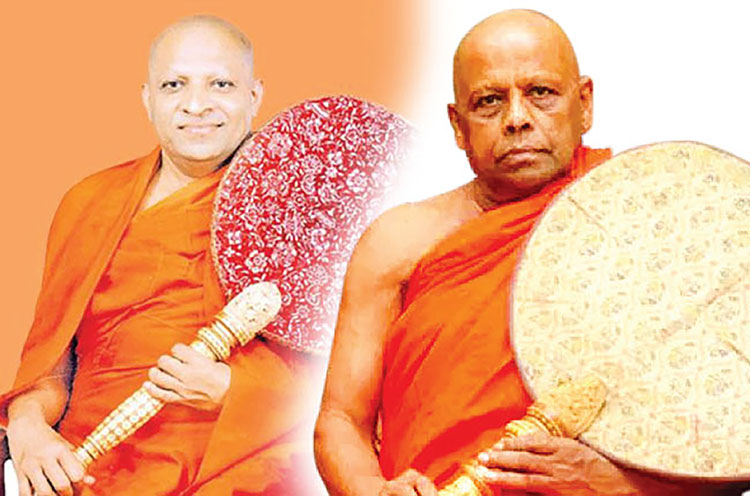
MONETABRIEF– Sri Lanka’s two most senior Buddhist chapters, Malwatte and Asgiriya, demanded special concessions for monks serving prison sentences, following the disrobing of convicted monk Ven. Galagodaatte Gnanasara in line with established procedures.
The chief prelate of the Asgiriya chapter, Most Venerable Warakagoda Sri Gnanarathana, told Prisons Commissioner Senaka Palletenna that Ven. Gnanasara, who is serving a six-year sentence for contempt of court, must be released immediately.
Prison authorities have no power to release or pardon convicts, but Palletenna told the monk in Kandy on Friday that he would convey his request to the relevant government authorities.
“There is no point in talking about this and that… The entire country has been shaken (??????? ) . He must be released,” the Asgiriya chief prelate said.
The Malwatte chief prelate, Most Venerable Thibbatuwawe Sri Siddhartha Sumangala, appeared to accept the court verdict against Ven. Gnanasara, but asked the prisons chief whether a separate section could be established for convicted monks.
Palletenna noted that a special ward for the clergy already existed at Welikada Prison.
At least 63 convicted Buddhist monks are currently incarcerated within Sri Lanka’s criminal justice system.
Meanwhile, a group of 34 Buddhist monks named in a Colombo Fort Magistrate’s Court order to vacate the vicinity of the Presidential Secretariat ended their protest and dispersed after lunch on Friday.The monks are demanding an unconditional pardon for Ven. Gnanasara, who has previously been imprisoned, making him a reconvicted prisoner.
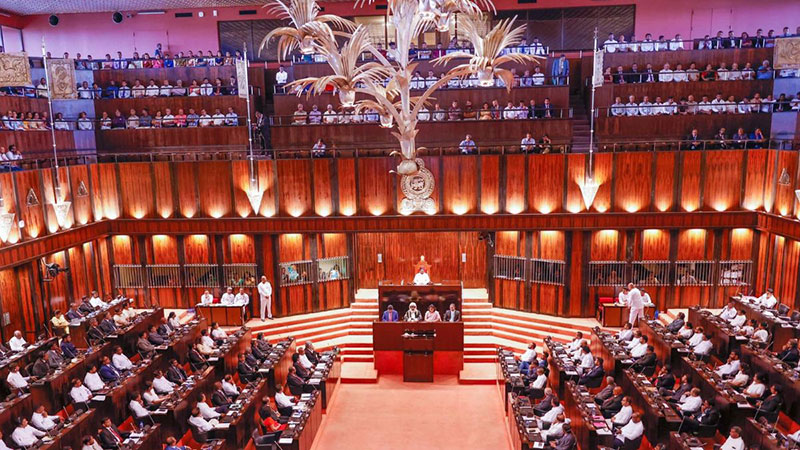
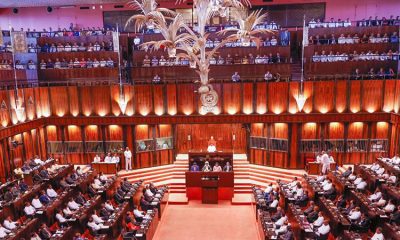
The debate on the no-confidence motion against Speaker Dr. Jagath Wickramaratne, submitted by the Samagi Jana Balawegaya (SJB), has been postponed indefinitely pending the Attorney General’s opinion on certain technical issues in the motion.
Government representatives raised the matter at a meeting of the Committee on Parliamentary Business, pointing out that several provisions of the motion required clarification and that the Attorney General’s advice should be obtained.
As obtaining the opinion would take time, the debate could not be scheduled for the next parliamentary week, parliamentary sources said.
Chief Opposition Whip Gayantha Karunatilaka said a date for the debate would be decided after the Attorney General’s advice was received.
Meanwhile, Parliament is scheduled to meet from October 20 to 23, Secretary General of Parliament Kushani Rohanadeera announced.
The parliamentary business for the week was finalised at a meeting of the Committee on Parliamentary Business held on Friday (16) under the chairmanship of Deputy Speaker Dr. Rizvie Salih.
On each sitting day, the period from 9.30 a.m. to 10 a.m. will be allocated for parliamentary business under Items 1 to 6 of Standing Order 22. Questions for Oral Answers will be taken up from 10 a.m. to 11 a.m., followed by questions under Standing Order 27(2) from 11 a.m. to 11.30 a.m.
On Tuesday, October 20, an Opposition-sponsored Adjournment Motion will be debated from 11.30 a.m. to 5.30 p.m.
On Wednesday, October 21, a resolution under the Public Debt Management Act and a Supplementary Estimate will be taken up for debate and approval from 11.30 a.m. to 5 p.m. The annual reports of five statutory institutions will subsequently be presented for approval without debate, while questions at the Adjournment Time will be taken up from 5 p.m. to 5.30 p.m.
On Thursday, October 22, the Second Reading debates on two Bills to amend the Poisons, Opium and Dangerous Drugs Ordinance (Bills Nos. 79 and 80) will be held from 11.30 a.m. to 5 p.m.
The annual reports of five statutory institutions will then be taken up for approval without debate, followed by an Opposition-sponsored Adjournment Motion from 5 p.m. to 5.30 p.m.
On Friday, October 23, the Second Reading debate on the Elimination of Rabies and Registration of Dogs Bill will be held from 11.30 a.m. to 5 p.m. A Government-sponsored Adjournment Motion will be debated during the final half-hour of the sitting.

Record 1,600 students take Russian Classical Ballet examination in Sri Lanka

Half a million people join protests in France, but some turn violent

Deadly fire breaks out at Canada military base

Showers or thundershowers will occur in most parts of the island after 1.00 p.m.

Buddhist hierarchy demands prison perks for monk convicts

Debate on NCM against Speaker postponed indefinitely

‘Dates have the highest sugar content to fight Coronavirus’

Sunday Island 27 December – Headlines

#SundayIsland 17th December – Headlines

Sunday Island – 28th March

Sunday Island Headlines – 21 March

Sunday Island – 21st February – Headlines
-

 Latest News5 days ago
Nissanka’s return headlines Sri Lanka’s Test squad against Pakistan
-

 Latest News6 days ago
Farhan and Sadaqat help Pakistan seal series in style
-

 Features6 days ago
Intake 16: 45 years of duty and honour
-
 News6 days ago
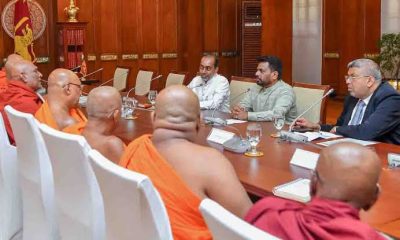
Malwathu Chapter issues statement on talks with President over Gnanasara Thera’s robes
-
 News6 days ago
CP alleges NPP has taken the blame for illegal US sanctions on Iranian vessels
-

 News4 days ago
Sri Lanka, India caught in US-Iran ship crisis
-

 Opinion6 days ago
How long can Sri Lanka remain silent on its demographic crisis?
-
 Latest News4 days ago
Kusal Mendis’ unbeaten 87 hands Sri Lanka consolation win