
Latest News
US build-up of warships and fighter jets tracked near Iran

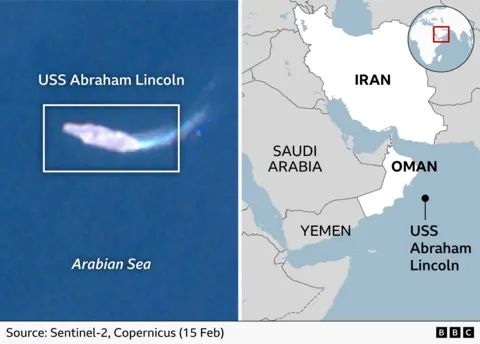
BBC Verify has confirmed the location of US aircraft carrier the USS Abraham Lincoln near Iran using satellite imagery, as Washington continues to put pressure on the country over its military program and recent deadly crackdown on protesters.
US and Iranian officials are set to meet in Swizerland on Tuesday for a second round of talks. Iran says the meeting will focus on its nuclear programme and the potential lifting of economic sanctions imposed by the US. Washington has previously indicated it wants to discuss other issues as well.
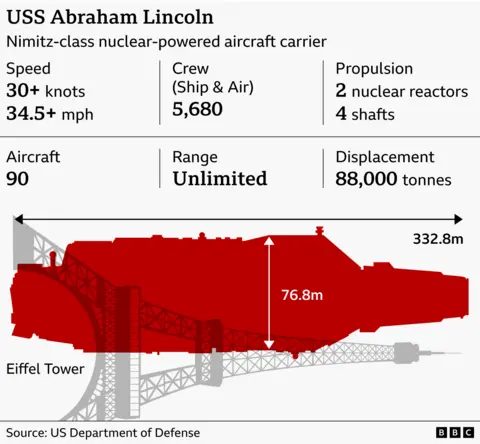
The Abraham Lincoln, which leads a strike group with three guided missile destroyers, carries 90 aircraft including F35 fighters, and 5,680 crew, was reportedly deployed to the Gulf region in late January but has not been seen in satellite imagery until now. It has been located off the coast of Oman, around 700km from Iran.
The US has also reportedly sent the USS Gerald R Ford, the world’s largest warship, to the Middle East, which could arrive in the region within the next three weeks.
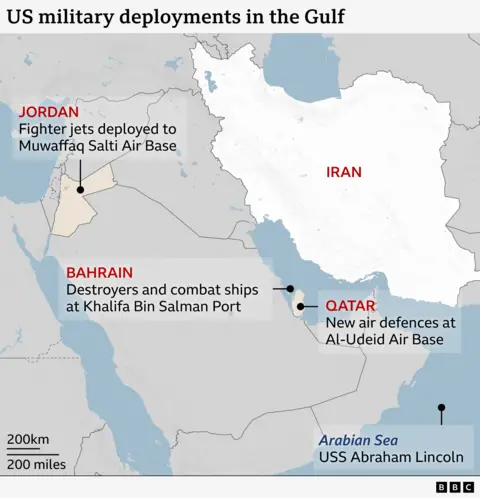
The Abraham Lincoln’s arrival adds to what we know about the current US military build-up in the Middle East over the past few weeks, where BBC Verify has tracked an increase of US destroyers, combat ships and fighter jets in the region.
Publicly available images from the European Sentinel-2 satellites show Abraham Lincoln in the Arabian Sea around 150 miles (240km) off the coast of Oman.
It had not been seen since it reportedly entered the region in January but it had been crossing the open sea where satellite coverage is limited. Military assets on land are more visible and frequently captured on satellite.
It means we have now tracked 12 US ships in the Middle East through satellite imagery: the Abraham Lincoln, a nuclear-powered Nimitz-class carrier, which together with three Arleigh Burke class destroyers forms a carrier strike group; plus two destroyers capable of carrying out long-range missile strikes and three specialist ships for combat near to the shore that are currently positioned at Bahrain naval station in the Gulf. Two other destroyers have been seen in the eastern Mediterranean near the Souda Bay US base, and one more in the Red Sea.
We have also been following the movements of US aircraft in the region, where we have seen an increase of F-15 and EA-18 fighter jets stationed in Muwaffaq Salti military base in Jordan, and an increase in US cargo planes and refuelling and communications aircraft moving towards the Middle East from the US and Europe.
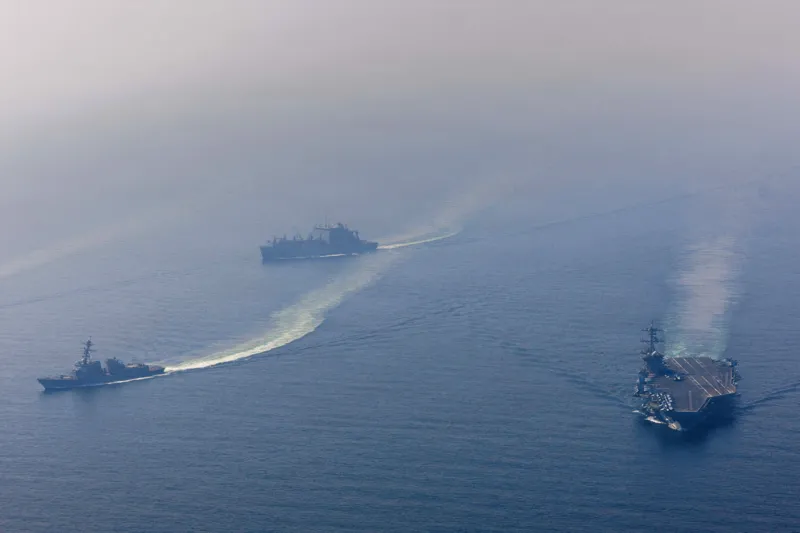
The US Central Command released images of the Abraham Lincoln flanked by destroyers, fighter jets, surveillance aircraft and coastguard vessels in the Arabian Sea in an apparent show of military prowess on 6 February, which Iran has met with its own show of force.
On Monday the Islamic Revolutionary Guard Corps (IRGC) launched a maritime drill in the Strait of Hormuz, located in the Gulf between Oman and Iran. The drill saw IRGC Commander‑in‑Chief Maj Gen Mohammad Pakpour inspecting naval vessels at a harbour before missiles are seen launching from a ship, the IRCG-linked Tasnim News Agency reported.
The Strait is considered one of the world’s most important shipping routes and a vital oil transit choke point. Around a fifth of the world’s oil and gas flows through the Strait, including from Kharg Island, Iran’s main oil export terminal. Pakpour was seen flying over the island in a helicopter in the report showing Iran’s latest military manoeuvres.
Military intelligence expert Justin Crump told BBC Verify that the current US military preparations in the Middle East show “more depth and sustainability” than its manoeuvres ahead of the seizure of former Venezuelan president Nicholas Maduro in January, or the operation carrying out air strikes on Iran’s nuclear facilities last June.
They all feature a carrier strike group and several destroyers operating independently. However, the US deployed its assets in Venezuela and Iran last year under quite different circumstances.
The US deployed the Gerald R Ford to the Caribbean ahead of its strikes on Venezuela, one of eight warships we tracked in the region at the time, though it used fewer aircraft as it could easily send jets from surrounding US bases on America’s mainland or from its base in Puerto Rico instead. The US also deployed amphibious assault ships within the Caribbean, which can be used as launch platforms for helicopter operations as was seen with the capture of Maduro. But Venezuela’s military is generally seen as less capable of defending itself or retaliating against the US.
When the US struck Iran last year in Operation Midnight Hammer, which targeted Iran’s nuclear facilities, it was attacking a country with a much more powerful military than Venezuela. Iran’s military is capable of hitting US bases across the Middle East.
During Midnight Hammer the US had two aircraft carrier strike groups in the region, five destroyers placed in the Mediterranean and Red Seas, and three combat ships in the Gulf. It had also moved squadrons of fighter jets and refuelling aircraft from the US to Europe, but the B2 stealth bomber flights that were used to hit the Fordo, Isfahan and Natanz nuclear sites actually took off from US bases in Missouri.
Crump, chief executive of risk and intelligence company Sibylline, said the build-up of US warships and aircraft, as well as eight existing airbases in the region would allow it to conduct a “fairly intensive and sustained strike rate” of about 800 sorties a day, with the aim of rendering any Iranian responses “ineffective”.
“What we are seeing isn’t just strike preparation, but rather a broader deterrent deployment capable of being scaled up or down,” he said. “This means it has more depth and sustainability than the force packages arranged for either Venezuela or Midnight Hammer last year. It’s designed to sustain an engagement and counter all potential responses against US assets in the region and, of course, Israel.”
[BBC]

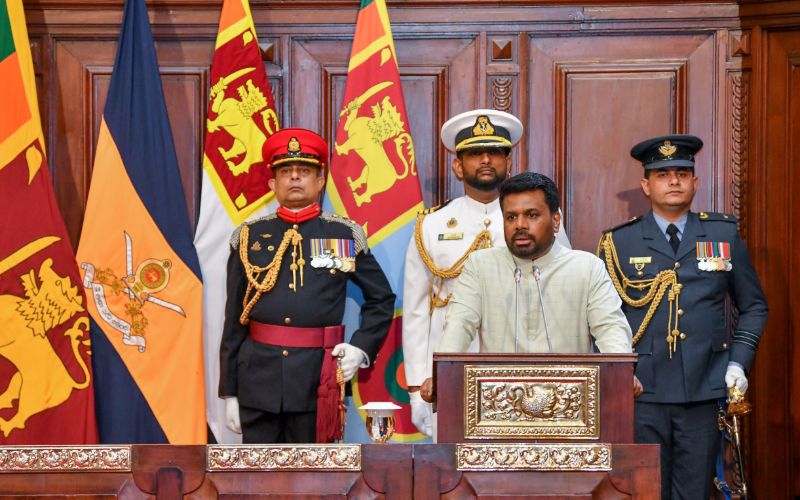
The presentation of the “Vishishta Seva Vibhushana” medals, awarded in recognition of the distinguished service rendered by senior officers of the regular forces of the Sri Lanka Army, Navy and Air Force, was held this afternoon (30) at the Presidential Secretariat under the patronage of President Anura Kumara Dissanayake.
The President stated that the senior officers of the three Armed Forces receiving the “Vishishta Seva Vibhushana” medals today have made an exceptional contribution to the country and its people. He noted that they remained committed to their duties and accountable for their responsibilities regardless of whether it was day or night, whether weather conditions were favourable or adverse, or whether their lives were at risk. He emphasised that the country needs a public service of this nature today.
The “Vishishta Seva Vibhushana” medal, established as an award under a proclamation issued by the President, is a distinguished honour. It is awarded only to officers of the three Armed Forces who have completed at least 25 years of continuous service and have maintained a commendable service record, and in accordance with regulations established by the President through a notification published in the Gazette regarding its conferment, forfeiture or restoration.
A total of 57 serving and retired officers of the three Armed Forces were presented with the “Vishishta Seva Vibhushana” medals by the President.
Following the presentation, the President joined the medal recipients for a group photograph.
The full speech delivered by President Anura Kumara Dissanayake on the occasion is as follows:
“We have a special appreciation for you as a group of officers who have demonstrated a strong sense of responsibility and accountability. As the most senior officers of the three Armed Forces, you are receiving one of the most important and distinguished honours today. You have earned this honour in recognition of the exceptional contribution you have made throughout a significant part of your lives towards safeguarding our motherland and its people. We are deeply grateful to you for the outstanding service you have rendered in protecting the country and its people.
As the most senior officers who have served in the three Armed Forces, you have played an exceptional role for more than 25 years, including during the highly complex periods of armed conflict faced by our country and during other natural disasters. I know that you carried out these responsibilities with greater commitment, endurance and risk than an ordinary public servant. Your wives and family members also played an exceptional role in supporting you throughout your discharge of these social responsibilities. They stood behind you and provided the strength and support you needed while you made immense sacrifices and faced considerable risks. We must also extend our special appreciation to them for the significant role they played in supporting you.
One of the major challenges we face as a Government today is the lack of a strong public service. The public service has suffered a significant decline. We are all aware, to varying degrees, of the reasons that have contributed to this situation. If we are to move forward as a country, we need a strong public service. The contribution you have made as public officials towards strengthening the public service has been exceptional. As the most senior officers of the three Armed Forces, you have played a significant role in serving the public service. You remained committed to your duties. You did not consider whether your duties had to be performed during the day or at night, under favourable or adverse weather conditions, or in situations where your lives were at risk. You remained committed to your duties and accountable for your responsibilities. We need a public service of this nature. As a group that has demonstrated responsibility and accountability, we have a special appreciation for you.
If our country has experienced setbacks on many fronts, overcoming these challenges and moving forward requires people who have the resilience to endure them. You are receiving this distinguished “Vishishta Seva Vibhushana” honour today as a group that has faced the challenges encountered throughout your careers and made an exceptional contribution towards overcoming them.
A common challenge we face as a country is establishing professionalism. We can create positions and professions. However, the question remains as to whether an individual has attained the required professional standard in the discharge of their duties. Today, these 57 officers have been selected from among the many officers of the three Armed Forces as those who have demonstrated such professionalism. This is essential to our public service. You have set important examples towards restoring the public service.
There is also a concern regarding discipline within our public service and society. All of us must have the ability to maintain self-discipline. This is extremely important if we are to move forward as a country. Public servants work within the public service in the course of their duties, while in their everyday lives, they live and interact with wider society. In such circumstances, how do we maintain self-discipline? Many countries have progressed not merely through laws and regulations, but through the self-discipline developed by their people.
Society is exposed to many forms of irregularities and anti-social activities. In such an environment, how do we maintain self-discipline? If we are able to maintain self-discipline regardless of the external environment, even when it is contrary to such values, that is extremely important.
It is true that the “Vishishta Seva Vibhushana” award recognises your service. It is also true that, as President, I and the State honour you. However, this should no longer be regarded as something personal. This is not merely a medal or recognition that you have received. It should be regarded as a social responsibility. Only then can you become an example to your children, neighbours and relatives. You can also become an example to your institution. Only then can we rebuild our public service and society, which are facing a serious decline, and provide an example for others to follow. Therefore, I believe that the medal you receive in recognition of your distinguished service will serve as a foundation for our society to move in a new direction”.
Deputy Minister of Defence, Major General Aruna Jayasekara (Retired), Secretary to the President Dr Nandika Sanath Kumanayake, Secretary to the Ministry of Defence, Air Vice Marshal H. S. Sampath Thuyacontha (Retd) and senior officials, including the Commanders of the three Armed Forces, were also present.
[President’s Media Division]

[Prime Minister’s Media Division]
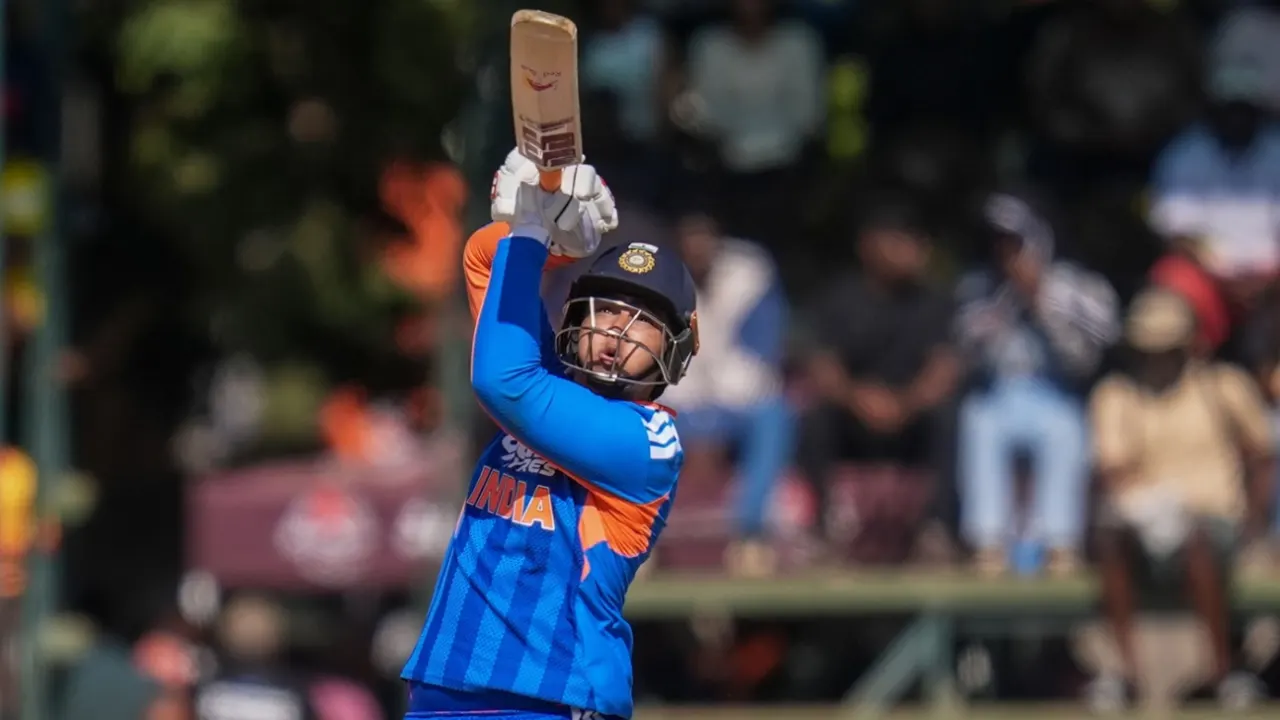
After six abandoned matches, five of them without a toss, because of incessant rain – Shreyas Iyer called it a “torrential downpour” – in Nisshin, we might finally get some cricket again at the men’s Asian Games.
The timing couldn’t have been better because the four remaining games will decide the positions on the podium. Pakistan and Bangladesh still don’t have a gold in this edition (as of Wednesday morning); Sri Lanka have just one; India have seven but that’s well behind the 28 they finished with in 2023.
India are the defending champions, and it will take a gargantuan effort from the second string Sri Lanka side to throw them off their path. Even the full-strength Sri Lanka T20I side has not been able to score 150 of late, or win a match since June, and have only one win from their last ten attempts. The Sri Lanka squad that hasn’t played even a moment of cricket since landing in Japan has a captain – Sahan Arachchige – with just one T20I to his name, which came back in the 2023 Asian Games, when they lost to Afghanistan. The more recognisable names are Niroshan Dickwella and Ashen Bandara, who haven’t featured in a T20I since 2021 and 2023 respectively. There are six other players in that squad of 15 who have played fewer than ten T20Is each, and another four who are uncapped.
India, unlike most other Full Member sides, have sent their big guns to Japan.
There’s also an ODI series going on at home, and the ODI World Cup is just a year away. But they chose to send the likes of Jasprit Bumrah, Shreyas Iyer and Ishan Kishan, among others, to Japan instead, which shows their commitment to the gold-medal cause.
Rain or shine, Sri Lanka will have to sweat it out on Thursday to try and get the better of India.
India have been plagued by injuries of late and one of the names on that list was that of Washington Sundar, who returned to action in the Japan T20I last week. He didn’t get to bat, but bowled two overs and took two wickets in his first game in two months. India would want to give him more game time before he heads back home for the West Indies T20Is that start on October 6. Washington has otherwise had an impressive year across formats with an unbeaten 52 in an ODI to give India their first win of their UK tour after he took a four-for in the Test against Afghanistan, in which he also scored 52*.
Niroshan Dickwella last played a T20I in 2021 and he is back in the scheme of things despite an underwhelming Lanka Premier League a couple of months ago, where he scored only 110 runs in six innings at a strike rate of 142.85 while averaging 18.33. He has, however, been among the runs of late, and scored a brisk 80 off 115 balls in the first Test against India. If he gets to bat on Tuesday, this could be a great chance for Dickwella to show why he was once an all-format regular for Sri Lanka.
India had rested Bumrah for the one-off T20I against Japan and played Arshdeep Singh and Yash Thakur as the quicks, and Ravi Bishnoi, Axar Patel and Washington as the lead spinners. India will now have to decide whom to leave out for Bumrah. The other question will be whether to give Vaibhav Sooryavanshi a game, although neither Abhishek Sharma nor Sanju Samson have any reason to be dropped.
India (possible): Abhishek Sharma, Sanju Samson (wk), Ishan Kishan, Shreyas Iyer (capt), Tilak Varma, Axar Patel, Shivam Dube, Washington Sundar, Ravi Bishnoi, Yash Thakur/Arshdeep Singh, Jasprit Bumrah
Sri Lanka will be expected to hand out a few debut caps and give game time to some of the more inexperienced players.
Sri Lanka (possible): Niroshan Dickwella (wk), Lasith Croospulle, Sahan Arachchige (capt), Nuwanidu Fernando, Ashen Bandara, Chamika Karunaratne, Tharindu Ratnayake, Wanuja Sahan, Vijayakanth Viyaskanth, Nuwan Thushara, Binura Fernando
[Cricinfo]

US-assisted ‘Ice’ detection: NPC to examine IGP’s move to transfer drug-busting team

2027 Budget to be held from 12 Nov. to 14 Dec.

CB Governor confident over timely disbursement of next IMF tranche; hands post-2027 programme decisions to govt.

Cabinet spokesman explains why Thileepan statue was removed

CA dismisses writ petition filed by MP Jayaweera

Harsha’s committee warns unnecessary regulations could discourage businesses and create a risk of hindering economic growth

‘Dates have the highest sugar content to fight Coronavirus’

Sunday Island 27 December – Headlines

#SundayIsland 17th December – Headlines

Sunday Island – 28th March

Sunday Island Headlines – 21 March

Sunday Island – 21st February – Headlines
-

 Features6 days ago
Beyond traditional jobs: Why Sri Lanka needs to facilitate the gig economy
-

 Editorial5 days ago
Birth of a bad law
-

 News3 days ago
Police remove Thileepan statue in Jaffna
-
 Latest News6 days ago
Kusal, Wellalage star as Sri Lanka defend 322 in Headingley thriller
-

 News5 days ago
TIN mandatory for key transactions from Nov. 1
-

 Features3 days ago
The 22nd Amendment, constitutional recovery and illiberal slippage
-

 Features3 days ago
Of foreigners as CEOs of Lankan ventures
-

 News3 days ago
Sajith rejects Jt. Opp. protest sabotage claim; SJB TU chief demands remedial action