
News
Urgent action needed in South Asia to curb deadly air pollution

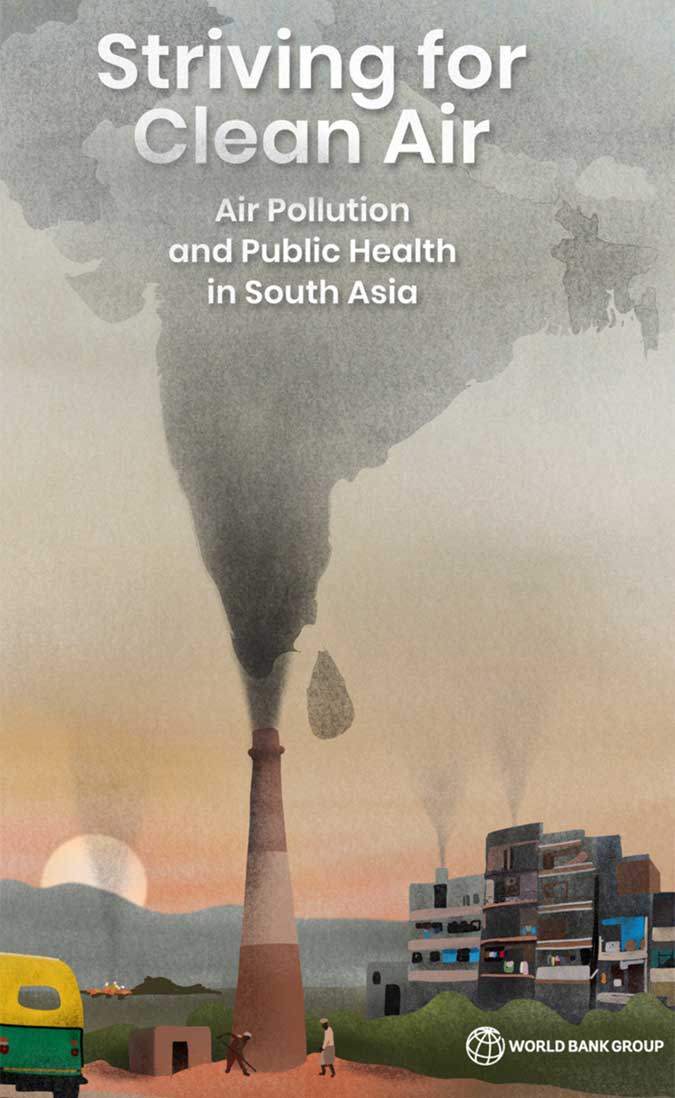
South Asia is home to nine of the world’s ten cities with the worst air pollution, which causes an estimated two million premature deaths across the region each year and incurs significant economic costs. A new World Bank report shows that there are economically feasible, cost-effective solutions to achieve clean air in the region, but this requires countries to coordinate policies and investments.
Striving for Clean Air: Air Pollution and Public Health in South Asia, released recently says concentrations of fine particulate matter such as soot and small dust (PM 2.5) in some of the region’s most densely populated and poor areas are up to 20 times higher than what WHO considers healthy (5 µg/m?). Exposure to such extreme air pollution has impacts ranging from stunting and reduced cognitive development in children, to respiratory infections and chronic and debilitating diseases. This drives up healthcare costs, lowers a country’s productive capacity, and leads to lost days worked.
Large industries, powerplants and vehicles are dominant sources of air pollution around the world, but in South Asia, other sources make substantial additional contributions. These include combustion of solid fuels for cooking and heating, emissions from small industries such as brick kilns, burning of municipal and agricultural waste, and cremation.
Air pollution travels long distances— crossing municipal, state, and national boundaries—and gets trapped in large “airsheds” that are shaped by climatology and geography. The report identifies six major airsheds in South Asia where spatial interdependence in air quality is high. Particulate matter in each airshed comes from various sources and locations, for example less than half of the air pollution in South Asia’s major cities is produced within cities.
“Persistently hazardous levels of air pollution have caused a major public health crisis in South Asia that demands urgent action,” said Martin Raiser, World Bank Vice President for South Asia. “Curbing air pollution requires not only tackling its specific sources, but also close coordination across local and national jurisdictional boundaries. Regional cooperation can help implement cost-effective joint strategies that leverage the interdependent nature of air quality.”
Several South Asian countries have adopted policies to help improve air quality, but their focus on mitigating air pollution generated within cities is yielding insufficient results. The report shows that current policy measures will only be partially successful in reducing PM 2.5 concentrations across South Asia even if fully implemented. To achieve greater progress, the focus of policy makers should expand into other sectors, particularly small manufacturing, agriculture, residential cooking, and waste management.
The report analyzes four scenarios to reduce air pollution with varying degrees of policy implementation and cooperation among countries. The most cost-effective scenario, which calls for full coordination between airsheds, would cut the average exposure of PM 2.5 in South Asia to 30 µg/m³ at a cost of $278 million per µg/m? of reduced exposure, and save more than 750,000 lives annually.
“The economic benefits of policies to reduce air pollution in South Asia exceed the economic costs by a large margin,” said Hans Timmer, World Bank Chief Economist for South Asia. “But optimal solutions depend on several factors such as better monitoring systems, more scientific capacity, greater coordination between governments, and behavioral change among farmers, small firms, and households.”
To this end, the report offers a three-phased roadmap:
• Phase 1: Sets the condition for airshed wide coordination by expanding the monitoring of air pollution beyond the big cities, sharing data with the public, creating or strengthening credible scientific institutes that analyze airsheds, and taking a whole-of-government approach.
• Phase 2: Abatement interventions are broadened beyond the traditional targets of powerplants, large factories and transportation. During this phase major progress can be made in reducing air pollution from agriculture, solid waste management, cookstoves, brick kilns, and other small firms. At the same time, airshed-wide standards can be introduced.
• Phase 3: Economic incentives are finetuned to enable private-sector solutions, to address distributional impacts, and to exploit synergies with climate change policies. In this phase trading of emission permits can also be introduced to optimize abatement across jurisdictions and firms.


The Cabinet of Ministers approved the resolution furnished by the President in his capacity as the Minister of Finance, Planning and Economic Development to instruct the Legal Draftsman to prepare a draft bill to amend the State Mortgage and Investment Bank Law No. 13 of 1975
By Cabinet decision dated 2025-12-01, policy approval was granted to amend the definition of the term “animal” in the Animals Act No. 29 of 1958 by including, pigs, goats, and sheep, in addition to cattle and buffaloes, within the interpretation section of the act.
In accordance with the said approval, the Legal Draftsman has drafted an Amended Bill in all three languages, and the clearance of the Attorney General has also been obtained.
Accordingly, the Cabinet of Ministers has approved the
resolution furnished by the Minister of Agriculture, Livestock, Land and Irrigation to publish the draft Amendment Bill in the Government Gazette and thereafter to submit the same to the Parliament for its concurrence.
News
Cabinet approves establishment of a ‘Trust’ to carry out the management of the Jaffna Thiruvalluvar Cultural Centre

The Jaffna Thiruvalluvar Cultural Centre, comprising 11 floors, has been constructed with the assistance of the Government of India with the objective of serving as a hub for cultural activities in Sri Lanka and expanding bilateral cooperation for the promotion, preservation, and fostering the cultural heritage of Jaffna.
In accordance with the approval granted at the Cabinet meeting held on 2022-02-21, a Joint Management Committee has been appointed to make decisions relating to the affairs of the said cultural centre, in terms of the Memorandum of Understanding signed for the operation of the Jaffna Thiruvalluvar Cultural Centre.
According to the provisions of the aforementioned MOU, upon completion of the construction of the project, the cultural centre should be transferred to the Jaffna Municipal Council through the Government of Sri Lanka.
Following such transfer, the relevant parties have reached an agreement to establish a ‘trust’ for carrying out the management activities of the centre. The Attorney General’s clearance has been received for the draft trust deed prepared for that purpose.
Accordingly, the Cabinet of Ministers has approved the resolution furnished by the Minister of Buddhasasana, Religious and Cultural Affairs to establish the trust to continue the management activities of the Jaffna Thiruvalluvar Cultural Centre

State Mortgage and Investment Bank Law No. 13 of 1975 to be amended
Animals Act No. 29 of 1958 amended
Cabinet approves establishment of a ‘Trust’ to carry out the management of the Jaffna Thiruvalluvar Cultural Centre

Prime Minister Keir Starmer under pressure as ministers quit, 80 MPs urge him to resign

Nahid Rana rips through Pakistan to seal a final-session win for Bangladesh

South Africa’s Shabnim Ismail reverses retirement for T20 World Cup

‘Dates have the highest sugar content to fight Coronavirus’

Sunday Island 27 December – Headlines

#SundayIsland 17th December – Headlines

Sunday Island – 28th March

Sunday Island Headlines – 21 March

Sunday Island – 21st February – Headlines
-

 News6 days ago
MIT expert warns of catastrophic consequences of USD 2.5 mn Treasury heist
-

 News3 days ago
Lanka Port City officials to meet investors in Dubai
-

 Editorial6 days ago
Clean Sri Lanka and dirty politics
-

 Editorial5 days ago
The Vijay factor
-

 News4 days ago
SLPP expresses concern over death of former SriLankan CEO
-

 News7 days ago
Development Officer bids Rs. 48 mn for CPC’s V8 at auction
-
 News4 days ago
Police inform Fort Magistrate’s Court of finding ex-CEO of SriLankan dead under suspicious circumstances
-
 Opinion7 days ago
Postmortem reports and the pursuit of justice