
News
UNP compares government to a person afflicted with leprosy

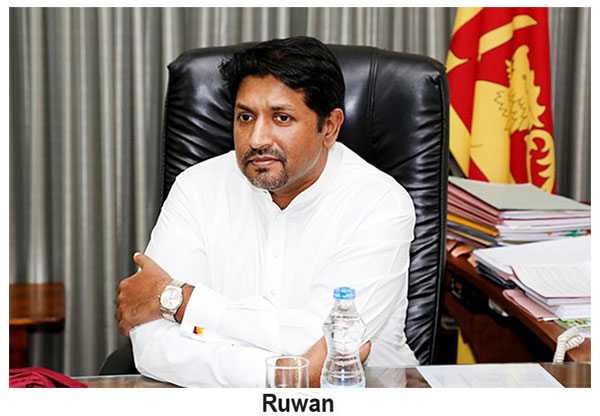
The UNP says that in terms of insensitivity there was no big difference between the government and a person affected with leprosy.
Speaking at a ceremony held at the party headquarters Sirikota in Colombo, UNP Deputy Leader Ruwan Wijewardene said that the government acts as a leper in the face of mounting problems and people’s suffering and woes.
“Majority of people are starving and they have no ability to get three meals. Construction workers have lost their jobs due to shortage of cement. Owing to a dollar scarcity there is no medicine and milk powder and it is imminent that the situation will turn worse in the coming months since we have lost cultivation of this season and are poised to lose harvest owing to government bungling with organic fertiliser promotion. On top of that, the price of paper has gone up. The Central Bank does not give dollars to printers to import paper. This will render printing text books and newspapers impossible. Presses too would be out of work soon. This will result in children not getting their textbooks. In the middle of all these troubles, the government pours down millions of rupees to celebrate independence as if there will be no tomorrow thereafter,” Wijewardene said.
“We are not against celebrating independence, but the government should have taken into consideration the present situation before engaging in wasting public money on such extravagances at a time like this.
“Our late leader D.S. Senanayake ushered in independence to this country. They did not think that this country would face this sort of mess later on. They did not foresee the country would be ruined to this level. They expected that people would be free economically and socially.
“Look at the way the power cuts are handled and you’ll see that the government has no sense. The Public Utility Commission says in the morning that there will be no power cuts. But by the time of noon, more than half of the country does not have electricity. The government has lost its senses.”
He said that our children who lost their education owing to the pandemic are now posed to lose some more because there would be no school textbooks soon.

Latest News
Sun directly overhead Beruwala, Gurulubadda, Rakwana, Godakawela, Udawalawe and Thanamalwila at about 12:13 noon today (06)


On the apparent northward relative motion of the sun, it is going to be directly over the latitudes of Sri Lanka during 05th to 15th of April in this year.
The nearest areas of Sri Lanka over which the sun is overhead today (06th) are Beruwala, Gurulubadda, Rakwana, Godakawela, Udawalawe and Thanamalwila at about 12:13 noon.
Latest News
Heat Index at Caution Level in the Western, Sabaragamuwa, Southern, Eastern, North-western, Northern and North-central provinces and in Monaragala district
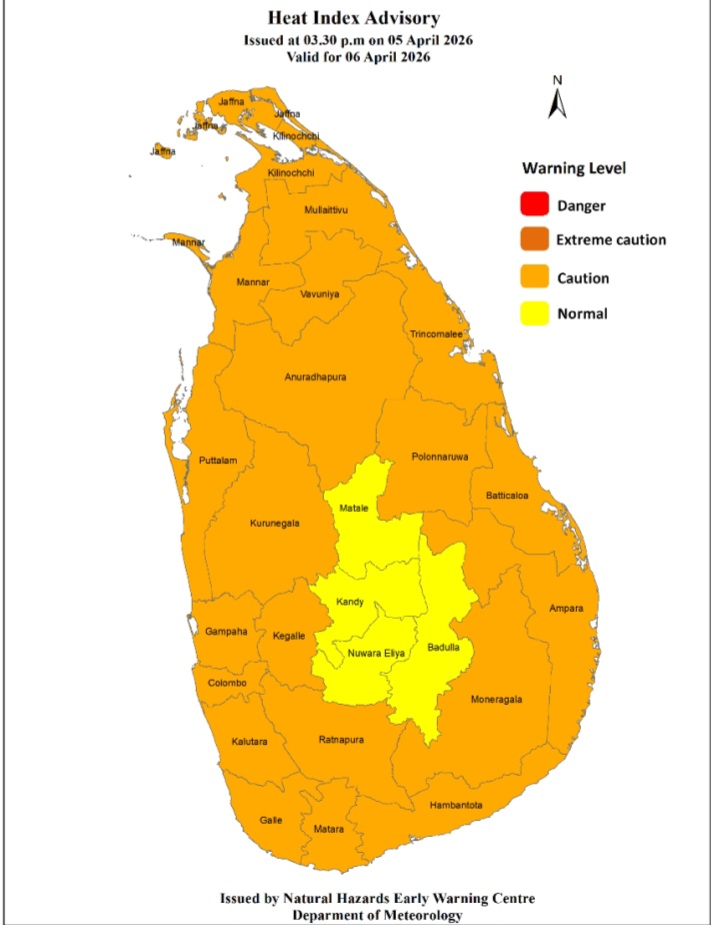
Warm Weather Advisory
Issued by the Natural Hazards Early Warning Centre
Issued at 3.30 p.m. on 05 April 2026, valid for 06 April 2026.
The Heat index, the temperature felt on human body is likely to increase up to ‘Caution level’ at some places in the Western, Sabaragamuwa, Southern, Eastern, North-western, Northern and North-central provinces and in Monaragala district.
The Heat Index Forecast is calculated by using relative humidity and maximum temperature and this is the condition that is felt on your body. This is not the forecast of maximum temperature. It is generated by the Department of Meteorology for the next day period and prepared by using global numerical weather prediction model data.

Effect of the heat index on human body is mentioned in the above table and it is prepared on the advice of the Ministry of Health and Indigenous Medical Services.
ACTION REQUIRED
Job sites: Stay hydrated and takes breaks in the shade as often as possible.
Indoors: Check up on the elderly and the sick.
Vehicles: Never leave children unattended.
Outdoors: Limit strenuous outdoor activities, find shade and stay hydrated.
Dress: Wear lightweight and white or light-colored clothing.
Note:
In addition, please refer to advisories issued by the Disaster Preparedness & Response Division, Ministry of Health in this regard as well. For further clarifications please contact 011-7446491.

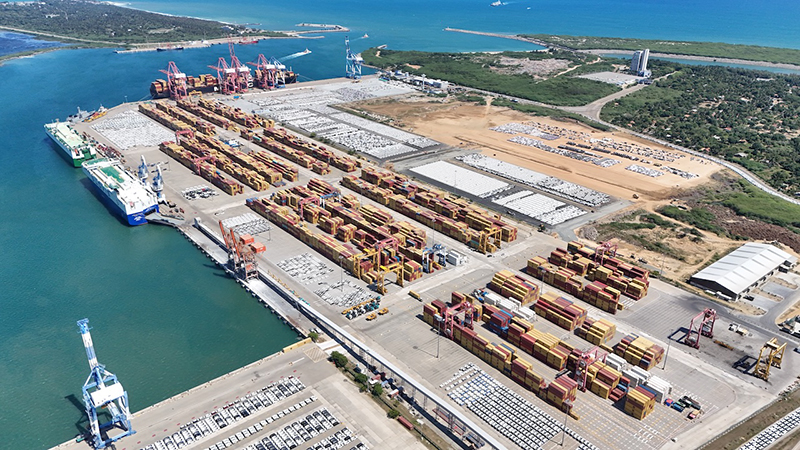
The ongoing West Asia war, triggered by joint Israel-US attack on Iran on 28 Februar, has benefited the China-run Hambantota International Port (HIP).With Iran imposing restrictions on the Strait of Hormuz shipping, in retaliation for unprovoked attack, thereby choking vital shipping routes, particularly for crude oil and refined oil products, HIP situated, along the East-West shipping corridor, has received the anticipated attention.
Soon after the sinking of an unarmed Iranian frigate, just outside Sri Lanka’s territorial waters, in India’s backyard, Indian External Affairs Minister Subrahmanyam Jaishankar categorised HIP as a foreign military base, along with Diego Garcia, Bahrain and Djibouti, where both the US and China maintained major bases.
HIP, in a press release issued on Sunday (05), declared that the Port has significantly expanded its operational capacity, in response to a sharp surge in global shipping volumes, resulting from the West Asia conflict.
The company asserted that the developing situation reinforced its position as a key alternative hub along the East–West shipping corridor.
The port has doubled its Roll-on/Roll-off (RoRo) yard capacity and increased its container yard capacity by 30%, as shipping lines divert operations away from disrupted routes in search of stable and efficient alternatives.
HIP is situated just 10 nautical miles from the main East–West shipping route, allowing vessels to divert with minimal deviation while maintaining schedule integrity.
The Chinese government-owned China Merchant Port Holdings (CMPort) under controversial circumstances acquired controlling interests of the Hambantota port in 2017 during the Yahapalanaya administration. Although the Sri Lankan government repeatedly said that Sri Lanka was paid USD 1.12 bn according to the HIP website CMPort invested $974 mn in the HIP and held 85 percent of the shares.
The 2017 agreement granted CMPort a 99-year lease to develop, manage and operate the Port area. The Supreme Court dismissed a fundamental rights petition filed by lawmaker Vasudeva Nanayakkara pointing out that the original agreements pertaining to the Hambantota port had been signed in 2012 and 2013 during Mahinda Rajapaksa’s tenure as the president when he was a member of the Rajapaksa Cabinet.
The HIP press release quoted CEO of HIP Wilson Qu as having said: “What we are witnessing today is a structural shift in global shipping patterns. At HIP, we have focused on building the capacity and operational agility to respond to such changes. Our ability to scale quickly, combined with our location, allows us to support global shipping lines when reliability becomes critical. Looking ahead, we will continue to invest in infrastructure and capabilities to strengthen Hambantota’s role as a key logistics and transshipment hub in the region.”
The rise in both vehicle transshipment and container volumes has driven yard utilization levels to the highest in HIP’s history, highlighting the scale of ongoing supply chain disruptions and the port’s growing strategic importance in global trade.
To accommodate increased throughput, HIP has rapidly expanded yard space across both cargo segments, enabling it to handle higher volumes while maintaining operational efficiency and minimizing congestion. Expanding capacity within a short time frame in a live port environment presents considerable operational and technical challenges and requires significant investment. However, through close coordination across management, engineering and operational teams, HIP was able to deliver these enhancements in step with rising demand.
The HIP statement added: “The expansion reflects Hambantota International Port’s continued development as a resilient logistics platform in the Indian Ocean, as geopolitical developments reshape established maritime routes and increase demand for alternative hubs. As infrastructure scales in tandem with demand, HIP is increasingly positioned to capture a larger share of regional transshipment volumes while supporting the continuity of global supply chains.”
Amidst the continuing uncertainty caused by war and growing threat to international shipping the Hambantota International Port Group (HIPG) the owning group of HIP recently finalised an agreement to invest USD 108 mn to procure new container handling equipment- six quay cranes, 16 rubber-tyred gantry cranes (RTGs) and 40 trailers, under the initial phase of the port’s Phase II container terminal development.
By Shamindra Ferdinando

Trump threatens ‘hell’ for Iran over Hormuz Strait as deadline approaches

Tim David, Rajat Patidar inflict bruising defeat on Chennai Super Kings

Shami sets up Lucknow Super Giants victory before Pant fifty takes them home

Showers or thundershowers will occur at several places in the Northern, Eastern, North-central, Central and Sabaragamuwa provinces and in Puttalam, Galle and Matara districts after 2.00 p.m.

Sun directly overhead Beruwala, Gurulubadda, Rakwana, Godakawela, Udawalawe and Thanamalwila at about 12:13 noon today (06)

Heat Index at Caution Level in the Western, Sabaragamuwa, Southern, Eastern, North-western, Northern and North-central provinces and in Monaragala district

‘Dates have the highest sugar content to fight Coronavirus’

Sunday Island 27 December – Headlines

#SundayIsland 17th December – Headlines

Sunday Island – 28th March

Sunday Island Headlines – 21 March

Sunday Island – 21st February – Headlines
-

 News5 days ago
2025 GCE AL: 62% qualify for Uni entrance; results of 111 suspended
-

 Features2 days ago
Ranjith Siyambalapitiya turns custodian of a rare living collection
-

 News2 days ago
Global ‘Walk for Peace’ to be held in Lanka
-

 News7 days ago
Tariff shock from 01 April as power costs climb across the board
-

 Business6 days ago
Hour of reckoning comes for SL’s power sector
-

 Editorial5 days ago
Search for Easter Sunday terror mastermind
-

 Features7 days ago
Seychelles … here we come
-

 Opinion7 days ago
Sri Lanka has policy, but where is the data?