
News
UNICEF helps accelerate supplementary measles immunisation activity in SL

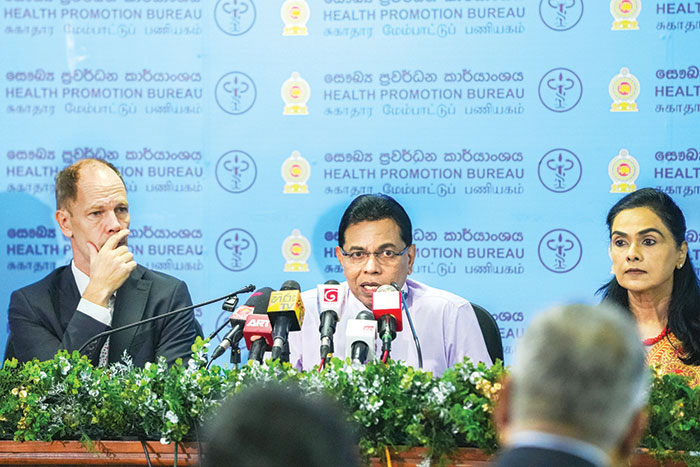
UNICEF, together with WHO, will assist the Ministry of Health in implementing a supplementary measles immunization activity (SIA) in Sri Lanka to control the ongoing measles outbreak, amidst over 700 measles cases reported in the country since May 2023.
The SIA will be launched in two phases; the first phase will commence on 6 January, targeting 6-9-month-olds in nine identified districts with a high population density, where measles cases were reported including Colombo, Gampaha, Kalutara, Galle, Matara, Kandy, Jaffna, Kurunegala and Kalmunai. The second phase will be initiated on January 20 and extended to other age groups across the country.
Speaking at a press briefing held in Colombo recently to announce the launch of the supplementary immunisation activity, UNICEF Representative in Sri Lanka, Christian Skoog said, “UNICEF, as well as
WHO, has been closely associated partners with the Ministry of Health for many years in the implementation of the national immunisation programme, which is a success story in Sri Lanka. However, even with a high immunisation coverage, measles outbreaks can occur among unvaccinated children, especially when there are outbreaks in the region. While the numbers are small with the recent measles outbreak, it is important to take it seriously and that is what the Ministry of Health is doing, in taking appropriate steps to control it.”
He also added the assistance extended by UNICEF during COVID-19 pandemic in 2020-2021 to maintain the quality of vaccines by addressing the gaps in the cold chain equipment system, will undoubtedly support in implementing this effective supplementary immunisation activity.
Meanwhile, Secretary to the Ministry of Health (MoH), Dr. Palitha Mahipala expressed confidence in the success of the vaccination drive, stating, “There is no other country in the world which has reached over 99% immunisation coverage. I can confidently state without any hesitation that Sri Lanka is the only country which reached a 99.9% immunisation coverage. So, I am optimistic that with this supplementary immunisation activity, the measles cases reported will be reduced.”
The measles, mumps and rubella (MMR) vaccine was introduced into Sri Lanka’s immunisation program in 1984. In 2001, a second dose of the vaccine was introduced to improve population level immunity and in 2019, the WHO declared Sri Lanka as a country free of Measles. However, a significant drop in global immunisation coverage from 2020 to 2022 impacted many countries in the region, which has led to a rise in measles cases once again, including in Sri Lanka.
Dr. Alaka Singh, WHO Representative to Sri Lanka who also spoke at the presser said, “The cases reported so far have been mild, and no deaths have been reported. However, measles can be a major childhood disease, which can and must be prevented. Accordingly, MoH has embarked on a rapid supplementary immunization activity in two phases through the strong primary healthcare system. We, as WHO, reiterate our full support for this program and overall recovery in Sri Lanka going forward.”
Other experts in attendance at the media briefing included Dr. Asela Gunawardena, Director General of Health Services, Ministry of Health; Dr. Vinod Kumar Bura, Coordinator, Immunisation and Vaccine Development, Department of Communicable diseases, WHO South-East Asia Regional Office; the Chief Epidemiologist; Director, Health Promotion Bureau as well as other consultants and specialists from MoH.
UNICEF and MoH, through this latest SIA are committed to combating any possible measles outbreaks in Sri Lanka. While measles is highly infectious, past vaccination initiatives have shown success in controlling outbreaks when high coverage is achieved. Stakeholders noted that strategic public awareness and community engagement will be critical in conveying the urgency of vaccinations and ensuring the campaign’s success.







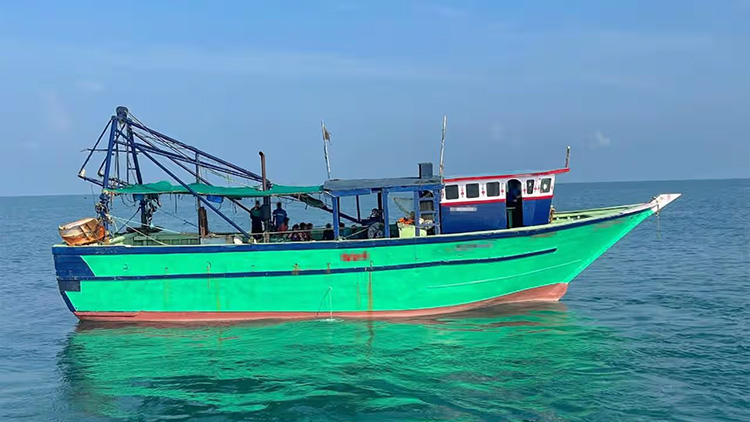
Nine Indian fishermen and their fishing boat taken into custody by the Navy on 3 October for engaging in illegal fishing south of Delft Island, Jaffna, were brought to Kankesanthurai harbour yesterday (04) morning.
The Navy took the boat into custody after it crossed the International Maritime Boundary. The fishing boat and the nine fishermen have been handed over to the Jaffna District Fisheries and Aquatic Resources Department for legal action.

The National Peace Council (NPC) said that the death sentence imposed on Sri Lankan citizen Sivarasa Anojan in Saudi Arabia and the removal of the Thileepan statue in Jaffna are very different events that carry the risk of turning into grievances that affect entire communities. The NPC urged the government as well as political parties, civil society and religious leaders to ensure that this does not happen.
The text of the statement: “NPC welcomes the government’s efforts in the Anojan case and the appeals for clemency made by political and religious leaders, including Muslim leaders. We encourage Muslim, Buddhist, Hindu and Christian leaders to express solidarity together. This would demonstrate that the life of a Sri Lankan citizen is a concern of all Sri Lankans, and that seeking mercy for him is not against any one religion. In particular, political, civil and religious leaders should reject attempts to turn the case into a source of anti-Muslim sentiment or collective blame. It is in this spirit that NPC joins the appeal for clemency for Anojan.
The Thileepan statue raises a different but related peacebuilding concern. Many Tamils attach deep significance to Thileepan, who died on 26 September 1987 after a twelve-day fast to protest the terms of the Indo-Lanka Peace Accord. The statue erected during this year’s commemoration was removed by police on 27 September. The government has raised legal concerns relating to the commemoration of a person associated with the LTTE, which remains a proscribed organisation. But the depth of Tamil anguish cannot be disregarded. For many Tamils, remembrance of Thileepan is connected to grief, loss and historical memory.
NPC notes that the Office for Reparations Act, No. 34 of 2018 provides for policies on memorialisation within its broader reparations framework. The government needs to engage the Office for Reparations and examine whether an appropriate form of memorialisation can be accommodated within the law. The JVP that now leads the NPP Government was itself once proscribed, later entered democratic politics, and now for many years has publicly commemorated its own fallen. The opportunity to remember those who died, while remaining within the law, should not belong to one community alone.
The cases involving Anojan and Thileepan give Sri Lanka an opportunity to demonstrate that it has learned from its past. Peacebuilding is the capacity to address today’s difficult issues in ways that prevent them from becoming tomorrow’s communal divisions. That is the real test of Sri Lanka’s continuing peace.”

The Sri Lanka Podujana Peramuna (SLPP) has accused the government of bending the law and targeting opposition politicians to distract the public from large-scale corruption, including alleged coal import losses, missing containers, and illegal dollar outflows.
Speaking at the launch of the “Yukthiya Wenuwen Nagitimu” (Stand Up for Justice) conference series in Kalutara, SLPP National Convener D.V. Chanaka claimed that key government figures are currently operating above the law while state investigative institutions are being politically manipulated.
Chanaka noted that diesel prices have risen significantly to Rs. 392 per litre compared to Rs. 283 when President Anura Kumara Dissanayake took office, despite drop in global oil prices.
He claimed the public was misled by prior political narratives.
Alleging that all 19 coal shipments imported under the current administration failed quality and procedural standards, Chanaka claimed the resulting Rs. 50 billion loss translates to an additional burden of Rs. 8,500 per household across Sri Lanka’s 6 million electricity consumers.
He emphasised that despite over 23 formal complaints filed with the CIABOC (Bribery Commission) and the CID, no arrests or prosecutions have taken place.
He raised concerns over 323 illegally released containers and a missing sum of $2.5 million, noting that no suspects have been detained.
Furthermore, he alleged that a senior police officer involved in a recent drug bust was transferred to prevent public connections to the missing container cases.
He accused the government of selectively weaponising law enforcement to target opposition leaders, specifically to distract the public from its own administrative corruption and financial irregularities.
During his address Chanaka also argued that high-profile arrests are deliberately timed to coincide with exposure of government scandals, including alleged coal procurement losses, missing containers, and illegal foreign currency outflows.
Chanaka specifically alleged that the administration was carrying out targeted arrests of key opposition figures, including Shasheendra Rajapaksa, former Minister Johnston Fernando, and SLPP National Organiser MP Namal Rajapaksa, strictly as a media tactic to divert public attention whenever new government corruption allegations surfaced.
Citing a 12-year-old case involving sponsorship funds for a rugby tournament, the speaker argued that law enforcement bypassed standard investigative protocols, such as interviewing tournament organisers or verifying properly approved corporate sponsorships, and instead pursued arbitrary arrests based on forced statements.
The government was criticised for failing to investigate or recover over $1 billion allegedly smuggled out of the country between 2025 and 2026, alongside other unresolved multi-million-dollar scandals.
Chanaka also expressed concern over the perceived loss of independence within key institutions, claiming that senior appointments across the Police, CID, and Commission to Investigate Allegations of Bribery or Corruption (CIABOC) are tied to ruling party political affiliations.
Concluding his address, Chanaka called on the public and opposition forces to unite for country-wide street protests, stating that the campaign initiated in Kalutara will expand nationally to demand justice and accountability.

Nine Indian poachers brought to KKS with their boat

Quo Vadis? Private sector medicine in Sri Lanka

Sri Lanka must rethink plastics before waste crisis deepens, says OUSL Vice Chancellor

Dons’ frustration and rulers’ nonchalance

The internationally acclaimed play ‘Every Brilliant Thing’ comes to Sri Lanka

JXG’s Spartans I graduates step forward to forge their futures

‘Dates have the highest sugar content to fight Coronavirus’

Sunday Island 27 December – Headlines

#SundayIsland 17th December – Headlines

Sunday Island – 28th March

Sunday Island Headlines – 21 March

Sunday Island – 21st February – Headlines
-

 News7 days ago
Police remove Thileepan statue in Jaffna
-

 Latest News5 days ago
Gold winner Tharanga gets brand-new Honda Vezel from SLAAJ
-

 News7 days ago
Sajith rejects Jt. Opp. protest sabotage claim; SJB TU chief demands remedial action
-

 Features5 days ago
Why Sri Lanka needs an Inclusive Civic Nationalism – urgently
-

 News4 days ago
US-assisted ‘Ice’ detection: NPC to examine IGP’s move to transfer drug-busting team
-

 Features6 days ago
Thailand’s biggest new global star …
-
 News6 days ago
First cases taken up by SC after enactment of 22A dismissed
-

 News5 days ago
Civil society activist accuses govt. of favouring Ven. Gnanasara