
News
UNHRC efforts to target SL armed forces:Govt. may contemplate new laws, constitutional safeguards

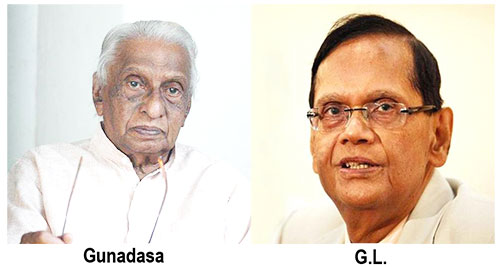
Dr. Amarasekera warns govt. to be wary of vile Western strategies
By Shamindra Ferdinando
Under severe pressure on the human rights front with UN Human Rights Commissioner Michelle Bachelet pushing for punitive measures against Sri Lanka, SLPP Chairman Prof. G.L. Peiris on Monday (1) said that the government wouldn’t hesitate to introduce news laws in Parliament to guarantee protection for the armed forces.
Prof. Peiris emphasized that they were even ready to provide what he called constitutional safety for the armed forces. Prof. Peiris, who is also the Minister in charge of the education portfolio, said that the government bore the responsibility to take tangible measures to safeguard the interests of the armed forces. Prof. Peiris dealt with the issue at the weekly SLPP media briefing at Battaramulla.
The top academic said that the Constitution could be amended to afford the required protection.
The 46th session of the Geneva-based United Nations Human Rights Council (UNHRC) is now underway.
Prof. Peiris who served as the External Affairs Minister, after the successful conclusion of the war in 2009, explained constitutional safeguards in place for the protection of US and UK military personnel deployed for overseas missions. However, in the guise of protecting human rights, war-winning Sri Lanka was being relentlessly harassed by interested parties bent on causing turmoil here, while hiding the sins of their own armed forces, Minister Peiris said.
UNHRC adopted three resolutions against Sri Lanka in 2012, 2013 and 2014. In Oct. 2015, Sri Lanka co-sponsored Resolution 30/1 against its own armed forces and the war winning political leadership. In March 2020, Sri Lanka announced withdrawal from Resolution 30/1 though it firmly remained involved in the process.
Commenting on Bachelet’s controversial report that dealt with the situation here, Prof. Peiris alleged that it was unfair by Sri Lanka. Although a Bachelet’s Office agreed to make some amendments, such gestures weren’t sufficient to rectify the harm caused to Sri Lanka.
Alleging that the UNHRC pursued an agenda in respect of Sri Lanka at the behest of some member states, Prof. Peiris questioned the rationale in Bachelet focusing on purely domestic issues, particularly developments following the Nov 2019 presidential election.
Prof. Peiris discussed how the UK turned a blind eye to LTTE theoretician Anton Balasingham’s wife, Adele’s direct involvement in LTTE terrorism. Minister Peiris pointed out the absurdity in the British position as regards accountability issues having provided a safe haven to Adele who sent child soldiers into battle after tying cyanide phials around their necks.
Prof. Peiris, who once led the government negotiating team for talks with the LTTE said that those who had been involved with the LTTE had no qualms in promoting their association with the terrorist group. Pictures and video footage of Adele in LTTE combat uniform is in the public domain.
Referring to US National Security Adviser John Bolton threatening the International Criminal Court (ICC) in case it sought to prosecute Americans, Prof. Peiris explained how the world’s solitary superpower sought to protect its interests. However, Sri Lanka was at the receiving end for bringing the war to a successful conclusion over a decade ago, Prof. Peiris said, pointing out the Western powers sought protection for their armed forces deployed in other countries whereas our forces operated within Sri Lanka territory.
Federation of National Organizations (FNO) spokesperson Dr. Gunadasa Amarasekera urged the government to be wary of Western strategies. Asked whether the nationalist organizations approve of the government’s stand in Geneva, Dr. Amarasekera emphasized that the country couldn’t under any circumstances accept the Core Group’s resolution. Dr. Amarasekera said that having quit the accountability resolution in March last year it would be ridiculous to accept another resolution. The civil society activist said that losing a vote in Geneva was much better than giving in to their despicable strategy. The government should be wary of their perceived readiness to listen to our grievances, Dr. Amarasekera said, urging those responsible for Geneva policy to review the strategy. Dr. Amarasekera regretted the government’s pathetic failure to exploit valuable evidence provided by US and UK defence advisors, a confidential UN survey, Wikileaks and other documents to disprove unsubstantiated war crimes accusations against the backdrop of UN confidentiality clause that denied Sri Lanka an opportunity at least to examine accusations till 2031.
Dr. Amarasekera said that the government hadn’t done its homework and struggled in Geneva expecting other countries to save Sri Lanka. Their failure to present Sri Lanka’s case properly in Geneva couldn’t be justified, Dr. Amarasekera said, pointing out how New Delhi made use of the situation again to demand the full implementation of the 13th Amendment to the Constitution, which was forced on the country by Delhi. Dr. Amarasekera was referring to New Delhi’s recent statement in Geneva.
Dr. Amarasekera said that Bachelet was pushing for wider actions against the armed forces. Her report should be examined against the backdrop of the US declaring Army Commander General Shavendra Silva a war criminal, the veteran nationalist said. What she wanted was individual member states to take punitive measures, Dr. Amarasekera said, Field Marshal Sarath Fonseka and Maj. Gen. Chagie Gallage, too, were denied visas, based on false accusations.



More than 1,600 students sat this year’s Russian Classical Ballet Examination, the largest number ever to take part in the examination in Sri Lanka. Exams were held in Colombo from 5, to 18, October and in Galle on 10 October.
Students aged four and above came from across the island, including Colombo, Galle, Gampaha, Negombo, Matara, Kelaniya, Panadura, Wattala, Kiribathgoda, Ratnapura, Kandy, Kurunegala, Bandarawela and Badulla. They are taught by 15 dedicated teachers trained in the Vaganova method, the renowned Russian system of classical ballet training.
They were examined by Dr. Oxana Karnovich of the Moscow State Academy of Choreography, a distinguished academic and curator.
The Russian School of Ballet and Dancing was established in 2001 by Michael Ustinov, Buddhapriya Ramanayake and Mrs Chandi Aluvihare, with Mrs Galina Pleshakova as its founding instructor. Today the School is led by Director Madam Maria Popova, Counsellor of the Embassy of the Russian Federation in Sri Lanka.


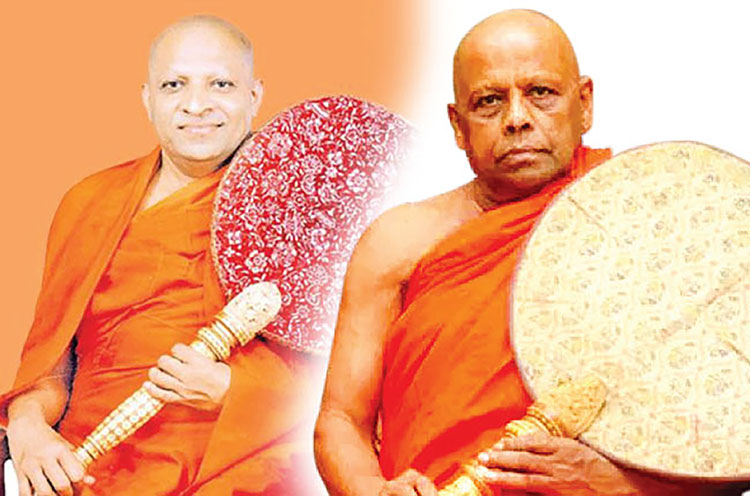
MONETABRIEF– Sri Lanka’s two most senior Buddhist chapters, Malwatte and Asgiriya, demanded special concessions for monks serving prison sentences, following the disrobing of convicted monk Ven. Galagodaatte Gnanasara in line with established procedures.
The chief prelate of the Asgiriya chapter, Most Venerable Warakagoda Sri Gnanarathana, told Prisons Commissioner Senaka Palletenna that Ven. Gnanasara, who is serving a six-year sentence for contempt of court, must be released immediately.
Prison authorities have no power to release or pardon convicts, but Palletenna told the monk in Kandy on Friday that he would convey his request to the relevant government authorities.
“There is no point in talking about this and that… The entire country has been shaken (??????? ) . He must be released,” the Asgiriya chief prelate said.
The Malwatte chief prelate, Most Venerable Thibbatuwawe Sri Siddhartha Sumangala, appeared to accept the court verdict against Ven. Gnanasara, but asked the prisons chief whether a separate section could be established for convicted monks.
Palletenna noted that a special ward for the clergy already existed at Welikada Prison.
At least 63 convicted Buddhist monks are currently incarcerated within Sri Lanka’s criminal justice system.
Meanwhile, a group of 34 Buddhist monks named in a Colombo Fort Magistrate’s Court order to vacate the vicinity of the Presidential Secretariat ended their protest and dispersed after lunch on Friday.The monks are demanding an unconditional pardon for Ven. Gnanasara, who has previously been imprisoned, making him a reconvicted prisoner.
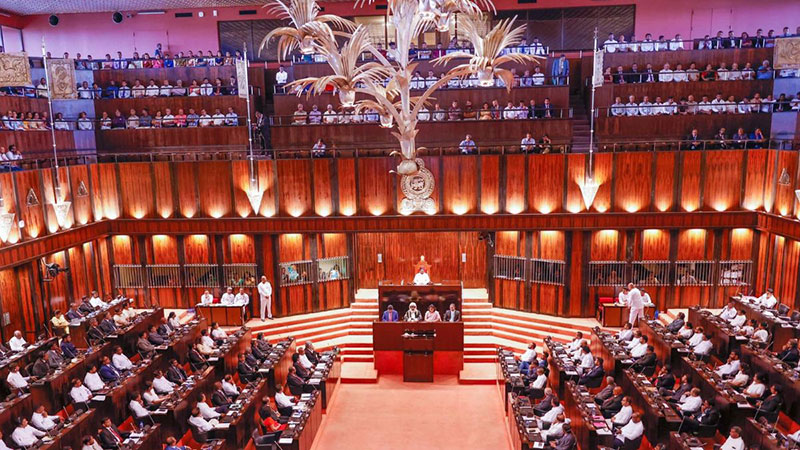
The debate on the no-confidence motion against Speaker Dr. Jagath Wickramaratne, submitted by the Samagi Jana Balawegaya (SJB), has been postponed indefinitely pending the Attorney General’s opinion on certain technical issues in the motion.
Government representatives raised the matter at a meeting of the Committee on Parliamentary Business, pointing out that several provisions of the motion required clarification and that the Attorney General’s advice should be obtained.
As obtaining the opinion would take time, the debate could not be scheduled for the next parliamentary week, parliamentary sources said.
Chief Opposition Whip Gayantha Karunatilaka said a date for the debate would be decided after the Attorney General’s advice was received.
Meanwhile, Parliament is scheduled to meet from October 20 to 23, Secretary General of Parliament Kushani Rohanadeera announced.
The parliamentary business for the week was finalised at a meeting of the Committee on Parliamentary Business held on Friday (16) under the chairmanship of Deputy Speaker Dr. Rizvie Salih.
On each sitting day, the period from 9.30 a.m. to 10 a.m. will be allocated for parliamentary business under Items 1 to 6 of Standing Order 22. Questions for Oral Answers will be taken up from 10 a.m. to 11 a.m., followed by questions under Standing Order 27(2) from 11 a.m. to 11.30 a.m.
On Tuesday, October 20, an Opposition-sponsored Adjournment Motion will be debated from 11.30 a.m. to 5.30 p.m.
On Wednesday, October 21, a resolution under the Public Debt Management Act and a Supplementary Estimate will be taken up for debate and approval from 11.30 a.m. to 5 p.m. The annual reports of five statutory institutions will subsequently be presented for approval without debate, while questions at the Adjournment Time will be taken up from 5 p.m. to 5.30 p.m.
On Thursday, October 22, the Second Reading debates on two Bills to amend the Poisons, Opium and Dangerous Drugs Ordinance (Bills Nos. 79 and 80) will be held from 11.30 a.m. to 5 p.m.
The annual reports of five statutory institutions will then be taken up for approval without debate, followed by an Opposition-sponsored Adjournment Motion from 5 p.m. to 5.30 p.m.
On Friday, October 23, the Second Reading debate on the Elimination of Rabies and Registration of Dogs Bill will be held from 11.30 a.m. to 5 p.m. A Government-sponsored Adjournment Motion will be debated during the final half-hour of the sitting.

Record 1,600 students take Russian Classical Ballet examination in Sri Lanka

Half a million people join protests in France, but some turn violent

Deadly fire breaks out at Canada military base

Showers or thundershowers will occur in most parts of the island after 1.00 p.m.

Buddhist hierarchy demands prison perks for monk convicts

Debate on NCM against Speaker postponed indefinitely

‘Dates have the highest sugar content to fight Coronavirus’

Sunday Island 27 December – Headlines

#SundayIsland 17th December – Headlines

Sunday Island – 28th March

Sunday Island Headlines – 21 March

Sunday Island – 21st February – Headlines
-

 Latest News5 days ago
Nissanka’s return headlines Sri Lanka’s Test squad against Pakistan
-

 Latest News7 days ago
Farhan and Sadaqat help Pakistan seal series in style
-
 Features7 days ago
Intake 16: 45 years of duty and honour
-
 News7 days ago
Malwathu Chapter issues statement on talks with President over Gnanasara Thera’s robes
-
 News7 days ago
CP alleges NPP has taken the blame for illegal US sanctions on Iranian vessels
-

 News5 days ago
Sri Lanka, India caught in US-Iran ship crisis
-

 Opinion7 days ago
How long can Sri Lanka remain silent on its demographic crisis?
-

 Latest News5 days ago
Kusal Mendis’ unbeaten 87 hands Sri Lanka consolation win