
News
UK sanctions on war-winning military: NJC slams govt. over its lukewarm response

The National Joint Committee (NJC) has strongly condemned what it called the NPP government’s weak response to the sanctions imposed on retired senior military officers and former LTTE Ampara-Batticaloa leader.
The following is the text of statement issued by Lt Col. (retd.) Anil Amarasekera, on behalf of the NJC:
“On 24th of March 2025 UK Foreign Commonwealth & Development Office in a press release titled “UK sanctions for Human Rights Violations and Abuses during the Sri Lanka Civil War” stated that the UK Government has imposed sanctions on four individuals, three of them are former military commanders of the Sri Lanka Armed Forces. The National Joint Committee cannot understand how the government of the United Kingdom came to the conclusion that there was a civil war in Sri Lanka when the security forces in Sri Lanka only conducted a humanitarian confrontation against the LTTE that was considered by the American FBI as the most ruthless terrorist organisation in the world. The Sinhalese were not at war with the Tamils; in fact a majority of the Tamils lived and continue to live peacefully with the Sinhalese in the south of Sri Lanka.
In a mild and weak response the Foreign Ministry of Sri Lanka says that such unilateral actions by countries do not assist but serve to complicate the national reconciliation process underway in Sri Lanka. The Foreign Ministry of Sri Lanka should have informed the UK Government that there was no civil war in Sri Lanka and that Sri Lanka had a non–international armed conflict for over three decades in which the armed forces of the government had a confrontation with the LTTE, an armed terrorist organisation. The Foreign Ministry of Sri Lanka should have also informed the United Kingdom government that the aim of the LTTE, for three decades, was to divide the country and establish a separate state of Eelam by overthrowing governments that the people elected democratically to rule the country and that the LTTE was finally defeated by the government armed forces of Sri Lanka in 2009.
The Sri Lankan diaspora in several western countries that support the division of Sri Lanka are influencing politicians in these western countries to impose sanctions for alleged war crimes against security forces heroes that defeated the separatists. The government that won the conflict against LTTE terrorists, as well as all the other governments elected by the people, subsequently, failed to inform the UNHCR and the international community adequately regarding this non-international armed conflict in which LTTE terrorists were even recruiting child soldiers. The UK government has, up-to-date, failed to take effective action against Adela Balasingham who was responsible for training child soldiers. The armed forces sacrificed so much blood, sweat, tears and toil, sometimes even their very life and limb to save the Tamil people who were held as a human shield by the LTTE. As a result of defeating the LTTE the armed forces were able to protect and preserve the unity and territorial integrity of their nation for posterity.
The 2nd Mandate of the Maxwell Paranagama Presidential Commission of Inquiry that was completed in August 2015 secured the services of several leading internationally renowned legal and military experts, like Sir Desmond de Silva Q.C., Professor David Crane, Sir Geoffrey Nice Q.C. and Major General John Holmes, the former Commander of the SAS, to assist the Commission on international humanitarian law, international human rights law, customary international law and the laws of armed conflict generally. It remains a mystery as to why this comprehensive report that negated all allegations made by the so called Panel of Experts (PoE) was not taken into consideration when the final version of the HRC Report was released to the public on 16th of September 2015. Foreign Minister Mangala Samaraweera of the Sirisena-Wickremesinghe government instead of making use of the available material in the 2nd Mandate of the Maxwell Paranagama Presidential Commission of Inquiry to clear the Security Forces of alleged war crime charges, co-sponsored the UNHRC Resolution 30/1 on 1st October 2015 and assisted the Western Powers to implement their neo-colonial strategy probably to please the Western Powers that made the 2015 regime change possible in Sri Lanka.
In October 2017 Lord Naseby informed the House of Lords that there was no basis for the PoE claim of 40,000 civilian deaths in the Vanni based on British wartime dispatches from Colombo sent by Colonel Gash from January to May 2009. He reiterated during the Queen’s Speech in the House of Lords in January 2020 that around 6000 Tamil civilians were killed and that quarter of them would have been LTTE combatants. He also said that reports of Colonel Gash made it clear that the Sri Lanka Army behaved admirably and looked after the civilians. He further said that the Sri Lanka Army would not have brought 295,000 Tamil civilians safely across the lines if they wanted to knock them off. Why the Sirisena-Wickremesinghe government fail to make use of the revelations made by Lord Naseby and request the help of the British government to establish the truth by releasing the entire set of dispatches sent by Colonel Gash to clear the Sri Lanka Security Forces of war crimes allegations is beyond comprehension.
In June 2011 at the first defence seminar held after the end of the Eelam war the US Defence Advisor in Colombo Lt Col. Lawrence Smith questioned the very basis of allegations including the execution of surrendering LTTE terrorists directed at the Sri Lanka Army. Both the Army and the then External Affairs Ministry pathetically failed to take notice that there couldn’t have been a better defence for Sri Lanka than a top US representative publicly denouncing false propaganda directed at Sri Lanka. The ICRC head of operations for South Asia Jacque de Maio during a confidential conversation on 9th July 2009 with the US Ambassador Clint Williamson, based in Geneva, had said that the Army was determined not to let the LTTE escape from the shrinking territory even though this meant that civilians being kept hostage by the LTTE were at an increasing risk and as a result there were serious widespread violations of international humanitarian law but that it did not amount to genocide and that he could cite examples of where the Army had stopped shelling when the ICRC informed them it was killing civilians. He had further said that the Army actually could have won the military battle faster with higher civilian casualties, yet that it chose a slower approach which led to a greater number of Sri Lanka Army deaths. Based on this information Ambassador Clint Williamson had sent a cable to the US State Department on 15th July 2009 clearing the Sri Lanka Army of crimes against humanity.”



Latest News
Heat Index at ‘Caution Level’ in the Western, Sabaragamuwa, Southern, Eastern, North-western, Northern and North-central provinces and in Monaragala district

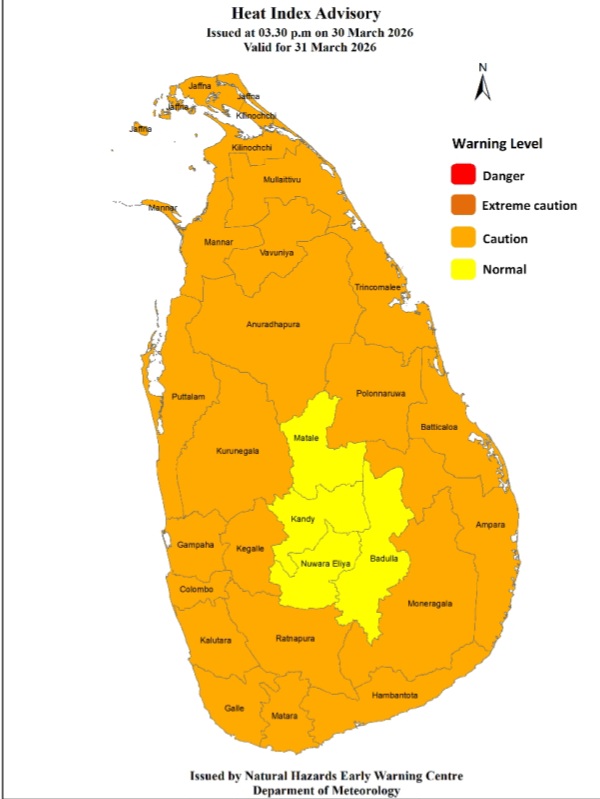
Warm Weather Advisory
Issued by the Natural Hazards Early Warning Centre
Issued at 3.30 p.m. on 30 March 2026, valid for 31 March 2026.
The Heat index, the temperature felt on human body is likely to increase up to ‘Caution level’ at some places in the Western, Sabaragamuwa, Southern, Eastern, North-western, Northern and North-central provinces and in Monaragala district.
The Heat Index Forecast is calculated by using relative humidity and maximum temperature and this is the condition that is felt on your body. This is not the forecast of maximum temperature. It is generated by the Department of Meteorology for the next day period and prepared by using global numerical weather prediction model data.

Effect of the heat index on human body is mentioned in the above table and it is prepared on the advice of the Ministry of Health and Indigenous Medical Services.
ACTION REQUIRED
Job sites: Stay hydrated and takes breaks in the shade as often as possible.
Indoors: Check up on the elderly and the sick.
Vehicles: Never leave children unattended.
Outdoors: Limit strenuous outdoor activities, find shade and stay hydrated.
Dress: Wear lightweight and white or light-colored clothing.
Note:
In addition, please refer to advisories issued by the Disaster Preparedness & Response Division, Ministry of Health in this regard as well. For further clarifications please contact 011-7446491.

The Public Utilities Commission of Sri Lanka (PUCSL) has granted approval to increase electricity tariffs with effect from 1st April .
The Ceylon Electricity Board (CEB) requested a 13.56% electricity tariff revision for the second quarter of this year.
The revision announced by the PUCSL for domestic consumers:
0–30 units category, electricity tariffs will rise by 4.3%,
31–60 units category, tariffs will rise by 6.9%,
61–90 units category, tariffs will rise by 6.9%,
91–120 units category, tariffs will rise by 7.2%,
Above 180 units, electricity tariffs will rise by 25.3%
The PUCSL has decided not to increase electricity tariffs for religious and charitable institutions that consume below 180 units monthly and a 9.6% increase for institutions that consume above 180 units.
Ectricity tariffs for the general and household consumer categories has been increased by 8%, while the electricity tariff increase for the industrial sector is 8.7%, the increase in tariff for government institutions is 14.4%.

It was decided at the committee appointed to oversee the distribution of essential goods to appoint five officials from the Ceylon Petroleum Corporation to cover all ministries in order to examine fuel-related issues and undertake the necessary interventions.
It was further discussed that the responsibility of these officials would be to examine fuel-related issues arising in institutions under each ministry and to intervene in providing solutions by maintaining coordination with the Corporation.
These matters were discussed at a meeting of the committee appointed to oversee the distribution of essential goods, chaired by Minister of Transport, Highways and Urban Development Bimal Rathnayake held on Friday (27) at the Presidential Secretariat.
It was also noted, with particular attention, that requests have been made by industrialists indicating that the current fuel quota allocated to vehicles for the distribution of their products across the country is insufficient. It was further discussed that, if these concerns are not addressed, there is a likelihood of an increase in the prices of goods, which could in turn cause significant hardship to the public during the festive season.
The committee also discussed the issuance of fuel for the distribution of essential food items by state and private institutions, including supermarkets such as Sathosa, wholesale importers, tourism-related service providers, hotels and other service-providing organisations.
Accordingly, it was discussed that requests for fuel quotas submitted by these institutions should be carefully considered and prompt action taken as necessary and that such requests should be forwarded to the Ministry of Energy through the relevant ministries.
Attention was also drawn to the need for the swift implementation of a QR code system for the issuance of fuel to other sectors, including agriculture and the fisheries industry, based on letters issued on the recommendations of the relevant government officials, including agricultural research officers, instead of the previous method of direct fuel allocation.
Minister Bimal Rathnayake emphasised the need to ensure a continuous and properly managed fuel supply, with particular focus on providing goods to the public without shortages and preventing excessive price increases during the forthcoming Sinhala and Hindu New Year season.
The discussion was attended by a group of government officials, including Minister of Trade, Commerce, Food Security and Cooperative Development Wasantha Samarasinghe, Deputy Minister of Power Arkam Ilyas, Senior Additional Secretary to the President, Kapila Janaka Bandara and Chairman of the Ceylon Petroleum Corporation, D. J. Rajakaruna.

Heat Index at ‘Caution Level’ in the Western, Sabaragamuwa, Southern, Eastern, North-western, Northern and North-central provinces and in Monaragala district

Electricity tariffs to be increased from 1st April

A QR code system to be introduced for agricultural lands and other sectors requiring fuel

Rickelton, Rohit, Shardul break Mumbai’s first-game jinx

Oil tops $116 a barrel as Iran accuses US of preparing invasion

Iranian attack damages Kuwait power and desalination plant, kills worker

‘Dates have the highest sugar content to fight Coronavirus’

Sunday Island 27 December – Headlines

#SundayIsland 17th December – Headlines

Sunday Island – 28th March

Sunday Island Headlines – 21 March

Sunday Island – 21st February – Headlines
-

 News6 days ago
Senior citizens above 70 years to receive March allowances on Thursday (26)
-

 Features3 days ago
A World Order in Crisis: War, Power, and Resistance
-

 News4 days ago
Energy Minister indicted on corruption charges ahead of no-faith motion against him
-

 News5 days ago
US dodges question on AKD’s claim SL denied permission for military aircraft to land
-

 Business5 days ago
Dialog Unveils Dialog Play Mini with Netflix and Apple TV
-
 Business7 days ago
Postponement of Sri Lanka Investment Forum 2026
-

 News6 days ago
CEB Engineers warn public to be prepared for power cuts after New Year
-

 Sports4 days ago
SLC to hold EGM in April