
Foreign News
Two arrested over theft of jewels at Louvre museum in Paris

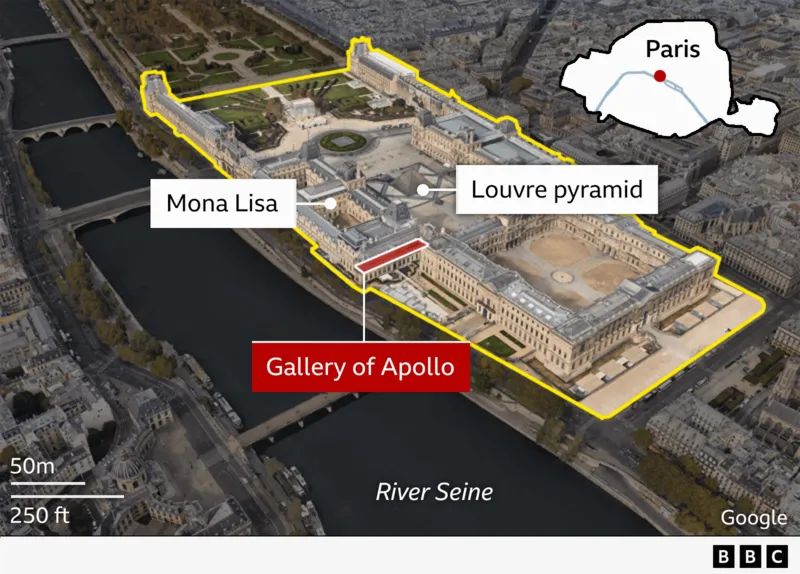
Two suspects have been arrested over the theft of precious crown jewels from Paris’s Louvre museum, French media say.
The Paris prosecutor’s office said one of the men had been taken into custody as he was preparing to take a flight from Charles de Gaulle Airport.
Items worth €88m (£76m; $102m) were taken from the world’s most-visited museum last Sunday, when four thieves wielding power tools broke into the building in broad daylight.
France’s justice minister has conceded security protocols “failed”, leaving the country with a “terrible image”.
The Paris prosecutor’s office said in a statement that the arrests had been made on Saturday evening, without specifying how many people had been taken into custody.
One of the suspects was preparing to travel to Algeria, police sources have told French media, while it is understood the other was going to Mali.
Specialist police can detain and question them for up to 96 hours.
According to reports in French media on Sunday, DNA found at the scene of the robbery led to the identification of one of the suspects.
The gang left behind a number of items, including gloves and a high-vis jacket.
It has previously been reported that they dropped a crown that once belonged to Empress Eugenie, the wife of Napoleon III.
The Paris prosecutor criticised the “premature disclosure” of information related to the case, adding that it hindered efforts to recover the jewels and find the thieves.
The thieves reportedly arrived at 09:30 (08:30 GMT), shortly after the museum opened to visitors.
The suspects arrived with a vehicle mounted mechanical lift to gain access to the Galerie d’Apollon (Gallery of Apollo) via a balcony close to the River Seine.
Pictures from the scene showed the ladder leading up to a first-floor window.
Two of the thieves entered by cutting through the window with power tools.
They then threatened the guards, who evacuated the premises, and cut through the glass of two display cases containing jewels.
A preliminary report has revealed that one in three rooms in the area of the museum raided had no CCTV cameras, according to French media.
French police say the thieves were inside for four minutes and made their escape on two scooters waiting outside at 09:38.
The museum’s director told French senators this week that the only camera monitoring the exterior wall of the Louvre where they broke in was pointing away from the first-floor balcony that led to Gallery of Apollo.
CCTV around the perimeter was also weak and “ageing”, Laurence des Cars said, meaning that staff failed to spot the gang early enough to stop the theft
Experts have also expressed concern that the jewels may have already been broken up into hundreds of pieces.
Gold and silver can be melted down and the gems can be cut up into smaller stones that will be virtually impossible to track back to the robbery, Dutch art detective Arthur Brand told the BBC.
Security measures have since been tightened around France’s cultural institutions.
The Louvre has transferred some of its most precious jewels to the Bank of France following the heist. They will now be stored in the Bank’s most secure vault, 26m (85ft) below the ground floor of its elegant headquarters in central Paris.
[BBC]

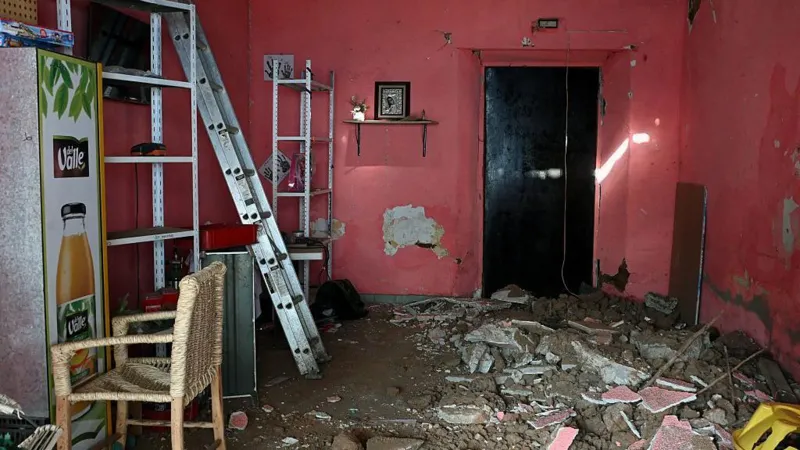
At least two people have died after a powerful earthquake hit southern and central Mexico on Friday.
The epicentre of the 6.5 magnitude earthquake was near the popular tourist town of Acapulco, near San Marcos in the south-western state of Guerrero, which suffered moderate damage.
A 50-year-old woman died in Guerrero, the state’s governor Evelyn Salgado said, while Clara Brugada, Mexico City’s mayor, confirmed the death of a 60-year-old man and said 12 others had been injured in the capital.
Mexico is situated in one of the world’s most seismically active areas, sitting at the meeting point of four tectonic plates.
Late on Friday night, Brugada said power has been restored to “98% of the failures reported” in Mexico City.
Two structures were being evaluated for risk of collapse, she said, while 34 buildings and five homes were being inspected as a preventative measure.
Damage assessments are under way in Mexico City after roads and hospitals were impacted, according to news agency Reuters, while authorities noted various landslides on highways around the Guerrero state.
Mexico’s seismological service had registered 420 aftershocks by midday local time (18:00 GMT).
President Claudia Sheinbaum was holding her first press conference of the year when the earthquake struck.
In a video capturing the moment, Sheinbaum can be heard saying “it’s shaking” as an earthquake alert system rings in the background. She then tells the media to “all get out calmly”.
Additional footage shows buildings shaking in Mexico City and cars trembling in Acapulco.
After hearing the Mexican Seismic Alert System early on Friday, residents and tourists rushed into the streets of Mexico City and Acapulco.
The seismic system was put into place following the deadly 1985 earthquake that claimed more than 10,000 lives.
In 2017, a 7.1 magnitude quake, killed more than 200 people and toppled dozens of buildings in Mexico City.
(BBC)

The United States Coast Guard has said it has suspended its search for survivors days after the US military said it struck two more boats in the eastern Pacific amid its ongoing military campaign in waters in and around Venezuela.
In a statement shared on its website on Friday, the Coast Guard said the three-day search had been focused on water “approximately 400 nautical miles [about 740km] southwest of the Mexico/Guatemala border” and had continued for more than 65 hours, but that no sightings of survivors had been reported.
(Aljazeera)

Russia finished 2025 with what Ukraine described as an information operation designed to avoid engaging in peace talks and continue its war, despite suffering staggering casualties for meagre territorial gains this year.
On Monday, December 29, Russian Foreign Minister Sergey Lavrov accused Ukraine of attempting to assasinate Russia President Vladimir Putin at his residence at Lake Valdai, 140km (87 miles) northeast of Moscow.
“The Kyiv regime launched a terrorist attack using 91 long-range unmanned aerial vehicles (UAVs) on the state residence of the president of the Russian Federation in the Novgorod Region. All the UAVs were destroyed by the air defence systems of the Russian Armed Forces,” said Lavrov in a statement.
He did not say whether Putin was in residence at the time.
Lavrov’s Ukrainian counterpart, Andrii Sybiha, quickly dismissed the claim. “Almost a day passed and Russia still hasn’t provided any plausible evidence to its accusations of Ukraine’s alleged ‘attack on Putin’s residence’. And they won’t. Because there’s none. No such attack happened,” Sybiha said.
Russia produced photographs of drone debris lying in the snow two days later, but the drone’s location, manufacture and the time of its downing could not be corroborated from them.
“The attack on Putin’s Valdai residence is presumably a Kremlin fake,” wrote the opposition outlet Sota. “Residents of Valdai, where Putin’s ‘Dinner’ residence is located, told Sota that last night they did not hear the work of the air defence, which would have shot down 91 drones.”
Sota also pointed out that drones attacking Valdai “necessarily cross a specially protected airspace with objects of the Strategic Missile Forces, East Kazakhstan region, military aviation, closed administrative units such as Solnechny, Lake, etc.
“A drone crossing the territory of these facilities can fly to the Dinner residence only by miracle,” Sota said.
Lavrov’s claim also appeared at odds with an earlier announcement from the Russian Ministry of Defence that only 41 drones had been downed in the Novgorod region on the night of December 28-29.
Russia’s Defence Ministry later issued an update, saying another 49 drones had been shot down over Bryansk and one over Smolensk “flying in the direction of Novgorod region”.
Ukraine observers pointed out that Bryansk and Smolensk are hundreds of kilometres from Valdai.
The Institute for the Study of War (ISW), a Washington-based think tank, stated that none of the usual evidence of Ukrainian strikes accompanied the alleged attack, such as footage, heat signatures, statements from local officials, or local media reports.
For example, a successful Ukrainian attack against an oil depot in Rybinsk on December 31 was well-documented on social media. So was an attack on the Novoshakhtinsk refinery in Rostov a week earlier, as well as a number of other strikes during the week.

News of the alleged attack came a day after Ukrainian President Volodymyr Zelenskyy concluded successful talks with United States President Donald Trump in Florida, garnering a promise that US forces would participate in Ukraine’s security following any peace agreement with Russia.
It was the first time the US had agreed to such security guarantees, and it appeared to make Polish Premier Donald Tusk optimistic that the war in Ukraine could end early in 2026.
“Peace is on the horizon,” he told a cabinet meeting on Tuesday.
“The key result of recent days is the American declaration of willingness to participate in security guarantees for Ukraine after a peace agreement, including the presence of American troops, for example, on the border or on the line of contact between Ukraine and Russia,” Tusk said.
Zelenskyy said Ukraine’s allies, known as the Coalition of the Willing, were scheduled to meet in Kyiv on January 3 and in France three days later.
Lavrov’s announcement cast a pall on this optimism when he said, “Russia’s negotiating position will be reviewed.” On the same day, Putin ordered his forces in southern Ukraine to continue efforts to seize the unoccupied remainder of the southern Ukrainian region of Zaporizhia. Moscow controls three-quarters of the region.
Zelenskyy said Russia was “looking for a pretext” to escalate hostilities and avoid engaging in peace talks, following his successful meeting with Trump.
“Russia is at it again, using dangerous statements to undermine all achievements of our shared diplomatic efforts with President Trump’s team,” he wrote on social media.
Russia has repeatedly dashed Trump’s hopes for peace, refusing to cede occupied territory or to accept US and European forces on Ukrainian soil.
Yet Trump appeared to believe Moscow’s allegations.
“I don’t like it. It’s not good,” Trump told reporters on Monday. “It’s one thing to be offensive… It’s another thing to attack his house. It’s not the right time to do any of that. And I learned about it from President Putin today. I was very angry about it.”
Other US officials were not convinced. US Ambassador to NATO Matthew Whitaker expressed scepticism, telling an interviewer on Monday, “It’s unclear whether it actually happened.” On Wednesday, the Wall Street Journal reported that US intelligence had determined that Ukraine did not target Putin’s residence.
Moscow’s messaging appeared to bookend Zelenskyy’s meeting with Trump, targeting the US president.
Putin held staged meetings with his General Staff on Saturday, December 27, and Monday, just before and after Zelenskyy’s meeting with Trump, during which commander-in-chief Valery Gerasimov broadcast exaggerated claims of success.
He said Russian forces had occupied 6,640 square kilometres (2,564 square miles) of Ukrainian territory and seized 334 Ukrainian settlements in 2025. The ISW said it had “observed evidence indicating a Russian presence in 4,952 square kilometres (1912 sq miles)” and 245 settlements.
Ukrainian commander-in-chief Oleksandr Syrskii said territory amounting to 0.8 percent of Ukraine’s 603,550sq km (233,032sq miles) had been lost. at the cost of almost 420,000 dead and wounded Russians.
Ukraine’s General Staff estimated total Russian casualties for the war at more than 1.2 million, almost 11,500 tanks and 24,000 armoured fighting vehicles, more than 37,000 artillery systems, 781 aircraft and well in excess of 4,000 missiles.
By the end of 2025, Russian forces had still not taken Pokrovsk and Myrnohrad, the eastern Ukrainian towns in Donetsk that they had been fighting to capture for five months. They held 55 percent of Hulyaipole in the southern Zaporizhia region, despite claiming to have seized it. Even Russian military reporters admitted Russian forces were being squeezed out of Kupiansk in the northern Kharkiv region, despite claiming also to have seized that.
“Due to inaccurate reports on the situation to higher authorities, reserves that were ‘not needed’ for the capture and clearing of Kupiansk were redeployed to other areas,” wrote one Kremlin-friendly outlet, citing “systematic exaggeration of successes”.
While it remained doubtful whether Ukraine did target Valdai, Russia’s attacks on Ukrainian cities were documented. During the last week of the year, Russia launched just more than 1,000 drones and 33 missiles at Ukraine’s cities. Ukraine’s Air Force said it intercepted 86 percent of the drones and 30 of the missiles.


[Aljazeera]

PM lays foundation stone for seven-storey Sadaham Mandiraya

Showers will occur at times in the Eastern and Uva provinces and in Nuwara-Eliya, Matale, Polonnaruwa, and Mullaittivu districts

Curran, bowlers lead Desert Vipers to maiden ILT20 title

PUCSL and Treasury under IMF spotlight as CEB seeks 11.5% power tariff hike

Bellana says Rs 900 mn fraud at NHSL cannot be suppressed by moving CID against him

First harvest of rice offered to Dalada Maligawa

‘Dates have the highest sugar content to fight Coronavirus’

Sunday Island 27 December – Headlines

#SundayIsland 17th December – Headlines

Sunday Island – 28th March

Sunday Island Headlines – 21 March

Sunday Island – 21st February – Headlines
-

 News2 days ago
Health Minister sends letter of demand for one billion rupees in damages
-
 News5 days ago
Leading the Nation’s Connectivity Recovery Amid Unprecedented Challenges
-

 Features6 days ago
It’s all over for Maxi Rozairo
-

 Opinion4 days ago
Remembering Douglas Devananda on New Year’s Day 2026
-

 News6 days ago
Dr. Bellana: “I was removed as NHSL Deputy Director for exposing Rs. 900 mn fraud”
-

 News5 days ago
Dons on warpath over alleged undue interference in university governance
-

 News8 hours ago
Private airline crew member nabbed with contraband gold
-

 Features6 days ago
Rebuilding Sri Lanka Through Inclusive Governance