
News
Troubled Lanka receives economic assistance amounting to USD 2.5 bn from India this year

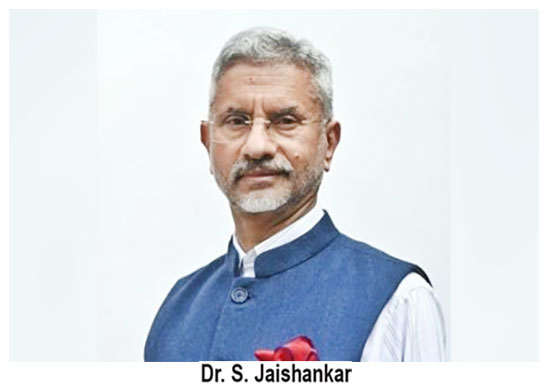
India has provided economic assistance to Sri Lanka amounting to USD 2.5 bn, so far this year, according to the Indian High Commission in Colombo. The announcement was made in the wake of External Affairs Minister (EAM) Dr. S. Jaishankar’s talks with President Gotabaya Rajapaksa, Foreign Affairs Minister Prof. G.L. Peiris and others on the first day of discussions, during his visit to Colombo on Monday (28).
Dr. Jaishankar is accompanied by a five-member official delegation from the Ministry of External Affairs, New Delhi for the bilateral and BIMSTEC engagements.
The Indian HC stated: “The EAM called on President Gotabaya Rajapaksa and conveyed personal greetings from Prime Minister Narendra Modi. The President of Sri Lanka thanked the Government of India (GOI) for economic assistance amounting to around USD 2.5 billion, extended to Sri Lanka in 2022. Dr. S. Jaishankar assured India’s continued support in Sri Lanka’s economic recovery process. The discussions also covered the recent Government-TNA talks, defence and energy cooperation, and thefishermen’s issues. It was agreed to deepen economic and commercial linkages with special emphasis on Indian investments.
The EAM joined Prime Minister Mahinda Rajapaksa at a special event held at the Temple Trees to virtually inaugurate the Jaffna Cultural Centre. They watched a cultural performance at the Centre – a Bharatnatyam rendition, a prayer dedicated to the peoples of India and Sri Lanka and their eternal friendship. They also had a virtual tour of the Artificial Limb Fitment Camp in Jaffna which is supported by GOI. In addition, they also witnessed signing of MoU on implementation of grant assistance from India to promote Buddhist ties between India and Sri Lanka. Further, there was an exchange of notes on the amendment to Article IX of the MoU on construction of Jaffna Cultural Centre.
The EAM met the Finance Minister. Basil Rajapaksa in the morning, who stressed the significance of deeper economic engagement between the two neighbours at a time when the impact of COVID-19 is still being strongly felt. EAM reiterated that India’s partnership with Sri Lanka was rooted in the ‘Neighbourhood First’ approach and S.A.G.A.R (Security And Growth for All in the Region) doctrine. India has stood by Sri Lanka in the hour of its need.
Foreign Minister Prof. G.L Peiris held talks with EAM in the evening. They covered the entire gamut of bilateral engagement. Attesting to the comprehensive nature of bilateral ties, they also witnessed the signing of bilateral documents in diverse areas:
i) MOU on implementation of Sri Lanka Unique Digital Identity (SL-UDI) programme with GOI’s grant assistance;
ii) MOU for providing Maritime Rescue Coordination Centre;
iii) MOU on implementation of Hybrid Power Projects in three Islands off Jaffna;
iv) MOU on cooperation in development of Fisheries Harbours in Sri Lanka;
v) MOU for the establishment of Modern Computer Labs and smart boards with customized curriculum software in 200 schools in Galle District; &
vi) MOU between Sushma Swaraj Institute of Foreign Service and the Bandaranaike International Diplomatic Training Institute.
The EAM separately met Minister of Fisheries and Aquatic Resources Douglas Devananda. They discussed issues pertaining to fishermen and exchanged views on devolution.
The EAM’s other engagements included a visit to HCL Technologies, an LIOC petrol station, and discussions with leaders representing various Tamil political parties. It may be recalled that HCL Technologies has created more than 1,800 jobs locally. LIOC has been at the forefront of energy cooperation between the two countries since its incorporation as a Sri Lankan Company two decades back.
The Jaffna Cultural Center is a glowing example of India-Sri Lanka development partnership. It was conceived as a reconciliation project primarily aimed at expanding cultural infrastructure for people of Northern Province. This state-of-the-art facility, constructed with grant assistance from GOI, consists of multiple facilities such as a museum of two floors; an advanced theatre style auditorium for more than 600 people; an 11-storeyed learning tower; a public square which could also act as an amphitheater; etc.”



Former first lady Shiranthi Rajapaksa, wife of former President Mahinda Rajapaksa was produced before the Hulftsdorp court, after being arrested by officers of the Commission to Investigate Allegations of Bribery or Corruption (CIABOC) and produce
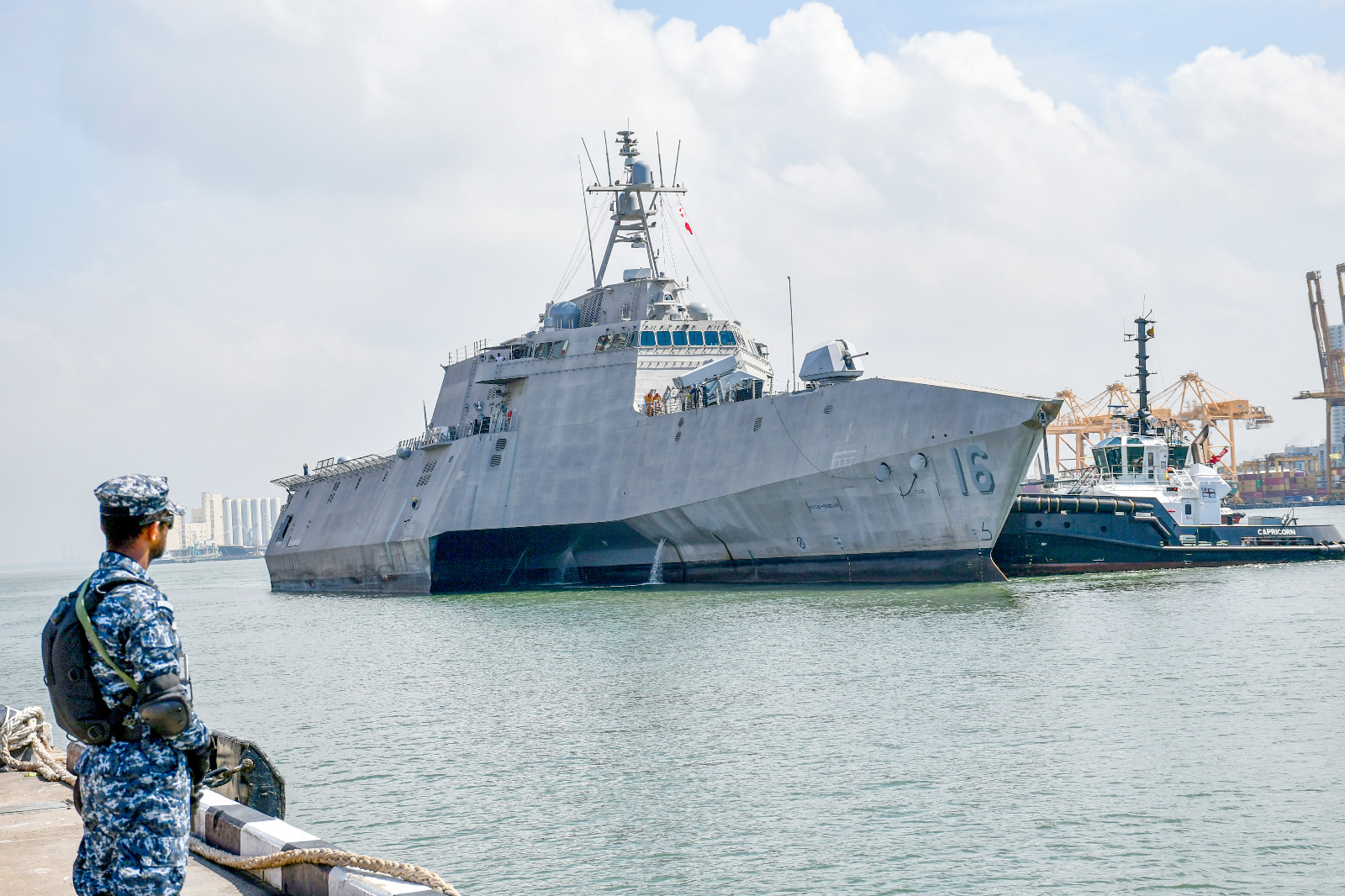
The U.S. Navy ship USS Tulsa (LCS 16) arrived at the Port of Colombo this morning, 7 October 2026 for replenishment purposes.
The visiting ship was welcomed by the Sri Lanka Navy in accordance with naval traditions.
The 127.7-metre-long platform is a Littoral Combat Ship commanded by Commander BM Wanier. Commissioned on 16 February 2019, USS Tulsa has since been in service with the US Navy.
The ship previously made a port call in Sri Lanka on 27 August 2025.
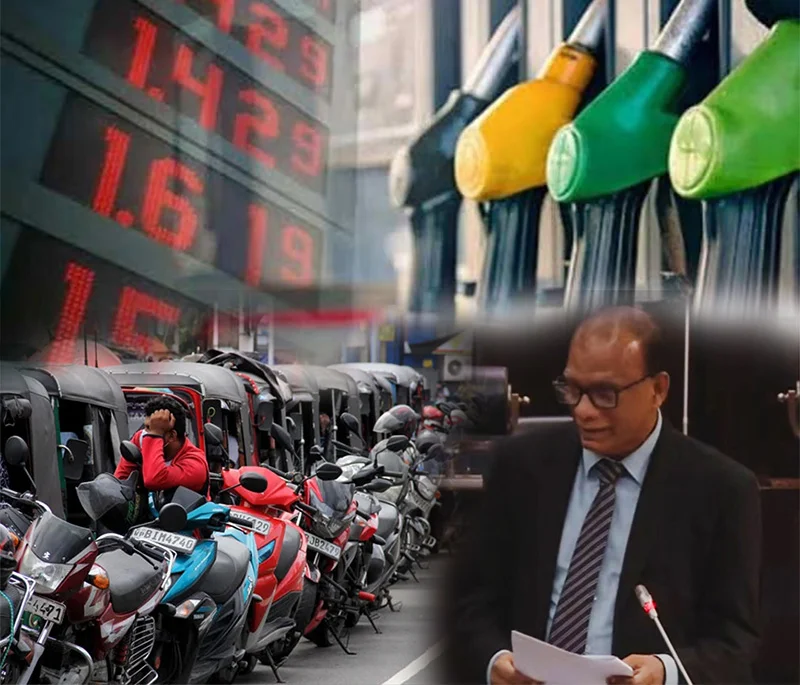
Govt. tells fuel distributors to maintain stocks to ensure uninterrupted supplies
by Saman Indrajith and Norman Palihawadane
The government had instructed private fuel distributors to maintain minimum stocks and ensure uninterrupted supplies to the market, Energy Minister Anura Karunathilaka told Parliament yesterday (06).
Karunathilaka said the Ministry of Energy Secretary had notified the relevant companies of the requirement, following a reduction in supplies by some private distributors, amid higher international fuel prices.
The Minister said private companies had informed the government that they were facing losses because international prices had risen while fuel was being sold, locally, at prevailing prices. As a result, some companies had reduced the volumes released to the market.
The reduced supplies had increased the burden on the Ceylon Petroleum Corporation (CPC), whose share of the diesel market had risen from about 54% to 82%, the Minister said.
“The CPC currently holds an 82% share of the market,” he said, adding that it had increased its supplies, compared with February, to compensate for the reduction by private distributors.
Karunathilaka said the government could not, under the existing agreements with private companies, specify the quantities they should supply to individual filling stations. However, it could require them to maintain minimum stocks in the country.
The Minister said the Energy Ministry had already instructed companies that had failed to maintain the required stocks to take steps to prevent supply disruptions.
The Minister attributed the queues reported at some filling stations to reduced supplies from private distributors, as well as normal variations in fuel distribution. He also said demand for CPC fuel had increased because private companies generally did not provide fuel to dealers on credit, while the CPC offered a three-day credit facility.
“We expect that, as the Ceylon Petroleum Corporation takes on this additional burden, the problem will ease to some extent by Wednesday or Thursday,” Karunathilaka said.
He said instructions had also been issued to increase supplies to CPC filling stations. A special discussion on the issue is scheduled for today (07), with officials of the Energy Ministry and CPC expected to participate,
along with President Anura Kumara Dissanayake.
Meanwhile, Petroleum Dealers’ Association officials have called for an early solution to the supply issue. Association Chairman D.V. Shantha Silva said queues had been reported at many filling stations, mainly those operated by private distributors.
He said the situation was not due to an overall shortage of fuel, but was linked to reduced orders by Lanka IOC, Sinopec and R.M. Parks amid concerns over losses incurred on fuel sales.
The Ceylon Petroleum Private Tanker Owners Association has urged motorists to refrain from panic buying, saying there was no nationwide disruption to fuel supplies.
The government earlier increased fuel prices and introduced a per-litre diesel subsidy following concerns raised by distributors over rising international prices.

Showers above 100 mm are likely at some places in the Western, Sabaragamuwa, Central, Uva and Southern provinces and in Anuradhapura district

Remembering Juvenal, Coke, Acton and Machiavelli

West Asian conflict undergoing manifold complications

Nissanka absence opens door for Sri Lanka’s young guns

The prelate who walked the talk

Needs of populace hit by Cyclone Ditwah seen as waiting to be addressed

‘Dates have the highest sugar content to fight Coronavirus’

Sunday Island 27 December – Headlines

#SundayIsland 17th December – Headlines

Sunday Island – 28th March

Sunday Island Headlines – 21 March

Sunday Island – 21st February – Headlines
-

 Editorial6 days ago
Colombo Port drug bust: The plot thickens
-

 Features4 days ago
The first woman in the foreign service or Ceylon Overseas Service it was then called
-

 Editorial5 days ago
Fuelling discontent and protest
-

 News3 days ago
Geneva takes up Sallay’s case and govt. ignores opportunity to answer accusations
-

 Latest News5 days ago
Tharindu Rathnayake, bowlers secure Asian Games Bronze for Sri Lanka
-

 Foreign News5 days ago
Ten injured after car crashes into rugby supporters in Australia
-

 Features3 days ago
Sri Lanka Cricket Bill: Governance reform is not yet a cricket strategy
-

 News4 days ago
Nearly 20 Iranian tankers stranded off Lanka amid US sanctions