
News
TNA accepts president’s overture, MP suggests party ready to talk federal


ECONOMYNEXT —Tamil National Alliance (TNA) will engage constructively in sincere attempts at resolving the ethnic issue, legislator M A Sumanthiran said responding to President Ranil Wickremesinghe’s overtures to the opposition, while also suggesting that the TNA was open to a federal solution.
“We will engage constructively in every sincere attempt as we have always done but will not allow any farcical process,” Sumanthiran tweeted Thursday November 24 afternoon.In a speech made in parliament the previous day, the Jaffna district MP said there can be no reconciliation by sweeping the truth under the carpet.
“It is only by the ascertainment of the truth that there can be true reconciliation,” he said.
“Your actions must be louder than words. All we have are words, words and words. As I speak, more lands are being acquired,” he added, highlighting an example that prompted a response from President Wickremesinghe that he would look into the matter.
Wickremesinghe on Wednesday re-extended an open invitation to opposition parties to a discussion on a permanent solution to Sri Lanka’s decades-long ethnic problem. Talks would begin after December 11, he said, with a view to agreeing on a solution by February 04 2023 when the island nation celebrates 75 years of independence from the British.
“We welcome the president’s initiative. He said everyone must agree on the solution. We want all the people of this country to be content and be satisfied and feel secure that this is their country,” said Sumanthiran.The MP said there is broad consensus already on the issue and that only a few things need to be ironed out.
“That can be done in a day’s sitting. You don’t require three months,” he said.
President Wickremesinghe agreed in his speech that there is nothing new left to talk about.If the president is looking at the South African example, said Sumanthiran, it must be noted that that country underwent a political transformation “before they could look at accountability issues”.
“That fundamental change must happen and must precede other measures,” he said.
Among the issues that Sri Lanka is confronted with with regard to reconciliation between communities is the matter of alleged human rights abuses, particularly during the final phase of the 26-year armed conflict. Missing persons, militarisation and alleged land grabs have also figured prominently in various international fora where Sri Lanka’s human rights record has come up for discussion.
“Of course you need to do many confidence-building exercises because there is a serious lack of trust because of the long history and what happened,” said Sumanthiran.
The MP said it is crucial that the core, root issues are settled first before considering issues of justice and accountability, which he said would provide the people a different outlook on resolving those issues.He also paid what has lately been a rare compliment to President Wickremesinghe from the TNA.
“We recognise that perhaps you are the only person in this House today — although you’re not a member of this house — who’s had the longest experience in this matter. You were part of the government negotiation team that negotiated with the TULF from the middle to the end of 1986, which ended with the Indo-Lanka accord, and the 13th amendment which we did not accept as a meaningful scheme of devolution,” he said.
The 13th amendment to Sri Lanka’s constitution emerged out of the controversial Indo-Lanka Accord of 1987 as a purported solution to the worsening ethnic conflict. Provincial councils came in the wake of this amendment, but land and police powers have yet to be devolved to the provinces as originally envisioned. Both Sinhalese and Tamil nationalists have opposed the 13th amendment, the former claiming it devolved too much, the latter complaining it didn’t devolve enough.
Wickremesinghe knows “everything that is to know about the resolution of this”, said Sumanthiran. He also acknowledged the All Party Representative Committee (APRC) appointed by former President Mahinda Rajapaksa.
“Though we did not participate in the APRC, that’s a good report. Many members in the front row today in the government were members of the cabinet in August 2000 when President Chandrika Bandaranaike Kumaratunga brought a constitution bill to parliament. The UNP at that time led by President Wickremesinghe opposed it only because of a transitional provision with regard to executive presidency, not because of the devolution arrangements in that,” he said.
The UNP government notoriously burnt the draft bill in parliament when the Kumaratunga government presented it. Analysts have revisited that event as a possible misstep in Sri Lanka’s path to a lasting peace, though others disagree.Sumanthiran said consensus is already there and all that is required is for decisions to be made.
“That is what has been entrusted to the president now,” he said.
The president’s call for a permanent resolution by the 75th Independence Day celebrations is a good ideal to work towards, but there isn’t much time, the MP warned.
“So we are willing to work with you constructively to achieve the objective you have enunciated. We’re willing to achieve the reasonable and legitimate aspirations of our people and indeed all the people that live in this country,” he said.In his speech, Sumanthiran was emphatic that his party does not wish to do anything behind the back of the majority.
“Everyone must feel secure. That is our desire as well. That the majority of this country must accept it.”
The MP then said that more than 40 percent of the world’s population live in federal countries. (There are 25 countries with a federal form of government).
“Those are the strongest countries in the world,” the MP claimed.
“You have others who are quasi federal, who sometimes call themselves unitary, like Great Britain, where the extent of devolution is far more than even in a federal form of government.
“We don’t ask for something that is not found anywhere in the world. We’re asking for something that is reasonable and is practised all around the globe. That will ensure that all our people will live with dignity and self respect in this country. We want the majority people to accept and understand that. You are, after all, a preponderant majority. No one can shift that. It was Prime Minister S W R D Bandaranaike who in 1926 introduced the idea of federalism to this country, not the Tamil leaders,” he said.Sumanthiran recalled that it was in fact the Kandyan chiefs who had asked for a federal form of government on two separate occasions in the early 20th century.
“So it can’t be bad for the Sinhala people, it was the Sinhala people who asked for it,” he said, noting that over time wrong messages have been communicated to the country.
“There are suspicions those must be allayed. We must resolve this in a just way, so that we can all can then stand up as the president envisages by Feb 04 2023 as the children of one mother,” Sumanthiran said.
Federalism has been a highly controversial and politically inflammable idea in Sri Lanka over the years, with many nationalist or even some moderate parties in the south vehemently opposing the very suggestion of it. It is unclear whether this stance has softened over the 13 years since the end of the war, but to date no Sinhalese-dominated party has come out in support for it.
Sri Lanka Podujana Peramuna (SLPP) MP Gevindu Kumaratunga who now sits in the opposition responding to Wickremesinghe’s invitation on Wednesday cautioned that they can only support a proposal that will honour Sri Lanka’s unitary character.
“If you’re asking for a consensus within a unitary Sri Lanka, we’ll agree. Outside of that, I don’t think a majority of people will agree. There is a ground reality here. Our soldiers laid down their lives to protect the unitary state,” said Kumaratunga.




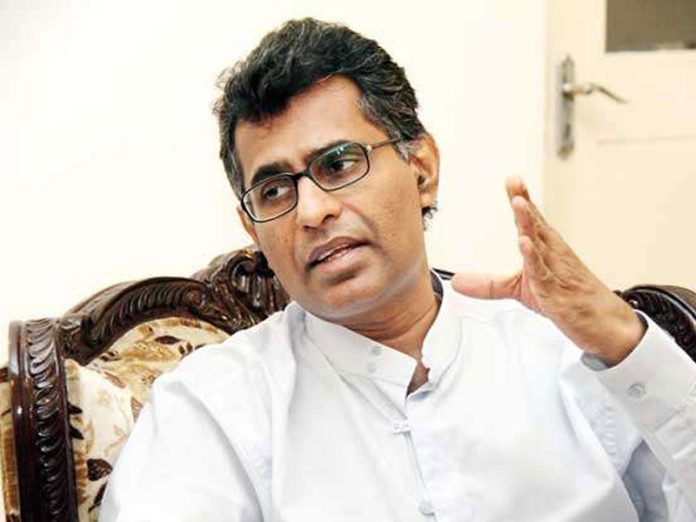
… reminds AKD led over 560 protests during Yahapalanaya
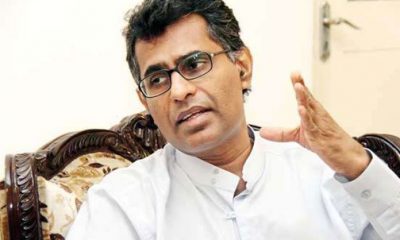
Former Yahapalana Minister and United Republican Front (URF) leader Patali Champika Ranawaka yesterday (19) alleged that the JVP, which carried out over 560 protests during the 2015-2019 period, was now bent on preventing the Opposition from exercising its democratic right to protest.
Recalling the declaration made by the JVP at the height of the violent protest campaign in July 2022 that it would set the Parliament ablaze, the former parliamentarian lashed out at the JVP-led administration for using the police excessively to curb political opposition. Ranawaka said this while addressing the media at the former President Ranil Wickremesinghe’s Flower Road Office .
Commenting on the protest campaign launched by the Maha Sangha, demanding presidential pardon for General Secretary of the Bodu Bala Sena (BBS) Ven. Galagotaatte Gnanasara, the ex-Colombo District lawmaker alleged that President Anura Kumara Dissanayake used a combination of police, investigative units and JVP cadres to break up the monks’ protest. The government went to the extent of compelling the JVP/NPP-run Colombo Municipal Council (CMC) to deprive the peaceful protesters of basic toilet facilities, he alleged.
The government’s actions proved that only those with prior approval from JVP Pelawatte headquarters could launch protests in Colombo, its suburbs or in the provinces. The police have become a political tool in the hands of the JVP, the ex-Minister said. (SF)

By SK Samaranayake
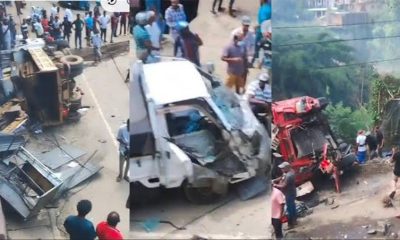
Six people were killed and seven others injured when a speeding bulker lorry carrying cement and concrete ploughed into several vehicles and a shop on the Kandy-Jaffna A9 road at Kurugoda, Akurana, yesterday (19).
Four of the victims, two women and two men, died on the spot in the accident which occurred around 10.30 am, according to Alawathugoda Police.
Police said the bulker, travelling at high speed from the Matale direction, collided with three three-wheelers, two motorcycles and two lorries before veering off the road and crashing into a commercial establishment.
Five of the injured were rushed to the National Hospital of Kandy, where hospital sources said two remained in critical condition.
The bodies of the four victims were placed at the Akurana Hospital, where two others, who suffered minor injuries, were also receiving treatment.
The driver of the bulker was arrested by the Alawathugoda Police Traffic Division and is to be produced before court.
Investigations are being conducted under the supervision of Central Province Senior DIG Lalith Pathinayake.

By Shamindra Ferdinando
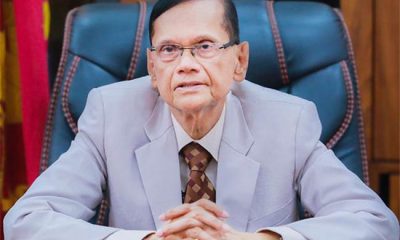
owledging that there had been an administrative lapse on the part of the President’s Office in 2019 when Maithripala Sirisena granted presidential pardon to Ven. Gnanasara Thera, Convener of Janathawadi Joint Opposition Prof. G.L. Peiris yesterday (19) urged President Anura Kumara Dissanayake to rectify whatever those shortcomings and release the General Secretary of Bodu Bala Sena.
Addressing the media at the former President Ranil Wickrekmesinghe’s Flower Road Office, Prof. Peiris emphasized that it was not fair to hold Ven. Gnanasara accountable for lapse or technical fault of others at the Presidential Secretariat during President Sirisena’s tenure.
Prof. Peiris was flanked by UNP Chairman Wajira Abeywardena and United Republican Front (URF) leader Patali Champika Ranawaka.
The fresh appeal was made on behalf of Ven. Gnanasara in the wake of President Dissanayake and JVP heavyweight Anura Kumara Dissanayake ruling out fresh presidential pardon for the monk. Minister Lal Kantha declared that the government couldn’t under any circumstances meet the continuing monks’ protest demanding Ven. Gnanasara’s release. President Dissanayake dismissed repeated appeals for Ven. Gnanasara’s release when he addressed the NPP really in Badulla.
Sirisena granted presidential pardon in May 2019 even before he completed a year of his six-year term of rigorous imprisonment for contempt of court during proceedings of the media personality Prageeth Ekneligoda’s 2010 January disappearance in the Homagama Magistrate’s court.
At the onset of the regular weekly briefing, Prof. Peiris said that he would report to the Commission to Investigate Allegations of Bribery or Corruption (CIABOC) today (20) morning as requested by the commission. “The CIABOC wanted to record my statement regarding a meeting I chaired at the ministry after the conclusion of the war in 2009 pertaining to an ongoing investigation.”
Commenting further on the imprisonment of Ven. Gnanasara, the former parliamentarian said that President Sirisena intervened following a spate of requests made on behalf of BBS General Secretary by the Mahanayakes, Anunayakes and other Maha Sangha.
The Supreme Court on 10 September, 2026 rescinded the presidential pardon granted in late May 2019.

Heavy showers about 100 mm are likely at some places in the Northern, North-central, Central, Eastern, North-western and Uva provinces

Molineux, Dunkley enter WPL 2027 auction with top base price of INR 50 lakh

Ranawaka accuses govt. of using JVP cadres and police to suppress political opponents

Six killed as speeding bulker crashes into vehicles, shop in Akurana

Prof. Peiris, summoned by CIABOC, appeals for Ven. Gnanasara’s release

Tusker Agbo found safe and in good health

‘Dates have the highest sugar content to fight Coronavirus’

Sunday Island 27 December – Headlines

#SundayIsland 17th December – Headlines

Sunday Island – 28th March

Sunday Island Headlines – 21 March

Sunday Island – 21st February – Headlines
-

 Latest News7 days ago
Nissanka’s return headlines Sri Lanka’s Test squad against Pakistan
-

 Features2 days ago
Kotahena:A Small Enclave, An Extraordinary Legacy
-

 News6 days ago
Sri Lanka, India caught in US-Iran ship crisis
-
 Latest News7 days ago
Imran Khan’s PTI braces to fight federal takeover of Khyber Pakhtunkhwa
-
 News3 days ago
Asgiri Mahanayake calls for immediate release of Gnanasara Thera
-

 Latest News6 days ago
Missiles intercepted near Riyadh after Saudi coalition hits Yemen fuel depot
-
 Latest News6 days ago
Kusal Mendis’ unbeaten 87 hands Sri Lanka consolation win
-
 News5 days ago
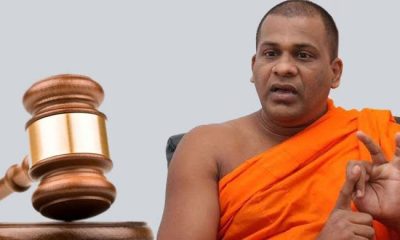
AC President recuses himself from hearing prison attire case pertaining to Gnanasara Thera