
Latest News
Tiny possum and glider thought extinct for 6,000 years found in remote West Papua


A tiny possum with one extra-long finger on each hand is one of two species thought to have been extinct that have been discovered in West Papua, in what’s been called an “exceptional” scientific discovery.
The other is a a ring-tailed glider with a tail that can grasp branches. Both have been found living in remote rainforests after they were thought to have disappeared 6,000 years ago.
Finding living examples of a lost species is rare, but discovering two is “remarkable,” say scientists who published their findings in the Records of the Australian Museum journal on Friday.
Such discoveries are known as “lazarus taxon”, a term inspired by a biblical figure who was raised from the dead.
“The discovery of one lazarus taxon… is an exceptional discovery,” said Prof Tim Flannery, a prominent Australian scientist best known for his 2005 The Weather Makers book about climate change.
“But the discovery of two species, thought to have been extinct for thousands of years, is remarkable.”
The first rediscovered species was the pygmy long-fingered possum, a striped marsupial weighing about 200g, which is understood to have vanished from Australia during the Ice Age.
A distinguishing feature is that on each hand, the possum’s fourth finger is twice the length of other digits, which scientists say help it dig out wood-boring insect larvae, it’s main source of food.
The second species is the ring-tailed glider, and just like its Australian cousin the greater glider, it lives in the hollows of tall trees.
The discoveries were made by piecing together parts of a puzzle with scientists combing through decades-old fossils, rare photos and old specimens to gather clues before making visits to remote New Guinea locations.

Flannery, along with another of the paper’s co-authors Prof Kris Helgen and researchers from the University of Papau, spoke to local elders from the Tambrauw and Maybrat clans – some of whom have only had contact with the modern world since the 1960s.
Identification of the species would not have been possible without their help, according to Rika Korain, a Maybrat woman and another co-author.
“They’re very traditional people,” Flannery added, and regard the glider as so sacred that “not only won’t they hunt it, they won’t mention its name”.
But the gliders habitat was increasingly coming under threat from logging in the area, Flannery said.
This, in part, has prompted efforts by scientists and wildlife groups to try secure native title for the forests to ensure logging cannot be carried out without consent from locals, he said.

(BBC)

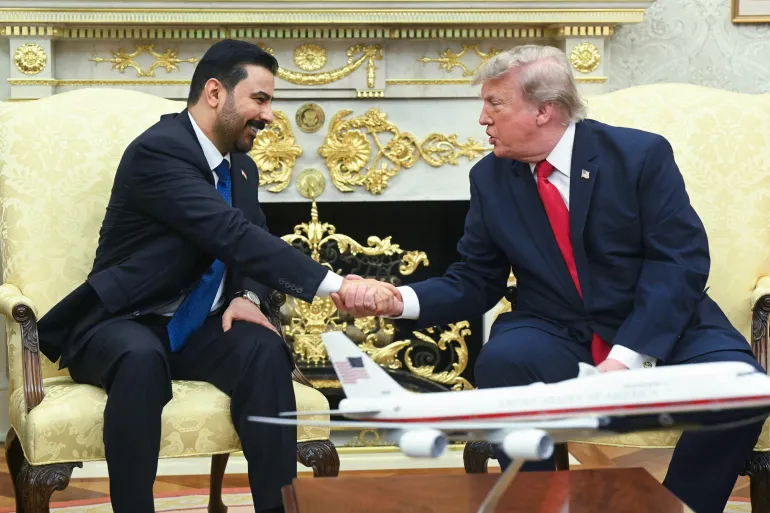
United States President Donald Trump and Iraqi Prime Minister Ali al-Zaidi have met at the White House in Washington, DC, with both leaders pledging to deepen economic ties and boost Iraq’s oil output.
The meeting on Tuesday came after Trump threw his support behind al-Zaidi, a businessman with no history in politics, and publicly opposed Iraq’s former Prime Minister Nouri al-Maliki for the prime ministerial role earlier this year.
Al-Maliki, a divisive figure seen as having close ties to Iran, subsequently dropped out of contention in April.
The Iraqi government had previously said it expected several oil and gas agreements to be signed during al-Zaidi’s visit to the US, with Trump also vowing a raft of deals during the Oval Office meeting.
He called al-Zaidi “a fantastic champion, a new champion”.
“Iraq has tremendous potential because of their oil and because of other things, but because of their oil, and we’re going to be doing a lot of deals,” Trump said.
“We’re going to create a lot of jobs for both countries, and we’re going to be taking out a lot of oil. A lot of oil is coming out,” he said.
Al-Zaidi, meanwhile, said the “visit was not like any other visit”, calling it the beginning of an “economic partnership”.
He said US-Iraqi relations were shifting from militaristic to economic.
Both he and Trump said the remaining US forces in Iraq, believed to number fewer than 2,000, would completely withdraw from Iraq by September 30. That is the same date al-Zaidi pledged that armed factions active across Iraq would disarm.
Iraq has long contended with the competing influences of Tehran and Washington in its domestic politics, with tensions over the continued US troop presence, deployed amid the conflict with ISIL (ISIS), and the pull of Iran-aligned armed groups.
In his first speech in parliament as prime minister, al-Zaidi vowed to disarm the country’s varied paramilitary groups, which have wielded power since the 2003 US-led war on Iraq.
He has not said how he will achieve the ambitious goal. Shortly before his departure, the Islamic Resistance in Iraq, an umbrella group of Iran-backed armed groups in the region, including Iraq, said it would reject any outcomes of al-Zaidi’s visit.
Iraq has also been one of several fronts in the US-Israeli war with Iran that began on February 28, with the conflict looming and its recent escalation looming large during al-Zaidi’s visit.
Iraq’s economy has also been particularly hard hit by Iran’s effective closure of the Strait of Hormuz, with about 90 percent of its 3.4 million barrels per day of fossil fuel exports passing through the water.
The recent fighting has thrown into question the future of a memorandum of understanding (MoU), which in June beckoned in a temporary end to the fighting, the opening of the Strait of Hormuz, and the lifting of a US naval blockade on Iran.
Speaking to reporters at the White House, al-Zaidi also said that Iraq needs a “fair share” from the Organization of the Petroleum Exporting Countries (OPEC).
Iraq has been pushing for a higher quota on its oil production, with al-Zaidi saying the need is a direct result of the destruction caused by the war against ISIL, over which Iraq officially declared victory in 2017.
“The damage suffered by Iraq exceeds $400bn, and to this day, some Iraqis still have destroyed homes and are living in camps,” he said. “I have a plan to return them to their homes, and that is why I want a fair share for Iraq in OPEC.”
[Aljazeera]

Spain snuffed out France’s dream of a third World Cup triumph, taming their galaxy of forwards to win 2-0 and progress to a final against England or Argentina.
Didier Deschamps’ men were hot favourites for the trophy after a string of breathtaking displays in the United States but they met their match against the slick European champions at the semifinal stage on Tuesday.
Mikel Oyarzabal opened the scoring for the 2010 winners with an emphatic penalty in the first half in Arlington, Texas, and Pedro Porro doubled their lead in the second half.
Shell-shocked France could not find a way back into the match despite their wealth of attacking riches.
The game at the Dallas Stadium caught fire midway through the first half when Salvadoran referee Ivan Barton pointed to the penalty spot after a reckless challenge by France left-back Lucas Digne on Spain winger Lamine Yamal.
Oyarzabal hammered the ball past France goalkeeper Mike Maignan for his fifth goal of the World Cup to leave France trailing for the first time in the tournament.

Minutes later they suffered another blow when centre-back William Saliba had to leave the pitch after a recurrence of his lower back injury, replaced by Crystal Palace defender Maxence Lacroix.
Spain went agonisingly close to extending their lead after some dazzling one-touch football but Dayot Upamecano’s challenge denied Fabian Ruiz.
France finished the half without a single shot on target, and just two attempts overall.
Deschamps threw on Desire Doue for Bradley Barcola in the 57th minute in a bid to supercharge his attack but a minute later they were 2-0 down after a stunning team goal for Luis de la Fuente’s men.
Defender Porro delivered a sharp pass to the feet of Dani Olmo on the edge of the box and collected the return ball before coolly slotting past Maignan.
(Aljazeera)
Latest News
S. N. B. M. Patdmasiri appointed Director General of the Department of Government Factories

The Cabinet of Ministers approved the resolution furnished by the Minister of Housing, Construction and Water Supply to
appoint S. N. B. M. Patdmasiri who is a Special Grade officer in Sri Lanka Engineering Service and currently serving at the Department as the Additional Director General to the post of Director General of the Department of Government Factories with immediate effect.

Trump meets Iraq PM at White House, promises ‘a lot of deals’

A few showers may occur in the Western, Sabaragamuwa and North-western provinces and in Kandy, Nuwara-Eliya, Galle and Matara districts

Negombo Prison riot: No convicts among 21 inmates killed

2026: 128 elephants killed in first four-and-a-half months

Sigiriya Jungles marks 10 years with community medical camp

Protests continue in Valikamam North demanding military-held land

‘Dates have the highest sugar content to fight Coronavirus’

Sunday Island 27 December – Headlines

#SundayIsland 17th December – Headlines

Sunday Island – 28th March

Sunday Island Headlines – 21 March

Sunday Island – 21st February – Headlines
-

 News5 days ago
Herath warns prospective migrant workers not to get fleeced by racketeers
-

 Features3 days ago
Prison riots and politics: NPP’s biggest challenge and Sri Lanka’s biggest opportunity
-

 Editorial4 days ago
What’s the world coming to?
-

 Foreign News5 days ago
Tensions erupt in Indian state after 11-year-old raped and murdered
-

 Features5 days ago
Devanesan Annan – in Memoriam
-

 News6 days ago
Negombo Prison riot: Ensuring protection of prisoners fundamental responsibility of the state – UN
-
Editorial5 days ago
Punishment in hellholes
-
 News6 days ago
Representatives of the Organization of Professional Associations (OPA) of Sri Lanka meet the Prime Minister