
Life style
Time to end Santa’s ‘naughty list’?

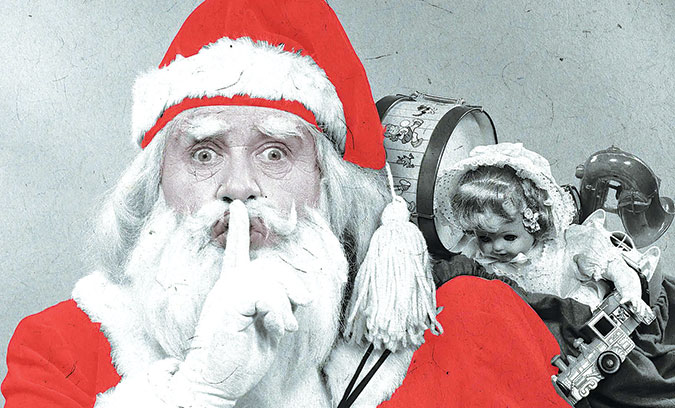
Many of us have magical memories of Santa secretly bringing gifts and joy to our childhood homes – but is there a darker side to the beloved Christmas tradition?
“You better watch out, you better not cry, you better not pout, I’m telling you why, Santa Claus is coming to town.”
And don’t I know it! This is the first year that my three-year-old daughter has fully immersed herself in the mythology of Santa. As she tells me just how Old Saint Nick is going to fit down our chimney, I can see a glint of pure wonder in her eyes that immediately transports me back to my own childhood Christmases.
I was – and I’m happy to admit it – a full-blown believer. I absolutely loved the magic of Christmas, especially Santa Claus, and my parents went, let’s say, above and beyond to encourage it. On Christmas morning I would tiptoe downstairs to find the fireguard ajar, the remnants of a hurriedly-eaten mince pie on a plate, a reindeer-chewed carrot and a tissue with a red smudge where Santa had clearly polished Rudolph’s nose (definitely not my Mum’s lipstick). The evidence was, as far as I was concerned, insurmountable.
However, as I begin to construct my own Santa Claus myth for my daughter I can’t help but feel pangs of guilt. Could fuelling her belief in all this festive magic in some way undermine her trust? In moments of exasperation, I can hear myself invoke the threat of the “naughty list” and I see a sudden flash of fear across her face. It’s made me wonder what kind of Santa I want to create for my daughter and, to be honest, whether I should be doing it at all.
Fascinatingly, although the modern world feels like it has been stripped of so much of its magic, belief in Santa Claus has remained remarkably consistent. Back in 1978, a study published in the American Journal of Orthopsychiatry found that 85% of four-year-olds said they believed in Santa. More than a quarter of a century later, in 2011, research published in the Journal of Cognition and Development found that a very similar 83% of 5-year-olds claimed to be true believers. And that is despite Google Trends showing that the search term “is Santa real” spikes every December.
I guess it’s not all that surprising. The cultural evidence we create as a society for the existence of Santa certainly stacks up. He features in every Christmas TV show and movie, he’s camped out in strange little sheds in every shopping centre we visit. Each year the North American Aerospace Defence Command (NORAD) allows you to track Santa’s journey on Christmas Eve. To reassure children during the pandemic in 2020, the World Health Organisation issued a tongue-in-cheek statement declaring that Santa was “immune” from Covid 19. To be honest, there’s more evidence for Santa’s existence out there than my own, which is almost enough to trigger a mild existential crisis.
And it’s precisely this effort on behalf of parents, and society in general, to create such seemingly overwhelming evidence for the existence of Santa Claus that David Kyle Johnson, a professor of philosophy at King’s College in Pennsylvania, describes as “The Santa Lie” in his book The Myths That Stole Christmas.
“When I say ‘The Santa Lie’, I am not referring to the entire mythos of Santa Claus, I am referring to a particular practice within that myth: Parents tricking their children into believing that Santa Claus is literally real,” says Johnson. He highlights how we don’t simply ask children to imagine Santa, but rather to actually believe in him. It’s this emphasis on belief over imagination that Johnson sees as harmful.
“I definitely think it can erode trust between a parent and a child, but I think the biggest danger is the anti-critical thinking lessons that they are teaching,” says Johnson. “Parents who are especially dedicated to ‘The Santa Lie’ will perform feats of insanity to ensure their children keep believing.”
This brings a flash back to my childhood, where at eight-years-old I wrote a letter to Santa probing the logistics of his yearly mission, only for my Dad to write back in his best “olden times” handwriting, covering the reply in sooty fingerprints (probably whilst gnawing on a raw carrot). My colleague Rob shared that his Mum apparently found the carrot a particularly disgusting part of the Christmas Eve ritual.
For Johnson, it is this creation of false evidence and convincing kids that bad evidence is in fact good evidence that undermines the kind of critical thinking we should be encouraging in children in this era of fake news, conspiracy theories and science denial. “The ‘Santa lie’ is part of a parenting practice that encourages people to believe what they want to believe, simply because of the psychological reward,” says Johnson. “That’s really bad for society in general.”
When magic is no longer the answer, children start to gather evidence – Cyndy Scheibe
Interestingly, there are some experts, however, who argue that believing in Santa Claus can actually encourage critical thinking in children. It hinges on how parents support them in the process of eventually discovering and accepting the truth. Cyndy Scheibe, professor of psychology at Ithaca College in New York, and an expert in media literacy, has been researching children’s belief in Santa Claus since the 1980s. She has conducted research in three different time periods and found surprisingly consistent results each time.
“Kids start to ask questions around four or five, and then really start to have doubts around the age of six,” says Scheibe. Each time she conducted her research Schiebe found the same thing, that the average age children stop believing in Santa was between seven and eight. However, it is very rarely a sudden thing. “I found that that process seemed to take about two years for kids to navigate through.”
Scheibe explains that this transition period, of between seven and nine years old, makes sense because it aligns with the ages when children go from being so-called “pre-operational thinkers” to “concrete operational thinkers”. Swiss psychologist Jean Piaget developed these terms to explain how children gradually build up their understanding and knowledge of the world. At the pre-operational stage, a child’s idea of the world is mainly shaped by how things appear, rather than by deeper logical reasoning. But that changes as children begin to probe and question the things they see or hear. “A concrete operational thinker wants evidence,” Scheibe says. “They begin to mature cognitively, where the story doesn’t make logical sense and magic is no longer the answer. Then they start to gather evidence.”
And it is at this stage that Scheibe says parents need to be led by their children, in order to help them develop their critical thinking skills. “They function as little scientists, testing out hypotheses and gathering data to figure out what’s true and what’s not,” Schiebe says. This is something parents can encourage through asking careful questions. “In media literacy it’s all about asking questions. What do you think? How could we really find out? Why do you think people do that?” Scheibe explains.
My colleague Amy told me about the evidence that triggered the end of her belief in Santa Claus when she was around seven: “I recognised my mum’s handwriting on the label and was totally shocked!”. However, Amy said she doesn’t remember feeling hurt or betrayed by the discovery. Rather, “it made me feel like a grown-up and that I understood something about the world”.
Amy’s experience tallies with research published in Child Psychology and Human Development that found children generally discovered the truth about Santa on their own at the age of seven and reported “predominantly positive” reactions to discovering this. However, the study showed parents, on the other hand, fared less well, describing themselves as “predominantly sad” in reaction to their child’s discovery.
And herein lies the major issue for both Johnson and Schiebe: It’s not so much children but rather their parents who refuse to let go of Santa Claus.
Schiebe describes how throughout her decades of research the only times she saw belief in Santa become “problematic” was when parents continued to perpetuate the belief beyond the time the child was ready for the truth. “I think that one problem is kids are ready to hear the truth, but you’re not ready to let go of the truth, and you’ve got to let go of the truth,” Scheibe says.
As a father I can understand the draw of keeping hold of the Santa mythology for as long as possible. On the one hand it feels like it’s a way of stopping them growing up too fast, of protecting an element of their innocence somehow. On the other hand, Santa has, for many parents – and I include myself in this – become a quick-fix for managing behaviour with his infamous “naughty list”.
The idea that Santa is watching all of the time can be quite a frightening concept for children – Rachel Andrew
It’s always been the part of the Santa Claus myth that I have found the most uncomfortable. His presence as a sort of festive Big Brother, an all-seeing eye constantly judging your behaviour as either “naughty” or “nice”. And recently this element of the mythos has gained a whole new lease of life, with Elf on the Shelf – described on its own website as “Santa’s scout elf” – supposedly reporting behaviour back to Santa, and even fake CCTV “Santa cams” that parents can install to hammer home the message that you are never not being watched. In many ways it feels Santa has become a working model for Foucault’s panopticism – a form of internalised surveillance and self-monitoring that no longer requires external enforcement.
“For a lot of children Santa can be quite a scary figure. That idea that he is watching all of the time can be quite a frightening concept,” says Rachel Andrew, a clinical psychologist specialising in child and family psychology. Andrew believes using Santa’s “naughty list” as a behaviour management tool is flawed in numerous ways. “Having children believe they are on an imaginary naughty list for behaviour they have done over, what, an entire year? Three or four months? It’s so far against what we know is likely to encourage positive behaviour in our children,” Andrew says.
For Andrew, the way parents use Santa for discipline is too vague for children to really understand what we are asking of them, and the time frames are often so broad it is unattainable.
“One of the issues might be that the discipline is not coming from you as a parent. You’re giving it away to somebody who is outside of your own family home,” says Andrew. This can open up the potential that your child doesn’t see you as the person they need to change or monitor their behaviour for. Also, Andrew sees the age-old threat of Santa not delivering toys to naughty children as realistically unenforceable. “It’s not proportionate to any behaviour that a child is going to do, that they might lose all their Christmas gifts. And I haven’t met a child yet who’s not had any gifts due to their behaviour. It’s unlikely any parent is going to follow it through, so it is also an empty threat.”
There’s another uncomfortable by-product of Santa making a list and checking it twice to find out who’s been naughty or nice: it builds an idea that gifts are a measurement of their moral worth.
“We have so many ways that we perpetuate the idea that people get what they deserve,” says Philip N Cohen, professor of sociology at the University of Maryland, College Park. “You’re telling [children] that the presents they get are a function of the quality of their goodness, which just seems a harsh lesson in a world with so much inequality.”
Cohen wonders what happens when children’s belief in Santa intersects with their increasing awareness of the inequality around them, especially at an age when they may be looking for explanations for that inequality. “Do you have seven-year-old kids who can see inequality all around them who still believe that Santa gives you presents based on your moral worth?” Cohen asks. “That would be teaching well-off children that they’re getting what they deserve, because they’re good, and the poor children are getting what they deserve, because they’re not good. That just seems like a corrosive lesson for them.”
As the cost of living crisis bites this Christmas, this feels a more relevant issue than ever. Scheibe believes that one way to combat this is to share out Santa’s gift giving responsibilities. “There are some families in which all the gifts come from Santa. Personally I think that’s a mistake,” Scheibe says. She argues that children should be more involved in the process of gift giving at Christmas. “Have Santa Claus be a piece, but also it’s about more than that, it’s about giving and receiving and you can get kids involved in that pretty early.”
So, as my daughter sits down to watch another episode of The Santa Clauses, what kind of Santa is it that I want to create for her?
I think I definitely want to be careful that I don’t try to stray too far from playful imagination into literal belief. I certainly want to burn the “naughty list” – I’d like her Santa to be more Gandalf, less all-seeing Eye of Sauron. And as she gets older I hope I am prepared to let go of the truth when she is ready for me to, and to encourage her in that journey of discovery. Although I don’t believe that means letting Santa go, but rather just initiating a new Santa to the club.
A perfect example of this is what Schiebe told me happened when her own daughter stopped believing: “I said: ‘So now that you know the truth, you get to be Santa Claus, and you know what that means? You can get up in the middle of the night put things in people’s stockings, but you’ve got to make sure nobody sees you, and it’s got to be something you know they want. So then, the next Christmas morning, when I woke up, there were things in my stocking that I hadn’t gotten. The look on her face of how excited she was that she had been able to be Santa Claus, that was just spectacular.”
(Guardian)


Cinnamon Life that has re-defined Colombo’s skyline added another accolade to its journey as it officially received its five star certification placing it among the most distinguished luxury properties in Sri Lanka’s hospitality landscape.
Receiving the five star classification is a significant achievement for any hotel but Cinnamon Life – the flagship of Sri Lanka’s most ambitious integrated lifestyle development, the accolade carries exceptional meaning. The recognition follows a rigorous evaluation of service standards,facilities,and operational excellence,underscoring the property’s commitment to delivering world class guest experiences
– Cinnamon Life at City of Dreams has been officially awarded the esteemed Five-Star Certification by the Sri Lanka Tourism Development Authority (SLTDA), underscoring its status as a landmark in Sri Lanka’s hospitality landscape and a benchmark for excellence in the region.
As South Asia’s largest and first fully integrated resort, Cinnamon Life at City of Dreams represents a transformative investment in Sri Lanka’s tourism and leisure economy. Developed by John Keells Holdings PLC with a historic USD 1.2 billion investment – the largest private development in the country – the resort has reshaped Colombo into a premier destination for luxury travel, entertainment, world-class events, and international business.

The team marks a major milestone with the property’s five star accreditation
A hallmark of the property is its extensive event and convention infrastructure, featuring over 160,000 sq. ft. of versatile, high-spec event space. With five signature ballrooms, cutting-edge technology, and three exceptional outdoor venues offering panoramic views of the ocean and the Colombo skyline, Cinnamon Life has established itself as an unrivalled hub for global conferences, high-profile celebrations, and corporate gatherings for both local and international travellers.
“We are deeply honoured to receive this Five-Star Certification from the Sri Lanka Tourism Development Authority,” said Sanjiv Hulugalle, CEO and General Manager of Cinnamon Life at City of Dreams. “This recognition reflects our unwavering commitment to world-class service, guest centric innovation, and the elevated experiences that define Cinnamon Life. Our aspiration is to set new standards for luxury, leisure, and MICE tourism in the region, while supporting Sri Lanka’s positioning on the global stage.”
The Five-Star Certification further cements Cinnamon Life at City of Dreams as one of Sri Lanka’s foremost luxury destinations. With its two luxury hotels, curated signature dining concepts, immersive entertainment arenas, and a vibrant retail and lifestyle precinct, the resort offers an unparalleled blend of hospitality, lifestyle, and experiences under one iconic address.
The certification was presented at Cinnamon Life, attended by senior leadership from SLTDA and Cinnamon Life, members of the hospitality industry, and media representatives. The event celebrated this milestone achievement and marked a significant step forward in elevating Sri Lanka’s luxury hospitality offering.
About City of Dreams
City of Dreams is Sri Lanka’s largest and most ambitious integrated resort, redefining Colombo’s skyline as a symbol of modern luxury and innovation. Designed as a “city within a city,” the destination offers 800 luxury rooms and suites, with 687 at Cinnamon Life and 113 at NUWA, complemented by a diverse selection of 13 restaurants and bars that showcase global cuisines alongside Sri Lanka’s rich culinary heritage. Adding to its appeal is a vibrant mix of high-end retail, Sri Lanka’s premier entertainment arena, a shopping mall, office towers, and luxury residences. This integrated ecosystem enables delegates to stay, work, meet, dine, shop, and celebrate seamlessly under one roof, delivering unmatched convenience and engagement.

Tiesh jewellery , announced a meaningful partnership with the Infinite Grace Foundation Sri Lanka, an organisation dedicated to transforming lives through love, dignity, purpose, and long-term social impact.
This collaboration marks a significant milestone as two Sri Lankan entities join hands to address some of the country’s most urgent and overlooked challenges, including mental health, drug addiction, prisoner rehabilitation, anti-human trafficking awareness, and the empowerment of estate communities.
Founded on the belief that “Every life deserves to be seen and loved,” the Infinite Grace Foundation symbolises hope, transformation, and inclusion. The Foundation works to extend a lifeline to those often ignored or marginalised, ensuring they are reminded that they are valued, loved, and never alone.
Their vision is deeply aligned to create a Clean Sri Lanka—not only in its physical environment, but in its hearts, minds, and communities. Through systemic intervention, awareness, and rehabilitation, the organisation aims to restore dignity, provide second chances, and help individuals reclaim their potential.
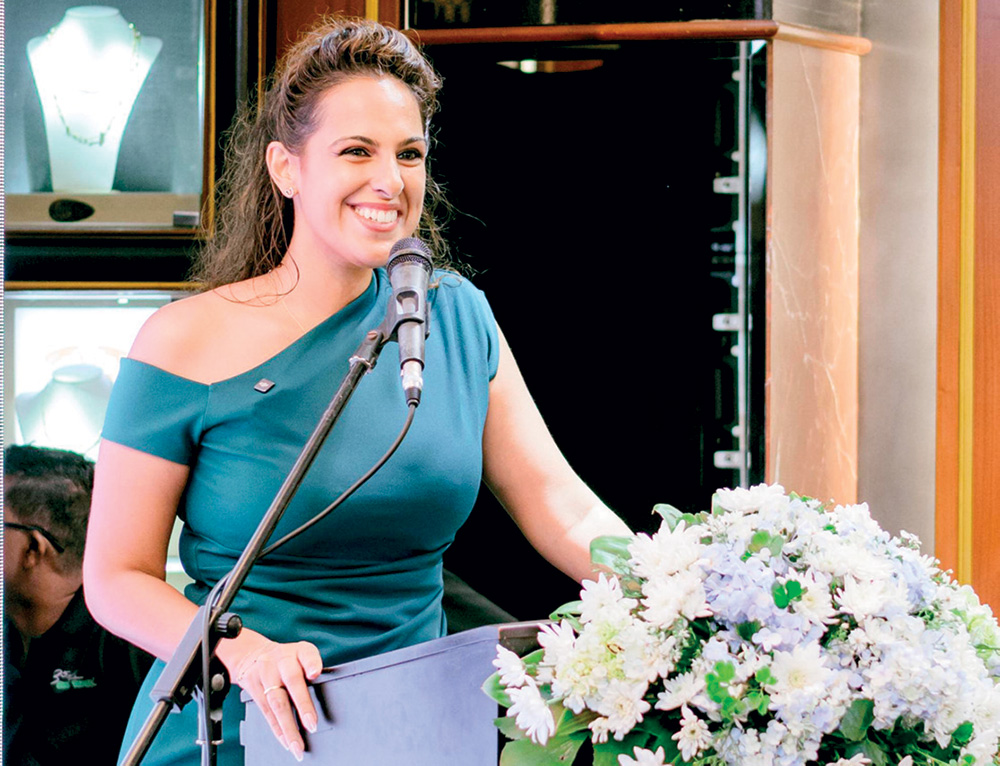
Stephanie Siriwardhana, Founder of the Infinite Grace Foundation and Brand Ambassador for Pure Gold by Tiesh
As part of its awareness and empowerment initiatives, Infinite Grace Foundation has launched the “I See You” campaign—an effort to recognise, support, and uplift individuals who have long been overlooked. Through this campaign, the foundation aims to promote year-round advocacy, encompassing mental health support, panel discussions, and collaborations with organisations and hotlines that support vulnerable groups across the island.
In support of this meaningful initiative, Tiesh has designed an exclusive jewellery collection created with intention and purpose. All proceeds from the collection will be donated directly to the Infinite Grace Foundation. The range features intricately crafted earrings, pendants, chains, rings, and more for women, as well as bracelets, cufflinks, lapel pins, and rings for men. Offered in diamonds, as well as gold and silver, each piece carries a profound message—that every life deserves to be seen, acknowledged, and loved.
With a legacy spanning more than two decades, Tiesh founded by Lasantha and Bryony De Fonseka, has become synonymous with innovation, excellence, and artistry in Sri Lanka’s jewellery landscape. Today, the family-run business is led by the next generation, with Directors Ayesh De Fonseka and Thiyasha De Fonseka continuing to uphold the brand’s commitment to integrity, community, and craftsmanship.
Stephanie Siriwardhana, Founder of the Infinite Grace Foundation and Brand Ambassador for Pure Gold by Tiesh, expressed the impact of this partnership: “This collaboration is special in many ways, and I’m truly grateful that a prestigious jeweller like Tiesh cares about communities that are often unseen—such as prisoners and estate workers. When you change one life, you change a family. When families transform, communities transform, and soon you change the nation. This initiative comes from a personal place. Many people struggle to ask for help, including myself. Through the ‘I See You’ campaign, we aim to provide support, raise awareness, and offer year-round mental health programs, alongside organisations and hotlines that are equipped to help victims and individuals in need. This partnership with Tiesh will be deeply impactful.”
The work of the Infinite Grace Foundation spans multiple critical pillars, including prison reforms, addiction rehabilitation, community education, vocational training, anti-human trafficking awareness, and mental health destigmatisation—all designed to create long-term, sustainable change across Sri Lanka.
Reflecting on the significance of the collaboration, Director of Tiesh, Ayesh De Fonseka, added, “Helping the community is rooted in our beliefs and upbringing. This partnership presented a meaningful opportunity to give back and support an important cause. We believe in second chances, and many individuals need guidance, care, and the opportunity to rebuild their lives. We are honoured to donate all profits from this collection. In the future, we hope to extend support further by offering job opportunities—whether in jewellery craftsmanship, box making, design, or other livelihood pathways.”
Through this partnership, Tiesh and Infinite Grace Foundation reaffirm their shared commitment to building a Sri Lanka where hope thrives, opportunities are equitable, and transformation is within reach for all.
For those wishing to support this initiative or explore the special collection, please visit the Tiesh showroom at 253 R. A. De Mel Mawatha, Colombo 03, or follow Tiesh on social media for updates and campaign information.
Cyclone Ditwah carved a trail of devastation as it roared across many regions, unleashing a deluge that transformed the entire towns into destruction. This is one of the most unforgiving storms in recent years – bringing torrential rains, violent winds and a trail of destruction that left thousands displaced in a matter of hours. Homes swept away, roads disappeared and families were forced to flee.
Yet beneath the chaos and loss, a quiet resilience emerged, communities rallied, rescue teams worked around the clock to restore roads, relocate displaced families and ensure the safety of the tourists.
Now with waters slowly receding, the full story of Ditwah’s impact is only a beginning to unfold – a story of heartbreak, survival and the long road to rebuilding.
Cyclone Ditwah delivered a sharp blow to the tourism sector within hours and days, disrupting travel routes, damaging coastal routes, and forcing authorities to reassess visitor safety. as hoteliers,tour operators,and government agencies worked round the clock to stabilise operations.The industry soon reassured global travellers that the island remains open and resilient.Rescue teams were deployed immediately, working around the clock to evacuate families and restore essential services.
While several areas experienced significant damages, authorities assured that key tourism zones remain safe and operational.
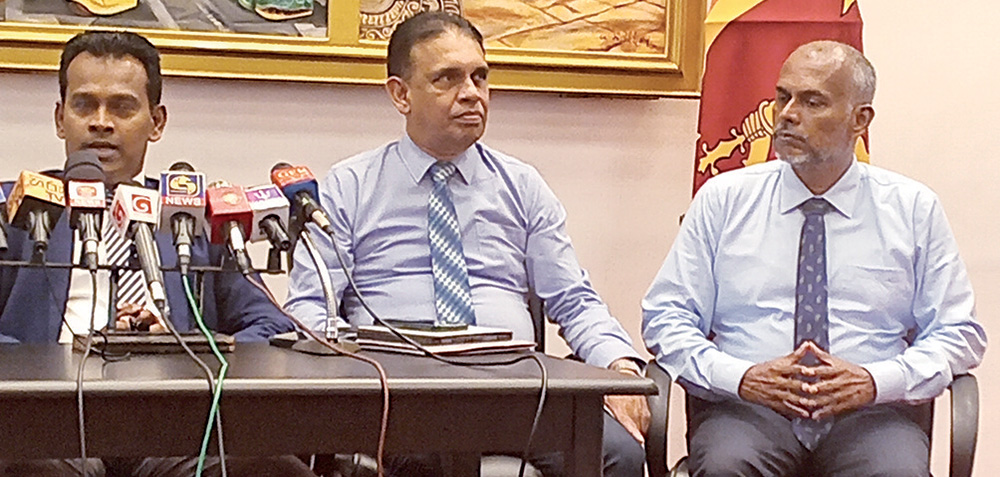
 A press conference was summoned by the Ministry of Tourism and Foreign affairs, last week bringing together top officials, media and other hospitality partners to address growing public concern,assure international travellers and outline the immediate steps taken to ensure safety across all tourist zones. The Deputy Minister of Tourism, Professor Ruwan Ranasinghe and Chairman of SLTPB, Buddhika Hewawasam stepped forward to present a clear,unified message that Sri Lanka remains safe, prepared and committed in protecting the visitors. They calmed anxieties,dispelled myths,rumours and dispelled misinformation and revealed the coordinated efforts of the government to keep the hospitality industry unshaken.
Tourism authorities pointed out even in the aftermath of Ditwah,the arrival of the cruise ship sent a powerful message. the ship’s docking underscored that Sri Lanka is safe . The arrival of this luxury cruise liner carrying hundreds of international passengers, was part of a regional voyage from Mumbai to Singapore. This was a symbolic moment unfolding at the harbour, it was a glimmer of hope in a week overshadowed by stormy clouds. The Tourism authorities reflected this arrival as a sign that confidence in Sri Lanka had not lost hope and showed Sri Lanka is steady,ready,and open.
The Deputy Minister of Tourism Professor Ruwan Ranasinghe in a speech marked by confidence and determination said. “Our teams have worked round the clock to ensure safety, restore access routes and support our travellers”.
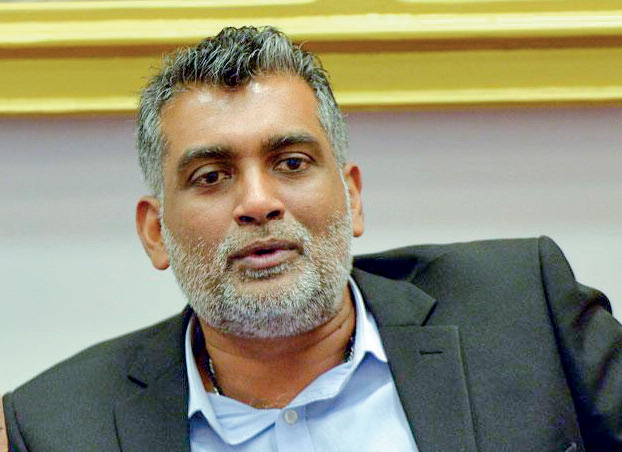
SLTPB Chairman, Buddhika Hewawasam
Today I assured every traveller Sri Lanka is safe, Sri Lanka is open, and Sri Lanka is ready. He confirmed that all major coastal resorts from Negombo to Bentota remain fully operational. Cultural destinations such as Kandy, Dambulla, Kandy,Sigiriya, are now open. He further noted that national parks,including Yala, Udawalawe,Wilpattu had returned operations following rapid assessments. Our key tourist zones are open,accessible and operating under verified safety conditions. He assured that every tourist in the island was safe,
He praised the rescue teams who had worked round the clock, cleaning roads, supporting displaced families and ensuring tourism infrastructure remained intact. To the world I say please come visit, and explore. Our island stands tall and more ready than ever to welcome you. This is not just recovery, he concluded,this is resilience in action. Finally he stressed that Sri Lanka’s tourism sector had demonstrated structural resilience,operational continuity and readiness to maintain international confidence.
The Chairman of the SLTPB Buddika Hewawasam also briefed the media on the ongoing relief operations. He acknowledged the sharp blow and destruction but underscored the country’s resilience. We want to assure travellers that Sri Lanka remains safe. Our teams are on the ground, our infrastructure is being restored and our hospitality sector stands ready to welcome visitors as recovery unfolds.
He said “New the waters have receded, and Sri Lanka is ready to welcome the world. Cyclone Ditwah swept through the island with devastating force, but in its aftermath, a story of resilience, beauty and unwavering hospitality has emerged – one that travellers are invited to witness firsthand”.
For travellers, this is a chance to experience a Sri Lanka that is vibrant and sparkling with life where cultural heritage, natural beauty and warm hospitality blend. Cyclone Ditwah may have left a mark, but it could not dim the island’s radiance.
The Tourism sector is preparing to move forward with renewed emphasis on resilience, safety and rebuilding confidence among international travellers. Sri Lanka has weathered the storm and the world is already sailing back to its shores.

Pramodya Wickramasinghe to head Sri Lanka’s new selection committee

Ramakrishnan Sridhar appointed Sri Lanka’s fielding coach until T20 World Cup

Carey century keeps Australia afloat as Ashes refuses to find slower gear

Ambidextrous spinner Gimhani named in Sri Lanka’s new-look squad for India T20Is

“The future needs leaders who can adapt, learn, and respond to change without losing ethical direction” – Prime Minister

PM’s attention draws attention to the Salary Issue of the Government Translators’ Service

‘Dates have the highest sugar content to fight Coronavirus’

Sunday Island 27 December – Headlines

#SundayIsland 17th December – Headlines

Sunday Island – 28th March

Sunday Island Headlines – 21 March

Sunday Island – 21st February – Headlines
-

 Business6 days ago
Cabinet approves establishment of two 50 MW wind power stations in Mullikulum, Mannar region
-

 News7 days ago
Gota ordered to give court evidence of life threats
-

 Features7 days ago
Cliff and Hank recreate golden era of ‘The Young Ones’
-

 Features7 days ago
Sri Lanka and Global Climate Emergency: Lessons of Cyclone Ditwah
-

 Editorial7 days ago
Experience vs. Inexperience
-

 Features4 days ago
Why Sri Lanka Still Has No Doppler Radar – and Who Should Be Held Accountable
-
 News7 days ago
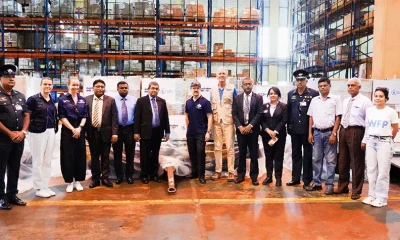
WFP scales up its emergency response in Sri Lanka
-

 Features6 days ago
Ditwah: A Country Tested, A People United