
News
Think tank argues power tariff structure is outdated, inefficient, riddled with distortions

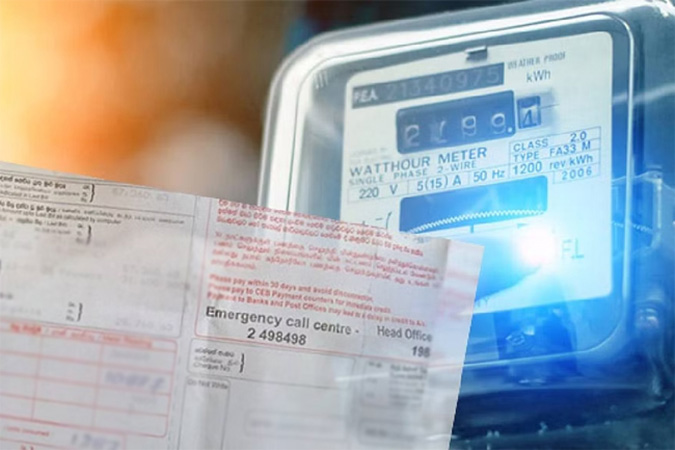
Sri Lanka’s electricity tariff structure is outdated, inefficient, and riddled with distortions that undermine transparency, equity, and economic sustainability, according to a new policy submission by the Advocata Institute.
The Colombo-based think tank has formally proposed a comprehensive overhaul of the current pricing system to the Public Utilities Commission of Sri Lanka (PUCSL), urging reforms that better reflect the realities of electricity generation and consumption.
“Electricity tariffs in Sri Lanka have never made much economic sense,” the report states. “They are full of distortions, cross-subsidies, and based on outdated assumptions.”
Advocata’s proposals emphasise that electricity, unlike many other commodities, is homogeneous, non-storable, and highly time-sensitive in terms of cost. As such, any rational pricing system must be cost-reflective and sensitive to demand fluctuations throughout the day.
The current tariff structure categorises users—such as domestic, industrial, government, religious, and charitable—under different rate schedules. However, these distinctions often lack a clear rationale. The institute notes, for instance, that a restaurant in a hotel may pay a lower rate than an identical establishment in a shopping mall.
Advocata argues for unifying these classifications into a single bulk user category, removing arbitrary differences that penalise modern service industries such as IT and BPO while subsidising less competitive, energy-intensive industries.
The think tank also recommends eliminating special tariffs for religious and charitable institutions, suggesting that any concessions be funded through direct budgetary support rather than through tariff distortions.
Drawing on global best practices, Advocata has outlined five guiding principles for electricity tariff reform:
1. Cost-reflective pricing – Covering generation, transmission, distribution, and system losses.
2. Non-discrimination – Equal treatment for similar consumption patterns, except for targeted subsidies.
3. Time-of-use (TOU) tariffs – Encouraging efficiency by varying rates based on the time of day.
4. Regulatory clarity – Ensuring the PUCSL focuses on pricing and sustainability, while social objectives are met through fiscal transfers.
5. Minimization of cross-subsidies – Promoting transparency by funding social goals via the national budget.
Key reforms proposed by Advocata include:
Expanding TOU pricing across all user categories to encourage off-peak usage and reduce system strain.
Replacing multiple subsidies with a single lifeline tariff targeted at low-income households.
Reforming solar net metering to better reflect time-based costs, supporting grid stability.
Avoiding penalties on remote work, which benefits the broader economy through reduced congestion and emissions.
Introducing spot market pricing for bulk users, akin to Singapore’s Energy Market Company model.
Advocata urges greater transparency from the Ceylon Electricity Board (CEB), recommending the publication of detailed quarterly cost breakdowns—including generation, transmission, distribution, and administrative expenses—as well as all major procurement contracts.
The think tank also calls for performance-based incentives within the CEB and strict accounting for technical, commercial, and collection losses, all of which should be minimized before being factored into tariff calculations.
“Distorted tariffs don’t just cause financial losses—they misallocate capital, confuse consumers, and stifle innovation,” Advocata said. It argues that electricity should not be used as a vehicle for hidden welfare programs. Instead, social equity should be ensured through transparent, direct fiscal transfers from the Treasury.
Advocata urges the PUCSL to:
Eliminate discriminatory pricing while preserving a targeted lifeline tariff for the poor.
Implement TOU tariffs broadly and introduce real-time pricing for large users.
Ensure complete cost transparency through independent audits of the CEB.
Avoid using tariffs for redistribution, leaving that responsibility to the government’s fiscal authorities.
“These reforms are essential to ensure the long-term sustainability of Sri Lanka’s electricity sector, attract investment, and align with global best practices,” the think tank stated.

Latest News
Landslide Early Warnings issued to the districts of Kalutara, Nuwara Eliya and Ratnapura


The Landslide Early Warning Centre of the National Building Research Organisation (NBRO) has issued early warnings to the Districts of Kalutara, Nuwara Eliya and Ratnapura from 1600hrs on 13th June 2026 till 1600hrs on 14th June 2026.
Accordingly,
LEVEL I (YELLOW) landslide early warnings have been issued to the Divisional Secretaries Divisions and surounding areas of Palindanuwara and Agalawatta in the Kalutara district, Ambagamuwa in the Nuwara Eliya and Ayagama, Pelmadulla,
Godakawela, Elapatha, Kalawana, Ratnapura and Nivithigala in the Ratnapura district.

The Indian Naval Ship (INS) ‘Sharda’ departed the island today (13 Jun 26), concluding her replenishment purposes.
On departure the vessel was accorded a traditional naval farewell by the Sri Lanka Navy at the Port of Colombo.
The visit also paved the way for vibrant personnel interactions, fostering camaraderie and goodwill. The crew of INS Sharda and personnel from the Sri Lanka Navy participated in a
friendly volleyball match and a joint yoga session. A
dditionally, Sri Lanka Navy personnel had the opportunity to visit the Indian naval vessel, while the visiting crew took time to explore several culturally significant landmarks across the island.
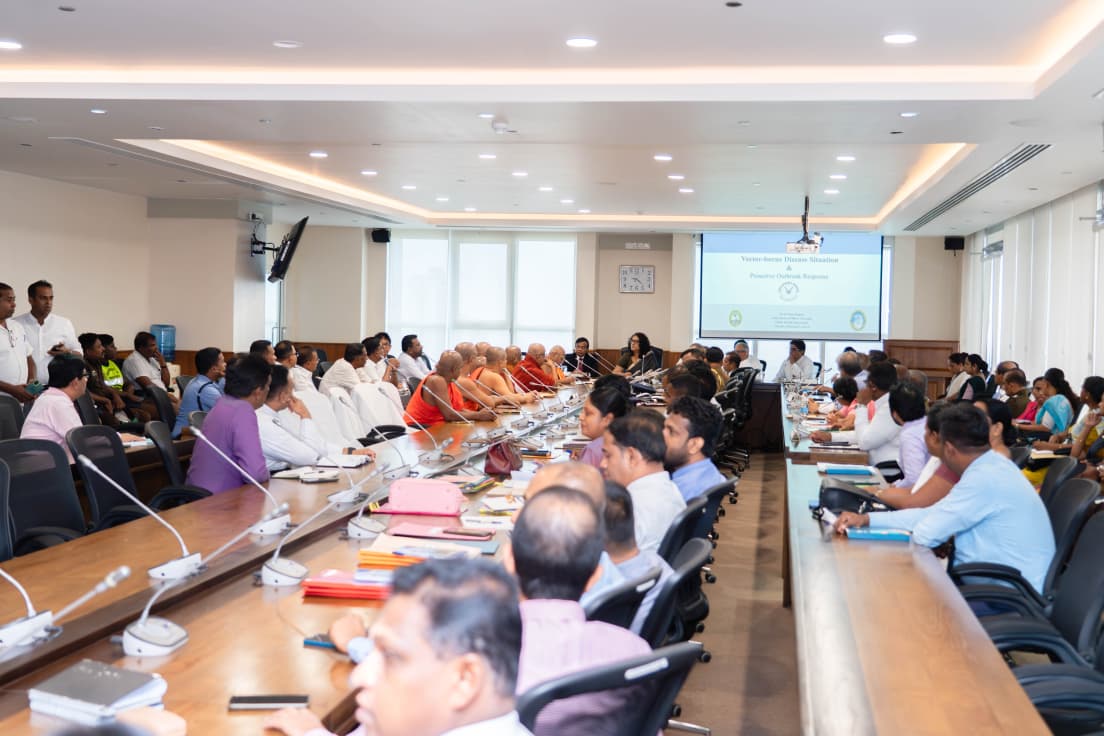
A decision has been taken to declare a Special Dengue Prevention Week from 15 to 21 of June by the Colombo District Dengue Control Committee to curb the spread of the disease in the Colombo District.
This decision was taken at the meeting of the Colombo District Dengue Control Committee held on Friday (12) at the Colombo District Secretariat under the patronage of Prime Minister Dr. Harini Amarasuriya.
Compared to last year, the number of dengue cases reported this year has increased significantly. According to the National Dengue Control Unit, approximately 39,100 dengue cases have been reported island wide to date, of which 25.8% have been recorded in the Colombo District. Following this situation, the Colombo District has been identified as a high-risk district.
Health authorities informed that the increasing spread of the disease has been influenced not only by the nature of circulating virus but also to the lack of sufficient immunity among the population. They further noted that the recent period of heavy rainfall has aggravated the spread of Dengue.
It was also identified that the current outbreak is being reported more frequently from public places such as government institutions, private establishments, schools, and religious venues rather than from residential premises. Observations have identified improperly managed solid waste and drainage systems in offices and other public locations as major breeding grounds for mosquitoes.
Accordingly, during the Dengue Prevention Week from 15 to 21 June, a series of measures will be implemented, including, organising community clean-up campaigns in government and private institutions, schools, residential areas, and other public spaces; Conducting inspections of high-risk premises by Divisional Secretariats and taking legal action, where necessary, followed by awareness programmes; Distributing informational leaflets, displaying banners, and carrying out public awareness campaigns through the media. Health authorities also requested school administrations not to involve students below Grade 10 in school cleaning programmes and to immediately notify the relevant Medical Officer of Health (MOH) office if a student is diagnosed with dengue.
The programme is expected to receive the active support and participation of the district’s political leadership, religious leaders of all faiths, public officials, local government institutions, the tri-forces, the police, and the general public.
The event was attended by the Chairperson of the District Coordination Committee, Members of Parliament, representatives of local government authorities, government secretaries, police officers, and officials representing the education and health sectors, among others.
[Prime Minister’s Media Division]

Mismatch in batting firepower could dictate the outcome again

Landslide Early Warnings issued to the districts of Kalutara, Nuwara Eliya and Ratnapura

INS Sharda departs Colombo concluding replenishment visit

Special Dengue Prevention Week declared in Colombo District from June 15 to 21

The leader of the indigenous Vedda community Uru Warige Wannila Aththo Meets Prime Minister Dr. Harini Amarasuriya

SpaceX IPO debuts in US markets, Musk becomes world’s first trillionaire

‘Dates have the highest sugar content to fight Coronavirus’

Sunday Island 27 December – Headlines

#SundayIsland 17th December – Headlines

Sunday Island – 28th March

Sunday Island Headlines – 21 March

Sunday Island – 21st February – Headlines
-

 News7 days ago
Women’s T20 World Cup 2026 warm-up: Chamari Athapaththu’s 94 helps Sri Lanka beat Pakistan
-

 News7 days ago
Lankan-Canadian inducted to Toronto Sports Hall of Fame
-

 Editorial6 days ago
Probe Sallay’s complaint
-
 News4 days ago
Local firms move millions of dollars overseas for phantom imports: Govt.
-
 News2 days ago
CIABOC summons Yoshitha over his participation in British Navy training programme
-

 Editorial7 days ago
Prez in the dock
-

 Features7 days ago
Entering MIT for my Ph.D program, coping with harsh Boston winter and breasting the tape
-
 Midweek Review4 days ago
July 09: An inexcusable overall security failure and exceptional contingency plan