
Features
The likely Fourth Wave: Impending doom

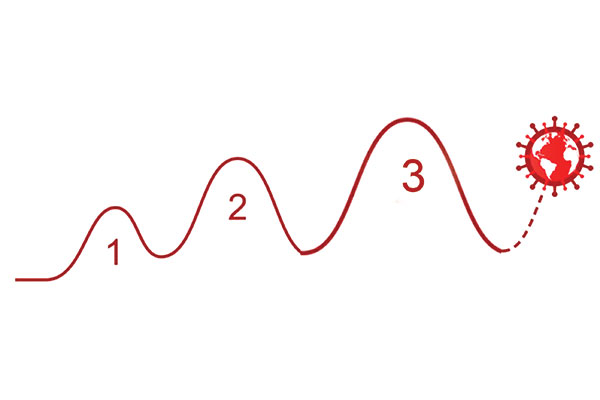
COVID-19 has had us in its vice-like grip for over a year. It was, and still is, a pandemic that was able to inflict many a telling blow to this resplendent Motherland of ours. We have had violent cluster spread of the disease, and to all intents and purposes, bar the shouting, there is community spread in many areas of the country. We have gone through a recent debilitating ‘lockdown’ from June 2021 with all kinds of restrictions and now the powers-that-be have decided to ease quite a lot of restrictions as of mid-July 2021. The vaccination drive is chugging along at unprecedented levels, with the available vaccines, but adequate tranches of supplies are brought into the country in fits and starts. The country, borders are to be opened, gatherings are to be permitted; albeit with some restrictions, liquor bars and clubs have opened, restaurants are allowed to start serving their customers, many businesses would be functional and limited attendance at social events are to be permitted. There are plans to open schools for the children in the near future, too. All these have been undertaken with the proviso that the populace adheres strictly and scrupulously to the health guidelines of avoiding unnecessary gatherings of people, wearing of protective face-masks, stringent washing of hands and keeping a social distance of over one metre. To all and sundry, a new era is on the horizon.
Yet for all that, there are very many major, quite worrying and real concerns for the medical fraternity. New cases are being detected in significant numbers, every day, and deaths have remained quite recalcitrant. The vast majority of these unfortunate deaths are in the elderly, mostly with other already existent co-morbid diseases. True enough, all these numbers have shown some degree of abatement over the last couple of weeks but not in a way that implies that we could assume a profound status of complacence. The virus has definitely not gone away nor is it even under reasonable control.
 At the present time our healthcare services are being stretched to the maximum and are on the verge of bursting at its seams. The dedicated Intensive Care Units for treatment of COVID-19 are full and so are the High Dependency Units. Most worrying are the somewhat escalating numbers of symptomatic patients and those who need oxygen therapy, especially over the last week or so. To compound things further, there seems to be some uncontrolled spread of the much-dreaded mutant Delta variant of the virus right round the country.
The million-dollar question is whether we are likely to suffer a Fourth Wave of the pandemic, particularly by the Delta variant? This latter strain is a particularly horrible and brutal one with markedly increased transmissibility from person-to-person, and a nasty tendency to cause more severe complications of the disease. We have seen, and continue to see, the terrible destruction of lives caused by the Delta strain in neighbouring India. All these things are likely to make us wonder ever so seriously about the real possibility of a Fourth Wave of the pandemic; an unfortunate prophecy of impending doom perhaps? We hope and pray that it would not be so but if it does, it is likely to cause further mayhem in the country. All those gains made over the last couple of months would be washed away, just like an angry, vicious and roaring ocean wave would blow away a carefully crafted sand castle on the beach.
As we see it, the only way out of this veritable quagmire and to escape a Fourth Wave is to employ judicious and rigorous transmission control strategies on the virus. The readers may remember that in my article titled “COVID 19: PERHAPS THE FINAL WARNING FOR SRI LANKANS, published in The Island Newspaper on 24th April 2021, yes APRIL 2021, I wrote “It is our most unfortunate duty to warn the general public of the potential and quite imminent threat of a very nasty third wave of the COVID-19 outbreak over the next three weeks or so and the absolutely essential and indispensable need to take all possible precautions to avoid contracting the disease“.
Much as I dislike it, I am forced to say that I told you so. What started around May 2021 is still continuing, in spite of various restrictive control measures that were supposed to be implemented. The main reason for the continuation is the lukewarm attitude of the general public. Many did not take it seriously and the authorities concerned were somewhat lackadaisical in enforcing the health recommendations. During the lockdown period, although there were no public or private mass transport vehicles, private cars, vans, three-wheelers and two-wheelers were on the roads aplenty, almost like on any other day before the lockdown. The prime reason for the continuation of the spread of the disease was the irresponsible behaviour of the general public.
During the last weekend, when some of the restrictions were relaxed, there were throngs of people going around shopping and all the restaurants were filled to the brim. It was as if a caged set of animals had been set free. All social distancing requirements were mainly observed in the breach. Last Sunday evening, all restaurants, bars and the car parks, most of which were almost empty on a Sunday in the pre-COVID period, were filled to capacity. Total irresponsibility was the name of the game.
To add to all our woes, now there is the daunting challenge of a vision of the Delta variant running riot in Sri Lanka. Currently, even other countries, which had previously managed to successfully mitigate against the ravages of the pandemic have been dealt lethal body blows by the Delta variant. Most countries in Europe are in turmoil at the present time with the unmitigated rollicking spread of this variant. Thailand, Myanmar and Indonesia are seeing a terrible resurgence of the pandemic although they have pretty good records of vaccinations against the virus. Just to put things into a definitive perspective, in Indonesia alone, at least 458 doctors have died of COVID-19 from March 2020 to July 2021, most of them succumbing to the ravages of the virus this year. MARK MY WORDS…, a concerted attack by the Delta variant will finish us off.
There is a traditional, cultural and subservient tendency of our people to ape the West. The media, especially the visual electronic television and social media, show up people in the West, in several countries as well as in some countries in the East, going about without masks, not keeping the proper distance, storming the beaches, crowding up in the restaurants, etc. This is so even when their case numbers are quite significantly high. Their priorities are different. Sometimes, they just do not care a tuppence. What our people do not realise is that in those countries there is a much higher percentage of the populace being vaccinated, there are much better infrastructure amenities to trace contacts and well-organised facilities to look after those affected by the disease. Our vaccination rates do not come anywhere near theirs, at least not as yet. They can do what they like but we do not have to follow them blindly. For our people, most often, what the ‘suddas’ do is Gospel truth. We need to do what is most appropriate for the situation in our country and listen carefully to the advice provided by our own excellent medical authorities, rather than blindly following the intransigent crowds of the West.
It must be stated very clearly and most unambiguously, that it is not at all possible by any stretch of imagination, for the government or the armed forces or the police in Sri Lanka to control this pandemic WITHOUT the intense and dedicated, as well as the unselfish commitment, of the general public. It is ENTIRELY in the hands of all Sri Lankans. We should not put the blame on anybody else but ourselves if the Fourth Wave strikes our country. If such a catastrophe befalls our beloved Sri Lanka, it will simply be due to the very height of irresponsibility on the part of our own people.
The World Health Organisation (WHO) in a recent communique titled ‘Protect yourself and others from COVID-19’ has very clearly issued the following directive:-
“If COVID-19 is spreading in your community, stay safe by taking some simple precautions such as physical distancing, wearing a mask, keeping rooms well ventilated, avoiding crowds, cleaning your hands, and coughing into a bent elbow or tissue. Check local advice where you live and work. Do it all!“






 by Prof. C. A. Saliya
(The third instalment in a five-part series on the business of gambling, legal and illegal.)
Somewhere in the fine print of every trading app you’ve ever seen advertised on social media, there’s a sentence that almost nobody reads all the way through. It usually says something like this: “77% of retail investor accounts lose money when trading CFDs with this provider.”
Read that again. Not “some people lose money.” Not “trading carries risk.” Seventy-seven out of every hundred ordinary customers who sign up and put their own money in, lose it. And that number isn’t a scandal uncovered by an investigative journalist. It’s a legally required disclosure, printed by the company itself, sitting quietly at the bottom of the same advertisement promising you financial freedom.
Now imagine a casino was legally required to put a sign on its front door reading: “77 out of every 100 people who walk through this door will lose money.” Would anyone still walk in? Probably far fewer than they do today. And yet millions of people, a good number of them here in Sri Lanka, drawn in through Telegram groups, YouTube “gurus,” and slickly produced Instagram ads, open trading accounts every year, often with no idea that the product they’ve just signed up for behaves, mathematically, almost exactly like a casino game.
What a CFD actually is in plain language
CFD stands for “contract for difference.” Strip away the jargon and it means this: you’re not actually buying gold, or oil, or US dollars, or shares in a company. You’re placing a bet with a broker on whether the price of that thing will go up or down over some period of time, usually 24 hours. If you’re right, the broker pays you the difference. If you’re wrong, you pay them.
That alone isn’t necessarily gambling, plenty of legitimate financial hedging works this way. What tips it firmly into gambling territory is leverage. Most CFD and forex platforms let ordinary customers control a position many, many times larger than the money they’ve actually put in, sometimes 50 or 100 times larger. That sounds thrilling, because it means a small price move in your favour turns into a big profit. It also means a small price move against you wipes out your entire deposit in minutes, sometimes seconds. Currency and commodity prices wobble up and down constantly, for reasons that have nothing to do with any individual trader’s skill or analysis. Leverage simply turns that normal, everyday wobble into a coin flip with your rent money.
And underneath all of it sits something called the spread, the small gap between the price you can buy at and the price you can sell at. Every single trade you make, win or lose, hands the broker a slice through that spread. It costs the broker nothing to run more of them through the system. It is, in every meaningful sense, the exact same mechanism as a casino’s house edge on a roulette wheel, a guaranteed cut for the house, built into the game before a single card is dealt or a single trade is placed.
The numbers behind the disclosure
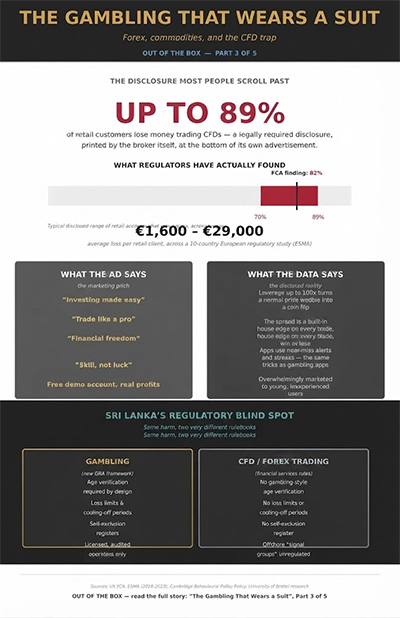 That 77 percent figure isn’t an outlier. Britain’s financial regulator found, in a review of the industry, that 82 percent of CFD customers lost money. Regulators across Europe studied 10 different countries and found the average retail customer lost somewhere between roughly €1,600 and €29,000 trading these products. Academic researchers, who have studied trading apps directly, including their “practice mode” demo accounts, found something else troubling: many of these apps are deliberately designed using the same psychological tricks as gambling apps. Near-miss messaging that makes a losing trade feel like it was almost a win. Streak counters. Push notifications nudging you back in right when you’ve stepped away. The researchers’ own conclusion was blunt: this “supports comparisons with gambling, where an overwhelming majority loses money.”
To be fair to the trading industry, it has a real counter-argument, and it deserves to be heard rather than dismissed. Genuine investing and trading, done properly, does involve skill, understanding a market, managing risk, not betting more than you can afford to lose, using regulated brokers who are supervised by real financial authorities. Nobody sensible would say buying shares in a well-run company is “gambling” in the same sense as a slot machine. The industry’s argument is that CFDs, used responsibly by informed traders, sit closer to that end of the spectrum than to a casino floor.
The trouble is that “used responsibly by informed traders” describes almost none of the customers these apps are actually advertising to. Nobody runs a slick Instagram campaign targeting sophisticated hedge fund managers. They target 19-year-olds with a bit of spare cash and a phone.
The Sri Lankan blind spot
Here is where this story becomes genuinely local, and genuinely urgent. Sri Lanka’s new gambling law, the one creating a single Gambling Regulatory Authority to oversee casinos, card games, and betting, has nothing to do with any of this. Forex and CFD trading falls under an entirely different part of the government’s rulebook, treated as a financial services matter for the Central Bank and securities regulators, not as gambling at all. On paper, that makes sense: trading involves real financial markets, real currencies, real commodities.
But in practice, it creates a gap you could drive a truck through. A card game at a funeral house, played for a few hundred rupees, falls under strict 19th-century anti-gambling law. A trading app that can empty a young person’s entire savings account in an afternoon, using exactly the same psychological hooks as a slot machine, falls under none of it, no age verification standard built for gambling harm, no loss limits, no cooling-off periods, no self-exclusion registers.
Meanwhile, unlicensed offshore forex “signal groups” and trading channels, plenty of them explicitly targeting Sri Lankan youth through Telegram and WhatsApp, operate almost entirely outside any meaningful oversight at all, local or foreign.
There’s a newer wrinkle worth a mention too: cryptocurrency trading and crypto-based gambling products increasingly blur into the exact same category as CFDs, some analysts value the global crypto gambling market in the tens of billions of dollars, though even the experts disagree wildly on the real number, which tells you how little anyone is actually tracking this corner of the industry closely.
The question this instalment leaves open
So here’s the question worth putting to Sri Lanka’s policymakers, and to readers thinking about their own accounts: if a product produces the same loss rates as a casino, uses the same psychological design as a betting app, and overwhelmingly targets the same young, inexperienced customers as illegal gambling operators, does it matter, for the purposes of protecting people, whether we call it “trading” or “gambling”? Right now, in Sri Lanka and in most of the world, the label is doing an enormous amount of legal work that the underlying product doesn’t actually earn.
We’ll return to this exact tension in our final instalment, when we ask what genuinely joined-up gambling regulation would look like, one that judges a product by what it does to the people using it, rather than by what its marketing department decided to call it.
Next week,
Part 4 heads to the racecourse, the one form of gambling that has stayed legal almost everywhere on Earth for centuries, to explain, in plain English, exactly how a bookmaker guarantees itself a profit no matter which horse crosses the line first.
Prof. C. A. Saliya, is a charted accountant, academic, researcher and former banker. He is the author of SAMAJA GAVESHAKAYA and Springer Publication DOING SOCIAL RESEARCH. He can be contacted at saliya.ca@gmail.com. The views expressed in this article are his own and do not necessarily represent those of the organisations with which he is affiliated.
by Jehan Perera
The ongoing 63rd session of the United Nations Human Rights Council, which runs from September 7 to October 7, 2026, in Geneva is important to Sri Lanka. Its outcome will send a signal to other international actors, including the European Union, as to whether Sri Lanka’s reform policy is on track. The written update on Sri Lanka, prepared by the Office of the United Nations High Commissioner for Human Rights under High Commissioner Volker Türk and presented by Deputy High Commissioner Nada Al-Nashif, has taken a more holistic approach to the government’s performance over the past year. It acknowledged the progress Sri Lanka has made under the NPP government in relation to accountability for financial fraud and other economic crimes. At the same time, the High Commissioner’s update made clear that progress in relation to economic crime cannot be equated with progress in relation to accountability for grave human rights violations committed during the armed conflict and in other periods of political violence.
The government may have felt sufficiently confident that its response to the High Commissioner’s update could be handled by its representative in Geneva and did not require the attendance of Foreign Minister Vijitha Herath. Sri Lanka’s representative Sumith Dassanayake called for a fundamental review of country-specific mandates within the UN Human Rights Council. Sri Lanka has been facing repeated scrutiny in the form of successive UNHRC resolutions from 2012 onwards. Ambassador Dassanayake argued that such mandates should not continue indefinitely and must be regularly assessed against measurable objectives and tangible outcomes. This may reflect confidence that its record of reform is beginning to receive recognition internationally. The reports and statements at the Human Rights Council acknowledged progress in the government’s efforts to address corruption and economic crime.
The government’s anti-corruption drive has included investigations into allegations involving individuals who held the highest political offices in the country. The arrest of former President Ranil Wickremesinghe in connection with alleged misuse of public funds, and the investigation into the controversial SriLankan Airlines Airbus transaction involving former President Mahinda Rajapaksa’s son, are examples of the reach of these investigations. The arrest of SLPP National Organiser and Member of Parliament Namal Rajapaksa in connection with allegations relating to the Airbus purchase scandal has also demonstrated that the government is willing to pursue cases involving politically powerful figures.
Wide Range
The ongoing investigations appear to encompass a wide range of parliamentarians and government members, both past and present. They suggest that accountability for corruption is not being confined to lower-level officials or to individuals who lack political influence. This is precisely the kind of accountability that the public has long demanded and that previous governments have too often failed to deliver. The government is also reaching into the upper levels of the military hierarchies of the past. The case in which 11 young men, most of them Tamil, disappeared after being abducted in Colombo between 2008 and 2009 involved allegations that some families were asked to pay ransoms. The investigation into this case has reached senior military figures. The willingness to pursue such cases is important because it challenges the assumption that those who exercised power during the war are beyond the reach of the law. Such cases would provide a practical test of whether the government’s commitment to accountability for economic crimes is part of a broader commitment to the rule of law.
Success in prosecuting corruption cannot substitute for justice for those who were unlawfully killed, disappeared, tortured or otherwise victimised. The UN report noted that there had been no recognition or accountability for crimes under international law, gross human rights violations and serious violations of international humanitarian law committed by all parties during the war. The government has yet to establish a credible and effective process to address the many cases of enforced disappearance, extrajudicial killing, torture and other serious violations. The government needs to take the international commitments it has inherited on human rights issues seriously. It needs to adopt a multi-pronged approach and go beyond focusing primarily on financial and corruption-related accountability.
Need Action
As a member of the international community, Sri Lanka has a responsibility to abide by the commitments it has made. It cannot selectively uphold international obligations postponing those that are politically difficult. Also, as a small country, Sri Lanka has a self-interest in ensuring the survival of international law, which is all that it has to protect it from the depredations of the bigger international actors. The erosion of international law by powerful states makes it all the more important that smaller states uphold the principles on which the international system is based. Sri Lanka cannot credibly appeal to international law when it is threatened from outside while disregarding its own obligations within. Sri Lanka also needs to win the confidence of its own population that it is committed to justice and equality for all. Public opinion polls and community-level research have disclosed that ethnic and religious minorities are appreciative of the sense of greater security they enjoy under the present government from ethnic or religious extremists.
But a sense of security is not the same as the fulfilment of rights. As far as the Tamil people are concerned, the government has yet to deliver on several of its specific promises. These include the long-standing problems of missing persons, the release of political prisoners who have been members of Tamil militant organisations, and the return of land taken over for military purposes during the war. The issue of Buddhist statues and archaeological sites found on their properties which are then taken from their control continue to trouble them especially as they see no signs of resolution of those disputes. The issue of pastureland in the east of the country in Mylathamadu is particularly concerning to them as they see orders by successive presidents, both President Ranil Wickremesinghe and President Anura Kumara Dissanayake, being disregarded on the ground. The Mylathamadu pastureland dispute is where traditional Tamil dairy farmers have engaged in multi-year protests against the ongoing encroachment of their ancestral grazing lands by Sinhalese crop cultivators relocated under government development schemes.
The government’s failure to hold Provincial Council elections is particularly troubling. The provincial council system is the only one that can provide the Tamil people and other ethnic minorities the opportunity to wield political power and exercise a measure of self-determination in the areas in which they are the numerical majority. The continued postponement of Provincial Council elections therefore has consequences that go beyond an ordinary electoral delay. It deprives communities of an important constitutional avenue for democratic participation and power-sharing. The ethnic and religious minorities appreciate what the government is doing in the larger national interest, but they must not be made to feel that their special concerns are being ignored. The government cannot resolve Sri Lanka’s entire legacy of rights violations overnight. But it does need to demonstrate that it is willing to move forward on multiple fronts, not only on a few.

 by Hasini Lecamwasam
Brain drain in Sri Lanka is at an all-time high. The latest Human Flight and Brain Drain Index for 2024 shows that we are 16th of 175 countries on this count, and first in South Asia. That this is a crisis goes without saying. Brain drain affects all sectors, and is a huge strain on the resources of a developing country. Particularly in Sri Lanka, where considerable public investment is made in the moulding of professionals through the system of free education, this amounts to transferring the resources of poorer countries to richer ones with top migration destinations. It is, therefore, important to consider the push and pull factors behind skilled outmigration, specifically from the public university system of Sri Lanka, a key focus of the Kuppi column.
From frustration to exit
Several bitter realities in our crumbling public university system act as push factors in the migration decisions of academics. Many essays on this column have, over several years, attempted to highlight numerous aspects of this erosion. Perhaps, primary among them is the lack of adequate funding, which has debilitating ramifications for the system: very little investment is made in the up-keep of infrastructure (and even less in its expansion), resulting in serious constraints in accommodating growing batches of students and the wellbeing of the staff (particularly in regional universities); research funding is negligible, severely curtailing academics’ ability to effectively discharge their primary duty of teaching which should ideally be informed by their research (and the research of others, access to which is also, unfortunately, mediated by funding); a funding crunch also means a slash in (or greater constraints on) recruitments, increasing the workloads of academics, currently in service, and eating into the quality of their teaching and research.
What recruitments are done frustrate those with any faith in merit. As many of our interventions in this column have shown, recruitment processes are characterised by archaic selection criteria that place very little weight on a candidate’s postgraduate growth and the advantages of interdisciplinary training. Added to this is the general preference for ‘culturally compliant’ candidates who would not rock the boat too much. The combined effect is that those with the capacity and spirit to try out innovations in education are discouraged from joining or staying on in the public university system. Some, or many, of them may instead seek appointments abroad.
A thread that binds all of these problems together is pervasive hierarchy which, again, many interventions on this column have sought to highlight. It is the interest in preserving hierarchy that leads to the preference for alumni in recruitment processes. Hierarchy within universities can be particularly frustrating for younger faculty and women, who typically have to bear the brunt of the workload of their senior, often male, colleagues. In a context of funding, and, therefore, recruitment, restrictions, this translates into a disproportionate burden being placed on junior (usually female) faculty, seriously hindering their prospects of growing into successful academics due to the time constraints within which they have to operate. Junior academics, therefore, are more likely to look to educational institutions abroad for what they hope would be a different work culture that respects them more.
Ideological ruses
On top of these structural frustrations are also the workings of neoliberal ideology. For one, the nature of relations between the global metropole and peripheral countries like Sri Lanka largely dictates what is desirable and what is not. The apparent lifestyles of Western countries – from food to clothing, housing, appliances, and so on – have continued to lure people from the periphery with the promise of a ‘better’ life, alongside better career advancement opportunities. This, of course, masks much of the struggle that goes on behind the scenes to survive in Western societies. For instance, in most cases highly attractive public infrastructure such as roads, public transport, clean air, quality control of food, and so on belie the astronomical privatised costs of healthcare and education. Health insurance is usually mandatory and steep in most high-income settings, while even subsidised education (for which eligibility criteria are strict) creates a serious dent in household earnings. Of course, the happy images of glossy trams and gleeful international travellers don’t convey this.
A second ideological ruse is the myth of greater opportunities and recognition abroad. While there is no denying that local skilled sectors – be it higher education, health, civil service, or private white-collar positions – are replete with issues that inhibit merit-based professional advancement, the notion that things are fundamentally different in Western countries stems from an uninformed optimism. As is now increasingly known and discussed, Western labour markets are notoriously racialised, and equivalent skills are rarely treated as such. Instead, it is usually demanded that skilled migrants clear certain formal examinations in their host countries. In fields like medicine, this is followed by an interview that may also be racially prejudiced. Once these initial steps are cleared, remuneration reverts to square one irrespective of experience accumulated abroad, not to mention the many subtle aggressions, rejections, and trials one has to go through in the negotiation of everyday life. In the many cases where professional qualifications are used as leverage for a move abroad, sights are set on a better future for one’s children, which again is informed by the misplaced faith in greater opportunities and a lack of awareness of the factors outlined above. Needless to say, in the global swing to the Right, things have become even more challenging. In such a context, considering the few rare cases where skilled migrants live extremely comfortable lives as the norm becomes a dangerous misconception.
The two ideological pull factors mentioned above are complemented by a push factor, which has to do with a highly classed understanding of what a white-collar professional is due in their society. Many of these aspirations are clearly articulated in academic trade union action demanding separate quotas for school entry, increased fuel allowances, winning back the presently stalled vehicle permit scheme, salary hikes, and so on. While working people have every right to agitate for better material conditions, insofar as it remains unconnected to a broader movement for improving the conditions of the lot of the working class, it remains self-serving and very much within the class logic of capitalist society. Since these demands are articulated as a means of maintaining distinction, it is clear that they are not envisaged as part of a class movement. The frustration of not having these needs for distinction satisfied may push some to seek greener pastures abroad, at least financially, (perhaps as a means of social mobility based on it), only to be disappointed on most occasions.
What is to be done?
Addressing the systemic push factors listed above requires, first and foremost, greater allocations for free public higher education. This would immediately translate into more recruitments and less work per academic, and better research and teaching in the long haul. An increase in funding would also ideally lead to greater infrastructural investments, especially including improving the living conditions of those who work in regional universities amid untold hardships. Next, fairer, more creative, and, therefore, more effective recruitment policies are badly needed to attract talented individuals to university positions. Rather than carving out a ‘special category’ for academics to achieve this purpose, which is informed by a classed logic, this needs to be done through fundamental reforms in recruitment processes. Third, a persistent attack on the entrenched hierarchy within universities through internal reform is much called for. Reforming recruitment practices will go a long way towards addressing this. Measures should also be taken to introduce more stringent policies against SGBV (not to mention ragging, even though it is not directly connected to brain drain). Such measures would create a safer, fairer, and more attractive workplace, which would give more reasons for people to stay.
On top of greater allocations, we also need a transformation of our aspirations themselves if this situation is to change. That necessitates a kind of education capable of questioning the ‘paradise’ conception of Western societies, and lays bare their colonial material and ideological dimensions, in both their historical and contemporary manifestations. These colonial understandings of the ‘good life’, moreover, have devastating ecological implications for the planet, not to mention social justice. An education with the ability to transform this mindset would hopefully prove to be more than a mere path to social mobility, rather being a tool of social emancipation that renders mobility moot.
(Hasini Lecamwasam is with the Department of Political Science, University of Peradeniya)
Kuppi is a politics and pedagogy happening on the margins of the lecture hall that parodies, subverts, and simultaneously reaffirms social hierarchies.

Construction of Accident and Emergency unit at Mannar District General Hospital begins under President’s patronage

Special Cabinet Subcommittee and Officials’ Committee appointed to address El Niño Climate Impact meet

Showers about 75 mm are likely at some places in the Western, Sabaragamuwa, Central and Southern provinces

Brook, Buttler, Baker star as Sri Lanka slump to 119-run rout

Where is Gnanasara Thera?Police pass buck to court

Russian citizens in Lanka to vote in State Duma elections

‘Dates have the highest sugar content to fight Coronavirus’

Sunday Island 27 December – Headlines

#SundayIsland 17th December – Headlines

Sunday Island – 28th March

Sunday Island Headlines – 21 March

Sunday Island – 21st February – Headlines
-

 Sports6 days ago
DDS set to lose Test captaincy
-

 News6 days ago
Sri Lanka faces new grid challenge as rooftop solar surges: former CEB GM
-

 Latest News6 days ago
Shafali, Deepti power India into sixth T20 Asia Cup final
-

 News4 days ago
Gnanasara Thero absconding after SC ruling
-

 Latest News5 days ago
Sri Lanka thwart Fatima Sana challenge to secure Asia Cup final spot
-
 Features7 days ago
Lost for 90 years: Rare Goby resurfaces in Jaffna
-

 News5 days ago
Ammunition cache found in old Kandy bungalow
-

 Editorial6 days ago
A flight of fancy