
Editorial
The Deshabandu dilemma


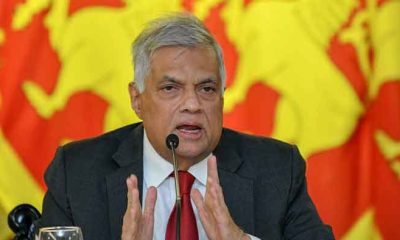
It is not necessary to labour the fact that Thursday’s order by a three-judge bench of the Supreme Court determining that Acting IGP Deshabandu Tennakoon, among four policemen, pay compensation of Rs. 500,000 each from personal funds to a police torture victim will be deeply embarrassing both to President Ranil Wickremesinghe and his government.
They recently made the three month acting appointment of Tennakoon, the Senior Superintendent of Police at Nugegoda at the time of the human rights infringement upheld by court, occurred. He is alleged to have participated with other cops in the torture of the victim by beating an ex-soldier robbery suspect who had been stripped naked and ordered to rub Siddhalepa on his genitalia.
The determination held that Tennakoon, named in the fundamental rights petition, had produced no evidence to distance himself from the offence. “I am of the view that supervising officers are to be directly held liable for the conduct of their subordinates in appropriate instances, even in the absence of direct participation.
Supervising officers can be held liable where there is affirmatory participation or participatory presence on the part of such supervising officers; or, where they have, directly or indirectly, implemented or enabled unconstitutional policies by turning a blind eye towards unconstitutional practices directly under their authority,” Justice S. Thurairaja observed in the determination.
It is well known that President Wickremesinghe had on several occasions extended the tenure of previous IGP Chandana Wickremaratne beyond his retirement age. The Constitutional Council stood in the way of a further extension and the acting appointment was recently made probably because of that.
It was believed that the president did not favour the appointment of Tennakoon, a principal contender for the position, who appeared to have enjoyed the backing of Law and Order Minister Tiran Alles. However that be, the protracted period during which the appointment of a successor to the previous IGP was delayed, resulted in a controversial claim by the president that the Constitutional Council was part of the Executive, something which has been contested.
The public perception of the Constitutional Council is that it was created as a ‘checks and balances’ mechanism with regard to appointments by the State to important public office. The Parliamentary High Posts Committee, created prior to the Constitutional Council, has long been in existence and continues to function. But we do not recall any occasion, bar one, where the High Posts Committee rejected an appointment.
This was in the case of Mr. Upali Wijewardene, who had already served for a long period as Chairman and Director General of the Greater Colombo Economic Commission (GCEC) was ex post facto deemed an unsuitable choice. The High Posts Committee at the time was chaired by then Prime Minister R. Premadasa whose antipathy to Wijewardene was very much in the open. But President Jayewardene, who appointed Wijewardene to the GCEC which was the precursor to the BOI, decreed that he remains in office despite the High Posts Committee determination.
All that, of course, is past history and water under the bridges. What arises at the present moment of time is whether Acting IGP Tennakoon, who is on record saying the police will not harass peaceful protests, and has been at great pains to demonstrate that intensive anti-narcotic action by the police will be a major priority during his tenure, will continue to remain in office despite the Supreme Court determination.
Most readers know it is a given in most countries that the official held culpable in circumstances such as this will resign post haste or be made to do so. But this is Sri Lanka which tourism promoting blurbs proclaim to be “a land like no other.” So what is to follow is anybody’s guess.
Any search for precedents will take memories back to the J.R. Jayewardene presidency where the legendary Vivienne Goonawardene, the firebrand woman MP of the Lanka Sama Samaja Party (LSSP) in its glory days, was roughed up by police. The government rewarded the police officer involved with a promotion! Later the homes of Supreme Court judges were stoned. Anything is possible in a country such as this.
Since the determination in the instant case has been made by the Supreme Court, there is no easy way out as there is no higher court where an appeal may be lodged. Whether the incumbent president will opt for the same route chosen by his uncle Dickie remains to be seen. But it must not be forgotten that RW was not an enthusiastic backer of Dehabandu Tennakoon for IGP. It could also be mentioned here that Minister Prasanna Ranatunga, who is also the Chief Government Whip, held guilty of a criminal offence, remains in office pending conclusion of legal appeals, This contrasts with with what happened in India where Rahul Gandhi, the Congress leader, lost his Lok Sabha seat over a court conviction.
The budget debate concluded last week with the government winning a comfortable majority on the third reading despite apprehensions raised by several SLPP MPs. The country is heading for a difficult year with little doubt that inflation will gallop with the recent increase in VAT effective from next January. The opposition continues to press for a parliamentary election so that the people can decide who will govern them.
None would disagree that the present rulers have lost their mandate. Although constitutionally empowered to dissolve Parliament at any time of his choosing, President Wickremesinghe who has assured there would be a presidential election next year but not declared his own candidacy, has only gone public with a promise of a parliamentary election in 2025 and not earlier. However events unfold, 2024 is going to be a difficult year for Sri Lanka and her people.








Monday 29th December, 2025
Sri Lankan politicians love the media dearly and take up the cudgels for the rights of journalists when they are out of power. The JVP/NPP leaders also defended the media to the hilt while they were languishing in the Opposition. Jekylls become Hydes after being ensconced in power, with the media exposing their failures and malpractices. Those who can, do; those who cannot, attack the media, one may say of the governments in this country, with apologies to Bernard Shaw.
The JVP-led NPP government, angered by bad press, is all out to intimidate the media it cannot control. Previous governments had the police on a string and used them to attack and harass independent journalists. The incumbent administration has gone a step further; the police have reportedly written to the Telecommunications Regulatory Commission (TRC), asking for action against Hiru TV for what they describe as broadcasting unverified, misleading news. Thus, the government has used the police to give Hiru a choice between toeing the official line and losing its licence. Thankfully, its efforts have run into stiff resistance, with media institutions and various associations circling the wagons around Hiru.
If the government thinks Hiru or any other media institution disseminates false information to the detriment of its interests, legal avenues are available for it to seek redress. The police must not be used as a political tool to intimidate the media.
Among the current defenders of the media are the SLPP, the UNP, the SLFP, etc. Their leaders are shedding copious tears for Hiru. But it was while the UNP and SLPP leaders were in power that the suppression of media freedom and violence against journalists became institutionalised for all intents and purposes. UNP governments not only throttled media freedom but also murdered journalists. SLFP regimes had media institutions attacked and journalists killed. An SLFP-led government, with the current SLPP leaders at the helm, had media institutions torched and journalists abducted, assaulted and murdered. These sinners currently in the political wilderness are condemning other sinners in power for suppressing media freedom.
The government deserves the bad press it gets. The police have been reduced to a mere appendage of the JVP/NPP. Two of the NPP’s Retired Police Collective members, namely former Senior DIG Ravi Seneviratne and former SSP Shani Abeysekera, have been appointed Secretary to the Public Security Ministry and CID Director, respectively. Absurd claims the police make in defence of the government remind us of Matilda, whose dreadful lies made one gasp and stretch one’s eyes.
When the police were asked why NPP MP Asoka Ranwala had not been subjected to a breathalyser test immediately after a recent road accident he caused, they had the chutzpah to claim they had run out of test kits. They transferred two of their officers over the incident to enable the government to save face. They arrested one of their own men assaulted by an NPP MP following a recent police raid on a cannabis cultivation in Suriyakanda. Acting just like legendary King Kekille, they let the MP off the hook and arrested the policeman, who was bailed out; they went on to suspend him from service. A few months ago, they unashamedly sided with a group of JVP cadres who stormed a Frontline Socialist Party office in Yakkala and forcibly occupied it. They go out of their way to ensure that the arrests of drug dealers with links to the Opposition get maximum possible publicity, but they do their best to keep the media in the dark when narcotics dealers with ruling party connections are taken into custody. They crack down on Opposition politicians and activists but steer clear of government members and their supporters. The despicable manner in which they are doing political work for the government reminds us of the Gestapo. Now, they are zeroing in on Hiru TV at the behest of their political masters for exposing their sordid actions.
The only way the NPP government can overcome problems and challenges on the political front and shore up its crumbling image is to mend its ways and fulfil its election pledges while taking action against its errant members who have brought it into disrepute and turned public opinion against it. Shooting the messenger is not the way to set about the task.

Pressure is mounting on President Anura Kumara Dissanayake to ensure that an Auditor General is appointed without further delay. But he has remained unmoved. He is determined to wear down the Constitutional Council (CC) and appoint one of his party loyalists as Auditor General. The CC has rejected his nominees—and rightly so; they are not eligible. Former Executive Presidents went all out to railroad the CC into rubber-stamping their decisions. They had no qualms about doing so while claiming to uphold the independence of the public service. President Dissanayake has failed to be different. His refusal to compromise amounts to brinkmanship; he is waiting until the CC blinks.
The NPP’s election manifesto, A Thriving Nation: A Beautiful Life, attributes the deterioration of the public service to ‘political appointments’ and state workers making political decisions. Among the steps the NPP has promised to take to straighten up the public service are ‘merit-based appointments and promotions’. This principle has fallen by the wayside where the question of appointing the Auditor General is concerned.
The government should take cognisance of the possible negative effects of the prolonged delay in appointing the Auditor General during a period of disaster response and international relief and rebuilding support.
The Bar Association of Sri Lanka has called upon President Dissanayake to appoint a person with proven competence, integrity, and independence, who commands wide acceptance as Auditor General forthwith. It has stressed the need to appoint a nonpartisan professional as the Auditor General to safeguard the integrity of the National Audit Office and inspire the confidence of both citizens and international partners in the financial governance of the State.
Transparency International Sri Lanka, the Civil Society Organizations (CSOs) and the other good governance activists, too, have faulted President Dissanayake and his government for the inordinate delay in appointing the Auditor General. They are of the view that a strong, independent Auditor General enables Parliament and the public to scrutinise government expenditure, identify irregularities, prevent misuse of funds, and ensure that those entrusted with public resources are held to account. The delay in appointing the Auditor General has weakened the effectiveness, authority, and the independence of the entire public audit system and created space for inefficiency, mismanagement, and corruption, they have noted. The situation will take a turn for the worse if the government succeeds in having one of its cronies appointed Auditor General.
The government is apparently playing a waiting game in the hope that the reconstitution of the CC due next year will provide a window of opportunity for it to appoint one of its loyalists as Auditor General.
Why the government is so desperate to place a malleable person at the helm of the National Audit Office is not hard to understand. If it succeeds in its endeavour, the next Auditor General will be beholden to the JVP/NPP. When an ineligible person is elevated to a high post, he or she naturally becomes subservient to the appointing authority. Such officials go out of their way to safeguard the interests of their political masters in case of irregularities involving state funds and other accountability issues.
A protracted delay in appointing the Auditor General or the appointment of a government supporter to that post will increase the risk of mismanagement of state funds and corruption, lead to the erosion of public trust and confidence in the National Audit Office, undermine legislative oversight and impair fiscal discipline. Most of all, the government’s failure to appoint a competent, independent person of integrity as Auditor General will diminish donor confidence especially at a time when the country is seeking disaster relief funds from the international community. There is no way the government can justify its refusal to appoint the current Acting Auditor General as the head of the supreme audit institution. He is obviously the most eligible candidate.

Saturday 27th December, 2025
The NPP government has released a cordial diplomatic letter from Indian Prime Minister Narendra Modi to President Anura Kumara Dissanayake, and gained a great deal of publicity for it as part of a propaganda campaign to boost Dissanayake’s image. Such moves are not uncommon in politics, especially in the developing world, where the heads of powerful states are deified and their visits, invitations and letters are flaunted as achievements of the leaders of smaller nations. However, the release of PM Modi’s letter to President Dissanayake is counterproductive, for it makes one wonder why the government has not made public the MoUs it has signed with India?
PM Modi’s Sri Lanka visit in April 2025 saw the signing of seven MoUs (or pacts as claimed in some quarters) between New Delhi and Colombo. Prominent among them are the MoUs/pacts on the implementation of HVDC (High-Voltage Direct Current) Interconnection for import/export of power, cooperation among the governments of India, Sri Lanka, and the United Arab Emirates on developing Trincomalee as an energy hub, and defence cooperation between India and Sri Lanka.
The NPP government has violated one of the fundamental tenets of good governance––transparency; there has been no transparency about the aforesaid MoUs or pacts, especially the one on defence cooperation. They cannot be disclosed without India’s consent, the government has said. This is a very lame excuse. The JVP/NPP seems to have a very low opinion of the intelligence of the public, who made its meteoric rise to power.
When the JVP/NPP was in opposition, it would flay the previous governments for signing vital MoUs and pacts without transparency. But it has kept even Parliament in the dark about the MoUs/pacts in question.
Ironically, the JVP, which resorted to mindless violence in a bid to scuttle the signing of the Indo-Lanka Accord in 1987, has sought to justify the inking of an MoU/pact on defence cooperation between Sri Lanka and India and keeping it under wraps, about three and a half decades later. The signing of that particular defence MoU/pact marked the JVP’s biggest-ever Machiavellian U-turn. How would the JVP have reacted if a previous government had entered into MoUs with India and kept them secret? It opposed the proposed Economic and Technology Cooperation Agreement (ETCA) between Sri Lanka and India tooth and nail, didn’t it?
Whenever one sees the aforesaid letter doing the rounds in the digital space, one remembers the MoUs/pacts shrouded in secrecy, which have exposed the pusillanimity of the NPP government, whose leaders cannot so much as disclose their contents without India’s consent.

Navy seizes an Indian fishing boat poaching in northern waters

Mandhana, Shafali and Ghosh help India edge run-fest to go 4-0 up

Showers predicted in several provinces today (29th December)

Delay in govt. response to UK sanctions on ex-military chiefs, and others causes concern

Sri Lanka outlines seven key vectors of international cooperation at Moscow forum

Sri Lanka third most preferred destination for Indians

‘Dates have the highest sugar content to fight Coronavirus’

Sunday Island 27 December – Headlines

#SundayIsland 17th December – Headlines

Sunday Island – 28th March

Sunday Island Headlines – 21 March

Sunday Island – 21st February – Headlines
-

 News7 days ago
Members of Lankan Community in Washington D.C. donates to ‘Rebuilding Sri Lanka’ Flood Relief Fund
-

 News5 days ago
British MP calls on Foreign Secretary to expand sanction package against ‘Sri Lankan war criminals’
-

 Features7 days ago
General education reforms: What about language and ethnicity?
-
 News7 days ago
Suspension of Indian drug part of cover-up by NMRA: Academy of Health Professionals
-
 Sports5 days ago
Chief selector’s remarks disappointing says Mickey Arthur
-
 News4 days ago
Street vendors banned from Kandy City
-

 Editorial7 days ago
A very sad day for the rule of law
-

 News7 days ago
US Ambassador to Sri Lanka among 29 career diplomats recalled