
Foreign News
Thailand cracks down on foreign companies using fig leaf of local ownership

On paper, it was registered as a nail salon.
In reality, it was allegedly a front for an adult content business run by an Israeli woman through the subscription-based website OnlyFans.
The woman’s company in the southern province of Krabi was just one of nearly 500 businesses – ranging from beauty salons to cannabis farms – that Thai authorities say were registered by a single accounting firm.
All of the companies were linked to foreigners who had falsely listed a Thai “nominee” as the majority owner to get around the law on foreign ownership, according to authorities.
Under the Foreign Business Act, non-citizens are generally prohibited from holding more than a 49 percent stake in local businesses.
To get around the rule, some foreign entrepreneurs pay locals to fill out paperwork stating that they own at least 51 percent of their company despite having little or no involvement in the business.
After years of turning a blind eye to the dubious use of Thai nominees, authorities are now cracking down and demanding proof that citizens listed as local partners have real holdings in the firms they are registered to.
After launching a wave of inspections across popular tourist areas and cross-checking official databases using artificial intelligence, the government has identified 50,000 foreign-linked companies for greater scrutiny.
Legal firms say they are being inundated with inquiries from foreign businesses and property owners who fear their assets could be frozen or seized if they are found to be part of illicit nominee schemes.
“All of them fear losing their investment and being charged with a criminal case,” Brian Ramsden, general manager of foreign affairs at Lawyers for Expats Thailand, told Al Jazeera.
“It’s always the same excuse: ‘We knew it was illegal, but the lawyers told us it’s OK,’” Ramsden said, explaining that his firm has been getting more than 100 calls a day, “asking us what to do”.
“If the company is not trading, it’s a red flag,” Ramsden added.

Thai Prime Minister Anutin Charnvirakul has been among those leading the charge against fraudulently registered companies.
On a tour of popular tourist areas in southern Thailand last month, Anutin pledged to throw the book at illegal businesses and take down any criminal organisations using shell companies, a matter of growing concern amid the proliferation of cyber-scam networks in Southeast Asia.
“In cases where … one person holds shares and owns over 200 companies, it is essentially selling companies, selling shells so that foreigners can go and conduct business,” he said.
“This violates the legislative intent of the law, and it is believed that we will be able to prosecute in this regard.”
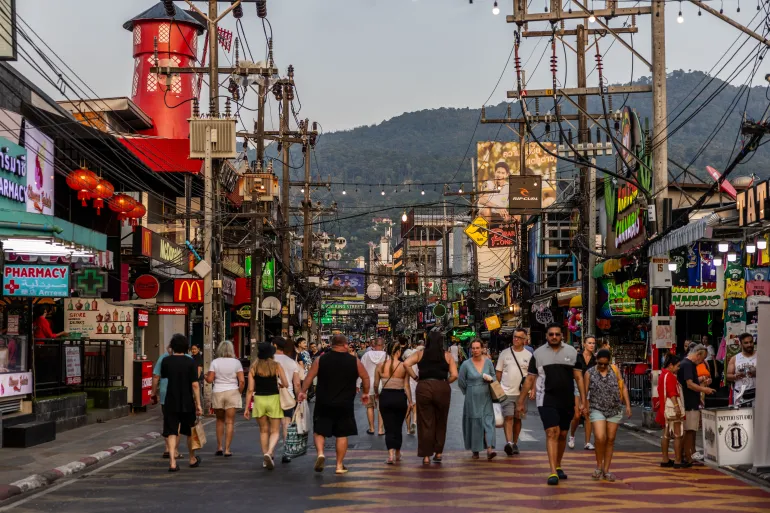
On resort islands Koh Samui and Koh Phangnan alone, about 70 percent of the 16,800 “registered legal entities” are part-owned by foreigners, the Ministry of Commerce said following an audit last month, though it added that their foreign links did not necessarily mean they were breaking the law.
Last week, authorities said they had referred 28 foreign suspects to prosecutors following an investigation into fraudulently registered firms in the provinces of Phuket and Surat Thani.
The arrests came after authorities in Koh Phangan had earlier announced the confiscation of 30 plots of land worth approximately 150 million baht ($4.5m) and arrested two Thai nationals linked to illegal companies.
The enforcement push comes as some local businesses complain about being undercut by foreigners.
“There are foreigners who invest in villas and convert them into Airbnbs, and once they’ve developed them, Thai people can no longer touch them price-wise,” Thong, a prominent Thai businessman who asked to be identified only by his nickname, told Al Jazeera.
“It is not right for foreigners to own them completely because it means many Thai people get left behind. That’s the real problem.”
The crackdown has also prompted fears that legitimate foreign investors could find themselves on the wrong side of the law unawares, damaging Thailand’s reputation as a place to invest.
While condominium ownership rules mean that 51 percent of any development must be reserved for Thais, it is not unheard of for developers in hot spots such as Bangkok, Phuket and Pattaya to sell entire apartment blocks to foreign clients.
On online forums, foreigners have shared horror stories about buying and leasing property in Thailand, including learning that they did not legally own the condo they bought because it had been reserved for Thai ownership.

Across Pattaya, foreign business-people and investors are in a state of “heightened wariness and stress”, said Victor Wong, a foreign investment and tax specialist based in Pattaya.
“The system is tightening without simultaneously expanding lawful entry points,” Wong told Al Jazeera.
“Clients are no longer looking for shortcuts; they are looking for sustainable, lawful structures that will allow them to continue operating in Thailand with confidence,” he said.
While the sudden enforcement of decades-old rules has sent a chill through the expat community, not all foreign residents are sympathetic to concerns about the crackdown.
“This isn’t Thailand’s fault,” said Ramsden of Lawyers for Expats Thailand.
“No one put a gun to the foreigners’ heads. They come to Thailand, and most of their common sense goes out the window,” he said.
“This is about the people not following the rules. This crackdown is going to be better and safer for Thailand.”
[Aljazeera]


The Philippine Coast Guard says it has recovered 41 bodies from the wreckage of a ferry that caught fire this week, bringing the total death toll to 76.
More than 130 people were on board the MV June Aster when the blaze erupted on Wednesday as it neared its destination at the tourist hotspot of Coron, after departing from Manila.
The coast guard said on Saturday the number of survivors remained 43, with many receiving treatment in hospital, but 13 people remain unaccounted for.
Recovery of bodies had been hampered due to toxic fumes and lingering heat, which meant authorities were unable to board until Friday.
Geronimo Tuvilla, an official for the Philippine Coast Guard, said the priority was identifying victims and determining the cause of the blaze.
Kristine Ablana, a tourism official in Coron, said relatives were being asked to help identify family members through personal items and DNA testing.
“Once someone is able to verify that this photo or these belongings are indeed those of their relative, they will be asked to provide a DNA sample,” she said.
Coast Guard spokesperson Commodore Noemie Cayabyab said the fire began in a cargo hold before spreading.
She said survivors had described hearing a loud explosion, “the appearance of smoke and then fire. It spread very quickly”. She added that those who had made it off the ship did not have time to put on lifejackets.
A survivor who was hauled to safety on a rescue boat told the BBC he had heard frantic cries onboard when the fire erupted, and was trampled by panicked people as he tried to escape.
The ferry, built in 2002, held valid safety certificates and passed an enforcement inspection in March, but investigators are looking into potential manifest discrepancies, cargo loading integrity, and crew emergency response protocols, the Palawan Daily reported.
The vessel was carrying 117 passengers and 17 crew members.
Atienza Interisland Ferries, the vessel’s operator, has pledged full co-operation with the inquiry.
[BBC]

A dress worn by Princess Diana to a party in London hours after a documentary was televised in which the then-Prince Charles admitted to committing adultery during their marriage is going up for auction.
Her dramatic arrival at the Serpentine Gallery in 1994 in a custom-made black silk evening dress by designer Christina Stambolian became an iconic pop-culture moment.
The media dubbed her outfit the “revenge dress”.
Auction house Sotheby’s expects the dress to sell for up to £220,000 ($300,000) when it goes under the hammer on 9 December.
A press release from Sotheby’s said it is the first time the dress has been offered at auction since 1997, when the late princess sold 79 of her dresses to raise money for charities.
Morgane Halimi, Sotheby’s Global Head of Handbags and Fashion, said in a statement that Princess Diana “understood instinctively” that fashion can be a language in its own right.
“On her own terms, Princess Diana turned the dress into one of the most powerful messages she ever made, during one of the most scrutinised and emotionally charged episodes of her life,” Halimi said.
“She walked into a moment in which so much of her story was being told for her and, through what she chose to wear, reclaimed the narrative for herself.”

According to Sotheby’s, Anna Harvey, her stylist at the time, said Diana “wanted to look a million dollars”.
The princess made a last-minute wardrobe change for the fundraising dinner and chose the strapless evening dress by the Greek designer Christina Stambolian – which she accessorised with a royal jewel, a black clutch and black heels.
The vintage Jaguar XJ40 car that Diana arrived in at the event was sold at auction earlier this year for £66,250.
The revenge dress is expected to fetch a considerably higher price.
If it does, it will not be the first time an item from the princess’s wardrobe has sold for a significant sum.
Princess Diana’s sweater featuring a black sheep among rows of white ones was sold for £920,000 at an auction by Sotheby’s in New York in 2023.
[BBC]

A Pakistan Under-19 cricket team suddenly became the centre of focus when it was mistaken for a group of asylum seekers in Portsmouth. A group of protesters gathered outside the Marriott Hotel in Portsmouth after reports that asylum seekers were staying there. The situation had to be later diffused when it was ascertained that the hotel was hosting the Pakistan Under-19 team.
According to the Guardian, the situation became tense when a crowd gathered outside the Marriott hotel after reports that about 40 men who did not seem to be English arrived at the hotel. George Madgwick, a Reform councillor, called the hotel to mediate between the Pakistan Under-19 staff and the assembled crowd, following which the crowd dispersed.
“I spoke to the coach of the team, who was very understanding,” Madgwick told the Guardian. “I went out to the protesters and told them, ‘You’ve got it wrong guys, it’s a cricket club.’ They left within a couple of minutes. It was a massively unfortunate incident.
“From the perspective of the people of Portsmouth who are already on high alert, this was a coach from the same company which was turning up with about 40 foreign men.”
The ECB has been in touch with the Pakistan management following the incident and is reviewing security arrangements.
The Pakistan Under-19 team played a four-day game against England Under-19 in Arundel from September 2 to 5, which they lost by ten runs. The two teams faced off in a Youth ODI on September 9, with Pakistan winning by 177 runs. Pakistan’s senior men’s team are also playing the third and final Test against England at Edgbaston.
[Cricinfo]

Showers about 75 mm are likely at some places in the Western, Sabaragamuwa, Central and Southern provinces

Brook, Buttler, Baker star as Sri Lanka slump to 119-run rout

Where is Gnanasara Thera?Police pass buck to court

Russian citizens in Lanka to vote in State Duma elections

Euro 110,000 research drive to tackle plastic waste in food sector

New SAU-RCSS pact to boost South Asian dialogue

‘Dates have the highest sugar content to fight Coronavirus’

Sunday Island 27 December – Headlines

#SundayIsland 17th December – Headlines

Sunday Island – 28th March

Sunday Island Headlines – 21 March

Sunday Island – 21st February – Headlines
-

 Sports5 days ago
DDS set to lose Test captaincy
-

 News5 days ago
Sri Lanka faces new grid challenge as rooftop solar surges: former CEB GM
-

 Latest News5 days ago
Shafali, Deepti power India into sixth T20 Asia Cup final
-

 Latest News4 days ago
Sri Lanka thwart Fatima Sana challenge to secure Asia Cup final spot
-

 News3 days ago
Gnanasara Thero absconding after SC ruling
-

 Features6 days ago
Lost for 90 years: Rare Goby resurfaces in Jaffna
-

 News4 days ago
Ammunition cache found in old Kandy bungalow
-

 Latest News6 days ago
Italian Naval Vessel ‘ITS Giuseppe Garibaldi’ arrives in Colombo