
News
Tamils’ struggle for political rights reasonable, says Sumanthiran


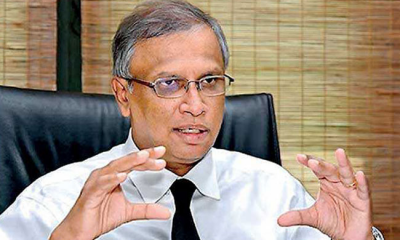
TNA MP M.A.Sumanthiran told Parliament yesterday that the Tamils’ struggle was a struggle for justice.
“It is a reasonable struggle for political rights. Our struggle may be too long and hazardous. But we will attain a just solution if we continue in the non-violent path without deviating from it,” he said, making a statement to the House.
Full text of Sumanthiran’s statement: “This week we commemorate the 15th anniversary of the Mullivaikkal killings and other atrocities. It was a time when our people were locked into a narrow strip of land with no avenue for escape and had to survive only on kanji, while losing many loved ones and seeing many others maimed due to heavy shelling and shootings.
When the sound of guns and bombs eventually ceased, many were shot dead by the Army as they emerged from the war zone. Men and women of a certain age were forced to surrender to the security forces, never to be seen again. The others were forcibly herded into camps, surrounded by barbed wires, and kept as prisoners for over one and a half years, unlawfully. No one has been prosecuted or found guilty for any of these serious international crimes to date.
In the reports of the Panel Of Experts, dated 31st March 2012, handed over to UN Secretary General and the OISL international inquiry released in September 2015, the fact that several internal crimes were committed during the last stages of the war and that persons responsible should be prosecuted and punished have been strongly recommended.
The Sri Lankan government co-sponsored Resolution HRC/30/1 on the 1st of October 2015, at the UNHRC which underline the importance of the participation of investigators, prosecutors, defence attorneys and judges in a judicial mechanism. However, the Sri Lankan government later resiled from that commitment.
I consider this moment, 15 years after the end of the armed struggle, as the opportune time to reflect and act on the changes that had happened in the political, social and economic positions of the Tamils.
An armed struggle was waged for our political liberation. Although it is my personal belief that a just political liberation cannot be achieved at the point of a gun, I have repeatedly stated that we cannot today decry or judge the decision taken by the Tamil youth who saw no other option at a time when oppression and military suppression was enforced on our people. I have also consistently emphasised that the commitment and sacrifices unselfishly made by those who took up arms on our behalf should be regarded very highly. However, there is not one Tamil who would even dream of another armed struggle as an option after this sacrificial struggle was silenced 15 years ago.
It is in this background that I suggest, as an important step, an introspection as to whether the strategies we have adopted in the last 15 years have been successful or not.
If we keep aside the struggle for political liberation for a moment, and look at our social and economic life, it’ll be apparent that we have continuously regressed. The evidence of this is found in the increase in drug abuse and violent gang warfare among our youth. These are efforts to weaken our youth and although it may be true that the rulers are encouraging this, still the primary responsibility to contain these trends rests with our political and community leaders.
Although extraneous factors such as cinema contribute towards violence and drug abuse, we have failed to take effective action to counter such forces. If this regression continues our youth will be rendered as persons who are ill-equipped to handle responsibilities even if we attain political freedom. It is a matter of pride that our youths have excelled at National, Regional and International levels in the fields of arts, culture and sports. This underscores the importance of investing effectively in developing the abilities and talents of our youth.
Similarly, although several projects have been undertaken with the help of our diaspora in order to uplift the lives of our people whose economic status has been severely weakened, we have not done anything to create job opportunities in a big way in order that our youth may continue to live here with dignity and self-respect and dissuade them from leaving the country. This fact was exposed by the way the youth voted in the Jaffna district in the last general elections.
The two factors referred to above are not unconnected to our political rights. On the contrary they are intrinsically interwoven. Our path to political freedom must have a holistic approach. The bitter truth is that we have failed in the last 15 years to follow such a path.
One slight exception is the period of the last Parliament, 2015 – 2019. During that time large areas of land under military control were released and significant sums of money were allocated for the development of our areas which were neglected for several decades. But subsequently we are aware that land grab efforts have been accelerated and several acts of oppression are imposed on our people. These trends must be arrested and reversed if we are to protect “Tamil Nationalism” and continue to live on this Island as a Nation. We cannot move our freedom struggle even an inch by mere rhetoric or speeches that ignite feelings of a war mentality or by passing resolutions that have no practical value. While we loudly proclaim our status as a nation, we must also engage in strategies that would enable us to continue to live as a nation.
We who are committed to follow the path set by our founder Chelvanayakam, must eschew violence and all different manifestations of the same. If the life sacrifices made by our youth are not to be in vain, there must be clarity in our thinking and speech with regard to our approaches that do not instigate violence. The warning given by Mr. Chenlanayakam: “We who set out to do good for our people, ourselves would have brought about their annihilation” to the youth who started acts of violence in 1957 is relevant to today’s context too.
While we remain steadfast in our policy and fight for a change in the governance systems that would enable us to live with dignity and self-respect, we must handle the opportunities that arise at elections and other times with sharp diplomatic acumen.
This is the approach that must necessarily be adopted by those numerically in the minority in any democratic set up. We must explain in appropriate ways to the other communities also that the Tamil National Question is the most important national question in the country. We must make them realise that acknowledging us as a nation will do no harm to their own status in the country.
Our struggle is a struggle for Justice; it is a reasonable struggle for political rights. Our struggle may be too long and hazardous. But we will attain a just solution if we continue in the non-violent path without deviating from it. I call on everyone to join us in such a pure and just struggle. Let us march towards a future with hope and confidence.”




Former first lady Shiranthi Rajapaksa, wife of former President Mahinda Rajapaksa was produced before the Hulftsdorp court, after being arrested by officers of the Commission to Investigate Allegations of Bribery or Corruption (CIABOC) and produce
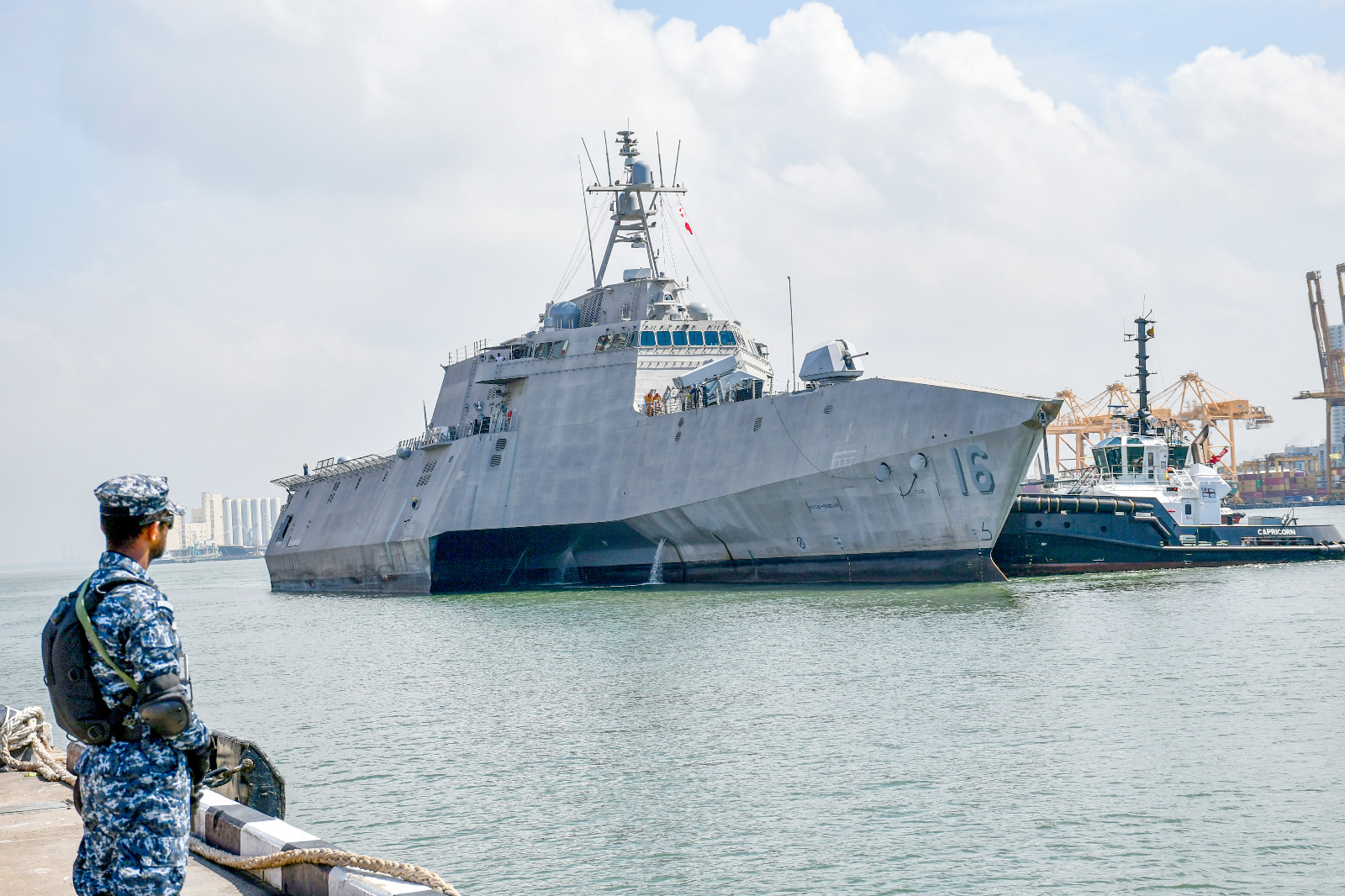
The U.S. Navy ship USS Tulsa (LCS 16) arrived at the Port of Colombo this morning, 7 October 2026 for replenishment purposes.
The visiting ship was welcomed by the Sri Lanka Navy in accordance with naval traditions.
The 127.7-metre-long platform is a Littoral Combat Ship commanded by Commander BM Wanier. Commissioned on 16 February 2019, USS Tulsa has since been in service with the US Navy.
The ship previously made a port call in Sri Lanka on 27 August 2025.
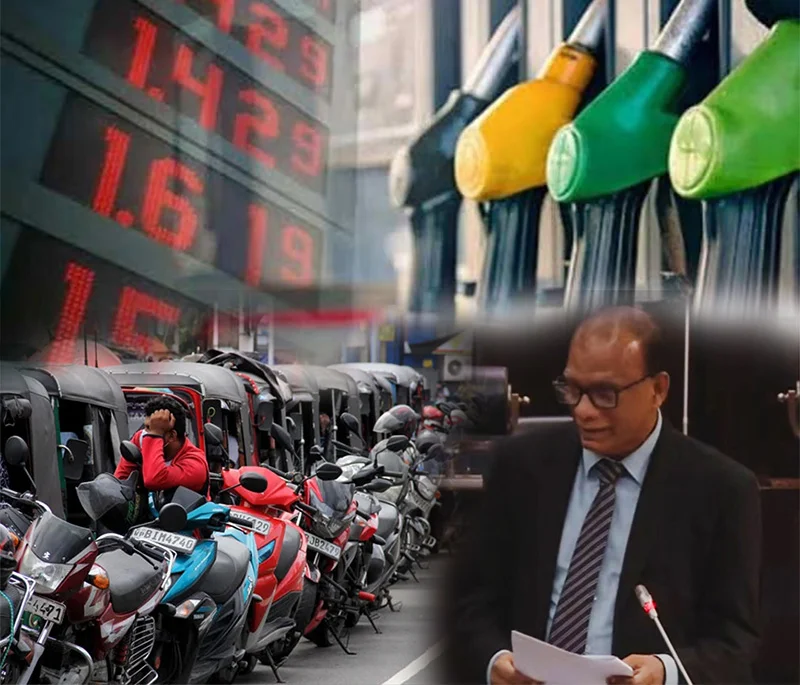
Govt. tells fuel distributors to maintain stocks to ensure uninterrupted supplies
by Saman Indrajith and Norman Palihawadane
The government had instructed private fuel distributors to maintain minimum stocks and ensure uninterrupted supplies to the market, Energy Minister Anura Karunathilaka told Parliament yesterday (06).
Karunathilaka said the Ministry of Energy Secretary had notified the relevant companies of the requirement, following a reduction in supplies by some private distributors, amid higher international fuel prices.
The Minister said private companies had informed the government that they were facing losses because international prices had risen while fuel was being sold, locally, at prevailing prices. As a result, some companies had reduced the volumes released to the market.
The reduced supplies had increased the burden on the Ceylon Petroleum Corporation (CPC), whose share of the diesel market had risen from about 54% to 82%, the Minister said.
“The CPC currently holds an 82% share of the market,” he said, adding that it had increased its supplies, compared with February, to compensate for the reduction by private distributors.
Karunathilaka said the government could not, under the existing agreements with private companies, specify the quantities they should supply to individual filling stations. However, it could require them to maintain minimum stocks in the country.
The Minister said the Energy Ministry had already instructed companies that had failed to maintain the required stocks to take steps to prevent supply disruptions.
The Minister attributed the queues reported at some filling stations to reduced supplies from private distributors, as well as normal variations in fuel distribution. He also said demand for CPC fuel had increased because private companies generally did not provide fuel to dealers on credit, while the CPC offered a three-day credit facility.
“We expect that, as the Ceylon Petroleum Corporation takes on this additional burden, the problem will ease to some extent by Wednesday or Thursday,” Karunathilaka said.
He said instructions had also been issued to increase supplies to CPC filling stations. A special discussion on the issue is scheduled for today (07), with officials of the Energy Ministry and CPC expected to participate,
along with President Anura Kumara Dissanayake.
Meanwhile, Petroleum Dealers’ Association officials have called for an early solution to the supply issue. Association Chairman D.V. Shantha Silva said queues had been reported at many filling stations, mainly those operated by private distributors.
He said the situation was not due to an overall shortage of fuel, but was linked to reduced orders by Lanka IOC, Sinopec and R.M. Parks amid concerns over losses incurred on fuel sales.
The Ceylon Petroleum Private Tanker Owners Association has urged motorists to refrain from panic buying, saying there was no nationwide disruption to fuel supplies.
The government earlier increased fuel prices and introduced a per-litre diesel subsidy following concerns raised by distributors over rising international prices.

Showers above 100 mm are likely at some places in the Western, Sabaragamuwa, Central, Uva and Southern provinces and in Anuradhapura district

Remembering Juvenal, Coke, Acton and Machiavelli

West Asian conflict undergoing manifold complications

Nissanka absence opens door for Sri Lanka’s young guns

The prelate who walked the talk

Needs of populace hit by Cyclone Ditwah seen as waiting to be addressed

‘Dates have the highest sugar content to fight Coronavirus’

Sunday Island 27 December – Headlines

#SundayIsland 17th December – Headlines

Sunday Island – 28th March

Sunday Island Headlines – 21 March

Sunday Island – 21st February – Headlines
-

 Editorial6 days ago
Colombo Port drug bust: The plot thickens
-

 Features4 days ago
The first woman in the foreign service or Ceylon Overseas Service it was then called
-

 Editorial5 days ago
Fuelling discontent and protest
-

 News3 days ago
Geneva takes up Sallay’s case and govt. ignores opportunity to answer accusations
-

 Latest News5 days ago
Tharindu Rathnayake, bowlers secure Asian Games Bronze for Sri Lanka
-

 Foreign News5 days ago
Ten injured after car crashes into rugby supporters in Australia
-

 Features3 days ago
Sri Lanka Cricket Bill: Governance reform is not yet a cricket strategy
-

 News4 days ago
Nearly 20 Iranian tankers stranded off Lanka amid US sanctions