
News
Talawakelle Tea Estates PLC and WNPS PLANT bring meaning to World Environment Day, through a massive reforestation drive

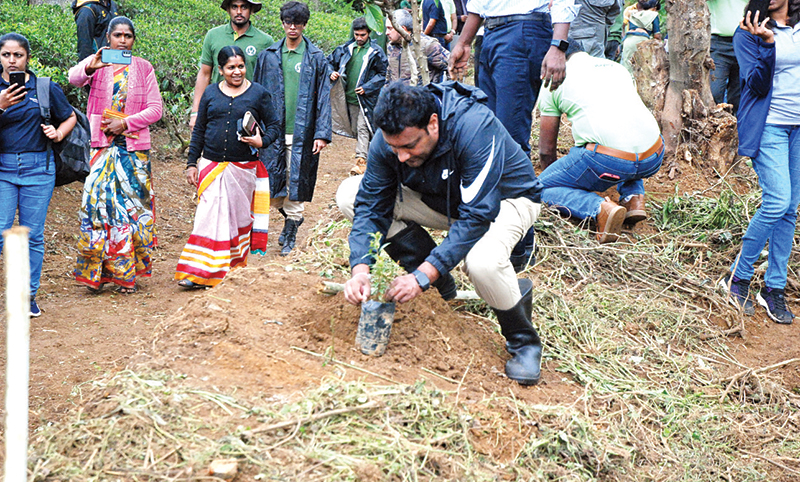
Embarking on a visionary restoration journey, Talawakelle Tea Estates PLC (TTE PLC) and WNPS PLANT jointly initiated one of the largest ecosystem restoration projects in recent times. This exciting but challenging, project in the central highlands aims at reforesting and creating a continual 13 km long forest passage bordering the Nanu Oya and Agra Oya banks, and will be supported by potentially different partners for each segment of the corridor, a WNPS news release said.
Celebrating World Environment Day on June 5, and the theme of this year- land restoration, desertification, and drought resistance, TTE PLC and WNPS PLANT launched the project with a tree planting program on the Somerset and Bearwell estate segments. The project will run through twelve estates under TTE PLC – Somerset, Bearwell, Dessford, Radella, Palmerston, Great Western, Mattakelle, Calsay, Clarendon, Holyrood, Wattegoda and Logie, and will create connectivity to the Great Western Mountain range forests.
The project spreads over four to five years and easily requires over 50,000 native trees and would create between 150 to 200 acres of new forest in the process. Giving life and hope to many wild species in the region, the initiative employs local community for the physical work, creates new plant nurseries and will have a baseline biodiversity study done as part of the process, the release explained.
“Restoring lands and bringing back biodiversity is critical for us to re-balance our hill country ecosystems. We desire to enhance the quality of life for all communities in and around our plantations, and protecting water sources, preventing flooding and helping people live in harmony with all species is very much a part of this vision.
“This initiative will yet again demonstrate our commitment and we are pleased to partner with WNPS PLANT on this ambitious multi-partner project” said Mr. Senaka Alawattegama, Director/ Chief Executive Officer of Talawakelle Tea Estates PLC.
The tree planting event brought together key figures and officials from the Central Environmental Authority, Forest Department, and Nuwara Eliya’s Assistant Divisional Secretary, along with key officials and volunteers from TTE PLC, WNPS, PLANT and the WNPS Youth Wing. The initially planned restoration work on the Somerset estate segment is funded by Avanti and Murtaza Esufally, whose generosity and social consciousness made a conservation dream a reality. The project invites added partners to join and take on the different segments in a similar fashion.
Speaking at the event, WNPS Senior Manager – Administration and Sustainable Initiatives, Ms. Rangika Perera called out the rich 130-year history of WNPS and outlined the PLANT vision of building connected forest corridors around the south-western parts of Sri Lanka and creating a social movement which anchored on private sector participation and land ownership. She iterated the importance of focusing on our future generations within the actions we take today.
Talawakelle Tea Estates PLC (TTE PLC) is renowned for its high-quality Ceylon tea and is owned by Hayleys Plantation Sector, which is one of the most awarded and certified plantation companies in the world. TTE PLC owns 16 estates, and some spread over Nanu Oya, and the Agra Oya. As part of their commitment towards restoring nature, TTE PLC has made it a priority to protect these natural spaces. Maintaining the riparian forest ecosystem associated with the upstream influents is crucial in safeguarding the overall health and function of the river.
WNPS PLANT is Sri Lanka’s largest private sector led ecosystem restoration initiative and aims at creating a reasonably connected forest corridor network, exclusively targeting the endemic rich southwestern quarter of the country (see www.plantsl.org). Recognized for its restoration work backed by solid science, PLANT mainly focuses on assisted natural regeneration and the natural regeneration of ecosystems.
Supported by many partners and working in over 20 locations already, PLANT focuses only on plant species that are native and typically found in that specific region or climatic zone and such efforts have further contributed to the continuous growth and success of WNPS PLANT. The WNPS (Wildlife and Nature Protection Society) and PLANT (Preserving Land and Nature (Pvt) Ltd) signed an MOU with the Hayleys Plantations in early 2023 to protect over 2,500 acres of land jointly and has been working continually on different initiatives since then.
Dr Roshan Rajadurai, Managing Director of Hayleys Plantation Sector expressed his appreciation to the teams for their commitment and hard work. “We began this journey with a clear vision of making a transformative impact on conservation, knowing full well that as a leading plantation company, we had a major obligation to Sri Lanka considering the land footprint that we are custodians for. Our entire Plantation sector has committed to deepen our conservation work through the engagement with PLANT and we see exciting outcomes through the progress so far” he added.
“Hill country wildlife is already challenged by increased incidents of conflict, and human populations continually keep encroaching into wilderness spaces for commercial and residential needs. By planting native species and creating corridors, PLANT and our partners aim to boost biodiversity, restore natural habitats, provide animal passages, improve water quality, and promote sustainability in this environmentally valuable region” said Sriyan de Silva Wijeyeratne, Chairman of PLANT.
Over the next few years, this project will continue to be a major focus of both parties as they battle against natural and man-made challenges. They feel that partners coming together to support a large project of this nature, is the only way forward in making impactful interventions of scale within Sri Lanka.


Of 180 member crew, 30 rescued by Sri Lanka Navy
Iran warship IRIS Dena (F75), returning home after participating in the Indian International Fleet Review, and MILAN 2026 international naval exercises, has been sunk off Sri Lanka. The US, Russia and Iran were among 74 participants.
Speculation is rife that the US attacked the vessel in international waters as part of the continuing offensive action under Operation Epic Fury, launched on 28 February. Before the attack in the Indian ocean, President Trump declared that the Iranian Navy Headquarters and nine Navy vessels had been destroyed.
The ill-fated Moudge-class frigate participated in the Indian exercises with the US Navy’s Arleigh Burke-class guided-missile destroyer USS Pinckney (DDG-91) and the Marshal Shaposhnikov, a Udaloy-class frigate of the Russian Navy. Sri Lanka also participated in the exercises. SLNS Sagara and Israeli built Fast Missile Vessel Nandimithra represented Sri Lanka. Forty two warships and submarines and 29 aircraft had been involved.
At the time of the attack, the domestically built vessel was crewed by 180 officers and men.
The US Embassy here did not respond to The Island media query whether the US sank IRIS Dena . The Island was unable to get in touch with Iranian Ambassador in Colombo Alireza Delkhosh though he earlier indicated his availability later in the day.
Minister of Foreign Affairs, Foreign Employment and Tourism, Vijitha Herath, told the Parliament yesterday that the Sri Lanka Navy and the Sri Lanka Air Force had acted in less than an hour of receiving the distressed signal at 5.08 am.
According to the Minister, the first naval craft was dispatched by 6 am, followed by a second vessel at 7 am, while Air Force units joined the mission, including the deployment of a surveillance aircraft to support search operations.
Approximately 180 personnel were believed to have been on board the stricken vessel. Of them, around 30 were reported to be in critical condition.
“To save the lives of those 30 persons, we intervened immediately,” Minister Herath said, adding that the rescued crew members were being transported to Karapitiya Hospital for urgent medical treatment. Some had already arrived by the time of his statement.
SLPP MP Namal Rajapaksa asked whether the Iranian ship had been attacked within Sri Lanka’s Exclusive Economic Zone (EEZ).
Responding to questions raised by Opposition MPs, including NDF Badulla District MP Chamara Sampath Dassanayake, who alleged that the Iranian vessel may have been struck in Sri Lankan waters, the Minister said the ship had been outside Sri Lanka’s maritime boundary when it issued the distress call.
MP Dassanayake queried whether the frigate had been hit as part of the ongoing military escalation involving the United States and Israel against Iran. There was no immediate confirmation from the government regarding the cause of the emergency.
Minister Herath stressed that Sri Lanka’s intervention was guided solely by humanitarian considerations and international obligations.
“We are bound by the International Convention on Maritime Search and Rescue (SAR) of 1979, which we have signed,” he told Parliament.
Under the convention, a signatory state is required to respond to maritime emergencies, regardless of nationality, the cause of the incident, or whether it occurs beyond its own territorial waters.
“According to this convention, if a vessel, or its crew, encounters danger beyond our territorial limits, we are obligated to intervene and protect those lives on humanitarian grounds,” Minister Herath said, adding Sri Lanka had acted immediately to prevent loss of life and had taken all urgent and necessary measures as a responsible state.
The Minister noted that the incident highlighted broader regional security vulnerabilities in maritime safety amid escalating tensions in the region. “A regional military situation would also have an impact on our country. The government’s position is that a negotiated solution must be pursued,” he said.
He also disclosed that President Anura Kumara Dissanayake had held a telephone discussion on Tuesday night with the leadership of the United Arab Emirates regarding the evolving regional situation.
Rescue operations were continuing at the time of going to press.
By Saman Indrajith and Shamindra Ferdinando
News
Justice Kumudini complains of male domination at senior levels, absence of a woman head of BASL


Judge of the Supreme Court Justice Kumudini Wickramasinghe has recently presented a stark analysis of the legal profession’s gender disparity, noting that in spite of women entering the legal field in substantial numbers, their representation dwindles at senior levels. She has highlighted critical statistics and the fact that only two women currently serve in the Supreme Court, none in the Court of Appeal, and that there has never been a woman President of the Bar Association of Sri Lanka (BASL).
“Inclusive leadership is not satisfied by entry-level participation,” Justice Wickramasinghe said. “It concerns who occupies the apex of institutional authority, who shapes doctrine, who speaks for the profession. These figures are not merely statistics; they are indicators of work yet unfinished.”
Justice Wickramasinghe said so at a seminar organised on the eve of International Women’s Day by the Bar Association of Sri Lanka (BASL), in collaboration with the Sri Lanka Women Lawyers’ Association (SLWLA). She underscored the need to address the systemic barriers preventing women from reaching the apex of the legal profession. Justice Wickramasinghe addressed the gathering as the Chief Guest.
BASL President Rajeev Amarasuriya, in his address, framed inclusivity not as charity or tokenism, but as “structural fairness.” He raised an important question being ‘who bears the responsibility of inclusivity’ and addressed the vital role of leadership in inclusivity. Furthermore, Amarasuriya challenged the profession to address the “gap between what we see coming into the profession and what we see at the top,” and clarified that such disparity did not stem from a lack of competence or commitment but from deep rooted practices and structural issues.
A dynamic panel discussion, moderated by Attorney-at-Law Tanushka Gunawardane, explored the multifaceted nature of inclusive leadership. The panel featured Justice Wickramasinghe, Constitutional Council Member Professor Wasantha Seneviratne (joining online), Senior Instructing Attorney Shiranthi Gunawardhana, and corporate leader Yanina Weerasinghe.
Professor Wasantha Seneviratne distinguished between mere representation and true participation, stating that inclusion becomes meaningful only when women have the “agency and authority to make decisions.” She emphasised that inclusive leadership is both a moral obligation and a pragmatic governance strategy.
Senior Instructing Attorney Shiranthi Gunawardhana shared personal anecdotes from her 50-year career, urging senior lawyers to act as mentors rather than gatekeepers. She stressed the importance of creating space for young female lawyers by offering flexibility and support to help them balance professional and personal responsibilities.
Yanina Weerasinghe, Head of Legal at Brandix, argued that true inclusion is measured by influence, not optics. “Diversity is being present; inclusivity is being influential,” she explained, warning against tokenism and calling for “cerebral opportunities” where women are selected, based on talent, and given a genuine voice in decision-making.
Justice Wickramasinghe addressed the relationship between judicial hierarchy and inclusion, asserting that authority and accessibility can coexist. “A judge can be firm in decisions while remaining approachable,” she said, adding that power exercised with transparency and humility strengthens, rather than weakens, institutional legitimacy.
The seminar also heard from Dilani Yatawaka, Managing Director/CEO of Ideal Motors, who shared her perspective as a female leader in the male-dominated automotive sector. She reinforced the critical role of supportive superiors and societal encouragement to enable women to ascend the career ladder while managing family responsibilities.
BASL Women Lawyers’ Professional and Career Development Committee Chair Indika Nagaratne Koththagoda in her welcome address said that the distinguished gathering was honoured to have Her Ladyship Justice Kumudini Wickramasinghe, Judge of the Supreme Court of Sri Lanka, as the Chief Guest and a key panellist and also welcomed the other panellists Attorneys-at-Law Professor Wasantha Seneviratne, Ms. Shiranthi Gunawardena and Yanina Weerasinghe for agreeing to share their insights on the subject during the ensuing panel discussion to be moderated by Attorney-at-Law Ms. Tanushka Gunawardane.
In her closing remarks, Nalani Manatunga, Co-Chairperson of the BASL Women Lawyers’ Professional and Career Development Committee, challenged the audience to reflect on the true meaning of leadership. “A position gives authority, but leadership gives direction,” she said. “Inclusive leadership is not about occupying space; it’s about creating space. Let our leadership not be measured by the chairs we occupy, but by the doors we leave open.”

A crisis was prevailing at the Government Printing Department due to the absence of a permanent Government Printer, Parliament was told yesterday, raising concerns over confidentiality, quality control and national security.
NDF MP Ravi Karunanayake demanded to know what steps the government had taken to fill the long-standing vacancy at the department, describing the situation as a serious administrative lapse.
“The Government Printing Department is a very important and closed service category institution. However, it has been functioning without a permanent Government Printer for some time,” Karunanayake said.
The MP pointed out that the department handles highly sensitive material, including documents related to defence and national security, as well as other classified publications.
“The non-availability of a permanent Government Printer affects the quality, confidentiality and sustainability of the work there. Has the Government conducted an audit on the possible issues arising from this situation? What immediate action has been taken to resolve this crisis?” he asked.
Responding on behalf of the Government, Prime Minister Dr Harini Amarasuriya said the vacancy had been filled on a temporary basis following a Cabinet decision.
She said an experienced officer from the Sri Lanka Administrative Service had been appointed on contract as Acting Government Printer to ensure operational continuity and maintain security standards in relation to sensitive printing tasks.
The Prime Minister acknowledged that the issue reflected broader systemic weaknesses in public service recruitment and professional development that had persisted for years.
“To bridge these gaps, the Government is initiating specialised training programmes and offering international scholarships for high-performing students to build future technical capacity,” she said.
Chief Government Whip and Health and Mass Media Minister Dr Nalinda Jayatissa said that under existing service minutes, more than two decades of experience were required for an officer to qualify for the top post, and that there were currently no internal candidates eligible for appointment.
He said that the department was facing a leadership crisis and administrative instability due to the lack of a permanent, qualified Government Printer.
By Saman Indrajith

Afternoon showers expected in the Uva and Sabaragamuwa provinces and in Hambantota, Nuwara-Eliya and Ampara districts

Trump administration launches US military operation in Ecuador

US sinks Iranian warship off Galle returning from Indian naval exercise

Justice Kumudini complains of male domination at senior levels, absence of a woman head of BASL

No qualified printer to head Government Printing Department

Wildlife Dept. fails on elephant fence management: Withanage

‘Dates have the highest sugar content to fight Coronavirus’

Sunday Island 27 December – Headlines

#SundayIsland 17th December – Headlines

Sunday Island – 28th March

Sunday Island Headlines – 21 March

Sunday Island – 21st February – Headlines
-

 Features3 days ago
Brilliant Navy officer no more
-

 Opinion6 days ago
Jamming and re-setting the world: What is the role of Donald Trump?
-
 Features6 days ago
An innocent bystander or a passive onlooker?
-

 Opinion3 days ago
Sri Lanka – world’s worst facilities for cricket fans
-

 Business6 days ago
An efficacious strategy to boost exports of Sri Lanka in medium term
-
 Features4 days ago
Overseas visits to drum up foreign assistance for Sri Lanka
-
 Features4 days ago
Sri Lanka to Host First-Ever World Congress on Snakes in Landmark Scientific Milestone
-

 Features3 days ago
A life in colour and song: Rajika Gamage’s new bird guide captures Sri Lanka’s avian soul