
News
Tainted NMRA directors must be removed to restore trust in medical procurement process: Kumudesh

By Rathindra Kuruwita
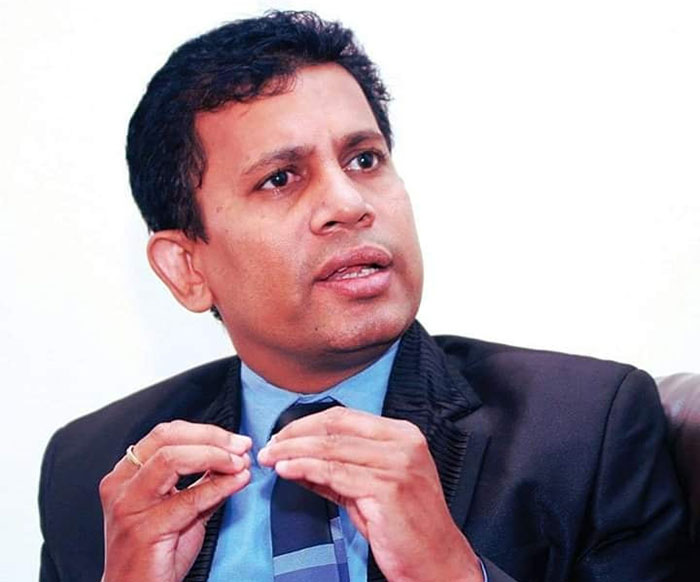
Health Minister Dr. Ramesh Pathirana needs to change the tainted Board of Directors of the National Medicines Regulatory Authority (NMRA) if he is really keen to address the issues in medical procurement, President of the College of Medical Laboratory Science (CMLS), Ravi Kumudesh, says.
Attorney-at-Law Manoj Gamage, who represented former Health Minister Keheliya Rambukwella, is a board member of the NMRA. He was present when a stock of bogus intravenous human immunoglobulin (IVIG) was procured by the Health Ministry, Kumudehs told The Island.
“It will be difficult for us to believe that Dr. Pathirana is acting in good faith, if the Minister, and the newly appointed head of the NMRA, plans to continue with the same board of directors. These people need to go to restore some trust,” he said.
Kumudesh added that NMRA still does not have a CEO. The newly appointed Chairman can’t do all the administrative work at the NMRA, he said.
“There is a management aspect and the institution needs an expert in management. Not only that, our main quality control lab, i.e., National Drug Quality Assurance Laboratory (NDQAL), has been operating without a director for the past few years. The whole world is talking about the quality control of our medicine. There is a large allocation for the improvement of medical drug quality testing in the budget. However, the quality assurance lab doesn’t have a director,” Kumudesh said.
Meanwhile, Society of Government Pharmacists (SGP) President Thushara Ranadeva said the NMRA leadership acted in a suspicious manner, from the beginning.
“When it was revealed that the Waiver of Registration (WOR), presented by the company that is involved with selling bogus immunoglobulin, was false, the then NMRA leadership started a media circus. Former Health Minister, Keshelya Rambukwella, former NMRA Chairman S.D. Jayaratne, and former CEO Dr. Vijith Gunasekera, should have informed the CID of this discovery and started an investigation. By talking about this in press conferences, these officials allowed some people involved in this to cover their tracks. A lot of vital documents needed for the investigation are missing. If an investigation was done in secret, the CID could have had an airtight case by now,” he said.
The CID on Thursday (28) recorded another statement from the owner of the company, which sold a stock of fake intravenous human immunoglobulin (IVIG) to the Health Ministry. The CID recorded the statement in compliance with an order issued by Maligakanda Magistrate Lochani Abeywickrama on Wednesday. When the case was taken up on Wednesday, a lawyer appearing for the defendant, said that his client had mentioned the name of former Health Minister Keheliya Rambukwella when he was questioned first. However, the investigators had refused to mention the former Minister’s name in the statement, the counsel said.




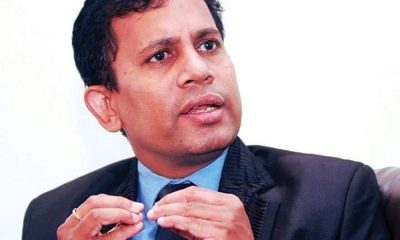

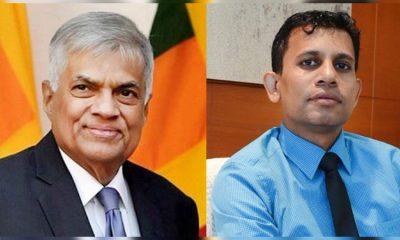


A senior electrical engineers attached to the Ceylon Electricity Board (CEB) have warned that unresolved structural and policy issues within the power sector could threaten the long-term stability of the national grid, urging authorities to act swiftly to address mounting technical and administrative concerns.
Speaking on condition of anonymity, they said the electricity network was operating under increasing strain due to delayed infrastructure upgrades, financial constraints, and growing demand.
“The national grid is not something that can be managed casually. It requires systematic planning, preventive maintenance, and timely investment. If these are compromised, the risk to system stability increases,” the engineers said.
They noted that several transmission and substation modernisation projects were behind schedule, while ageing thermal plants continued to shoulder a significant portion of the country’s base load demand.
“Engineers are committed to ensuring an uninterrupted supply. But professional expertise must be respected in decision-making. Technical matters cannot be subjected to short-term political considerations,” the engineers added.
Meanwhile, the powerful Ceylon Electricity Board Engineers’ Union (CEBEU) echoed similar concerns, warning that failure to address long standing professional and structural issues could have serious consequences for the power sector.
In a statement, the CEBEU has said that engineers have repeatedly called for reforms that safeguard the integrity of the utility and ensure that operational decisions remain grounded in technical evaluation.
“The electricity sector is a critical national asset. Any attempt to weaken institutional safeguards or bypass professional consultation will directly impact service reliability and long-term sustainability,” the union said.
The CEBEU has stressed the importance of transparent engagement between policymakers and technical personnel, noting that morale among engineers could be affected if their concerns continue to go unheard.
Industry analysts point out that the power sector plays a central role in Sri Lanka’s economic recovery efforts, particularly as the country seeks to expand industrial activity and attract investment. Stability in electricity supply remains a key determinant of business confidence.
The senior engineer stressed d that the objective of raising concerns is not confrontation but preservation of the grid’s integrity.
“Our responsibility is to the public. Electricity powers hospitals, industries, and homes. Safeguarding the system is a national duty,” he said.
With tensions simmering within the sector, stakeholders say meaningful dialogue between authorities, engineers, and trade unions will be crucial in ensuring that Sri Lanka’s power infrastructure remains resilient in the face of growing challenges.
By Ifham Nizam
The Central Bank (CBSL) yesterday announced that investigations had identified 24 companies and applications operating prohibited pyramid schemes.
In a public notice issued under Section 83C of the Banking Act, No. 30 of 1988 (as amended), the CBSL said the following entities had been “ascertained and determined as prohibited schemes”: Tiens Lanka Health Care (Pvt) Ltd, Best Life International (Pvt) Ltd, Mark–Wo International (Pvt) Ltd, V M L International (Pvt) Ltd, Global Lifestyle Lanka (Pvt) Ltd, Fast3Cycle International (Pvt) Ltd, Sport Chain App / Sport Chain ZS Society Sri Lanka, OnmaxDT, MTFE App / MTFE SL Group / MTFE Success Lanka / MTFE DSCC Group, Fastwin (Pvt) Ltd, Fruugo Online App / Fruugo Online (Pvt) Ltd, Ride to Three Freedom (Pvt) Ltd, Qnet / Questnet, Era Miracle (Pvt) Ltd and Genesis Business School, Ledger Block, Isimaga International (Pvt) Ltd, Beecoin App and Sunbird Foundation, Windex Trading, The Enrich Life (Pvt) Ltd, Smart Win Entrepreneur (Pvt) Ltd, Net Fore International (Pvt) Ltd / Netrrix, Pro Care (Pvt) Ltd and Shade of Procare (Pvt) Ltd, SGO / sgomine.com and I.C.A.N Advertising (Pvt) Ltd and its affiliates icanonlineadvertising.com, bannercuts.com, bannercuts.lk, bannercuts.net and bannercuts.org
The CBSL said pyramid schemes, also referred to as multi-level marketing or direct selling schemes in certain instances, operate as recruitment-based programmes in which members enlist others into an expanding “downline” structure resembling a chain letter.
Under such arrangements, a portion of the fees paid by new recruits is channelled upwards to earlier participants, known as the “upline”, who are fewer in number.
The Central Bank warned that such schemes are inherently unsustainable, with the vast majority of participants at the lower tiers eventually losing their investments, while only a small number of early entrants are able to recover or profit from the funds contributed by subsequent recruits. It noted that when a pyramid scheme collapses, up to 99 per cent of those in the lower levels risk losing their money.
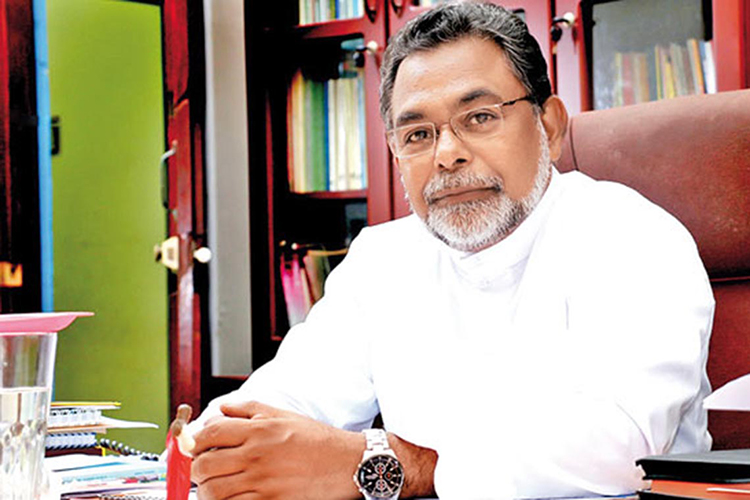
Director of Communications for the Archdiocese of Colombo, Rev. Fr. Cyril Gamini Fernando, yesterday expressed confidence that ongoing investigations into the 2019 Easter Sunday terror attacks would yield meaningful results and urged the public and all stakeholders to exercise patience and allow the probe to proceed independently.
Addressing a media briefing in Colombo yesterday, Fr. Fernando called on all parties to refrain from interfering with the investigations, warning that any attempt to obstruct the process would amount to a grave injustice to the victims.
He said he believed there was credible evidence to warrant the arrest of military intelligence veteran Maj. Gen. (Retd.) Suresh Sallay.
Referring to the coordinated bombings on April 21, 2019, which targeted churches and hotels and claimed nearly 300 lives, Fr. Fernando described the attacks as a “barbaric” act and a “massacre” that killed worshippers attending Easter services as well as individuals from different religious and ethnic communities.
By Norman Palihawadane

Can resourceful New Zealand lock in semi-final spot against already-qualified England?

Fair weather will prevail over most parts of the island

CEB engineers raise alarm over power sector stability

CB identifies 24 pyramid scams in Sri Lanka

Church urges patience, warns against interference with Easter attacks probe

GMOA ups the ante, pulls out of ‘Arogya Clinics’

‘Dates have the highest sugar content to fight Coronavirus’

Sunday Island 27 December – Headlines

#SundayIsland 17th December – Headlines

Sunday Island – 28th March

Sunday Island Headlines – 21 March

Sunday Island – 21st February – Headlines
-

 Features5 days ago
Why does the state threaten Its people with yet another anti-terror law?
-
 Features5 days ago
Reconciliation, Mood of the Nation and the NPP Government
-

 Features5 days ago
Victor Melder turns 90: Railwayman and bibliophile extraordinary
-

 Features4 days ago
LOVEABLE BUT LETHAL: When four-legged stars remind us of a silent killer
-
 Features5 days ago
Victor, the Friend of the Foreign Press
-
 Latest News6 days ago
New Zealand meet familiar opponents Pakistan at spin-friendly Premadasa
-

 Latest News6 days ago
Tariffs ruling is major blow to Trump’s second-term agenda
-

 Latest News7 days ago
ECB push back at Pakistan ‘shadow-ban’ reports ahead of Hundred auction