
Midweek Review
Sumathy’s Ingirunthu

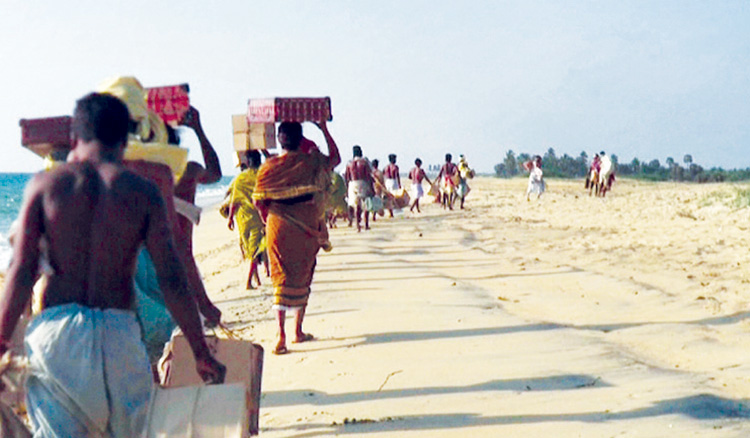
(Here and Now):
The Malaiyaha and Memory of the World 1823-2023
“It is intensely composed. I greatly appreciated the tension and obstacles to resolution along the way. We so rarely now see films that place that kind of creative demand/opportunity on the viewer.”
Anne Blackburn (Professor of South Asian & Buddhist Studies, Cornell University, 2017).
by Laleen Jayamanne
Structure and Process
Sumathy Sivamohan’s film Ingirunthu (2012), is astutely described here by Anne Blackburn. She highlights the unusually open ways in which shots, scenes and sequences are structured, which makes it difficult to immediately categorise the film generically and neatly thematise its several concerns and scope though it’s not a ‘difficult’ film, being very watchable. As the quotation indicates, the film invites us to think freely and imaginatively about what we have seen. As a film critic/scholar, I welcome this rare opportunity to provide a critical response, attentive to the film’s ethico-aesthetic crafting of Sivamohan’s own personal engagement (as an outsider) with vital aspects of life of the Malaiyaham people of the hill-country of Lanka. The experiences of this ethnic group, originally brought from South India as indentured labour to work in the coffee and tea plantations, by the Colonial British administration of Ceylon in the early 19th Century, have never been presented in all their historical complexity and violence, on film.
They, as an ethnically marked social group, speaking Tamil, have been hidden in plain sight. Sivamohan herself, as a Jaffna Tamil and Professor of English, who translates fluently between both Tamil and English, is a performer. She is well aware of the historical differences and tensions between the Jaffna Tamils and the Malaiyaha people whose very citizenship has been the site of post-colonial political violence and struggle. Among other stark differences, the differences in accents must be a powerful sonic marker of this fraught historical legacy which I can only imagine and read about because I don’t know Tamil. Within this historical context, the title of the film about the ‘here and now’ of Malaiyaha every-day-life is also presented as ‘Sumathy’s ‘here and now’ (in the credits), meaning that the very process of making of the film was part of the film’s story, folded into its telling. It’s worth recording that Sivamohan’s crew were multi-ethnic (as they continue to be in her practice), as was the case in the robust era of popular Sinhala cinema, from 1947 into the ’60s, when many technicians, producers, directors and musicians were both Muslim and Tamil. And of course, the star of the Lankan national cinema, Daisy Daniel or Rukmani Devi, was a Tamil who spoke and sang in a perfect Sinhala accent.
Intensive Composition
Also, the specification of what Blackburn calls ‘intensive composition’ invites a sustained conceptualisation, in terms of exploring the varying moods, tones, atmosphere and competing rhetorical moves of the film. This is the rich dynamic domain of sensations, feelings and emotions, which experiences have hardly impinged on the sensibilities of the Sinhala majority nation of Lanka except when the Malaiyaha people became an electorally significant block, as was the case with the Dalit of India. But we do know, as a general fact, the essential role their labour plays in the tea industry and the economy of the nation. But this awareness has mainly been culturally capitalised as picturesque images on tourist brochures or post cards of Malaiyaha women plucking tea with a smile or as smiling romantic couples in Sinhala genre films, driving sports cars through these scenic landscapes, singing love songs. The Malaiyaha people’s every-day life, their very here and now struggles, joys and aspirations have not been of much interest to the Lankans who may have glimpsed, through mist, their inadequate layams or line-housing (dotting beautiful hill-country landscapes, carpeted with lush green tea bushes), from a train window as we rode past them on up-country holidays, while their children waved to us.
Mobile Frames
-

- Peter the Accordion Player
Historians and theorists of Early Cinema (1895-1907), have linked the film frame to the window frame of trains, with their similar powers of mobility, selection and focus, unlike that of the still-photographic or painterly frames. They have also pointed out that historically, trains and the cinematic apparatus are technological products of 19th Century industrial modernity. The steam train and the movie camera are siblings, mechanical apparatuses that have transformed human civilization through industrialisation of production, distribution and consumption. They have also created new speeds in transportation and made human vision and mind adjust to the mechanisation of perception through technology. Some of the earliest black and white archival photographs (of those who became the Malaiyaha folk, as they arrived in Ceylon from several South Indian regions), are of them standing on railway platforms next to trains. Several scenes of the film take place at the Radella Station while trains wind through the landscape, tooting, from time to time. Some of the landscape shots are taken through train windows. Also, a popular genre of actuality films in the silent era were shot with the two mobile frames in concert. Among the very first films screened in Paris in 1895 was one simply called Arrival of a Train at the Station (1min) by the Lumiere Brothers.
One of the most powerful sequences in Ingirunthu takes place on the railway platform and on the train, taking a ‘repatriated’ group of Malaiyaha people back on their trek to India, which their own ancestors took on perilous boats and then on foot to the hill country, to create the coffee and tea plantations by clearing jungles, which also led to the building of the train tracks for commercial transport of goods. The shots of the women seated within the train compartments, the young girls hanging out of the several windows, become emotionally charged (intensive), because we have by then come to know some of them a little in the film; who they are, their families and their daily routines. They are now the victims of the 1964 ‘Sirima-Shasthri Pact’ of repatriation of some 500,000 Malaiyaha people back to India. A printed archival document and a voice over reportage provides this information. Then we are shown these handful of people subjected to its violent decree, shifting from historical document to the story embedded in framed shots on the railway platform and within the carriages. These doubly enframed shots (camera-frame and train window-frame) encompass a vast duration, and in so doing they become truly epic-memory (non-subjective), images of historical State violence and injustice done to the Malaiyaha citizens of Ceylon. This enframing, of history and individual memory within epic-memory, is a form of ‘intensive’ composition, the individuation of abstract historical forces (State decrees, statistics), that Blackburn spoke of. The intensity (dynamism), of this silent sequence is remarkable and we also become aware of how it is created (through enframing), at the same time, which is part of its Epic, rather than Dramatic structure. We see here how the mobile framed images are saturated with both thoughts and feelings. They also give us access to a deep historical time at a global scale of colonial expansion, of industrialisation of time, while keeping the individual subjects with their own person stories and the small provisional collective also in focus. This is intensive composition of time, intimating the dynamics of several competing durations within this silent sequence of shots, an epic memory or a ‘memory of the world’. I recall here the ‘Memory of the World’ archive, which is a UNESCO instrument for the preservation of the audio-visual heritage of mankind.
Modern Time
Railway travel in the 19th Century necessitated the standardisation and synchronisation of time and the invention of watches in the West. These in turn empowered the British Imperial project in the colonies. But these epic-shots and scene on the train are at the same time also individually tragic in terms of each person’s unique life story which the industrial magic of the camera acknowledges with its enframed close-ups of faces in clusters, one woman crying silently. The handsome middle-aged grandmother, of the orphaned, now adult mute Esther Valley, who we met at the beginning of the film (keening for her dead daughter and orphaned grand-child), is foregrounded at a window in profile, in a large handsome close-up, even as the train pulls out. This sequence leaves a sharp memory trace of the group and of the women focused on by the cinematic close-up with its unique sensory values of magnification of detail. The only person who stands on the platform watching the departing train, the silent witness to this historical wrenching of people he knew, from their homes, kin and country of birth, is Peter, the man with a piano accordion with whom the film opens.
The Accordion Player as Chorus
-

- Grandma expatriation
Ingirunthu opens with a man (Peter) walking towards us wearing a white verti, long white shirt, a dark wool vest and a multi coloured turban. He appears to carry something strung on his shoulder which we can’t quite see. His face has a natural intensity even in repose and as he walks forward and looks up, we cut to a large banner strung across the road announcing the arrival of MG Ramachandran, popular star of Tamil South India cinema who was in fact born in Kandy, Ceylon. Popularly known as MGR, he has a huge fan base on the estate with even a statue to him sporting a pair of dark glasses and a lamp lit in his honour. As Peter turns round to look, film music swells up and we cut to a clip of MGR in an open landscape near the Himalayas singing a song about his sacred homeland (janma bhumi), earth. We are now wafted into a very popular Tamil genre film musical routine which is played out for a while which cuts to the formal meeting welcoming the star to the estate. We get the feeling that this is not going to be a documentary about the tea estates. Peter joins the jostling crowd but soon leaves and next we see him seated alone in an open landscape playing his accordion for the first time, only to be chased off by a cop because his music would interfere with the proceedings of the meeting. The appearance of a cop out of nowhere is because of the presence of the star and the excited fans, one realises. But there is a hint of an undercurrent in that odd scene of casual censorship of music in the middle of a tea estate at night.
Sivamohan speaks of her process of creating the character of Peter in the following way:
“I wrote the character of Peter because I had met Shakthivel and spoken to him. I was fascinated by him and the role he could play as a figure who cuts across time. But wanted to give him palpable social space, too, in the layam. I wanted to begin with the MGR scene and Peter attending the event. I think he said he went to see him when he came to Hatton. If I’d not met Shakthivel and not had that conversation one evening in his layam I don’t think I would have had that figure. Doubt it. He triggered a lot”.
It would certainly have been a very different film without him! We can see that this character has a liminal presence, both a person living within the community but also one who stands apart watching, not least because of the accordion he carries and plays at whim. In real life he actually played his accordion in a band. But in the film narrative it’s unclear what he does in the community for a living, which ambiguity is emphasised as he is always dressed impeccably in white and disappears after the 1983 race-based violence, leaving his accordion on a railway bench. But he returns for the funeral (of two murdered political activists), almost like a phantom presence, as he lightly walks across Esther Valley’s room where she is absorbed in a picture book. At the film’s opening Peter enters a house where her grandmother (who we later see in close-up on the deportation train), is keening at the death of her own daughter who has left an orphaned infant who is Esther Valley. Peter goes up to the hanging cloth cradle, looks at the infant and then up repeatedly as he hears a distant hymn. A cut reveals the infant’s mother’s small funeral procession winding its way through the estate. When Peter goes out and is seated with hands clasped as in prayer, the parish priest comes up to him trying to soothe him with religious platitudes about heaven. He stands up respectfully and tells the priest firmly that the child has no mother and no father here, refusing the religious consolation of a hereafter.



The failure on the part of the Janatha Vimukthi Peramuna (JVP)-led National People’s Power (NPP) government to fulfil a plethora of promises given in the run up to the last presidential election, in September, 2024, and a series of incidents, including cases of corruption, and embarrassing failure to act on a specific weather alert, ahead of Cyclone Ditwah, had undermined the administration beyond measure.
Ditwah dealt a knockout blow to the arrogant and cocky NPP. If the ruling party consented to the Opposition proposal for a Parliamentary Select Committee (PSC) to probe the events leading to the November 27 cyclone, the disclosure would be catastrophic, even for the all-powerful Executive President Anura Kumara Dissanayake, as responsible government bodies, like the Disaster Management Centre that horribly failed in its duty, and the Met Department that alerted about the developing storm, but the government did not heed its timely warnings, directly come under his purview.
The NPP is on the back foot and struggling to cope up with the rapidly developing situation. In spite of having both executive presidency and an overwhelming 2/3 majority in Parliament, the government seems to be weak and in total disarray.
The regular appearance of President Dissanayake in Parliament, who usually respond deftly to criticism, thereby defending his parliamentary group, obviously failed to make an impression. Overall, the top NPP leadership appeared to have caused irreparable damage to the NPP and taken the shine out of two glorious electoral victories at the last presidential and parliamentary polls held in September and November 2024 respectively.
The NPP has deteriorated, both in and out of Parliament. The performance of the 159-member NPP parliamentary group, led by Prime Minister Dr. Harini Amarasuriya, doesn’t reflect the actual situation on the ground or the developing political environment.
Having repeatedly boasted of its commitment to bring about good governance and accountability, the current dispensation proved in style that it is definitely not different from the previous lots or even worse. (The recent arrest of a policeman who claimed of being assaulted by a gang, led by an NPP MP, emphasised that so-called system change is nothing but a farce) In the run-up to the November, 2024, parliamentary polls, President Dissanayake, who is the leader of both the JVP and NPP, declared that the House should be filled with only NPPers as other political parties were corrupt. Dissanayake cited the Parliament defeating the no-confidence motions filed against Ravi Karunanayake (2016/over Treasury Bond scams) and Keheliya Rambukwella (2023/against health sector corruption) to promote his argument. However, recently the ongoing controversy over patient deaths, allegedly blamed on the administration of Ondansetron injections, exposed the government.
Mounting concerns over drug safety and regulatory oversight triggered strong calls from medical professionals, and trade unions, for the resignation of senior officials at the National Medicines Regulatory Authority (NMRA) and the State Pharmaceutical Corporation (SPC).
Medical and civil rights groups declared that the incident exposed deep systemic failures in Sri Lanka’s drug regulatory framework, with critics warning that the collapse of quality assurance mechanisms is placing patients’ lives at grave risk.
The Medical and Civil Rights Professional Association of Doctors (MCRPA), and allied trade unions, accused health authorities of gross negligence and demanded the immediate resignation of senior NMRA and SPC officials.
MCRPA President Dr. Chamal Sanjeewa is on record as having said that the Health Ministry, NMRA and SPC had collectively failed to ensure patient safety, citing, what he described as, a failed drug regulatory system.
The controversy has taken an unexpected turn with some alleging that the NPP government, on behalf of Sri Lanka and India, in April this year, entered into an agreement whereby the former agreed to lower quality/standards of medicine imports.
Trouble begins with Ranwala’s resignation
The NPP suffered a humiliating setback when its National List MP Asoka Ranwala had to resign from the post of Speaker on 13 December, 2024, following intense controversy over his educational qualification. The petroleum sector trade union leader served as the Speaker for a period of three weeks and his resignation shook the party. Ranwala, first time entrant to Parliament was one of the 18 NPP National List appointees out of a total of 29. The Parliament consists of 196 elected and 29 appointed members. Since the introduction of the National List, in 1989, there had never been an occasion where one party secured 18 slots.
The JVP/NPP made an initial bid to defend Ranwala but quickly gave it up and got him to resign amidst media furor. Ranwala dominated the social media as political rivals exploited the controversy over his claimed doctorate from the Waseda University of Japan, which he has failed to prove to this day. But, the JVP/NPP had to suffer a second time as a result of Ranwala’s antics when he caused injuries to three persons, including a child, on 11 December, in the Sapugaskanda police area.
The NPP made a pathetic, UNP and SLFP style effort to save the parliamentarian by blaming the Sapugaskanda police for not promptly subjecting him for a drunk driving test. The declaration made by the Government Analyst Department that the parliamentarian hadn’t been drunk at the time of the accident, several days after the accident, does not make any difference. Having experienced the wrongdoing of successive previous governments, the public, regardless of what various interested parties propagated on social media, realise that the government is making a disgraceful bid to cover-up.
No less a person than President Dissanayake is on record as having said that their members do not consume liquor. Let us wait for the outcome of the internal investigation into the lapses on the part of the Sapugaskanda police with regard to the accident that happened near Denimulla Junction, in Sapugaskanda.
JVP/NPP bigwigs obviously hadn’t learnt from the Weligama W 15 hotel attack in December, 2023, that ruined President Ranil Wickremeinghe’s administration. That incident exposed the direct nexus between the government and the police in carrying out Mafia-style operations. Although the two incidents cannot be compared as the circumstances differ, there is a similarity. Initially, police headquarters represented the interests of the wrongdoers, while President Wickremesinghe bent over backwards to retain the man who dispatched the CCD (Colombo Crime Division) team to Weligama, as the IGP. The UNP leader went to the extent of speaking to Chief Justice Jayantha Jayasuriya, PC, and Speaker Mahinda Yapa Abeywardena to push his agenda. There is no dispute the then Public Security Minister Tiran Alles wanted Deshabandu Tennakoon as IGP, regardless of a spate of accusations against him, in addition to him being faulted by the Supreme Court in a high-profile fundamental rights application.
The JVP/NPP must have realised that though the Opposition remained disorganised and ineffective, thanks to the media, particularly social media, a case of transgression, if not addressed swiftly and properly, can develop into a crisis. Action taken by the government to protect Ranwala is a case in point. Government leaders must have heaved a sigh of relief as Ranwala is no longer the Speaker when he drove a jeep recklessly and collided with a motorcycle and a car.
Major cases, key developments
Instead of addressing public concerns, the government sought to suppress the truth by manipulating and exploiting developments
* The release of 323 containers from the Colombo Port, in January 2025, is a case in point. The issue at hand is whether the powers that be took advantage of the port congestion to clear ‘red-flagged’ containers.
Although the Customs repeatedly declared that they did nothing wrong and such releases were resorted even during Ranil Wickremesinghe’s presidency (July 2022 to September 2024), the public won’t buy that. Container issue remains a mystery. That controversy eroded public confidence in the NPP that vowed 100 percent transparency in all its dealings. But the way the current dispensation handled the Port congestion proved that transparency must be the last thing in the minds of the JVPers/NPPers holding office.
* The JVP/NPP’s much touted all-out anti-corruption stand suffered a debilitating blow over their failure to finalise the appointment of a new Auditor General. In spite of the Opposition, the civil society, and the media, vigorously taking up this issue, the government continued to hold up the appointment by irresponsibly pushing for an appointment acceptable to President Dissanayake. The JVP/NPP is certainly pursuing a strategy contrary to what it preached while in the Opposition and found fault with successive governments for trying to manipulate the AG. It would be pertinent to mention that President Dissanayake should accept the responsibility for the inordinate delay in proposing a suitable person to that position. The government failed to get the approval of the Constitutional Council more than once to install a favourite of theirs in it, thanks to the forthright position taken by its civil society representatives.
The government should be ashamed of its disgraceful effort to bring the Office of the Auditor General under its thumb:
* The JVP/NPP government’s hotly disputed decision to procure 1,775 brand-new double cab pickup trucks, at a staggering cost exceeding Rs. 12,500 mn, under controversial circumstances, exposed the duplicity of that party that painted all other political parties black. Would the government rethink the double cab deal, especially in the wake of economic ruination caused by Cyclone Ditwah? The top leadership seems to be determined to proceed with their original plans, regardless of immeasurable losses caused by Cyclone Ditwah. Post-cyclone efforts still remain at a nascent stage with the government putting on a brave face. The top leadership has turned a blind eye to the overwhelming challenge in getting the country back on track especially against the backdrop of its agreement with the IMF.
Post-Cyclone Ditwah recovery process is going to be slow and extremely painful. Unfortunately, both the government and the Opposition are hell-bent on exploiting the miserable conditions experienced by its hapless victims. The government is yet to acknowledge that it could have faced the crisis much better if it acted on the warning issued by Met Department Chief Athula Karunanayake on 12 November, two weeks before the cyclone struck.
Foreign policy dilemma
Sri Lanka moved further closer to India and the US this year as President Dissanayake entered into several new agreements with them. In spite of criticism, seven Memorandums of Understanding (MoUs), including one on defence, remains confidential. What are they hiding?
Within weeks after signing of the seven MoUs, India bought the controlling interests in the Colombo Dockyard Limited for USD 52 mn.
Although some Opposition members, representing the SJB, raised the issue, their leader Sajith Premadasa, during a subsequent visit to New Delhi, indicated he wouldn’t, under any circumstances, raise such a contentious issue.
Premadasa went a step further. The SJB leader assured his unwavering commitment to the full implementation of the 13th Amendment to the Constitution that was forced on Sri Lanka during President JRJ’s administration, under the highly questionable Indo-Lanka Accord of July, 1987, after the infamous parippu drop by Indian military aircraft over Jaffna, their version of the old gunboat diplomacy practiced by the West.
Both India and the US consolidated their position here further in the post-Aragalaya period. Those who felt that the JVP would be in a collision course with them must have been quite surprised by the turn of events and the way post-Aragalaya Sri Lanka leaned towards the US-India combine with not a hum from our carboard revolutionaries now installed in power. They certainly know which side of the bread is buttered. Sri Lanka’s economic deterioration, and the 2023 agreement with the IMF, had tied up the country with the US-led bloc.
In spite of India still procuring large quantities of Russian crude oil and its refusal to condemn Russia over the conflict in Ukraine, New Delhi has obviously reached consensus with the US on a long-term partnership to meet the formidable Chinese challenge. Both countries feel each other’s support is incalculably vital and indispensable.
Sri Lanka, India, and Japan, in May 2019, signed a Memorandum of Cooperation (MoC) to jointly develop the East Container Terminal (ECT) at the Colombo Port. That was during the tail end of the Yahapalana administration. The Gotabaya Rajapaksa administration wanted to take that project forward. But trade unions, spearheaded by the JVP/NPP combine, thwarted a tripartite agreement on the basis that they opposed privatisation of the Colombo Port at any level.
But, the Colombo West International Terminal (CWIT) project, that was launched in November, 2022, during Ranil Wickremesinghe’s presidency, became fully operational in April this year. The JVP revolutionary tiger has completely changed its stripes regarding foreign investments and privatisation. If the JVP remained committed to its previous strategies, India taking over CDL or CWIT would have been unrealistic.
The failure on the part of the government to reveal its stand on visits by foreign research vessels to ports here underscored the intensity of US and Indian pressure. Hope our readers remember how US and India compelled the then President Wickremesinghe to announce a one-year moratorium on such visits. In line with that decision Sri Lanka declared research vessels wouldn’t be allowed here during 2024. The NPP that succeeded Wickremesinghe’s administration in September, 2024, is yet to take a decision on foreign research vessels. What a pity?
The NPP ends the year on the back foot, struggling to cope up with daunting challenges, both domestic and external. The recent revelation of direct Indian intervention in the 2022 regime change project here along with the US underscored the gravity of the situation and developing challenges. Post-cyclone period will facilitate further Indian and US interventions for obvious reasons.
****

Perhaps one of the most debated events in 2025 was the opening of ‘City of Dreams Sri Lanka’ that included, what the investors called, a world-class casino. In spite of mega Bollywood star Shah Rukh Khan’s unexpected decision to pull out of the grand opening on 02 August, the investors went ahead with the restricted event. The Chief Guest was President Anura Kumara Dissanayake, who is also the Finance Minister, in addition to being the Defence Minister. Among the other notable invitees were Dissanayake’s predecessor Ranil Wickremesinghe, whose administration gave critical support to the high-profile project, worth over USD 1.2 bn. John Keells Holdings PLC (JKH) and Melco Resorts & Entertainment (Melco) invested in the project that also consist of the luxurious Nüwa hotel and a premium shopping mall. Who would have thought President Dissanayake’s participation, even remotely, possible, against the backdrop of his strong past public opposition to gambling of any kind?
Don’t forget ‘City of Dreams’ received a license to operate for a period of 20 years. Definitely an unprecedented situation. Although that license had been issued by the Wickremesinghe administration, the NPP, or any other political party represented in Parliament, didn’t speak publicly about that matter. Interesting, isn’t it, coming from people, still referred by influential sections of the Western media, as avowed Marxists?
By Shamindra Ferdinando

Through the Eyes of the Patua:
 Organised by the Colombo Institute for Human Sciences in collaboration with Millennium Art Contemporary, an interesting and unique exhibition got underway in the latter’s gallery in Millennium City, Oruwala on 21 December 2025. The exhibition is titled, ‘Through the Eyes of the Patua: Ramayana Paintings of an Artisanal Community’ and was organized in parallel with the conference that was held on 20 December 2025 under the theme, ‘Move Your Shadow: Rediscovering Ravana, Forms of Resistance and Alternative Universes in the Tellings of the Ramayana.’ The scrolls on display at the gallery are part of the over 100 scrolls in the collection of Colombo Institute’s ‘Roma Chatterji Patua Scroll Collection.’ Prof Chatterji, who taught Sociology at University of Delhi and at present teaches at Shiv Nadar University donated the scrolls to the Colombo Institute in 2024.
The paintings on display are what might be called narrative scrolls that are often over ten feet long. Each scroll narrates a story, with separate panels pictorially depicting one component of a story. The Patuas or the Chitrakars, as they are also known, are traditionally bards. A bard will sing the story that is depicted by each scroll which is simultaneously unfurled. For Sri Lankan viewers for whom the paintings and their contexts of production and use would be unusual and unfamiliar, the best way to understand them is to consider them as a comic strip. In the case of the ongoing exhibition, since the bards or the live songs are not a part of it, the word and voice elements are missing. However, the curators have endeavoured to address this gap by displaying a series of video presentations of the songs, how they are performed and the history of the Patuas as part of the exhibition itself.
The unfamiliarity of the art on display and their histories, necessitates broader explanation. The Patua hail from Medinipur District of West Bengal in India. Essentially, this community of artisans are traditional painters and singers who compose stories based on sacred texts such as the Ramayana or Mahabharata as well as secular events that can vary from the bombing of the Twin Towers in New York in 2001 to the Indian Ocean Tsunami of 2004. Even though painted storytelling is done by a number of traditional artisan groups in India, the Patua is the only community where performers and artists belong to the same group. Hence, Professor Chatterji, in her curatorial note for the exhibition calls them “the original multi-media performers in Bengal.”
‘The story of the Patuas’ also is an account of what happens to such artisanal communities in contemporary times in South Asia more broadly even though this specific story is from India. There was a time before the 21st century when such communities were living and working across a large part of eastern India – each group with a claim to their recognizably unique style of painting. However, at the present time, this community and their vocation is limited to areas such as Medinipur, Birbhum, Purulia in West Bengal and Dumka in Jharkhand.
A pertinent question is how the scroll painters from Medinipur have survived the vagaries of time when others have not. Professor Chatterji provides an important clue when she notes that these painters, “unlike their counterparts elsewhere, are also extremely responsive to political events.” As such, “apart from a rich repertoire of stories based on myth and folklore, including the Ramayana and other epics, they have, over many years, also composed on themes that range from events of local or national significance such as boat accidents and communal violence to global events such as the tsunami and the attack on the World Trade Centre.”
There is another interesting aspect that becomes evident when one looks into the socio-cultural background of this community. As Professor Chatterji writes, “one significant feature that gives a distinct flavour to their stories is the fact that a majority of Chitrakars consider themselves to be Muslims but perform stories based largely on Hindu myths.” In this sense, their story complicates the tension-ridden dichotomies between ethno-cultural and religious groups typical of relations between groups in India as well as more broadly in South Asia, including in Sri Lanka. Prof Chatterji suggests this positionality allows the Patua to have “a truly secular voice so vital in the world that we live in today.”
As a result, she notes, contemporary Patuas “have propagated the message of communal harmony in their compositions in the context of the recent riots in India and the Gulf War. Their commentaries couched in the language of myth are profoundly symbolic and draw on a rich oral tradition of storytelling.” What is even more important is their “engagement with contemporary issues also inflects their aesthetics” because many of these painters also “experiment with novel painterly values inspired by recent interaction with new media such as comic books and with folk art forms from other parts of the country.”
From this varied repertoire of the Patuas’ painterly tradition, this exhibition focusses on scrolls portraying different aspects of the Ramayana. In North Indian and the more dominant renditions of the Ramayana, the focus is on Rama while in many alternate renditions this shifts to Ravana as typified by versions popular among the Sinhalas and Tamils in Sri Lanka as well as in some areas in several Indian states. Compared to this, the Patua renditions in the exhibition mostly illustrate the abduction of Sita with a pronounced focus on Sita and not on Ravana, the conventional antagonist or on Rama, the conventional protagonist. As a result, these two traditional male colossuses are distant. Moreover, with the focus on Sita, these folk renditions also bring to the fore other figures directly associated with her such as her sons Luv and Kush in the act of capturing Rama’s victory horse as well as Lakshmana.
Interestingly, almost as a counter narrative, which also serves as a comparison to these Ramayana scrolls, the exhibition also presents three scrolls known as ‘bin-Laden Patas’ depicting different renditions on the attack on New York’s Twin Towers.
While the painted scrolls in this collection have been exhibited thrice in India, this is the first time they are being exhibited in Sri Lanka, and it is quite likely such paintings from any community beyond Sri Lanka’s shores were not available for viewing in the country before this. Organised with no diplomatic or political affiliation and purely as a Sri Lankan cultural effort with broader South Asian interest, it is definitely worth a visit. The exhibition will run until 10 January 2026.

Power comes like a demonic spell,
To restless humans constantly in chains,
And unless kept under a tight leash,
It drives them from one ill deed to another,
And among the legacies they thus deride,
Are those timeless truths lucidly proclaimed,
By prophets, sages and scribes down the ages,
Hailing from Bethlehem, Athens, Isipathana,
And other such places of hallowed renown,
Thus plunging themselves into darker despair.
By Lynn Ockersz

Ex-Malaysia PM Najib Razak given 15-year jail term over state funds scandal

Two dead in 50-vehicle pile up on Japan highway

New York blanketed in snow, sparking travel chaos

Showers will occur in the Northern, North-central, Eastern, Uva, Southern and Central provinces and in Kaluthara district

Environmentalists warn Sri Lanka’s ecological safeguards are failing

IGP warns cops against presenting hampers or gifts to superiors

‘Dates have the highest sugar content to fight Coronavirus’

Sunday Island 27 December – Headlines

#SundayIsland 17th December – Headlines

Sunday Island – 28th March

Sunday Island Headlines – 21 March

Sunday Island – 21st February – Headlines
-

 News5 days ago
Members of Lankan Community in Washington D.C. donates to ‘Rebuilding Sri Lanka’ Flood Relief Fund
-

 News3 days ago
British MP calls on Foreign Secretary to expand sanction package against ‘Sri Lankan war criminals’
-

 News6 days ago
Air quality deteriorating in Sri Lanka
-

 News6 days ago
Cardinal urges govt. not to weaken key socio-cultural institutions
-

 Features5 days ago
General education reforms: What about language and ethnicity?
-
 News5 days ago
Suspension of Indian drug part of cover-up by NMRA: Academy of Health Professionals
-

 Opinion6 days ago
Ranwala crash: Govt. lays bare its true face
-

 News6 days ago
CID probes unauthorised access to PNB’s vessel monitoring system