
News
Storm over attempts to build hydro-power project

By Ifham Nizam
The Centre for Environmental Justice is expected to hold a discussion with the Central Environmental Authority to register its protest against a controversial mini hydro project.
CEJ Senior Advisor Hematha Withanage told The Island that hundreds of protesters including villagers and environmentalists were urging government agencies to stop a small hydro power project near the Athwelthota Pilithuda Falls.
Environmentalists, Ven. Pahiyangala Ananda Sagara Thera, Hemantha Withanage, Nayanaka Ranwella Sajeeva Chamikara and Dilena Pathragoda said they would resort to legal action against the project.
Withanage said the National Building Research Organisation (NBRO) had asked the people to evacuate due to the region’s eco sensitivity but endorsed the construction of a mini-hydro project.
He said Renewable Energy Minister Duminda Dissanayake had ordered the acceleration of work on 19 proposed hydro power plants which were suspended previously due to public protests.
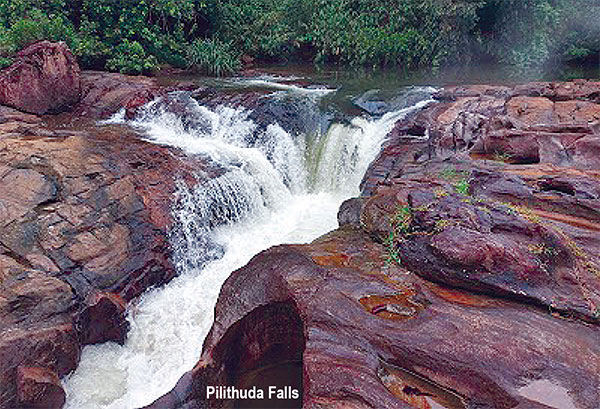
 Peelithuda Falls is on a tributary of the Sinharaja Ecosystem near the Palan River at Athwelthota, Morapitiya in the Palindanuwara Divisional Secretariat.
The Palindanuwara Pradeshiya Sabha has unanimously agreed not to allow this project. The Palindanuwara Divisional Secretariat has also informed the relevant agencies that the people are against the project.
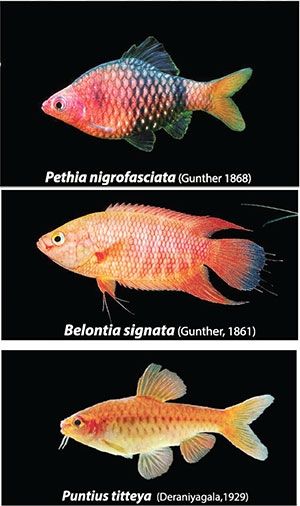
Naturalist Nayanaka Ranwella said that the area was home to 15 endangered fish species and 18 endemic fish species. In addition, there are specialised aquatic plants in the ecosystem, and many species of reptiles and frogs live along the river banks, he added.
Since 2007, Sakura Energy (Pvt) Ltd has been constructing a 1.5 MW small hydroelectric power plant across the falls. If such a power plant was built in the vicinity of this waterfall, the aforesaid ecosystem would be destroyed, environmental activists warned.
More than 1.5 metres of the embankment will be built over the waterfall and about 900 meters of the river will be drained. As a result, tourists as well as the people in the villages around Morapitiya, will lose both bathing places during the dry season. Many trees in the forest along the river will also be destroyed, Withanage said, adding that the area.
In 2014, the IEE prepared a preliminary environmental research report on this waterfall, obtained the approval letters from the relevant institutions and made arrangements to build a power plant across the Peelithuda Falls. The people of Morapitiya and Athwelthota strongly protested against it and the Centre for Environmental Justice took legal action. The case was dismissed based on the law of prescription and it could not be misconstrued as judicial approval for the project, Withanage said.
The National Aquatic Resources Agency (NARA) has prepared a research report on the endemic fish that live there. There has been no activity or construction associated with this waterfall since then. Despite this situation, in 2017, nine lives and physical property were destroyed due to landslides in the area around this waterfall. Extreme levels of flood danger were announced in at least two kilometres radius on both sides of the falls. Several families have already been evacuated from high-risk areas.
According to the landslide map released by the NBRO, there are several landslides in the region, one of which is above the proposed powerhouse. A few more are still in the lead above the Athwelthota Gangarama Temple.
It is illegal to request permission to carry out the project based on the initial environmental report, six years after it was prepared. According to the Environmental Assessment Act in the National Environmental Act No. 47 of 1980, the report is generally required to be executed within three years of its preparation. Otherwise, it will be invalid. Any other permit or validity issued for this purpose has already expired. In such a case, an environmental report and institutional approvals are required for this project. Despite repeated attempts, Sakura Senior Management was not available for comment.

News
Establishment of an Institutional Framework to Inagurate Upper Hydro Catchment Areas Management Authority


Policy approval of the Cabinet of Ministers was granted at their meeting held on 08.06.2026 to establish the Upper Hydro Catchment Areas Management Authority for identification and
execution of a formal and long – lasting remedy to secure the central hills including the upper hydro catchment areas enabling them to sustain amidst extreme weather conditions
due to natural calamities and human activities as well as to be used for the sustainable development of the country.
Accordingly, a concept paper has been prepared including
institutional structure, activities, powers, active subject area as well as administrative and coordination mechanism for the proposed authority by an expert technical committee appointed by the Secretary to the President.
Based on the said concept paper, the Cabinet of Ministers granted approval to the resolution furnished by the President to instruct the Legal Draftsman to prepare a draft bill including legal provisions required for the establishment of Upper Hydro Catchment Areas Management Authority.
News
Introduction of Flora and Fauna (Regulation of actions of the Indigenous Community within the nominated areas) Regulations
With the objective of securing the traditional livelihood and the eco system of the indigenous community, it has been recognized the necessity of introducing a formal regulation methodology to secure their engagement in livelihood activities by being more sensitive to the existing laws.
Thereby, the Fauna and Flora (regularizing) regulations under the Fauna and Flora Protection Ordinance (Authority 469) have been prepared so that nominated activities within the prescribed area to a member of the indigenous community
who has been registered for securing the rights acquired from law or custom or usage or traditional stance to execute an act within a certain state land that is fundamental to the survival of the indigenous community permission can be granted
Accordingly, the Cabinet of Ministers granted approval to the resolution furnished by the Minister of Environment to publish the said regulations in the government gazette notification and thereby submit to the Parliament for its concurrence.
Latest News
M. M. D. J. Senarathne, appointed Director General of the Department of National Botanical Gardens
The Cabinet of Ministers approved the resolution furnished by the Minister of Environment to appoint M. M. D. J. Senarathne, who is the senior most officer in Grade I of Sri Lanka Scientific Service se

Establishment of an Institutional Framework to Inagurate Upper Hydro Catchment Areas Management Authority
Introduction of Flora and Fauna (Regulation of actions of the Indigenous Community within the nominated areas) Regulations
M. M. D. J. Senarathne, appointed Director General of the Department of National Botanical Gardens

Harmanpreet Kaur steps down as India captain

Turkiye, Pakistan agree Saudi Arabia military deployment under Mecca pact

Rumesh Tharanga among nominees announced for World Athlete of the Year 2026

‘Dates have the highest sugar content to fight Coronavirus’

Sunday Island 27 December – Headlines

#SundayIsland 17th December – Headlines

Sunday Island – 28th March

Sunday Island Headlines – 21 March

Sunday Island – 21st February – Headlines
-

 Latest News7 days ago
Gold winner Tharanga gets brand-new Honda Vezel from SLAAJ
-

 News6 days ago
US-assisted ‘Ice’ detection: NPC to examine IGP’s move to transfer drug-busting team
-

 Features7 days ago
Why Sri Lanka needs an Inclusive Civic Nationalism – urgently
-

 Editorial5 days ago
Colombo Port drug bust: The plot thickens
-

 News7 days ago
Civil society activist accuses govt. of favouring Ven. Gnanasara
-

 Midweek Review7 days ago
Dappula’s Easter Sunday ‘grand conspiracy’ claim demolished
-

 Editorial7 days ago
When crime bosses rise above law and shrines
-
Editorial6 days ago
Drug busting, transfers and trust deficit