
Editorial
Stop blowing the coals


Thursday 22nd December, 2022
The Ceylon Electricity Board (CEB) trade unions and Minister of Power and Energy Kanchana Wijesekera have, true to form, locked horns over the availability of coal in the country, instead of getting themselves around the table and making a concerted effort to contain the power crisis. They are behaving like a bunch of overgrown schoolboys with very short fuses!
The CEB trade unionists have warned, at a recent media briefing, that the country will experience extended power cuts lasting for 10 hours or more daily because the Norochcholai power complex is running out of coal. The public has already panicked. Such power cuts will make the country’s economic recovery even more difficult.
Minister Wijesekera, who has gained a reputation for firing from the hip, lost no time in trying to pooh-pooh the CEB trade unionists’ claim; he even threatened disciplinary and legal action against the President of the CEB Engineers’ Union for making what he called misleading statements.
Are the CEB trade unions ‘merchants of gloom’, as the government says? Or, is the Minister of Power and Energy trying to hide the truth in verbal camouflage?
We cannot expect either the CEB trade unions or the government to tell us the truth, the whole truth and nothing but the truth about the coal issue. They are notorious for resorting to ‘terminological inexactitudes’, stretching the truth, making mendacious statements, or even telling barefaced lies to safeguard their interests. Both the political authority and officialdom are responsible for the current power crisis, and it is not out of any love for the public that the CEB trade unions have taken on the government. Similarly, the government politicians are all out to tame the power sector trade unions to facilitate its divestiture programme and line their pockets on the pretext of resolving the economic crisis.
In a few weeks, the people will know who is trying to mislead them. If the coal stocks are diminishing, as the CEB engineers have warned, then the government will have to ensure that the country has enough coal stocks. It has to pour on the coal! Otherwise, the Norochcholai power plants will not be able to operate, and it will be well-nigh impossible to meet the resultant shortfall in the power supply with electricity generated elsewhere; there will be longer power cuts in such an eventuality.
Is a sinister attempt being made in some quarters to create a coal shortage so that the CEB will have to buy power from the private sector at much higher prices, and the government will be able to bolster its claim that electricity tariffs have to be increased to maintain a reliable power supply? The government stands accused of having undertaken to jack up electricity tariffs to make the CEB attractive to investors as part of its divestiture programme.
As for the massive power tariff hike to be effected next year, the people are not likely to take it lying down. In fact, they will not be able to pay more for electricity, given the economic hardships the government continues to heap on them almost on a daily basis. Some CEB workers who tried to disconnect the power supply to a minister’s residence due to the nonpayment of bills had to beat a hasty retreat with black eyes and bumps on their heads, we are told. What if the people who cannot pay for electricity due to tariff hikes choose to emulate the minister concerned? The Opposition has threatened to take to the streets to prevent any more power tariff hikes.
The government politicians are behaving as if the people were responsible for the country’s bankruptcy. Having ruined the economy and caused many problems including power cuts, they are now asking the public to choose between paying more for electricity and facing extended power cuts! They are testing people’s patience, which is wearing thin, and inviting trouble. Let them be warned that they are playing with fire; the next popular uprising will take on tsunamic proportions.
The government claims that tourist arrivals are improving, and therefore its political rivals ought to act responsibly without staging street protests, etc. Longer power cuts will have a far worse impact on tourism than protests, and therefore everything possible will have to be done to ensure a reliable power supply. Hence the need for the Minister of Power and Energy, other government politicians, and the CEB trade unions to powwow and sort out the issues the power sector is beset with, instead of blowing the coals and going for one another’s jugular at the drop of a hat.



Trade unions and professional associations have been cranking up pressure on the NPP government to put its education reforms on hold and invite all key stakeholders to a serious discussion. Prime Minister Dr. Harini Amarasuriya struck a conciliatory note in Parliament the other day, indicating that the government was willing to take dissenting views on board. But President Anura Kumara Dissanayake has said in no uncertain terms that the government will go ahead with its education reform programme. Speaking at the launch of the Rebuilding Sri Lanka project yesterday, he made his government’s position on education reforms clear. The university teachers who naively sought President Dissanayake’s intervention to have the education reforms halted must be disillusioned.
Arguments against the education reforms, particularly the recently created modules, are tenable. Teachers and principals have highlighted serious flaws in them, and the government is trying piecemeal remedies such as removing pages containing errors. Some modules have already found their way into the hands of private tutors, according to teachers’ unions.
Prime Minister Amarasuriya met the Mahnayake Theras in Kandy on Thursday and briefed them on the government’s education reforms and related issues. The prelates expressed their concerns, and requested the government to resolve the issues other stakeholders had flagged. Addressing the media subsequently in Kandy, the PM put a bold face on the situation and sought to make light of the no-confidence motion the Opposition is planning to move against her. Claiming that her political rivals’ efforts had no chance of succeeding, she said a debate on the no-confidence motion against her would provide the government with an opportunity to elaborate on its education reforms. However, it is the Opposition parties that usually gain propaganda mileage in debates on no-confidence motions. The beleaguered SLPP government also defeated no-confidence motions against its members in the last Parliament, but could not prevent public opinion from turning against it.
There is no gainsaying that religious leaders should be kept informed of reforms in vital sectors such as education, but what matters most in implementing education reforms is not their support or blessings however important and valuable they may be. The government should make a serious effort to enlist the support of teachers and principals if it is to achieve its goal of reforming the education system properly. They are the frontline stakeholders who interact with students and perform core operational tasks.
Teachers and principals are on the warpath, insisting that the education reforms are ill-conceived and flawed and therefore they cannot implement them. The government must heed their voice and make a course correction. Most of all, it must ensure that all schools are provided with necessary facilities, such as smart boards. Parents must not be made to pay for them. General Secretary of the Ceylon Teachers’ Union Joseph Stalin has said some schools are already collecting money to buy smart boards, etc. The government is testing the public’s patience.
Doomed is a government that succumbs to hubris. Workers’ Struggle Centre Secretary Duminda Nagamuwa has likened the NPP government’s education reform package to the organic fertiliser drive of the Gotabaya Rajapaksa administration, which tried to bulldoze its way through and drove the public to stage an uprising. Gotabaya secured 52.24% of the total number of valid votes in the 2019 presidential election, and the SLPP mustered a two-thirds majority the following year. He and his party did not heed public opinion and views of independent experts, whom they considered enemies, and committed political hara-kiri.
Overwhelmingly dominant governments become complacent and unresponsive to dissenting views, and this is known as the supermajority syndrome, which has affected five governments led by the SLFP, the UNP, the SLPP and the JVP since 1970. It will be a mistake for the NPP administration to cross the Rubicon in its efforts to railroad key stakeholders into accepting its education reforms.

Saturday 10th Junuary, 2026
Prime Minister Dr. Harini Amarasuriya has revealed in Parliament that as many as 65 court cases, withdrawn during previous governments, have been refiled since the current administration came to power. Attorney General’s Department and the Commission to Investigation Allegations of Bribery or Corruption (CIABOC) had withdrawn those cases, she said yesterday in answer to a question raised by an Opposition MP. In this country, governments are notorious for perverting the legal and judicial processes to let lawbreakers among their members off the hook. They employ various methods for this purpose, and the state prosecutor and the national anti-graft commission have drawn severe criticism for facilitating such sordid operations. One of the NPP’s main campaign promises was to terminate this despicable practice, which has led to a severe erosion of public trust in the legal and judicial processes.
Cases must be neither filed nor withdrawn nor refiled for political reasons. Newly elected governments in this country abuse their power to have their political opponents arrested and prosecuted for various offences. Instances are not rare where charges are trumped up against Opposition politicians and activists, who are arrested and remanded for extended periods. The fact that the Attorney General’s Department, the CIABOC and the police are under the Executive’s thumb has helped governments launch political witch-hunts in the name of pursuing justice.
Governments also abuse their power to protect their members involved in various rackets and help them cover their tracks. But for intense pressure the Opposition, the media and civil society organisations brought to bear on the SLPP government, Minister Keheliya Rambukwella and several state officials would not have faced legal action for the procurement of fake medicines for cancer patients and enriching themselves. Thankfully, that administration, on its last legs, was not politically strong to open an escape route for the culprits.
Meanwhile, the Opposition has accused the NPP government of trying to cover up a mega coal scam. SLPP MP D.V. Chanaka has alleged in Parliament that the state has incurred massive losses due to the procurement of substandard coal for power generation. He has told Parliament that only 107 metric tonnes of coal are usually required per hour to generate 300 megawatts of electricity but 120 metric tonnes of newly imported coal are needed to produce the same amount of power. In other words, 13 extra tonnes of coal are required per hour and six extra shipments of coal a year.
MP Chanaka has said tests conducted at the Lakvijaya Coal Power Plant revealed that the calorific value of the first two newly imported coal shipments ranged from 5,600 and 5,800 kilocalories per kilogram (kcal/kg). But under the coal tender guidelines, the minimum required calorific value was 5,900 kcal/kg.
Energy Minister Kumar Jayakody has said the test reports issued by the Lakvijaya laboratory cannot be accepted because it does not have an accredited laboratory and action will be taken once the report from an accredited laboratory is received. One is intrigued. Coal has been tested at the Lakvijaya laboratory all these years, according to the Opposition and media reports, and why has the government refused to accept its test reports? What guarantee is there that the coal samples will be tested properly at the so-called accredited lab? Is the government trying to obfuscate the issue?
A thorough probe must be conducted into the alleged coal scam without further delay. What the members of the incumbent government must bear in mind is that they will not be in power forever; they will have to face legal action for their transgressions one day. Former ministers have been jailed for misusing fuel allowances and offences such as causing staggering losses to the state through coal scams will not go unpunished.
Friday 9th January, 2026
The SJB-led Opposition is in overdrive to move a no-confidence motion against Prime Minister Dr. Harini Amarasuriya, who is also the Minister of Education, for numerous shortcomings in the government’s education reforms, including content deemed unsuitable for children, flaws in modules, etc. The Opposition’s move is bound to fail in Parliament, where the government commands a two-thirds majority. But a debate on the no-confidence motion will provide the Opposition with an opportunity to gain some propaganda mileage at the expense of the JVP-led NPP, and the Prime Minister. Therefore, speculation is rampant that the government will do everything in its power to scuttle the Opposition’s no-faith motion. The JVP/NPP does not scruple to violate parliamentary traditions and Standing Orders when it has to defend its interests. The deplorable manner in which it prevented the Opposition from moving a no-confidence motion against Deputy Minister of Defence Aruna Jayasekera over some matters related to the Easter Sunday terror strikes is a case in point.
The general consensus is that education reforms are long overdue. However, reforming the education system is a very intricate task that has to be carried out carefully with the help of all key stakeholders. Intoxicated with power, the NPP government has blundered by rushing headlong to prepare an education reform package and trying to shove it down the throats of other stakeholders, triggering a backlash.
It has now been revealed that most of the modules prepared hurriedly under the current education reform programme contain flaws. But the government has declared that it will forge ahead no matter what. The arrogance of power blinds governments to reality. Supermajorities are jinxed in this country; they drive governments to perform dangerous high-wire acts without safety nets and suffer falls. Secretary of the Workers’ Struggle Centre Duminda Nagamuwa has aptly likened the NPP’s education reform programme to President Gotabaya Rajapaksa’s disastrous organic farming experiment which contributed to the downfall of the SLPP government.
A group of representatives of several education sector trade unions and professional associations, at a press briefing in Colombo, yesterday, pointed out numerous flaws in the NPP’s education reforms. They also said the government had not provided schools with facilities needed for the implementation of the education reforms. General Secretary of the Ceylon Teachers’ Union Joseph Stalin claimed that some schools were collecting money from students to buy smart boards, etc. The soaring cost of living has left most parents struggling to make ends meet. They cannot cough up any more money for their children’s education. Therefore, the government must put an end to the practice of schools raising funds at the expense of parents.
The critics of the controversial education reforms have called upon President Anura Kumara Dissanayake to direct PM Amarasuriya to abandon them. They are labouring under the misconception that President Dissanayake is not responsible for the education reforms at issue, and the blame for them should be laid solely at PM Amarasuriya’s doorstep. What they should bear in mind is that the controversial education reform package carries the imprimatur of President Dissanayake, who has been defending it to the hilt both in and outside Parliament. One may recall that in July 2025, taking part in a parliamentary debate, President Dissanayake waxed eloquent, endorsing the education reforms; he said no one could be satisfied with the current education system, the young generation it had produced, or the economy it has fostered. “Therefore, we urgently need comprehensive education reform. The proposed education reform is not merely limited to curriculum revision but will simultaneously elevate both the social and economic spheres of the country.”
Interestingly, both the opponents and proponents of the education reforms have concocted conspiracy theories. In response to the government’s claim of a conspiracy behind the campaign against the education reforms, the SBJ has argued that the conspirators may be some JVPers trying to smoke out PM Amarasuriya so that one of them could secure the premiership. If so, isn’t the SJB giving a boost to their campaign by singling out the PM for attack and moving a no-faith motion against her?
The only way the government can pull itself out of the current imbroglio is to put its education reform package on hold without delay and bring the key stakeholders to the table for a serious discussion.

India scrape home after Kohli, Gill hit half-centuries

Bride and groom killed by gas explosion day after Pakistan wedding

Shanaka, Mendis star in 12-over run-fest to square series for Sri Lanka

One person dead and 300 buildings destroyed in Australia bushfires

Iran warns it will retaliate if US attacks as protesters defy crackdown

GENERAL WEATHER FORECAST FOR NEXT 36 HOURS

‘Dates have the highest sugar content to fight Coronavirus’

Sunday Island 27 December – Headlines

#SundayIsland 17th December – Headlines

Sunday Island – 28th March

Sunday Island Headlines – 21 March

Sunday Island – 21st February – Headlines
-
 News23 hours ago
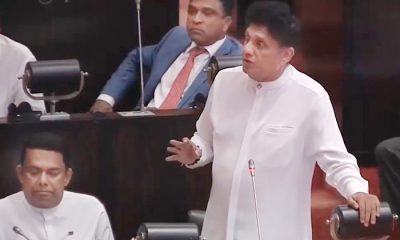
Sajith: Ashoka Chakra replaces Dharmachakra in Buddhism textbook
-

 News6 days ago
Interception of SL fishing craft by Seychelles: Trawler owners demand international investigation
-

 Business24 hours ago
Dialog and UnionPay International Join Forces to Elevate Sri Lanka’s Digital Payment Landscape
-

 Features23 hours ago
The Paradox of Trump Power: Contested Authoritarian at Home, Uncontested Bully Abroad
-
 News6 days ago
Broad support emerges for Faiszer’s sweeping proposals on long- delayed divorce and personal law reforms
-

 Features24 hours ago
Subject:Whatever happened to (my) three million dollars?
-

 News23 hours ago
65 withdrawn cases re-filed by Govt, PM tells Parliament
-

 Opinion3 days ago
The minstrel monk and Rafiki, the old mandrill in The Lion King – II