
News
Standing Orders don’t permit Speaker to order vote recount – Opposition

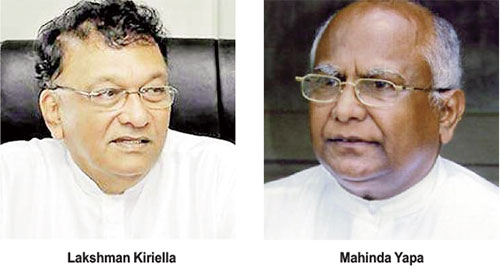
Chief Opposition Whip and Kandy District SJB MP Lakshman Kiriella says that once a vote was taken in Parliament and its results were announced by the Chair, that matter was considered over as per the Parliament’s Standing Orders and there was no provision for a vote recount.
Addressing the media online, MP Kiriella said that he had heard that the Speaker was planning to go for a recount of the votes cast for and against the Colombo Port City Economic Commission Bill on Thursday (20) in Parliament. “This is shocking news. As per the Standing Orders, once the vote is taken and its results are announced it is over and there cannot be a recount. Parliament Standing Orders do not permit the Speaker to go for a recount after the results are announced. I have been in this Parliament for 32 years, and have not heard of any precedence similar to this. The vote taken on the Bill proved that the government does not have a two-third majority in Parliament. Having failed to muster a special majority for the Bill, the government is pressureing the Speaker to go for a recount as a face-saving exercise. We call on the Speaker not to give in to government pressure. He is not the speaker of the government but the Speaker of Parliament. He is bound to uphold the dignity and supremacy of Parliament.
‘Instead of worrying about its two-thirds majority, the government should worry about the pandemic situation and the plight of the people, especially the vulnerable sections of society badly hit by the ongoing lockdowns.
Meanwhile, Speaker Mahinda Yapa Abeywardena in a statement said he had received a complaint that two votes had not been counted and investigations were going on to figure out what had happened.
The investigations would be held on the basis of two written requests by Justice Minister Ali Sabry and General Secretary of the SLPP and MP Sagara Kariyawasam that votes of two MPs of the SLPP had not been counted at the final vote on the Bill. Therefore, a technical investigation would be held to find out whether there was a mishap in the electronic voting system in the Chamber. The Speaker said he had instructed the Secretary to the Ministry of Information Technology Jayantha de Silva to conduct the technical investigation and submit a report. In addition there would be a separate investigation by former Secretary General of Parliament Dhammika Kithulegoda to examine the entire counting process and to provide a report on the matter, the statement said, adding that action would be taken to ensure that there would be no similar occurrences in vote taking processes in the Chamber.

News
Our objective is to ensure that the Commission to Investigate Allegations of Bribery or Corruption operates as an independent institution, free from any external influence – PM

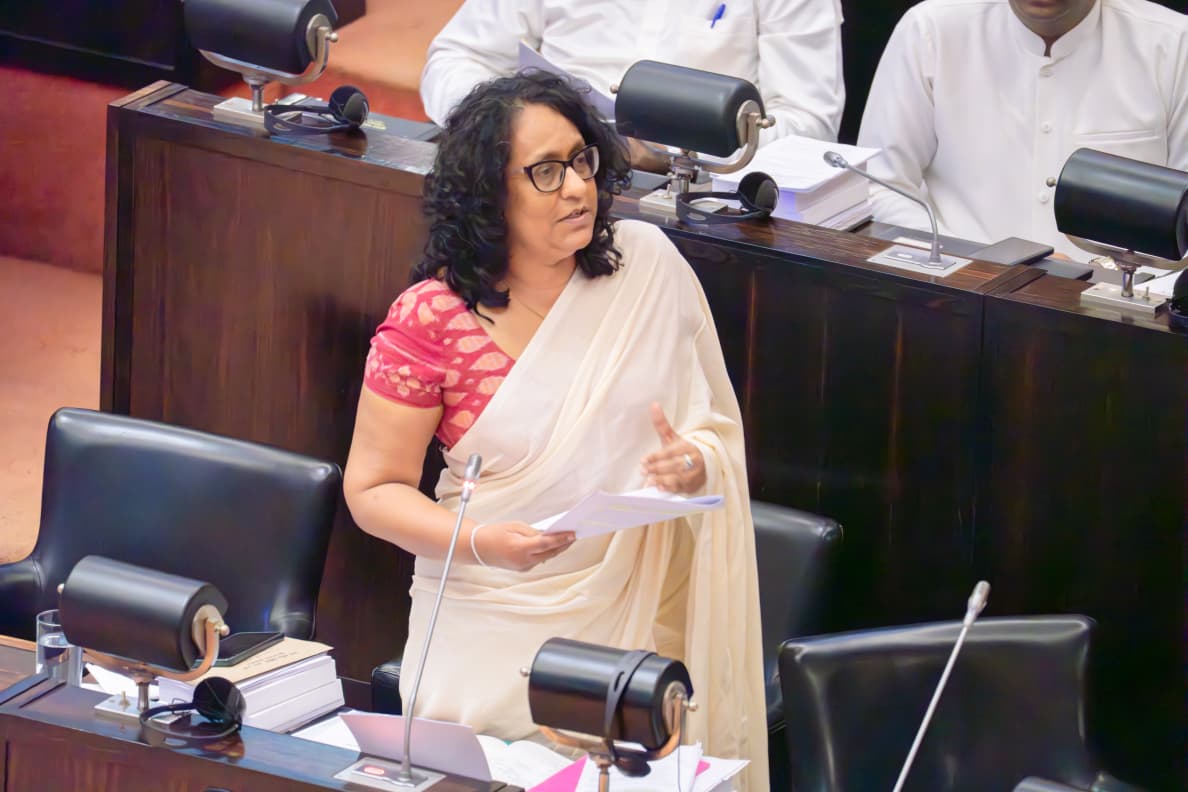
Prime Minister Dr. Harini Amarasuriya stated that the government’s objective is to ensure the environment for the Commission to Investigate Allegations of Bribery or Corruption [CIABOC] to function as an independent body, without influence from anyone, including Members of Parliament and Ministers.
The Prime Minister made these remarks while participating in the debate on the interim resolution concerning the determination of salaries and service conditions of the officers and employees of the Commission under the Anti-Corruption Act.
The Prime Minister stated:
“Honourable Speaker, I consider the proposal presented today on determining the remuneration and service conditions of the officers and employees of the Commission to Investigate Allegations of Bribery or Corruption to be highly important. Although the Anti-Corruption Act was passed in 2023, we only began to truly feel the presence of an active Commission from 2025.
Since then, we have had to experience a number of challenges in operationalizing the Commission. In particular, there were several obstacles, including limitations in recruiting officers, which hindered the Commission from functioning as required. It was necessary to establish several practical conditions, such as granting the Commission the freedom to determine allowances for its staff, to formulate the rules and regulations required for its operations, to recruit personnel, and to submit budget estimates relevant to its annual plans. At the time the new Director General assumed duties, there were over 4,000 investigation files within the Commission where investigations had been completed but cases had not yet been filed. Moreover, there were only about 31 legal officers.
Follow the adoption of this proposal, the Commission will be granted the authority to recruit officers, determine necessary allowances, and make independent decisions regarding financial matters. This will enable the Commission to effectively fulfill its intended mandate. This proposal plays a significant role in building a new political culture in our country, one that is anti-corruption and committed to a transparent public service that is free from bribery”.
Further commenting, the Prime Minister also addressed the country’s response to the ongoing global energy crisis.
“In the current global context, our economy and energy sector are facing multiple challenges. These conditions are constantly evolving and difficult to predict. However, it is our responsibility as a government to recognize these changes and manage their impact on our economy.
Following that, the Cabinet has decided to appoint four special committees. Accordingly, one committee will focus on ensuring the uninterrupted provision of essential services to the public; while another will make decisions on maintaining public services through energy management within the public sector; a third will work with the Procurement Commission to identify new methods of energy procurement in addition to existing mechanisms; and a fourth will examine the social impacts arising from this situation, including its effects on vulnerable groups, and recommend fair solutions, relief measures, and welfare services.
This is a situation that we, as a country, must face collectively. The public service, the private sector, the political leadership regardless of party differences and the people of our country must come together to overcome this, just as we have faced previous challenges. We are confident that, we will be able to successfully face this situation through proper leadership and management, and by making timely decisions.
[Prime Minister’s Media Division]
Latest News
Heat Index at ‘Caution Level’ in the Western, Sabaragamuwa, North-central, Southern and North-western provinces and in Monaragala, Mannar, Vavuniya and Mullaitivu districts
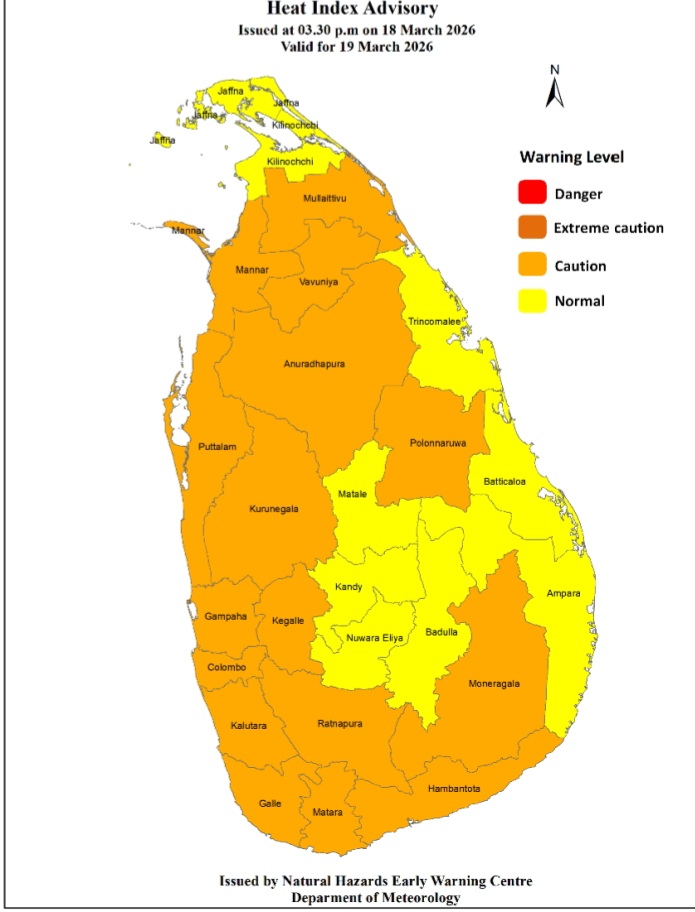
Warm Weather Advisory Issued by the Natural Hazards Early Warning Centre of the Department of Meteorology at 3.30 p.m. on 18 March 2026, valid for 19 March 2026
The general public are cautioned that the Heat index, the temperature felt on human body is likely to increase up to ‘Caution level’ at some places in the Western, Sabaragamuwa, North-central, Southern and North-western provinces and in Monaragala, Mannar, Vavuniya and Mullaitivu districts.
The Heat Index Forecast is calculated by using relative humidity and maximum temperature and this is the condition that is felt on your body. This is not the forecast of maximum temperature. It is generated by the Department of Meteorology for the next day period and prepared by using global numerical weather prediction model data.
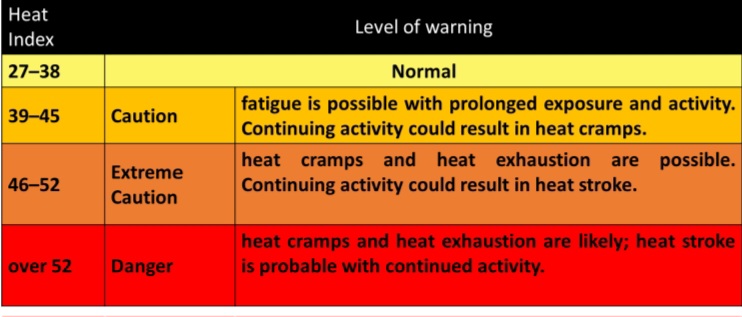
Effect of the heat index on human body is mentioned in the above table and it is prepared on the advice of the Ministry of Health and Indigenous Medical Services.
ACTION REQUIRED
Job sites: Stay hydrated and takes breaks in the shade as often as possible.
Indoors: Check up on the elderly and the sick.
Vehicles: Never leave children unattended.
Outdoors: Limit strenuous outdoor activities, find shade and stay hydrated.
Dress: Wear lightweight and white or light-colored clothing.
Note:
In addition, please refer to advisories issued by the Disaster Preparedness & Response Division, Ministry of Health in this regard as well. For further clarifications please contact 011-7446491.

A salary increase in the range of 15 to 20 percent is currently under discussion within the Ceylon Electricity Board (CEB), though no official decision has yet been taken, The Island reliably learns.
A senior electrical engineer who is is privy to ongoing salary negotiations, speaking on condition of anonymity, said the proposal had been put forward as a reasonable and necessary measure, rather than a rigid demand, in light of the prolonged delay in salary revisions. Earlier they have been asking for a staggering 40% salary increase.
“We are not insisting on this as a primary demand or condition. What we are requesting is for the authorities to seriously consider the possibility of granting an increase,” he said.
He emphasised that CEB employees had not received any salary increment since 2024 due to the ongoing reform and restructuring process, leaving staff to cope with rising living costs without adjustment.
“Under normal circumstances, the next salary revision would only be due in January 2027. That creates a significant and unfair gap. This proposal is, therefore, a justified attempt to secure at least a reasonable percentage in the interim,” he said.
The engineer warned that continued inaction could have serious implications for staff morale and operational efficiency at a time when the power sector is undergoing critical reforms.
Sources said that while internal discussions have pointed towards a 15 to 20 percent increase, the matter has not yet been formally taken up at policy level.
However, pressure is mounting on authorities to reach a timely and equitable decision, as frustration grows among employees over the absence of salary adjustments for nearly three years.
By Ifham Nizam

King Charles praises ‘living bridge’ with Nigeria at glitzy banquet

Our objective is to ensure that the Commission to Investigate Allegations of Bribery or Corruption operates as an independent institution, free from any external influence – PM

Showers above 50 mm can be expected at some places in the Central, Sabaragamuwa and Uva provinces and in Ampara district.

Oil nears $110 a barrel after gas field strike

Iran’s intelligence minister Esmail Khatib killed in air strike

Heat Index at ‘Caution Level’ in the Western, Sabaragamuwa, North-central, Southern and North-western provinces and in Monaragala, Mannar, Vavuniya and Mullaitivu districts

‘Dates have the highest sugar content to fight Coronavirus’

Sunday Island 27 December – Headlines

#SundayIsland 17th December – Headlines

Sunday Island – 28th March

Sunday Island Headlines – 21 March

Sunday Island – 21st February – Headlines
-

 Business4 days ago
Browns EV launches fast-charging BAW E7 Pro at Rs. 5.8 million
-

 Life style5 days ago
From culture to empowerment: Indonesia’s vision for Sri Lanka
-

 News2 days ago
CIABOC questions Ex-President GR on house for CJ’s maid
-

 Opinion7 days ago
M. D. Banda: Memories of Appachchi – II
-

 Business6 days ago
Sri Lanka Institute of Information Technology raises the bar for academic excellence
-

 Latest News5 days ago
QR code system will be implemented for fuel with effect from 06.00 a.m. today (15th)
-

 Life style5 days ago
Ranjith Fernando celebrates cricketing journey with Hob Nails to Spikes
-

 News3 days ago
Australian HC debunks misleading travel risk claims for Sri Lanka