
Latest News
Stage set for Sri Lanka to turn the tide and pounce on England


Pallekele was the stage, just under a week ago, for Sri Lanka’s turbo charged victory over a shell-shocked (and soon-to-be-eliminated) Australia. One minute the Aussies were 104 for 0 in the ninth over, and the hosts themselves were the ones contemplating an anxious exit from an unexpectedly competitive Group B. The next thing you knew, their spinners had ripped out Australia’s soul, and Pathum Nissanka had come howling through the breach with his wonderful 52-ball century.
Pallekele’s passionate, opinionatwd, fanbase made their presence felt that night, and as the concurrent scenes in Colombo have indicated, Sri Lanka is somewhat gripped by World Cup fever right now – notwithstanding their team’s shock loss to a surging Zimbabwe in their final group game.
That six-wicket defeat made no odds to the Super Eight, with the pre-seeded pools now awkwardly featuring all the group winners on one side of the draw and all the runners-up on the other. But it was conceivably an untimely bump back to earth, just in time for Sri Lanka’s reunion with a familiar set of foes. England won five matches out of six on their white-ball warm-up tour of the country last month, including three out of three in the T20I leg.
None of these wins were emphatic, but each of them was sealed by subtly different means – Adil Rashid’s spin strangle in game 1, Tom Banton’s middle-order awakening in game 2, Sam Curran’s guts and glory on a tricky turning deck in game 3, in which England’s back-up tweakers, Will Jacks and Jacob Bethell applied the coup de grace.
The net effect was to give the impression of a well-rounded England team, one that was ready to march into the main event with form to fall back on and faith in their myriad methods. And while that might still be the case in an eminently surmountable Group 2 which also features the known unknowns of New Zealand and Pakistan, the sheer terror of those near-misses against Nepal and Italy cannot be easily forgotten. Nor the disturbing passivity of their old-school trouncing in Mumbai by West Indies.
The stage is therefore set for Sri Lanka to pounce on the big occasion, as they have often done in the recent past, most notably with their wins at the 2019 and 2023 ODI World Cups, when their brace of victories went against the grain of their one-sided bilateral records.
Sri Lanka’s batting has broadly fired across the group stages, with Nissanka leading the line and Kusal Mendis contributing a trio of fifties in four matches, but agonisingly they’ll have to take the stage without the raw pace of Matheesha Pathirana, whose slingy action had England’s top order in all sorts of bother throughout their bilateral engagements. He lasted just four balls of the Australia game before succumbing to a calf strain, and has been replaced by Dilshan Madushanka.
Pathum Nissanka joined a curiously niche club when he smoked Australia to the brink of elimination last week. Only Chris Gayle before him had managed a T20 World Cup hundred, in addition to an ODI double-hundred and a century in all three formats – and if he’s got some way to go to match Gayle’s twin Test 300s, then a career-best 187 in his last series against Bangladesh suggests he’s tracking in the right direction. England did not see the best of him in the bilateral series just gone, but they’ll remember it alright. At The Oval in 2024, he blazed a superb fourth-innings 127 not out from 124 balls to swipe the third Test from under his opponents’ noses. At a time when England’s own batting lacks a touch of bravado, Nissanka is perfectly placed to steal a march once again.
Adil Rashid has been an unlikely barometer of England’s struggles. On his day, he remains absolutely integral to his team’s hopes of adding to the silverware that he has been instrumental in collecting over the course of the past decade. In England’s loss to West Indies, he did not concede a single boundary in serving up figures of 2 for 16 in four overs, while a combined haul of 5 for 69 in 12 in Pallekele last month suggests he will be right back on the mark on his return to a happy hunting ground. In between whiles, however, he has been treated with rare disdain by a succession of Associate batters, serving up combined figures of 4 for 121 in 11 overs, including a brutal outing of 3-0-42-0 against Nepal. Part of that might come down to a lack of inhibition from a succession of unfancied opponents who had licence to take him on. But with Brook’s tournament stratergy lean8ng so heavily on spin, England cannot afford many more bad days from their veteran. They aren’t programmed to cope when he goes missing.
England’s nerves haven’t been settled, but their team certainly has. Their depth of batting and bowling options came to the fore on their previous trip to Pallekele, and while there’s no expectation of wholesale changes, Brook did hint that some tweaks might be needed to avoid becoming predictable. Whether those are personnel or positional remain to be seen, although Luke Wood’s skiddier left-arm seam might be restored in place of Jamie Overton’s heavier lengths. The cut to Jacob Bethell’s bowling hand (sustained during the match against West Indies), may prevent him from bowling, because those fingers are still strapped. Brook hoped he’d recover in time, however.
England: (probable) Phil Salt, Jos Buttler (wk), Jacob Bethell, Tom Banton, Harry Brook (capt), Sam Curran, Will Jacks, Liam Dawson, Luke Wood, Jofra Archer, Adil Rashid
Pramod Madushan made his first appearance of the campaign in the Zimbabwe defeat, with Dushmantha Chameera taking a break with qualification already assured. That short-term arrangement is likely to be reversed, with Madushanka keeping his spot.
Sri Lanka: (probable) Pathum Nissanka, Kusal Perera, Kusal Mendis (wk), Pavan Rathnayake, Kamindu Mendis, Dasun Shanaka (capt), Dunith Wellelage, Dushan Hemantha, Maheesh Theekshana, Dilshan Madushanka, Dushmantha Chameera
(Cricinfo)


The general secretary of the Confederation of African Football (Caf) has resigned amid a chaotic time for football on the continent
Veron Mosengo-Omba said in a statement he was retiring, but his departure comes during the fallout over decisions to strip Senegal of the 2025 Africa Cup of Nations (Afcon) title and postpone the women’s tournament at the last minute.
These incidents have left Caf, the governing body for African football, battling a crisis of confidence.
Mosengo-Omba alluded to controversies faced during his tenure in his statement on Sunday.
“Now that I have been able to dispel the suspicions that some people have gone to great lengths to cast on me, I can retire with peace of mind and without constraint, leaving the CAF more prosperous than ever,” Mosengo-Omba, deputy to Caf president Patrice Motsepe, wrote.
The 66-year-old has been criticised for staying on as general secretary past the organisation’s mandatory retirement age of 63.
He has also been accused by some employees of creating a toxic atmosphere in the workplace, although an investigation after staff complaints cleared him of any wrongdoing.
Mosengo-Omba, who hails from the Democratic Republic of Congo but also holds Swiss nationality, was appointed general secretary in March 2021.
According to news agency Reuters, Caf’s competitions director, Samson Adamu, will take over as acting general secretary.
The governing body is awaiting a decision by the Court of Arbitration for Sport (Cas) on Senegal’s appeal against being stripped of the Afcon title.
Senegal is challenging Caf’s appeals body for overturning their 1-0 win over hosts Morocco in January’s Afcon final.
During the game, Senegal’s players left the field in protest when, with the score at 0-0, hosts Morocco were awarded a stoppage-time penalty.
When they returned after a delay of about 17 minutes, Morocco subsequently failed to score the spot-kick and Senegal netted an extra-time winner.
Following an appeal by the Moroccan FA (FRMF), Caf later ruled that Senegal had forfeited the match and Morocco were awarded a 3-0 victory.
(BBC)
Latest News
Heat Index likely to increase up to ‘Caution level’ at some places in the Western, Sabaragamuwa, Southern, Eastern, North-western, Northern and North-central provinces and in Monaragala district

Warm Weather Advisory
Issued by the Natural Hazards Early Warning Centre
Issued at 3.30 p.m. on 29 March 2026, valid for 30 March 2026.
The Heat index, the temperature felt on human body is likely to increase up to ‘Caution level’ at some places in the Western, Sabaragamuwa, Southern, Eastern, North-western, Northern and North-central provinces and in Monaragala district.
The Heat Index Forecast is calculated by using relative humidity and maximum temperature and this is the condition that is felt on your body. This is not the forecast of maximum temperature. It is generated by the Department of Meteorology for the next day period and prepared by using global numerical weather prediction model data.

Effect of the heat index on human body is mentioned in the above table and it is prepared on the advice of the Ministry of Health and Indigenous Medical Services.
ACTION REQUIRED
Job sites: Stay hydrated and takes breaks in the shade as often as possible.
Indoors: Check up on the elderly and the sick.
Vehicles: Never leave children unattended.
Outdoors: Limit strenuous outdoor activities, find shade and stay hydrated.
Dress: Wear lightweight and white or light-colored clothing.
Note:
In addition, please refer to advisories issued by the Disaster Preparedness & Response Division, Ministry of Health in this regard as well. For further clarifications please contact 011-7446491.

Despite driving his jeepney through some of Metro Manila’s busiest neighbourhoods on a daily basis, Arturo Modelo, 52, only takes home about a third of the 600 Philippine pesos ($10) he would normally earn, as thecost of fuel has soared in the Philippines and his profits have diminished as a result.
“I can’t even afford my kid’s lunch money,” he told Al Jazeera.
Leaning on his jeepney, Modelo explained how he joined two days of transport strikes in Manila on Thursday and Friday because he wanted “a deaf government to listen”.
Besides, he added, “you can’t really make a living on the road these days.”
The iconic jeepney, which emerged at the end of World War II when Filipinos repurposed old United States military jeeps to use as minibuses, is the cheapest and most common form of commuter transport in the Philippines.
Last week, jeepney owners staged a strike, which was followed by bigger demonstrations this week, as workers – from bus, taxi and minibus drivers to motorcycle taxi riders – representing nearly a dozen national transport groups joined the stoppage to protest rising fuel costs amid what they see as government inaction.
Thousands marched to the Presidential Palace on Friday, demanding price controls on petrol and diesel, scrapping fuel taxes, and tighter government regulation of the fuel industry.
The workers, who came together on Thursday and Friday under the No to Oil Price Hike Coalition, believe the government was too slow to act and had, for weeks, ignored their demands for price controls.
The No to Oil Price Hike Coalition also called out what it said was “American aggression” against Iran for the economic woes being felt in the Philippines.
“Filipinos didn’t start this war, don’t want any part of it, but are suffering because of it,” said Jerome Adonis, chairperson of the national workers’ group Kilusang Mayo Uno (May First Movement), who joined the strike.
“It’s like the United States also dropped a bomb on us,” Adonis said.
President Ferdinand Marcos Jr declared a state of national energy emergency on Tuesday night, a first as the US-Israel war on Iran entered its fourth week.
The emergency decleration will remain in force for one year, and allows the government to more rapidly procure fuel and petroleum products and to take action against the hoarding, profiteering and manipulation of petroleum product supplies.
Marcos said he ordered the “implementation of the fuel and energy allocation plan and other energy conservation measures” as a means to tackle the price surge and promised the country would have “a flow of oil”.
The Philippines has been hit harder than its neighbours by price shocks since the US and Israel attacked Iran last month. It has among the highest diesel and petrol prices in Southeast Asia, slightly behind Singapore – a country with higher wages and a far higher standard of living – as the global oil shortage bites.

Singapore diesel, according to various reports, was about $2.7 per litre this week, while diesel in the Philippines went up to $2.3 per litre. Petrol was about $2.35 per litre in Singapore, while in the Philippines it was nearly $2 per litre. In contrast, Malaysia, Vietnam and Thailand have recorded prices at about half of that at the fuel pumps.
As transport costs rise, students and workers in some cities in the country have been given free access to bus rides, and the government has started to provide a 5,000 peso ($83) subsidy to motorcycle taxi drivers and other public transport workers.
But for many, strike action is the only platform to express their concerns.
Transport union leaders said thousands had joined picket lines at 85 commuter terminals across the capital and major cities, while very few jeepneys could be seen on typically congested streets during the strike on Friday.
Authorities, however, said the two days of industrial action failed to paralyse Metro Manila, criticising the strike’s organisers and participants for inconveniencing commuters.
Asked on Friday if the government was considering directly subsidising fuel costs, similar to some countries in Southeast Asia, presidential spokesperson Claire Castro said the administration would study such a proposal.
Castro said the government had already doled out 2.5 billion pesos ($414m) in fuel subsidies this week to nearly 300,000 transport workers. However, advocacy groups say some 2 million people are likely working in the sector.
But transport workers also reported extremely long queues or missing out on the 5,000-peso payment due to their work details being absent from official government databases.
Jeepney driver Modelo, who spoke to Al Jazeera, said nobody from the transport terminal where he worked in Manila had received any government assistance.
Mody Floranda, national president of the transport workers group Piston, which initiated some of the strike action, said President Marcos Jr was favouring oil companies over Filipinos.
“Right now, Marcos can release an executive order for a price cap. He says it’s an emergency but acts like it isn’t,” said Floranda.
Presidential spokesperson Castro told reporters that the government’s swiftest action was “talking to manufacturing companies and other stakeholders not to increase the prices of goods”.
In a radio interview, Department of Energy (DOE) chief Sharon Garin said the agency aimed to please all stakeholders and that price caps imposed on fuel firms required the “right formula” to avoid harming businesses.
Experts attribute the high prices in the Philippines to the country’s dependence on oil imports and a deregulated market, plus excise taxes and a high value-added tax (VAT) of 12 percent.
Industrial economics Professor Krista Yu at De La Salle University in Manila said the dire situation was also due to the country’s “very limited domestic production and refining capacity”.
Yu said the government should prioritise securing “physical supply and reducing exposure to external shocks”.
According to the Energy Department, about 98 percent of the domestic crude oil supply is imported in the Philippines.

Emmanuel Leyco, chief economist at Credit Rating and Investors Services Philippines and the Center for People Empowerment in Governance (CenPEG), said that while the president is concerned about supply, “the public is already feeling the pain caused by unreasonable runaway prices.”
Leyco blamed the Oil Industry Deregulation Law of 1998 for the current situation, as it leaves fuel price adjustments in the hands of industry players.
“It is the main culprit. Even slight price adjustments cause serious problems because half the population is poor,” Leyco told Al Jazeera.
Faced with the likelihood of more strikes and growing public dissatisfaction, Marcos Jr separately signed a law on Wednesday allowing him to temporarily suspend excise taxes on fuel when crude oil exceeds a certain price per barrel for a month.
“Why not include the VAT and remove it with the excise taxes permanently?” asked opposition Kabataan Partylist lawmaker Renee Co.
“Both forms of taxation are regressive because they place the weight of commodity expenses on the people,” Co told Al Jazeera.
Co, along with other opposition lawmakers in Congress, had previously filed a bill to cancel both taxes, and on Wednesday filed a separate bill for state regulation of the oil industry.
Co was also among 50 members of Congress who passed a resolution calling for the “immediate cessation of hostilities in Iran, particularly an end to the military aggression instigated by the United States of America and Israel, in order to prevent further loss of life and humanitarian suffering”.
[Aljazeera]

Inquiry into female employee’s complaint: Retired HC Judge’s recommendations ignored

Motor Traffic CG remanded

Petition launched seeking resignation of Energy Minister Jayakody

SC e-filing portal operational

New arithmetic of conflict: How the drone revolution is inverting economics of war

SLT-MOBITEL turnaround signals new era for SOEs, says deputy minister

‘Dates have the highest sugar content to fight Coronavirus’

Sunday Island 27 December – Headlines

#SundayIsland 17th December – Headlines

Sunday Island – 28th March

Sunday Island Headlines – 21 March

Sunday Island – 21st February – Headlines
-

 News5 days ago
Senior citizens above 70 years to receive March allowances on Thursday (26)
-

 Features2 days ago
A World Order in Crisis: War, Power, and Resistance
-

 News3 days ago
Energy Minister indicted on corruption charges ahead of no-faith motion against him
-

 News4 days ago
US dodges question on AKD’s claim SL denied permission for military aircraft to land
-

 Business4 days ago
Dialog Unveils Dialog Play Mini with Netflix and Apple TV
-

 Sports3 days ago
SLC to hold EGM in April
-

 News5 days ago
CEB Engineers warn public to be prepared for power cuts after New Year
-
 Business6 days ago
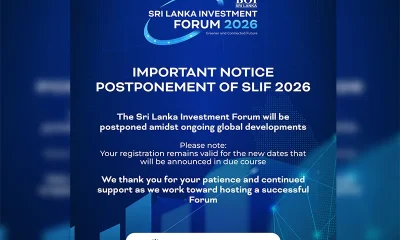
Postponement of Sri Lanka Investment Forum 2026