
News
Sri Lankan Oil and Gas exploration grinds to a standstill amid protracted legal battle


Sri Lanka’s efforts to attract and leverage international investment into exploration and commercialisation of two blocks adding to over 5,000 square kilometers with potential oil and gas resources in the Mannar Basin have once again been gridlocked by legal challenges in the Court of Appeal.
According to the latest developments in the CA (Writ) Application No: 392/2023, the court found that a prima facie case has been established by the Petitioner, Serendive Energy.
Accordingly the court issued orders restraining the 1st to 36th Respondents and/or its servants or agents from granting to any third party other than the Petitioner the rights to offshore exploration of blocks M1 and C1, until a final determination is reached in the case.
Serendive Energy, which has a strategic alliance partnership with a large Indian conglomerate commenced pursuit of legal remedies following a recent effort in 2023 to reverse exploration block award that had previously been made to the company.
Serendive Energy first participated in an open international tender (SL 2019-02) in 2019, and was awarded the blocks, Mannar Basin M1 and Cauvery Basin C1 in May 2021. This decision took place following evaluations conducted by the Petroleum Development Authority, and headed at the time by former Chairman Saliya
Wickramasuriya and Current Chairman Surath Ovitigama, who have long served among the nation’s leading domain experts on oil and gas.As stated in the 2021 Ministry of Power and Energy Annual Report “International competitive bids were called for in the year 2019 for the exploration and production of oil and gas of Mannar Block M1 and Cauvery Block C1 and the bid evaluation process had been concluded in May 2021.”
“Negotiations had been held by the government of Sri Lanka throughout the year 2021 with Serendive Energy (Pvt) Ltd for separate petroleum resources agreements in respect of M1 and C1 blocks, and about 90% of the negotiations have been concluded. The final petroleum resources agreement is expected to be entered into during the first half of the year 2022.”
While the awarding of blocks to Serendive Energy was hailed at the time as critical forward after many previous false starts, all activity on exploration ground to a halt during the country’s economic crisis and the ‘aragalaya’, following which attempts were subsequently made to reverse the award. The Petitioners submitted that such measures amount to a direct contravention of the 2003 Petroleum Act.
The effort to attract international players to invest in Sri Lanka’s Oil and Gas exploration industry which ground to a halt in 1984 with the civil war recommenced in 2003 with the opening up of tenders for exploration to international local and global investors via the Petroleum Resources Act, No.26 of 2003.
Hydrocarbon prospectivity and legislation in Sri Lanka was established in 2001 with the funding by the Asian Development Bank (ADB) and technical assistance from New South Global, a part of the School of Petroleum Engineering within the University of New South Wales (UNSW) based in Sydney, Australia
The team leader of this project, Prof. Ray Shaw concluded in the report that “The Gulf of Mannar basin represents a new deepwater frontier region which has the indicia for hosting significant hydrocarbon accumulations.”
This report and conclusion based on the 2001 TGS Norpec Seismic survey encouraged a further more detailed survey by TGS and a Gravity/Magnetic study which confirmed the finding of this ADB/University of New South Wales Project.
The Petroleum Act 2003 was passed by parliament under the leadership of the then Prime Minister Hon. Ranil Wickremesinghe. However, subsequent mismanagement and bureaucratic inaction hindered any meaningful progress from being achieved.
With exploration and development requiring around 10 years, the window to leverage the country’s natural resource if fast disappearing with global “Net Zero” targets approaching in 2045-50 since the production period offered by the government is 20 years. Hence, all future investors will not have the full 20 years before global demand drops off significantly, making investment in Sri Lanka less attractive.
With the chances of success in this industry being as low as seven to 10%, international investors were already extremely hesitant, while Sri Lanka’s history of nationalization of such industries has proved to be a further deterrent. This included previous instances arbitrary, and often overnight policy changes towards nationalization and expropriation such as with TGS Norpec Seismic survey 2001 and 2005 as well as Caltex, Shell and Esso in the early 1960’s.
With the uncertainty created by two upcoming elections in the next 12 months and the country’s exploration process stuck in legal proceeding, and given the time required post-general election to call for EOI/RFP, shortlist, negotiate, select and conclude various administrative processes, it is unlikely that Sri Lanka to commence a new exploration process for at least two years with new investors for other blocks.
Moreover, Sri Lanka’s oil and gas bid is also still recovering from developments which took place in 2013 when a large regional National Oil Company first announced its intention to bid on multiple blocks, intimidating other interested investors in participating in the tender, only to ultimately refrain from bidding, and subsequently make a global announcement claiming that there was no oil and gas “prospectivity: in the Mannar basin – contradicting many independence assessments and geophysical surveys.
The combination of these factors led to negligible investor interest over the past 10 years, evinced by the lack of progress in that time. The latest injunctions on the largest blocks currently opened for exploration may prove to be the final nail in the coffin.



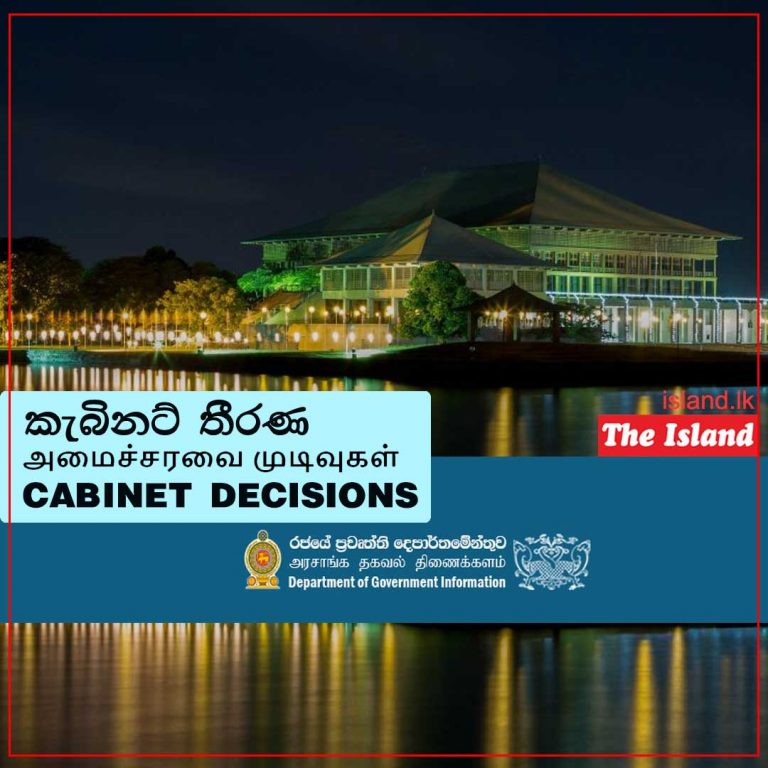
Approval of the Cabinet of Ministers was granted to the preparation of the Appropriation Bill for the financial year of 2027 at their meeting held on 30.06.2026.
Accordingly, clearance of the Attorney General has been given to the Appropriation Bill prepared by the Legal Draftsman.
Therefore, the Cabinet of Ministers approved the resolution furnished by the President in his capacity as the Minister of Finance, Planning and Economic Development to publish the aforementioned draft bill in the government gazette notification and thereby submit the same to the Parliament for its concurrence.
Latest News
Cabinet approves aditional Rs. 2,500 million to the Paddy Marketing Board to purchase 2026 Yala harvest

The Cabinet of Ministers has approved the resolution furnished by the Minister of Agriculture, Livestock, Land and Irrigation to provide an additional Rs. 2,500 million to the Paddy Marketing Board on a reimbursable basis from the Rs. 7,500 million additional allocations granted to the Ministry to implement
the expedited paddy purchasing program for the 2026 Yala harvest.
Latest News
Cabinet nod to host the 8th Asian Regional Conference of the Commonwealth Parliamentary Association and the 3rd Joint Asian and South-East Asian Regional Conference of the Commonwealth Parliamentary Association
The 8th Asian Regional Conference of the Commonwealth Parliamentary Association (CPA) and the 3rd Joint Asian and South-East Asian Regional Conference of the CPA are planned to be held over three days in Colombo during April/May 2027.
Approximately 90 delegates including speakers, Deputy Speakers, Member of Parliamentarians, and Parliamentary officers representing member countries of the Commonwealth Parliamentary Association, in the Asian and South-East Asian regions, are expected to participate in these conferences.
The Cabinet of Ministers has approved the resolution furnished by the Prime Minister of the Parliament of Sri Lanka to host the said conferences considering the opportunities to strengthen parliamentary diplomacy and regional cooperation, as well as to enhance international recognition of the Parliament of Sri Lanka within the Commonwealth Parliamentary Association.

Draft of the Appropriation Bill for the Financial Year 2027 su mitted to the Parliament
Cabinet approves aditional Rs. 2,500 million to the Paddy Marketing Board to purchase 2026 Yala harvest
Cabinet nod to host the 8th Asian Regional Conference of the Commonwealth Parliamentary Association and the 3rd Joint Asian and South-East Asian Regional Conference of the Commonwealth Parliamentary Association

SAARC Training Workshop on Financial Modeling for Renewable Energy Projects from 5th to 7th October in Colombo
National Children’s Week from 25th September to 01st October

Nairobi and Munich to host 2029 and 2031 World Athletics Championships

‘Dates have the highest sugar content to fight Coronavirus’

Sunday Island 27 December – Headlines

#SundayIsland 17th December – Headlines

Sunday Island – 28th March

Sunday Island Headlines – 21 March

Sunday Island – 21st February – Headlines
-

 Sports5 days ago
DDS set to lose Test captaincy
-

 News5 days ago
Sri Lanka faces new grid challenge as rooftop solar surges: former CEB GM
-
 Latest News5 days ago
Shafali, Deepti power India into sixth T20 Asia Cup final
-

 Opinion7 days ago
Navigating Sri Lanka’s Israeli Dilemma
-

 Latest News4 days ago
Sri Lanka thwart Fatima Sana challenge to secure Asia Cup final spot
-

 News3 days ago
Gnanasara Thero absconding after SC ruling
-
 Features6 days ago
Lost for 90 years: Rare Goby resurfaces in Jaffna
-

 News4 days ago
Ammunition cache found in old Kandy bungalow