
News
Sri Lankan Oil and Gas exploration grinds to a standstill amid protracted legal battle


Sri Lanka’s efforts to attract and leverage international investment into exploration and commercialisation of two blocks adding to over 5,000 square kilometers with potential oil and gas resources in the Mannar Basin have once again been gridlocked by legal challenges in the Court of Appeal.
According to the latest developments in the CA (Writ) Application No: 392/2023, the court found that a prima facie case has been established by the Petitioner, Serendive Energy.
Accordingly the court issued orders restraining the 1st to 36th Respondents and/or its servants or agents from granting to any third party other than the Petitioner the rights to offshore exploration of blocks M1 and C1, until a final determination is reached in the case.
Serendive Energy, which has a strategic alliance partnership with a large Indian conglomerate commenced pursuit of legal remedies following a recent effort in 2023 to reverse exploration block award that had previously been made to the company.
Serendive Energy first participated in an open international tender (SL 2019-02) in 2019, and was awarded the blocks, Mannar Basin M1 and Cauvery Basin C1 in May 2021. This decision took place following evaluations conducted by the Petroleum Development Authority, and headed at the time by former Chairman Saliya
Wickramasuriya and Current Chairman Surath Ovitigama, who have long served among the nation’s leading domain experts on oil and gas.As stated in the 2021 Ministry of Power and Energy Annual Report “International competitive bids were called for in the year 2019 for the exploration and production of oil and gas of Mannar Block M1 and Cauvery Block C1 and the bid evaluation process had been concluded in May 2021.”
“Negotiations had been held by the government of Sri Lanka throughout the year 2021 with Serendive Energy (Pvt) Ltd for separate petroleum resources agreements in respect of M1 and C1 blocks, and about 90% of the negotiations have been concluded. The final petroleum resources agreement is expected to be entered into during the first half of the year 2022.”
While the awarding of blocks to Serendive Energy was hailed at the time as critical forward after many previous false starts, all activity on exploration ground to a halt during the country’s economic crisis and the ‘aragalaya’, following which attempts were subsequently made to reverse the award. The Petitioners submitted that such measures amount to a direct contravention of the 2003 Petroleum Act.
The effort to attract international players to invest in Sri Lanka’s Oil and Gas exploration industry which ground to a halt in 1984 with the civil war recommenced in 2003 with the opening up of tenders for exploration to international local and global investors via the Petroleum Resources Act, No.26 of 2003.
Hydrocarbon prospectivity and legislation in Sri Lanka was established in 2001 with the funding by the Asian Development Bank (ADB) and technical assistance from New South Global, a part of the School of Petroleum Engineering within the University of New South Wales (UNSW) based in Sydney, Australia
The team leader of this project, Prof. Ray Shaw concluded in the report that “The Gulf of Mannar basin represents a new deepwater frontier region which has the indicia for hosting significant hydrocarbon accumulations.”
This report and conclusion based on the 2001 TGS Norpec Seismic survey encouraged a further more detailed survey by TGS and a Gravity/Magnetic study which confirmed the finding of this ADB/University of New South Wales Project.
The Petroleum Act 2003 was passed by parliament under the leadership of the then Prime Minister Hon. Ranil Wickremesinghe. However, subsequent mismanagement and bureaucratic inaction hindered any meaningful progress from being achieved.
With exploration and development requiring around 10 years, the window to leverage the country’s natural resource if fast disappearing with global “Net Zero” targets approaching in 2045-50 since the production period offered by the government is 20 years. Hence, all future investors will not have the full 20 years before global demand drops off significantly, making investment in Sri Lanka less attractive.
With the chances of success in this industry being as low as seven to 10%, international investors were already extremely hesitant, while Sri Lanka’s history of nationalization of such industries has proved to be a further deterrent. This included previous instances arbitrary, and often overnight policy changes towards nationalization and expropriation such as with TGS Norpec Seismic survey 2001 and 2005 as well as Caltex, Shell and Esso in the early 1960’s.
With the uncertainty created by two upcoming elections in the next 12 months and the country’s exploration process stuck in legal proceeding, and given the time required post-general election to call for EOI/RFP, shortlist, negotiate, select and conclude various administrative processes, it is unlikely that Sri Lanka to commence a new exploration process for at least two years with new investors for other blocks.
Moreover, Sri Lanka’s oil and gas bid is also still recovering from developments which took place in 2013 when a large regional National Oil Company first announced its intention to bid on multiple blocks, intimidating other interested investors in participating in the tender, only to ultimately refrain from bidding, and subsequently make a global announcement claiming that there was no oil and gas “prospectivity: in the Mannar basin – contradicting many independence assessments and geophysical surveys.
The combination of these factors led to negligible investor interest over the past 10 years, evinced by the lack of progress in that time. The latest injunctions on the largest blocks currently opened for exploration may prove to be the final nail in the coffin.




The government, under heavy Opposition fire over inclusion of a sex website in the Grade 6 English module, as well as overall education reforms, has decided to put on hold reforms in respect of Grade 6.
Cabinet Spokesman and Media and Health Minister Dr. Nalinda Jayatissa announced the government decision yesterday (13) at the post-Cabinet media briefing at the Information Department.
According to him, the decision had been taken at the previous day’s Cabinet meeting, chaired by President Anura Kumara Dissanayake. Dr. Jayatissa said that education reforms pertaining to Garde 6 had been put on hold until 2027.
The Minister said that other proposed education reforms would be implemented as planned. The Minister said that action would be taken against those responsible for the inclusion of a link to a sex website following investigations conducted by the Criminal Investigation Department and the National Education Institute.
The SJB and several other political parties, as well as civil society groups, have accused the government of promoting an LGBTQ agenda, through the proposed education reforms.
The Opposition grouping Mahajana Handa, on Monday, made representations to the Mahanayake Thera of the Malwatta Chapter regarding the controversial reforms, while urging their intervention to halt the project.
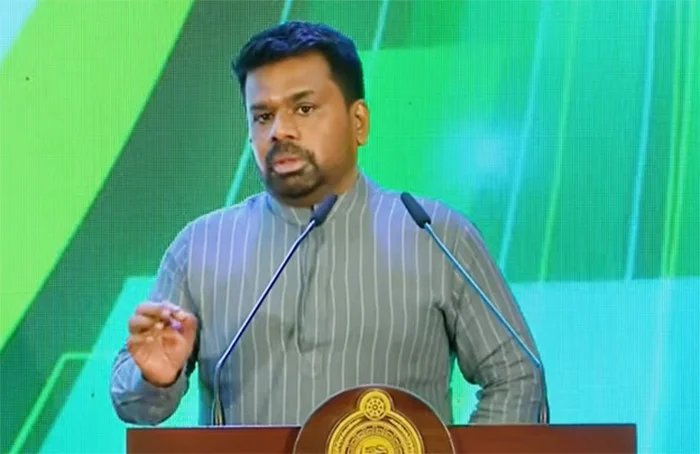
President Anura Kumara Dissanayake yesterday (13) vowed to go ahead with his government’s agenda, regardless of the destruction caused by Cyclone Ditwah.
Emphasising the responsibility on the part of all to contribute to the post-Ditwah recovery efforts, President Dissanayake said that he would have complete faith in the public service.
The President said so at the launch of the re-building Sri Lanka project at the BMICH yesterday.
The JVP and NPP leader said that he wouldn’t take advantage of the death and destruction caused by the cyclone or use the situation as an excuse to reverse their agenda or weaken it.
President Dissanayake said that in spite of many calling for amending the then Budget, in view of the cyclone, the government presented the proposals that were agreed before the disaster struck.

The United States has announced that it will provide the Sri Lanka Air Force with 10 US Navy TH-57 helicopters free of charge.
The announcement was made by outgoing US Ambassador Julie Chung, who stated, on social media, that the helicopters would be transferred under the United States’ Excess Defence Articles programme. The aircraft are Bell 206 Sea Ranger helicopters previously operated by the US Navy.
US sources said that the transfer was intended to strengthen Sri Lanka’s disaster response capabilities, following the devastating cyclone that struck the island at the end of 2025 and killed more than 600 people. US officials have framed the move as a humanitarian measure aimed at improving aerial rescue and relief operations.

Fair weather will prevail except for a few showers in the Uva, Eastern, Western and Central provinces and in Galle, Matara and Rathnapura districts

Trump cancels US-Iran meetings, urges protesters to take over institutions

Govt. bows to pressure, shelves Grade 6 reforms

AKD: Govt. agenda on track despite Ditwah disaster

SL to receive 10 helicopters from US

Foreign couple held over alleged biopiracy at Horton Plains

‘Dates have the highest sugar content to fight Coronavirus’

Sunday Island 27 December – Headlines

#SundayIsland 17th December – Headlines

Sunday Island – 28th March

Sunday Island Headlines – 21 March

Sunday Island – 21st February – Headlines
-

 Business3 days ago
Dialog and UnionPay International Join Forces to Elevate Sri Lanka’s Digital Payment Landscape
-
 News3 days ago
Sajith: Ashoka Chakra replaces Dharmachakra in Buddhism textbook
-

 Features3 days ago
The Paradox of Trump Power: Contested Authoritarian at Home, Uncontested Bully Abroad
-

 Features3 days ago
Subject:Whatever happened to (my) three million dollars?
-

 News3 days ago
Level I landslide early warnings issued to the Districts of Badulla, Kandy, Matale and Nuwara-Eliya extended
-

 News3 days ago
65 withdrawn cases re-filed by Govt, PM tells Parliament
-

 News3 days ago
National Communication Programme for Child Health Promotion (SBCC) has been launched. – PM
-

 Opinion5 days ago
The minstrel monk and Rafiki, the old mandrill in The Lion King – II