
Latest News
South Africa’s new coalition government unveiled

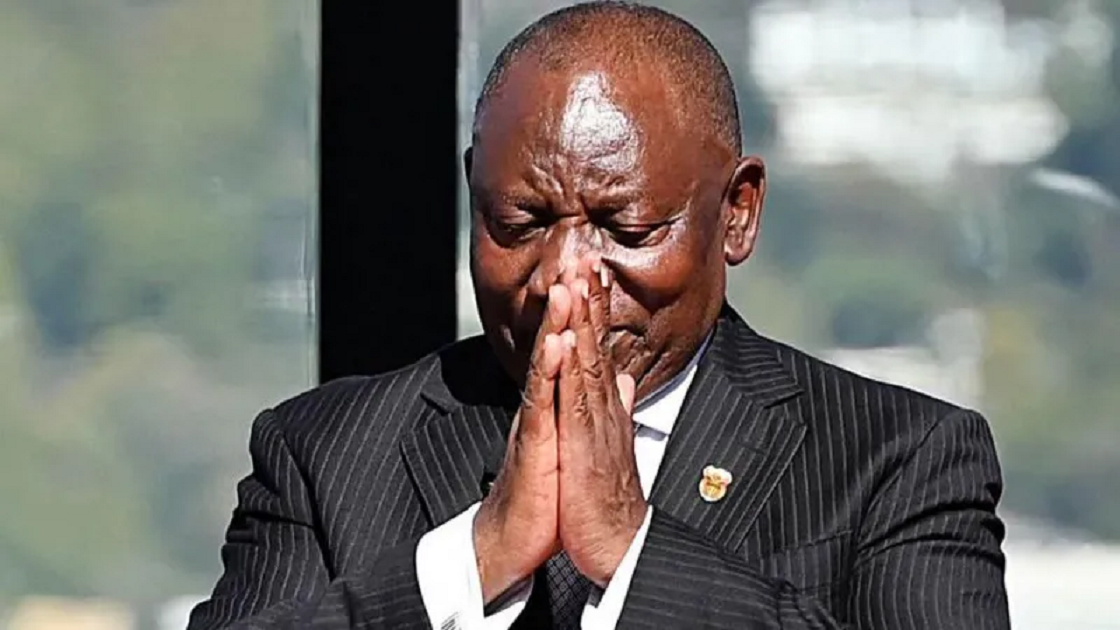
South Africa’s President Cyril Ramaphosa has unveiled a new coalition government, after his ruling African National Congress (ANC) party lost its parliamentary majority in May’s elections.
He said “the government of national unity… is unprecedented in the history of our democracy”.
The ANC will have 20 out of 32 cabinet posts, while the pro-market Democratic Alliance (DA) – until now the main opposition party – will hold six. Six other portfolios are shared amongst smaller parties.
These appointments followed weeks of tense negotiationa that threatened to scupper the agreement – at one point Mr Ramaphosa had accused the DA of trying to create a “parallel government” in breach of the constitution.
The shrinking of ANC support in the elections reflected public frustration over its poor record on delivering basic services and tackling unemployment, poverty and corruption.
The ANC led by Nelson Mandela came to power in 1994, ending decades of white-minority rule in South Africa.
Some of its activists have criticised it for sharing power with the DA, which some see as representing white interests.
The coalition government was welcomed by the business community who said it would ensure economic stability, in contrast to a potential deal with two radical parties which have split off from the ANC.
In the new cabinet, the ANC will keep key ministries such as defence, finance, and also foreign affairs – where it has been vocal in its support of the Palestinians and intensely critical of Israeli actions in Gaza. Outgoing Foreign Minister Naledi Pandor has been replaced by Ronald Lamola, who was previously justice minister.
The DA’s portfolios include home affairs – which controls immigration, as well as public works – which has been at the centre of a series of corruption scandals. Party leader John Steenhuisen will lead the agriculture ministry.
In a televised speech on Sunday, Mr Ramaphosa said: “The incoming government will prioritise rapid, inclusive and sustainable economic growth and creation of a more just society.”
The ANC welcomed the move as “an important step forward, and a testament to the resilience of our democracy”.
Meanwhile, the DA said it was “proud to rise to the challenge and take our place, for the first time, at the seat of national government”.
It also pledged “good governance, zero tolerance for corruption and pragmatic policy-making”.
Despite a coalition cabinet deal, stark political disagreements remain between the ANC and the DA.
Perhaps the biggest and most contentious issues are DA opposition to the ANC’s national healthcare policy and to its black economic empowerment programme.
Crucially the ANC retains control of those government ministries – mines, trade and land reform – which are key to its policies on black economic empowerment.
In May’s elections the ANC got 40% of the vote, while the DA secured 22%.
[BBC]


Rescue workers are racing to find dozens of people still missing following a landslide at a landfill site in the central Philippines that occurred earlier this week, an official has said.
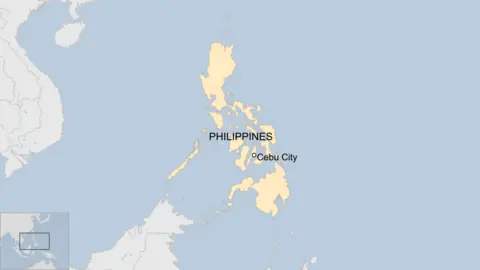
Mayor Nestor Archival said on Saturday that signs of life had been detected at the site in Cebu City, two days after the incident.
Four people have been confirmed dead so far, Archival said, while 12 others have been taken to hospital.
Conditions for emergency services working at the site were challenging, the mayor added, with unstable debris posing a hazard and crew waiting for better equipment to arrive.
The privately-owned Binaliw landfill collapsed on Thursday while 110 workers were on site, officials said.
Archival said in a Facebook post on Saturday morning: “Authorities confirmed the presence of detected signs of life in specific areas, requiring continued careful excavation and the deployment of a more advanced 50-ton crane.”
Relatives of those missing have been waiting anxiously for any news of their whereabouts. More than 30 people, all workers at the landfill, are thought to be missing.
“We are just hoping that we can get someone alive… We are racing against time, that’s why our deployment is 24/7,” Cebu City councillor Dave Tumulak, chairman of the city’s disaster council, told news agency AFP.
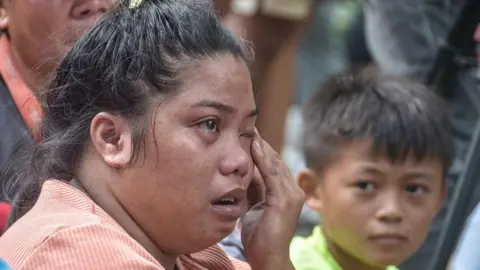
Jerahmey Espinoza, whose husband is missing, told news agency Reuters at the site on Saturday: “They haven’t seen him or located him ever since the disaster happened. We’re still hopeful that he’s alive.”
The cause of the collapse remains unclear, but Cebu City councillor Joel Garganera previously said it was likely the result of poor waste management practices.
Operators had been cutting into the mountain, digging the soil out and then piling garbage to form another mountain of waste, Garganera told local newspaper The Freeman on Friday.
The Binaliw landfill covers an area of about 15 hectares (37 acres).
Landfills are common in major Philippine cities like Cebu, which is the trading centre and transportation gateway of the Visayas, the archipelago nation’s central islands.
[BBC]

US President Donald Trump has asked for at least $100bn (£75bn) in oil industry spending for Venezuela, but received a lukewarm response at the White House as one executive warned the South American country was currently “uninvestable”.
Bosses of the biggest US oil firms who attended the meeting acknowledged that Venezuela, sitting on vast energy reserves, represented an enticing opportunity.
But they said significant changes would be needed to make the region an attractive investment. No major financial commitments were immediately forthcoming.
Trump has said he will unleash the South American nation’s oil after US forces seized its leader Nicolas Maduro in a 3 January raid on its capital.
“One of the things the United States gets out of this will be even lower energy prices,” Trump said in Friday’s meeting at the White House.
But the oil bosses present expressed caution.
Exxon’s chief executive Darren Woods said: “We have had our assets seized there twice and so you can imagine to re-enter a third time would require some pretty significant changes from what we’ve historically seen and what is currently the state.”
“Today it’s uninvestable.”
Venezuela has had a complicated relationship with international oil firms since oil was discovered in its territory more than 100 years ago.
Chevron is the last remaining major American oil firm still operating in the country.
A handful of companies from other countries, including Spain’s Repsol and Italy’s Eni, both of which were represented at the White House meeting, are also active.
Trump said his administration would decide which firms would be allowed to operate.
“You’re dealing with us directly. You’re not dealing with Venezuela at all. We don’t want you to deal with Venezuela,” he said.
The White House has said it is working to “selectively” roll back US sanctions that have restricted sales of Venezuelan oil.
Officials say they have been coordinating with interim authorities in the country, which is currently led by Maduro’s former second-in-command, Vice-President Delcy Rodríguez.
But they have also made clear they intend to exert control over the sales, as a way to maintain leverage over Rodríguez’s government.
The US this week has seized several oil tankers carrying sanctioned crude. American officials have said they are working to set up a sales process, which would deposit money raised into US-controlled accounts.
“We are open for business,” Trump said.
On Friday, Trump signed an executive order that seeks to prohibit US courts from seizing revenue that the US collects from Venezuelan oil and holds in American Treasury accounts.
Any court attempt to access those funds would interfere with US foreign relations and international goodwill, the executive order states.
“President Trump is preventing the seizure of Venezuelan oil revenue that could undermine critical US efforts to ensure economic and political stability in Venezuela,” the White House wrote in a fact sheet about the order.
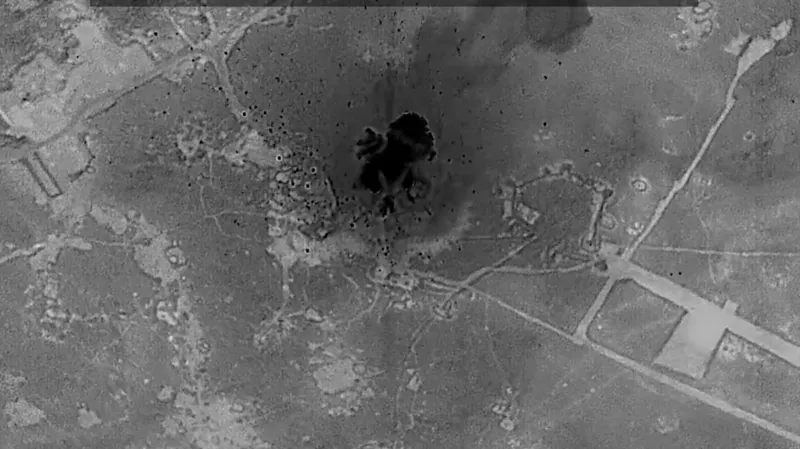
The US and its partner forces have carried out large-scale strikes against Islamic State (IS) group targets in Syria, the US Central Command (Centcom) has announced.
US President Donald Trump directed the strikes on Saturday, which are part of Operation Hawkeye Strike, in retaliation to the IS group’s deadly attack on US forces in Syria on 13 December, Centcom wrote on X.
The strikes were conducted in an effort to combat terrorism and protect US and partner forces in the region, according to Centcom.
“Our message remains strong: if you harm our warfighters, we will find you and kill you anywhere in the world, no matter how hard you try to evade justice,” Centcom said.
The US and its partner forces fired more than 90 precision munitions at more than 35 targets in an operation that involved more than 20 aircraft, an official told CBS News, the BBC’s US partner.
The official added that aircraft including F-15Es, A-10s, AC-130Js, MQ-9s and Jordanian F-16s had taken part in the strikes.
The location of the strikes and the extent of any casualties is not yet clear.
“We will never forget, and never relent,” Defence Secretary Pete Hegseth wrote on X on Saturday in reference to the military action.
The Trump administration first announced Operation Hawkeye Strike in December after an IS gunman killed two US soldiers and a US civilian interpreter in an ambush in Palmyra, located in the centre of Syria.
“This is not the beginning of a war – it is a declaration of vengeance,” Hegseth said when announcing the operation in December.
“The United States of America, under President Trump’s leadership, will never hesitate and never relent to defend our people.”
Prior to the latest strikes on Saturday, US forces killed or captured nearly 25 IS group members in 11 missions between 20 December and 29 December as part of Operation Hawkeye Strike, Centcom said.
In the operation’s first mission on 19 December, US and Jordanian forces carried out a “massive strike” against the IS group, deploying fighter jets, attack helicopters and artillery to strike “more than 70 targets at multiple locations across central Syria”, according to Centcom.
That operation, it said, “employed more than 100 precision munitions” targeting known IS infrastructure and weapons sites.
[BBC]

GENERAL WEATHER FORECAST FOR NEXT 36 HOURS

National Communication Programme for Child Health Promotion (SBCC) has been launched. – PM

Level I landslide early warnings issued to the Districts of Badulla, Kandy, Matale and Nuwara-Eliya extended

Rescuers race to find dozens missing in deadly Philippines landfill collapse

Trump seeks $100bn for Venezuela oil, but Exxon boss says country ‘uninvestable’

US military strikes Islamic State group targets in Syria, officials say

‘Dates have the highest sugar content to fight Coronavirus’

Sunday Island 27 December – Headlines

#SundayIsland 17th December – Headlines

Sunday Island – 28th March

Sunday Island Headlines – 21 March

Sunday Island – 21st February – Headlines
-
 News14 hours ago
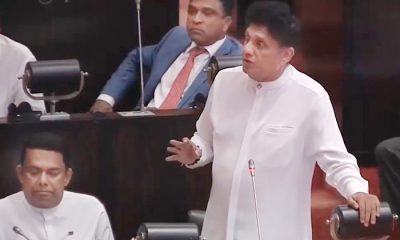
Sajith: Ashoka Chakra replaces Dharmachakra in Buddhism textbook
-

 News6 days ago
Interception of SL fishing craft by Seychelles: Trawler owners demand international investigation
-
 News6 days ago
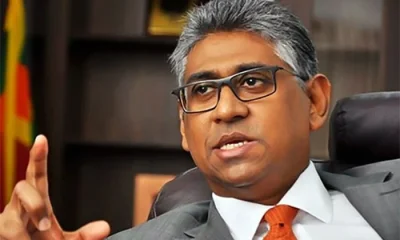
Broad support emerges for Faiszer’s sweeping proposals on long- delayed divorce and personal law reforms
-

 Opinion3 days ago
The minstrel monk and Rafiki, the old mandrill in The Lion King – II
-

 Features3 days ago
The Venezuela Model:The new ugly and dangerous world order
-

 News14 hours ago
65 withdrawn cases re-filed by Govt, PM tells Parliament
-

 Features14 hours ago
The Paradox of Trump Power: Contested Authoritarian at Home, Uncontested Bully Abroad
-

 Features14 hours ago
Subject:Whatever happened to (my) three million dollars?