
News
Solar industry warns of crisis amid power curtailment

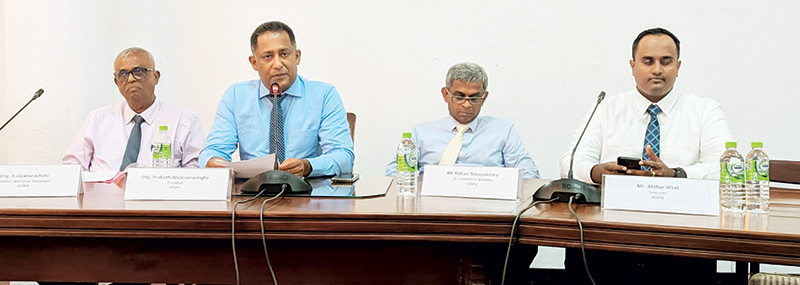
President of the Grid Connected Solar Power Association of Sri Lanka (GCSPASL), Prabath Wickramasinghe, said the national grid is losing nearly four million units of electricity per day due to the continued curtailment of grid-connected solar power plants.
Addressing a press conference in Colombo last week, Wickramasinghe warned that Sri Lanka’s renewable energy sector is facing a deepening crisis as prolonged power curtailment threatens the viability of local solar developers. Industry representatives cautioned that continued uncertainty could lead to widespread financial losses and the eventual collapse of the sector.
He noted that local solar developers currently supply approximately 1,800 MW of clean energy to the national grid. However, the Association said that for more than nine months since February 2025, power generation from large renewable energy plants has been curtailed on weekends and public holidays. While the Ceylon Electricity Board (CEB) has described the measure as an “emergency,” industry stakeholders argue that a recurring practice over several months cannot reasonably be classified as such.
According to Wickramasinghe, the curtailment has reduced monthly revenues of ground-mounted solar power plant owners by around 15 percent, severely disrupting cash flows. He stressed that these plants operate under “Must Run” status as specified in their Power Purchase Agreements (PPAs), and that curtailment therefore constitutes a breach of contractual obligations.
The Association also highlighted delays in the implementation of Battery Energy Storage Systems (BESS), despite developers expressing readiness to invest in storage facilities to absorb excess daytime solar generation and supply power during night-time peak demand. Although the Cabinet approved a tariff of Rs. 45.80 per unit in June 2025 and granted tax concessions in September, the CEB has yet to issue implementation guidelines or amend PPAs, despite directives from the Ministry of Power. As a result, the country continues to rely on expensive diesel-based power generation, placing further pressure on foreign exchange reserves.
Concerns were also raised over the proposed National Electricity Policy (2025). The Association warned that the planned removal of the Feed-in Tariff (FIT) mechanism—under which 92 percent of projects below 10 MW currently operate—would marginalise small and medium-scale local developers. The proposed shift to fully competitive bidding, curtailment without compensation, and rupee-denominated contracts were cited as increasing financial and exchange rate risks for investors.
The Association cautioned that these policy changes could lead to a rise in non-performing loans in the banking sector, as many renewable energy projects are financed through local banks and are now struggling to meet repayment obligations.
Calling for urgent government intervention, the Association urged authorities to immediately issue BESS-related guidelines, compensate developers for past losses, and retain the FIT system. Industry leaders stressed that private sector participation is essential to achieving Sri Lanka’s renewable energy targets by 2030, warning that continued delays could have long-term consequences for the economy and national energy security.

Engineers at the Ceylon Electricity Board have drawn a clear red line over the government’s plan to gazette the appointed date for restructuring the utility, warning that trade union action will follow if the move is pushed through without addressing their core demands, the Sunday Island learns.
The powerful Ceylon Electricity Board Engineers’ Union (CEBEU) says preparations are already under way for industrial action, most likely after the appointed date gazette is published, should the Minister proceed without resolving outstanding issues raised repeatedly by engineers.
“If the appointed date is gazetted without addressing our demands, we will have no option but to take trade union action,” a senior electrical engineer told The Island, stressing that the warning should be taken seriously.
CEBEU sources say the engineers’ demands are aimed at preventing a structural and financial crisis in the electricity sector, rather than blocking reform. They insist that unbundling the CEB without first putting in place firm safeguards would expose the sector to instability and consumers to higher costs.
The engineers’ key demands include: legally binding financial safeguards to ensure the proposed Electricity Generation Company is viable from inception; protection against the transfer of legacy liabilities, extraordinary costs, or inefficiencies to new entities or electricity consumers; enforceable accountability for management and policy decisions that inflate system costs; genuine, structured consultation with technical professionals before irreversible decisions are taken; and a halt to gazetting the appointed date until these safeguards are formally incorporated.
Engineers warn that rushing the appointed date would lock existing weaknesses into the new structure, making them harder—and more expensive—to fix later. “Once the appointed date is gazetted, there is no rewind button,” a senior engineer said. “If the foundation is flawed, the entire structure will suffer.”
Meanwhile, according to energy analyst, Dr. Vidhura Ralapanwe, electricity sector reforms must be grounded in technical and financial reality, not driven by administrative timelines.
He has cautioned that implementing structural changes without correcting underlying governance and cost issues risks destabilising the sector and undermining public confidence.
CEBEU officials reject claims that the union is resisting reform. They say engineers are being sidelined in decision-making while being held responsible for system performance. “We are accountable for keeping the system running, but our professional warnings are being ignored,” one engineer said. “That is not reform; it is reckless governance.”
With the Minister yet to gazette the appointed date, tensions within the power sector are rising sharply.
Engineers say the government now faces a stark choice: engage with professionals and fix the problems first—or brace for confrontation in a sector where disruption will have coutrywide consequences.
By Ifham Nizam ✍️

The annual Colombo Navam Maha Perahera, along with an exhibition of sacred relics brought from India, will be held at Gangaramaya Vihara in Hunupitiya, featuring a series of religious observances, according to Most Venerable Dr. Kirinde Assaji Thera.
Addressing a media briefing on Friday, the Venerable Thera said the Perahera will take place on January 31 and February 1, commencing at 7.30 p.m. and concluding before 10.00 p.m., after parading through the streets of Colombo.
He said specially decorated floats have been prepared to depict key historical events, enabling foreign visitors to better understand Sri Lanka’s cultural and religious heritage. The floats will portray significant moments such as the arrival of Arahat Mahinda, the bringing of the Sri Maha Bodhi, and the arrival of the Sacred Tooth Relic, and will be performed by leading local artistes.
The procession is expected to feature around 8,000 dancers and elephants, representing a wide range of traditional dance forms.
The exhibition of sacred relics from the Devnimodara Shrine in India will be held at Gangaramaya Vihara from February 4 to 11. The Venerable Thera urged devotees to visit the temple dressed in white and to refrain from bringing valuables or large items of luggage. He added that necessary facilities have been arranged to accommodate the large number of devotees expected.
Meanwhile, Minister of Buddhasasana, Religious and Cultural Affairs Dr. Hiniduma Sunil Senevi said a mobile application will be introduced to inform devotees of the approximate date and time allocated for venerating the Sarvagna Dhathu, in a bid to manage crowds more efficiently.
Senior DIG in charge of Colombo G. Nishantha de Zoysa said a special security plan has been implemented with the assistance of the tri-forces, in accordance with instructions from the Ministry of Public Security and the Inspector General of Police. He added that a comprehensive traffic management plan, including alternative routes, has been prepared, and that detailed police announcements will be issued shortly. The Senior DIG also advised the public not to carry large luggage, jewellery, mobile phones, or other valuables when visiting the exhibition.
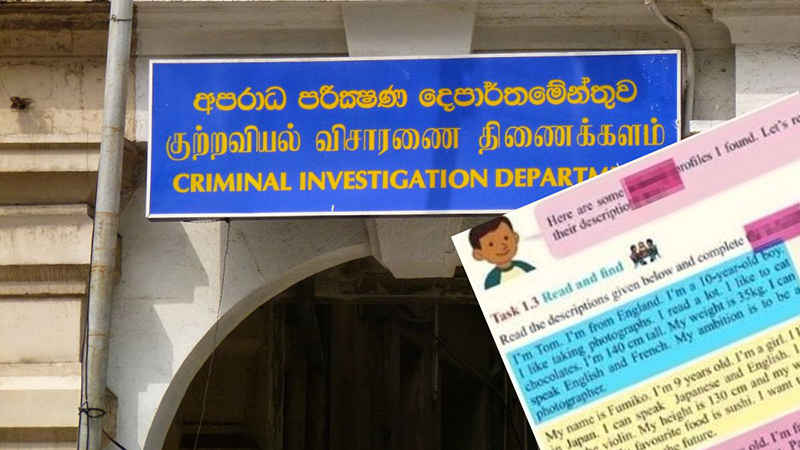
The CID has so far recorded statements from 15 individuals in connection with the Grade 6 English module, police headquarters sources said yesterday.
The CID stated that several officials of the National Institute of Education (NIE), Maharagama, are among those from whom statements have been obtained.
On Thursday, the CID also recorded a statement from Venerable Ulapane Sumangala Thera.
Several parties, including the Secretary to the Ministry of Education, had previously lodged complaints with the CID regarding the inclusion of the name of an inappropriate website in the Grade 6 English module.
by Norman Palihawadane ✍️

Engineers draw red line as CEBEU warns of union action over appointed date

Navam Perahera and sacred relics exhibition at Gangaramaya

CID sleuths still plodding on with their probe into controversial Grade 6 English module

Anusha Palpita remanded over alleged illicit assets

26th Edition: Journalism Awards for Excellence 2024

From colour to contour: Ramani Fernando on what next in 2026

‘Dates have the highest sugar content to fight Coronavirus’

Sunday Island 27 December – Headlines

#SundayIsland 17th December – Headlines

Sunday Island – 28th March

Sunday Island Headlines – 21 March

Sunday Island – 21st February – Headlines
-

 Features6 days ago
Extended mind thesis:A Buddhist perspective
-

 Opinion5 days ago
American rulers’ hatred for Venezuela and its leaders
-

 Business3 days ago
CORALL Conservation Trust Fund – a historic first for SL
-

 Opinion3 days ago
Remembering Cedric, who helped neutralise LTTE terrorism
-

 Opinion2 days ago
A puppet show?
-

 Opinion5 days ago
History of St. Sebastian’s National Shrine Kandana
-

 Features4 days ago
The middle-class money trap: Why looking rich keeps Sri Lankans poor
-

 Features2 days ago
‘Building Blocks’ of early childhood education: Some reflections