
News
SLPP: Words like container, solar panel, and wind power now seem banned in Parliament


Hambantota District SLPP MP D.V. Chanaka said on Friday that words such as container, solar panel, and wind power had been banned in Parliament.
Addressing a press conference at the SLPP headquarters in Battaramulla MP Chanaka said: “There are now several ‘banned’ words in Parliament. When someone mentions ‘container,’ government members stand up and say that’s not the topic being discussed today. The same happens when talking about wind power or solar panels — the government claims it’s not relevant to the day’s agenda. These have now become taboo words.”
“The entire country knows that 323 containers with red labels went missing. Customs officials themselves said they were suspicious, wondering if they contained weapons or other sensitive materials. Now, MP Arjuna says those containers held Prabhakaran’s weapons. When you connect the dots, the story begins to make sense.”
“To this day, the government hasn’t disclosed what was in those containers. We’ve been continuously raising concerns and demanding investigations — but there’s been no response. Finally, it’s MP Dayasiri Jayasekara, who made complaints on this matter. The CID summoned him. That’s like shooting the messenger. It is the Minister, the Deputy Minister, and the relevant officials who should have been questioned.”
“Also, for the past month or so the government has failed to import aviation fuel. As a result, pilot training schools are facing major difficulties. This is also affecting the tourism industry. Is this due to the government’s incompetence.”
by Anuradha Hiripitiyage







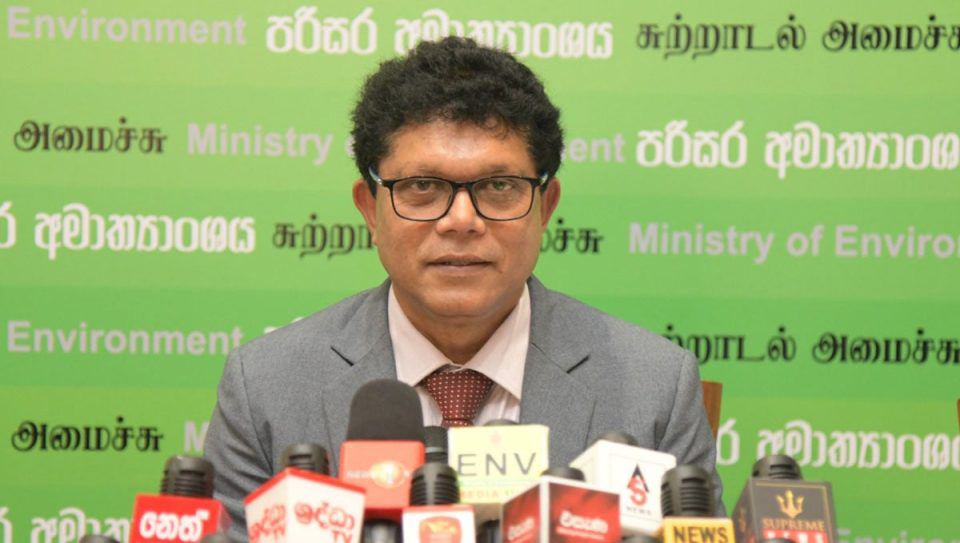
Environment Minister Dammika Patabedi said yesterday he had ordered an inquiry into the withdrawal of China-based Amber Adventures (Private) Ltd., from the Ambuluwawa Cable Car Project.Addressing the media, the Minister said the Environment Ministry had no direct agreement with the company, as the project was under the purview of the Board of Investment (BOI).
He said construction activities within the Ambuluwawa Environmental Zone had been suspended following complaints from environmental organisations in the aftermath of Cyclone Ditwah. All constructions in high-risk areas, he said, had been halted pending clearance by the National Building Research Organisation (NBRO).
According to the Minister, complaints had been received that construction at Ambuluwawa was continuing without NBRO clearance.
In response, the Ministry instructed the Central Environmental Authority (CEA) to conduct an investigation and thereafter construction activities were suspended pending a technical assessment by experts.
The Ministry of Environment subsequently ordered the immediate suspension of all construction activities within the Ambuluwawa Environmental Zone until the assessment was completed, he said, adding that work could resume if expert evaluations cleared the project.
Following the suspension, Amber Adventures (Private) Ltd,, described as the country’s first cable car venture, formally withdrew from the project, citing what it termed “regulatory obstruction and arbitrary state action.”
The company, a major Chinese investor in the project, proposed as Sri Lanka’s first cable car initiative with both Chinese and American investment, officially informed the BOI of its decision on Wednesday (14). In a letter to the BOI, the company said it had obtained all required permits and approvals in line with BOI procedures but faced repeated disruptions that resulted in significant financial losses.
Company Director Yuan Yuping warned that legal action would be pursued at the International Court of Arbitration to recover losses incurred due to the suspension of the project, citing continuous interruptions and government decisions as the cause.
Meanwhile, the Ambuluwawa Trust Board said the withdrawal of investors from the project was a major loss to the country, noting that it was regrettable that decisions had been taken without proper investigation, based on allegations by parties lacking a clear understanding of the facts.
It warned that halting a large-scale project of that nature would result in the loss of direct and indirect employment opportunities, as well as income sources for communities in the surrounding areas.
By Chaminda Silva and SK Samaranayake ✍️

Balangoda Kassapa Thero, held in Trincomalee remand prison over alleged violations of the Coastal Conservation Act, reportedly refused meals yesterday (15).
Prison authorities, however, said it could not be confirmed whether the monk’s action amounted to a hunger strike. Prison Media Spokesperson A. C. Gajanayake added that an official statement on the matter would be issued today (16).
The monk and eight others were remanded until 19 Jan by the Trincomalee Magistrate’s Court over allegations of unauthorised construction of a shelter to place a Buddha statue at the Sri Sambuddha Jayanthi Bodhiraj Viharaya. Prison sources said Thero had also declined food brought from outside.
The case follows reports to the court by the Trincomalee Harbour Police that unauthorised constructions had been carried out, despite instructions from the Court of Appeal to resolve the dispute peacefully.
by Chaminda Silva ✍️

The Food and Agriculture Organization of the United Nations (FAO) Headquarters in Rome issued an appeal calling for international assistance of USD 16.5 million to support the early recovery of livelihoods and food security for farming, livestock-keeping and fishing communities affected by Cyclone Ditwah in Sri Lanka, FAO said yesterday.
Cyclone Ditwah represents one of the most severe climate shocks the country has faced in decades, affecting all 25 districts and disrupting the lives and livelihoods of more than 2.2 million people. Over 1.1 million people are now in urgent need of food security, agricultural and nutrition assistance, at a time when vulnerabilities were already heightened by prolonged economic pressures.
The cyclone struck at the onset of the critical Maha 2025/26 cultivation season, causing widespread damage to agriculture, livestock and fisheries. Floods inundated more than 129 000 hectares of agricultural land, affecting over 227 000 farming households. Standing water, debris, siltation and damaged irrigation systems are delaying replanting, while shortages of seeds, fertilizers and access to machinery threaten to result in irreversible production losses if immediate support is not provided.
Livestock and fisheries losses have further compounded the crisis. More than 37 000 cattle and buffaloes, nearly 16 000 goats and sheep, and 475 000 poultry have been lost, while damage to fisheries and aquaculture is estimated at USD 66–69 million, undermining both food availability and household incomes.
“This appeal focuses on early recovery interventions that are urgently needed to stabilize livelihoods and safeguard food production.,” said Vimlendra Sharan, FAO Representative for Sri Lanka and the Maldives. “While the overall requirements for the agrifood sector to fully rebound are substantially higher, immediate early recovery support is critical to prevent long-term losses, deeper food insecurity and increased reliance on food assistance.”
Issued by FAO Headquarters in Rome, the appeal targets 256 000 households (approximately 1.03 million people) across the Central, Eastern, North Central, North Western, Northern, Uva and Western Provinces. The USD 16.5 million requirement reflects priority early recovery actions, designed to rapidly restore productive capacity and protect livelihoods.
FAO’s planned interventions include:
Restoring crop production by providing seeds, fertilizers and essential agricultural inputs to smallholder farmers;
Safeguarding livestock assets through emergency animal health services, vaccines, veterinary kits and poultry restocking;
Supporting fisheries and aquaculture livelihoods through the repair or replacement of damaged boats and fishing gear; and
Providing cash-based assistance, including cash-for-work, to meet immediate needs, support livelihood restoration and enable debris clearance where markets are functioning.
FAO is working closely with the Government of Sri Lanka, particularly the Ministry of Agriculture, Livestock, Land and Irrigation and the Ministry of Fisheries, Aquatic and Ocean Resources. FAO also co-leads the Food Security and Livelihoods Sector alongside the World Food Programme and coordinates its response with the Sri Lanka Humanitarian Priorities Plan – Cyclone Ditwah.
To date, USD 400 000 has been received, leaving a 97.6 percent funding gap. Without urgent donor support, hundreds of thousands of households risk missing an entire cultivation season, with lasting consequences for food security, nutrition and rural resilience.

Deol, Tryon power Warriorz to first win of season

Fair weather will prevail in most parts of the island.

Probe into Chinese exit from Cable Car Project

Buddha statue issue: monk refuses meals in remand prison

‘Lanka faces food crisis’ :FAO calls for $16.5m aid

Education Reforms: Academics, activists condemn personal attacks on PM

‘Dates have the highest sugar content to fight Coronavirus’

Sunday Island 27 December – Headlines

#SundayIsland 17th December – Headlines

Sunday Island – 28th March

Sunday Island Headlines – 21 March

Sunday Island – 21st February – Headlines
-

 Business1 day ago
Koaloo.Fi and Stredge forge strategic partnership to offer businesses sustainable supply chain solutions
-

 Business5 days ago
Dialog and UnionPay International Join Forces to Elevate Sri Lanka’s Digital Payment Landscape
-

 News5 days ago
Sajith: Ashoka Chakra replaces Dharmachakra in Buddhism textbook
-

 Features5 days ago
The Paradox of Trump Power: Contested Authoritarian at Home, Uncontested Bully Abroad
-

 Features5 days ago
Subject:Whatever happened to (my) three million dollars?
-
 Business1 day ago
SLT MOBITEL and Fintelex empower farmers with the launch of Yaya Agro App
-

 News5 days ago
Level I landslide early warnings issued to the Districts of Badulla, Kandy, Matale and Nuwara-Eliya extended
-
 Business1 day ago
Hayleys Mobility unveils Premium Delivery Centre