
News
SLPP urged to take up GR’s draft constitution with Prez

By Shamindra Ferdinando
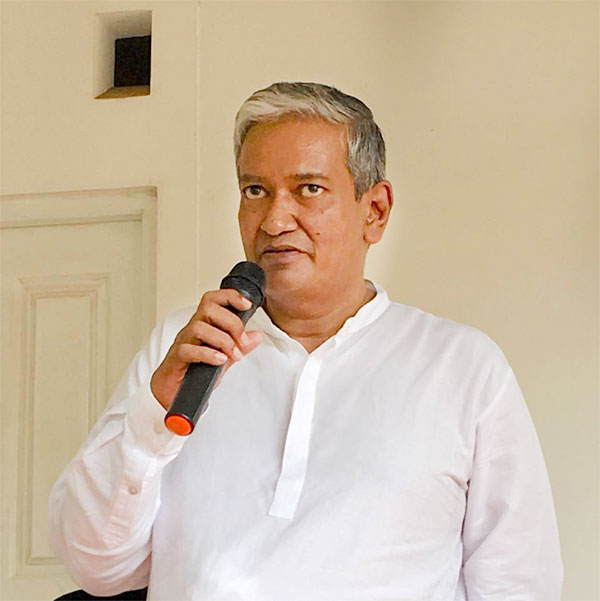
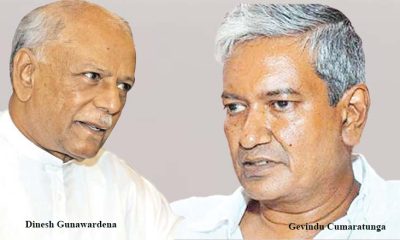
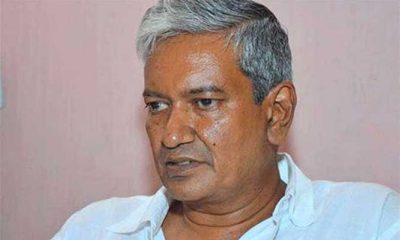
The ruling SLPP parliamentary group should intervene to make President Ranil Wickremesinghe examine the draft Constitution formulated by the nine-member committee appointed by President Gotabaya Rajapaksa’s Cabinet-of-Ministers, rebel SLPP List MP Gevindu Cumaratunga said yesterday (15).
President’s Counsel Romesh de Silva headed the committee.
Having elected UNP leader Wickremesinghe in July last year as the President to complete the remainder of the then President Gotabaya Rajapaksa’s five-year term, the SLPP couldn’t remain silent on their own initiative, Cumaratunga said.
Responding to a query raised by The Island, the leader of civil society group Yuthukama stressed that the SLPP received two mandates at the Nov. 2019 presidential and Aug. 2020 parliamentary polls to introduce a new Constitution.
President Wickremesinghe should under no circumstances implement the 13th Amendment to the Constitution or contemplate going beyond that particular amendment, the first time entrant to Parliament said.
Questioning the President’s Office’s request for political parties to submit their recommendations, regarding the 13th Amendment, by 15th August, MP Cumaratunga said that the SLPP owed an explanation regarding its failure to take up the issue at hand with the President.
The committee announced by the then Justice Minister Ali Sabry, PC, comprised Gamini Marapana P.C., Manohara de Silva P.C., Sanjeewa Jayawardena P.C., Samantha Ratwatte P.C., Prof. Naazima Kamardeen, Prof. A. Sarveswaran, Prof. Wasantha Seneviratne and Prof. G.H. Peiris.
According to the committee, the draft that had been finalized in March 2022 was handed over to the then President Gotabaya Rajapaksa in April though it was never subject to public discussion. Both Sinhala and English copies were handed over to the President while the Legal Draftsman was requested to translate it to Tamil.
Of the political parties represented in Parliament, the main Opposition SJB and President Wickremesinghe’s party the UNP haven’t made representations to Romesh de Silva’s Committee. In spite of the Joint Legal Secretaries of the SJB meeting the Chairman of the Committee to work out modalities, the anticipated meeting didn’t take place, sources said.
The Committee received representations from delegations led by Basil Rajapaksa (SLPP), R. Sampathan (TNA), Dinesh Gunawardena (MEP), Udaya Gammanpila (PHU), Wimal Weerawansa (JNP), Tiran Alles (UPP), Vasudeva Nanayakkara (DLF), Anura Kumara Dissanayake (JJB), Raja Collure (Socialist Alliance), Dew Gunasekera (CP), Nimal Siripala de Silva (SLFP), Rushdi Habeeb (ACMC), Douglas Devananda (EPDP), Bandula Chandrasekera (JHU), Mano Ganesan (TPA), V. Radhakrishnan (UPF), Sivanesathurai Chandrakanthan (TMVP), Senthil Thondaman (CWC), Prof. Tissa Vitharana (LSSP), C.V. Wigneswaran (TMTK) and Asanka Navaratne (SLMP).
About a week before President Rajapaksa fled the country, amidst violent protests, the Committee planned to address the media regarding the new Constitution at the Presidential Secretariat. However, the media briefing was cancelled at the eleventh hour.
The committee has been divided over the 13th Amendment to the Constitution, enacted in 1988, in the wake of the Indo-Lanka Accord, signed in the year before.
The majority of Romesh de Silva’s Committee has not endorsed the Provincial Council, introduced in terms of the 13th Amendment, whereas Prof. A. Sarveswaran disagreed with the relevant Chapter (XXII) that he asserted deprived Provincial Council the powers enjoyed under the present Constitution, thereby affected reconciliation efforts.
Those who opposed asserted that the 13th Amendment undermined the unitary character thereby threatened the security of the State.
One member declared his opposition to the Provincial Council system and was not in favour of the provisions incorporated in Chapter XXII. That particular member has explained the grave danger in continuing with the existing system and the intensification of that threat in case of further devolution of power.
But two members supported the proposed Chapter XXII on the basis that
(i) No separate elections are held to constitute Provincial Councils,
(ii) Provincial Councils to consist of representatives of Local Authorities elected at the Local Authority Elections,
(iii) Provincial Councils to exercise executive power subject to the executive powers of the President and the Cabinet of Ministers
(iv) Power of the National State Assembly is not restricted in any manner with regard to any subject on which a Provincial Council has the power to make statutes.
The draft contained a full chapter on Provincial Councils. The Committee has suggested election of members to Provincial Councils and Local Authorities will be held on the same day in one election with each elector having two votes to elect a member for his electoral unit [ward] and a member for the Provincial Council from any one of the candidates in his local government area.







The Department of Immigration and Emmigration has decided effective from 28th February 2026, to grant a free fourteen (14) day visa extension to all tourists who are unable to leave Sri Lanka due to flight cancellations. 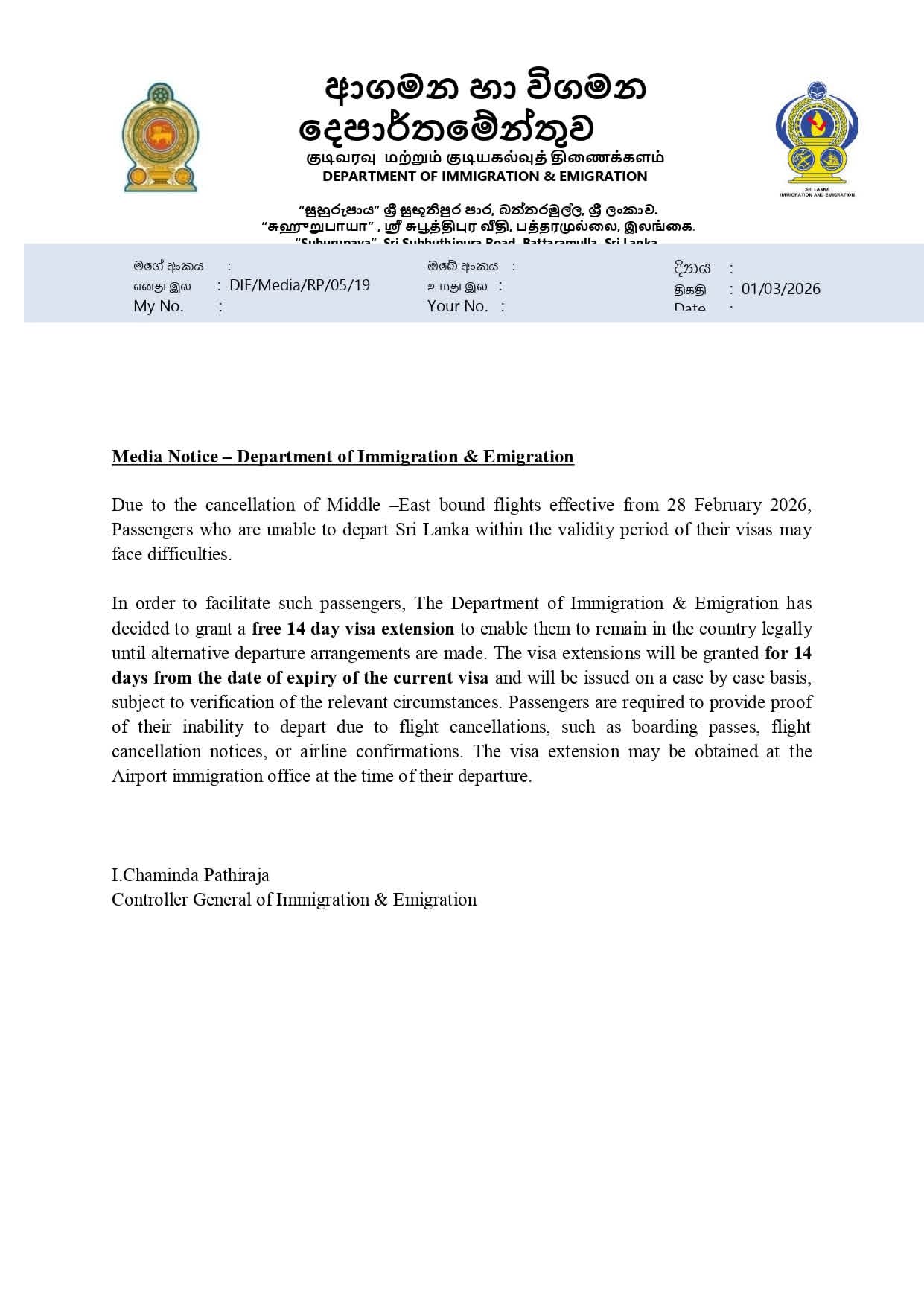
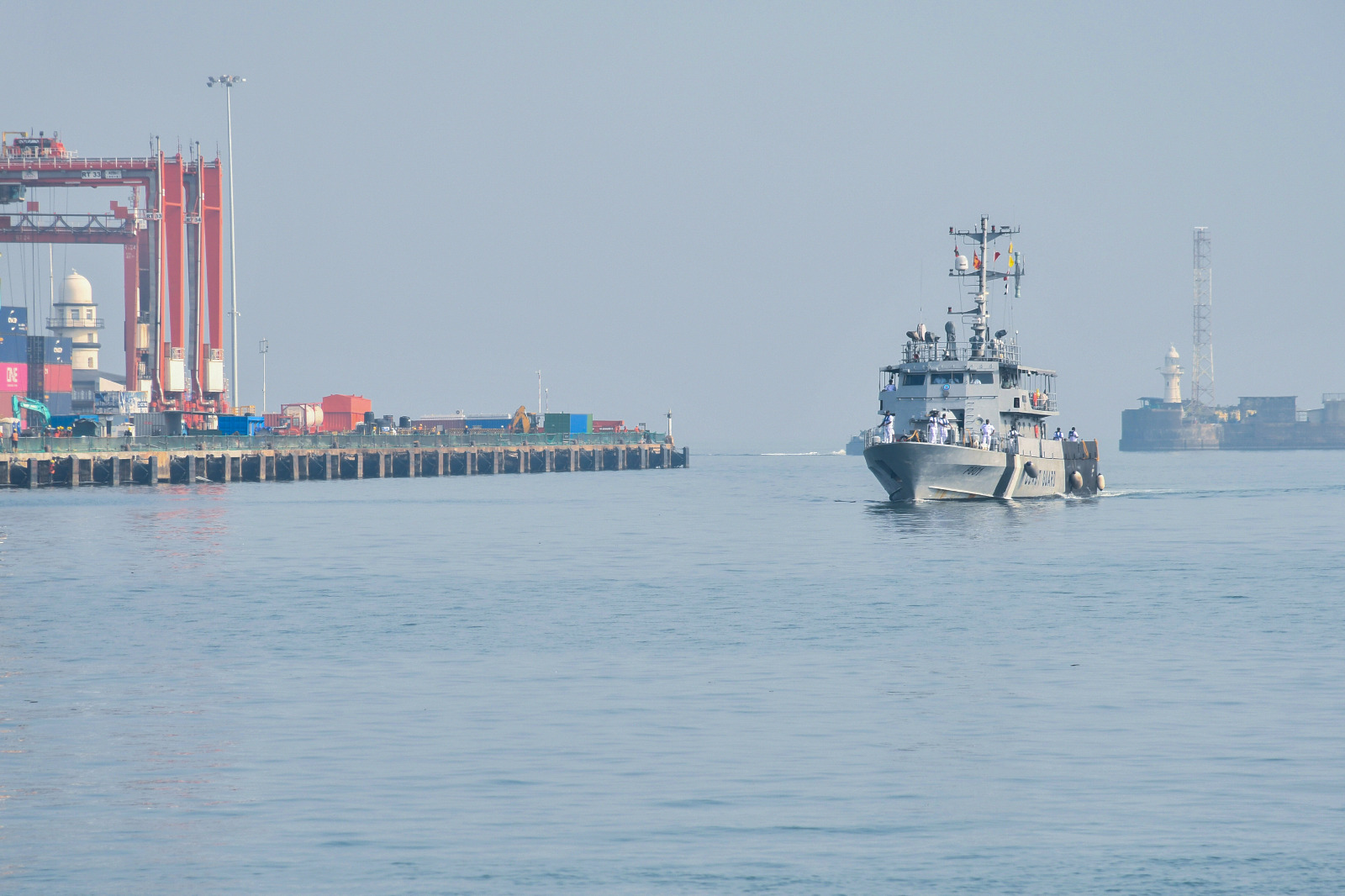
The Maldives Coast Guard Ship Huravee arrived at the Port of Colombo for replenishment purposes on 02 Mar 26. The visiting ship was welcomed by the Sri Lanka Navy (SLN) in compliance with time-honoured naval traditions.
The ship is a 48.9m long Offshore Patrol Vessel which is commanded by Lieutenant Colonel Ahmed Nafiu Mohamed.
Meanwhile, the ship’s crew is scheduled to visit several tourist attractions in the city of Colombo, during their stay in the island.
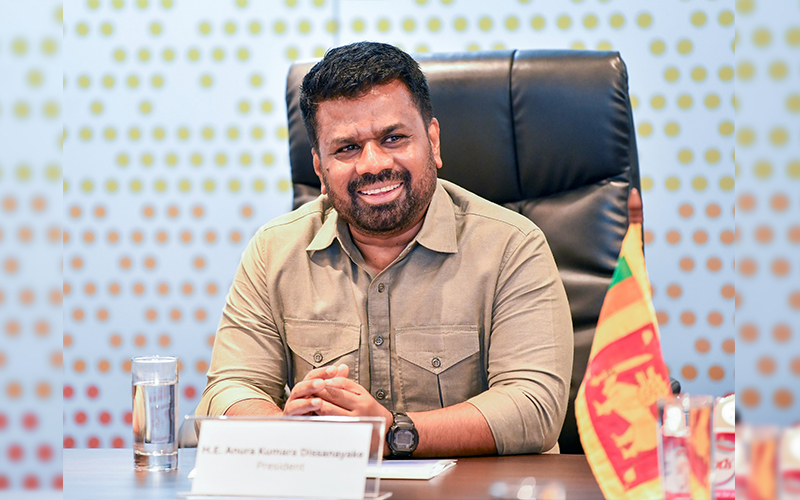
President Anura Kumara Dissanayake yesterday called for an immediate and peaceful resolution of the escalating Middle East conflict, warning that the crisis could have far-reaching repercussions on the global economy, including Sri Lanka.
Addressing Parliament, the President stressed that no military conflict benefited humanity, particularly at a time when destructive military technologies were rapidly advancing.
“Any military conflict does not create a favourable situation for any group of people,” he said, urging all parties to make urgent commitments towards peace. “As Sri Lanka, our position is that all parties involved in this war must, as soon as possible, take steps toward a peaceful world.”
He cautioned that Sri Lanka could not remain insulated from the fallout from the conflict, noting that disruptions to global oil and gas supplies, threats to migrant workers in the Middle East, and potential shocks to tourism, remittances, shipping and aviation were real concerns.
A national programme was being formulated to mitigate the impact, he said, adding that its success would hinge on broader international efforts to restore stability, the President said.
Acknowledging public anxiety shaped by past economic hardships, President Dissanayake said social stability could not be ensured through rhetoric alone but required tangible guarantees that citizens would not face another crisis.
While noting that the government had successfully navigated multiple challenges since assuming office, he described the Middle East situation as distinct due to the uncertainty surrounding its duration and outcome.
The government, he said, was closely monitoring developments. The Central Bank had conducted a review with a report on the likely economic impact expected shortly. The Ministry of Finance is also preparing an assessment of the potential effects on public life, alongside measures to ensure the uninterrupted provision of essential services locally and for Sri Lankans overseas.
“The primary responsibility for finding a path out of the crisis rests with the Government,” he said, calling on Parliament and the public to collectively confront the challenge under a unified national plan.
Providing a detailed account of the country’s energy reserves, the President said storage capacity rather than supply remained the key constraint. Excluding the Indian Oil Corporation tanks in Trincomalee, total storage capacity at Kolonnawa and Muthurajawela stands at approximately 150,000 metric tons.
Diesel stocks were currently sufficient for 33 days, with refining contributing around 1,800 metric tons daily. Petrol reserves will last 27 days, with a 35,000 metric ton shipment due on March 7 or 8 expected to extend availability to around 40 days.
Aviation fuel stocks are adequate for 49 days, supported by both daily refining and imports. Scheduled shipments include vessels from RM Parks on March 14, Sinopec on March 17, IOC on March 21 and the Ceylon Petroleum Corporation on March 28.
Crude oil supplies were sufficient to operate the refinery for 26 days, with an additional shipment expected to extend operations by a further 18 days, the President said.
“Because of this, there is no crisis regarding oil,” the President assured Parliament.

Free 14 day visa extension for visitors unable to depart Sri Lanka

US embassy in Dubai hit; Israel pounds Tehran, Beirut

Perera, Sugandika, Ranaweera take Sri Lanka to T20I series win over West Indies

Maldives Coast Guard Ship Huravee arrives in Colombo

New charges for son of Norway’s crown princess on trial for rape

US sends planes to evacuate nationals from Middle East as Iran conflict spreads

‘Dates have the highest sugar content to fight Coronavirus’

Sunday Island 27 December – Headlines

#SundayIsland 17th December – Headlines

Sunday Island – 28th March

Sunday Island Headlines – 21 March

Sunday Island – 21st February – Headlines
-
 Opinion5 days ago
Jamming and re-setting the world: What is the role of Donald Trump?
-
 Features5 days ago
An innocent bystander or a passive onlooker?
-

 Features2 days ago
Brilliant Navy officer no more
-
 Features6 days ago
Ratmalana Airport: The Truth, The Whole Truth, And Nothing But The Truth
-

 Opinion2 days ago
Sri Lanka – world’s worst facilities for cricket fans
-
 Business6 days ago
IRCSL transforms Sri Lanka’s insurance industry with first-ever Centralized Insurance Data Repository
-

 Business5 days ago
An efficacious strategy to boost exports of Sri Lanka in medium term
-
 Features3 days ago
Overseas visits to drum up foreign assistance for Sri Lanka