
Business
SLID and EY organize webinar on “Rising from the Pandemic”

The Sri Lanka Institute of Directors (SLID) together with EY organized a webinar titled “Rising from the Pandemic: Challenges, Responses and Learnings” recently to discuss and share insights on the experiences of leading companies and their successful response to the pandemic. Moderated by A. R. Rasiah – Chairman, SLID, the Keynote Speaker at the event was Jonathan Moreno – Chief Strategy Officer, Metro Retail Stores Group Inc., Philippines. Joining him on the panel were top Sri Lankan corporates Hanif Yusoof – Group CEO, Expolanka Holdings PLC, Suren Fernando – CEO, MAS Holdings (Pvt) Ltd and Nalin Karunaratne – Director/CEO, Ceylon Biscuits Ltd and CBL Exports (Pvt) Ltd.
In his keynote address Jonathan Moreno said that the severity of the pandemic can be seen by the ADB conducted survey in Philippines revealing that out of 74,000 firms surveyed, 40% were closed during the pandemic out of which 16% were permanently closed and 78% saying that they have either decreased or stopped staff payments. “In addition to the challenges faced due to quarantine measures, travel restrictions and inadequate tech infrastructure, executive myopia, attitudinal shifts in the workforce, analog mindsets, outdated business models, silo mentality, skills, leadership and capability gaps, transactional relationships with stakeholders, performance management and governance were some of the specific challenges that we faced” and added that Metro Retail responded with strategies to ensure team welfare and security, financial stability, business continuity, moving to scenario-based stress testing, creating new delivery channels, governance, and communication models.
Describing various events in the past which led to strategies being implemented to make the business agile, and lead and think on its feet had helped its successful response to the pandemic, Hanif Yusoof said “as a global organization with a large monthly overhead, our main challenges were the working capital required to keep the system going with potential losses for the next 6 months, health & safety of our employees, and possible delayed payments from customers aggravating the capital requirements” adding that adopting work from home policies and opening hotlines for employee support, involving the Main Board on a weekly basis with management, focusing on the short term when the future is unclear played a critical role in Expolanka’s successful response to the pandemic.
“Amidst many challenges including order cancellations and pushbacks, operational stability, and the large workforce, our approach at MAS in responding to the pandemic was very clear in that our first and foremost concern was to protecting lives and livelihoods of our people which has been our motto and principle. We have set up many top-of-the-line care centers to treat our impacted employees. This employee first strategy has enabled us to build trust and engagement at all levels including at the shopfloor. We also ensured open, honest, quick communication with our customers regarding the impact on their deliveries” said Suren Fernando. He also added that amongst others, the support of the Board including giving management the independence and autonomy to make calls and move on, and digitalization programmes as positive factors in responding successfully to the pandemic.
“With over 6,000 employees, 24-hour manufacturing, 12,000 farmers supplying produce for our manufacturing processes, distributors, and over 150,000 retail outlets who depend on our brands, CBL’s foremost concerns, in our response to the pandemic, lay in ensuring the health & safety of employees, and ensuring food safety & security in fulfilling a large-scale responsibility to the country. We went to the extent of upgrading facilities in hostels where our employees were residing to ensure their health & safety and made certain that we cared for even the families of our employees who were impacted by the virus which enabled us to gain great trust amongst our employees. Furthermore, any changes to the manufacturing facility were done only with the approval and concurrence of the health authorities. We also ensured that our facilities and processes were always in conformance with the SLS and other standards making us ready even for unannounced compliance audits” said Nalin Karunaratne. He added that sticking to the basics and doing the right things, not taking short-cuts even in the most challenging times, and relying on wisdom which overpowers business rationale helped them to successfully face the pandemic.
In his closing remarks, moderator A. R. Rasiah said that the employee first approach including focus on employee health & safety, wellbeing and caring, and livelihood protection which helped to obtain the trust, support, commitment, and cooperation of their people was highlighted by all panelists as the key and foremost strategy that helped them successfully navigate their companies amidst the challenges of the pandemic.

Business
SEC Sri Lanka eases Minimum Public Holding Rules for listings via introductions to boost market flexibility


The Securities and Exchange Commission of Sri Lanka (SEC) has approved amendments to the Colombo Stock Exchange (CSE) Listing Rules to provide greater flexibility regarding the Minimum Public Holding (MPH) requirement for companies listing through the Introduction method.
These revisions were proposed and deliberated under Project 6 – New Listings (Public and Private), one of 12 key strategic initiatives launched by the SEC to strengthen Sri Lanka’s capital market framework. Project 6 aims to drive national capital formation, promote listings by highlighting benefits and opportunities for listed entities, and attract large-scale corporates to enhance market depth, liquidity, and investor confidence.
The amendments reflect a joint effort by the SEC and CSE, underscoring strong collaboration between the regulator and the Exchange to address evolving market needs while maintaining market integrity, transparency, and investor protection.
The salient features of the amendments to the CSE listing Rules are as follows;
Entities seeking listing by way of an Introduction on the Main Board or Diri Savi Board that are unable to meet the MPH requirement at the time of submitting the initial listing application, may now be granted a listing, subject to certain conditions on compliance.
Non-public shareholders who have held their shares for a minimum period of eighteen months prior to the date of the initial listing application may divest up to a maximum 2% of their shares each month during the six months commencing from the date of listing, and simultaneously, be subject to a lock-in requirement of 30% of their respective shareholdings as at the date of listing, until MPH compliance or 18 months from the date of listing, whichever occurs first.
A phased MPH compliance framework has been introduced requiring a minimum 50% compliance with MPH requirement within 12 months and full compliance within 18 months from the date of listing.
Entities should include clear disclosures in the Introductory Document confirming their obligation to meet MPH requirements within the prescribed timelines.
In the event of non-compliance with the MPH requirement, certain enforcement actions have also been introduced.
The revised framework is expected to encourage more companies to consider listing via Introduction, thereby broadening market participation, improving liquidity, and contributing to the overall development of Sri Lanka’s capital market. Issuers, investors, and market intermediaries will benefit from a more enabling yet well-regulated listing environment.

Stock market activities were positive yesterday, mainly driven by manufacturing sector counters, especially Sierra Cables, Royal Ceramics and ACL Cables. Further, there was some investor confidence in construction sector counters as well.
Amid those developments both indices moved upwards. The All Share Price Index went up by 150.54 points, while the S and P SL20 rose by 41.5 points. Turnover stood at Rs 4.65 billion with six crossings.
Those crossings were reported in Royal Ceramics which crossed 3.8 million shares to the tune of Rs 174.3 million; its share s traded at Rs 45.20, VallibelOne 1.4 million shares crossed to the tune of Rs 138.6 million; its shares traded at Rs 99, Melstacorp 500,000 shares crossed for Rs 87.24 million; its shares traded at Rs 174.50, Sierra Cables two million shares crossed for Rs 68.2 million, its shares sold at Rs 34.30, Kingsbury 1.5 million shares crossed for Rs 31.8 million; its shares traded at Rs 21.20.
In the retail market companies that mainly contributed to the turnover were; Sierra Cables Rs 418 million (20 million shares traded), Royal Ceramics Rs 363 million (eight million shares traded), Colombo Dockyards Rs 323 million (1.7 million shares traded), ACL Rs 311 million (3.5 million shares traded), Renuka Agri Rs 149 million (12.3 million shares traded), Sampath Bank Rs 94.7 million (648,000 shares traded) and Bogala Graphite Rs 86.4 million (529,000 shares traded). During the day 122.8 million shares volumes changed hands in 34453 transactions.
Yesterday the rupee opened at Rs 310.00/25 to the US dollar in the spot market, weaker from Rs 310.00/310.20 the previous day, dealers said, while bond yields were broadly steady.
By Hiran H Senewiratne
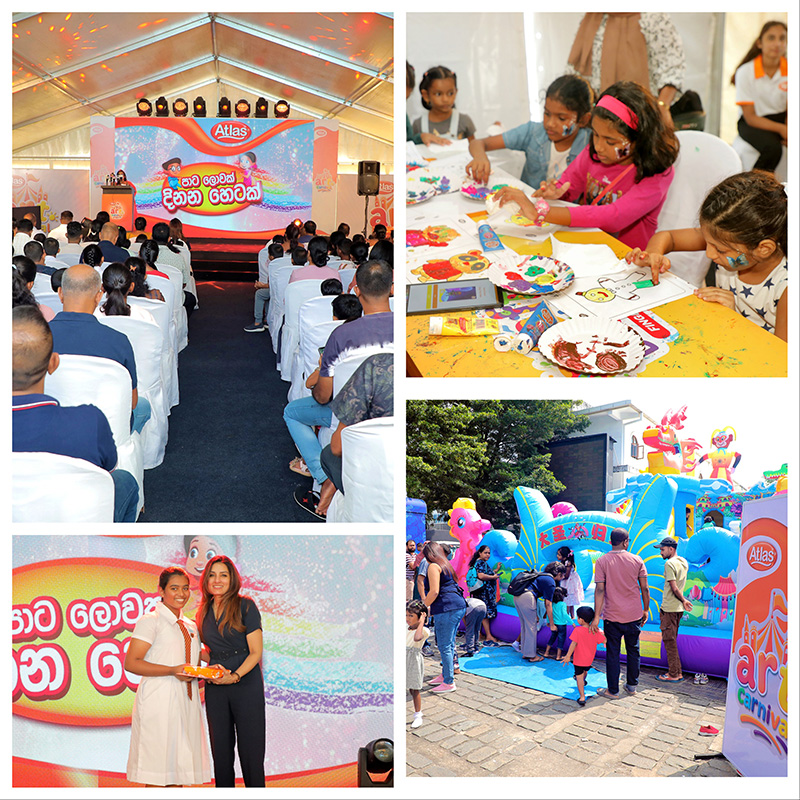
Atlas, Sri Lanka’s leading learning brand, reaffirmed its purpose of making learning fun and enjoyable through the Atlas All-Island Art Competition 2025, which concluded with a gifting ceremony held recently at Arcade Independence Square under the theme ‘Atlas paata lowak dinana hetak’. Students from Preschool to Grade 11 showcased their talents across five categories, with all island winners receiving cash prizes, certificates, and gift packs. Additionally, merit winners in each category were also recognized. The event brought together students, parents, and educators, highlighting Sri Lanka’s cultural diversity, nurturing young talent, and reinforcing Atlas’s long-standing commitment to education, creativity, and building confidence among schoolchildren. The event concluded with the ‘Atlas Art Carnival’, which brought children and parents together through games and creative art activities in a fun and lively atmosphere.

Zohran Mamdani sworn in as New York City mayor

In pictures: New Year welcomed around the world

Foreign warships commended for their assistance during weather disaster in Sri Lanka

Machu Picchu train crash leaves one dead and dozens injured

I invite you to step into 2026 with renewed energy, hope, and determination – PM

Fairly heavy showers about 75 mm are likely at some places in the Central and Uva provinces and in Batticaloa and Ampara districts

‘Dates have the highest sugar content to fight Coronavirus’

Sunday Island 27 December – Headlines

#SundayIsland 17th December – Headlines

Sunday Island – 28th March

Sunday Island Headlines – 21 March

Sunday Island – 21st February – Headlines
-
 News7 days ago
Street vendors banned from Kandy City
-

 Sports4 days ago
Gurusinha’s Boxing Day hundred celebrated in Melbourne
-

 News7 days ago
Lankan aircrew fly daring UN Medevac in hostile conditions in Africa
-
 News2 days ago
Leading the Nation’s Connectivity Recovery Amid Unprecedented Challenges
-

 Sports5 days ago
Time to close the Dickwella chapter
-

 Features3 days ago
It’s all over for Maxi Rozairo
-

 Features7 days ago
Rethinking post-disaster urban planning: Lessons from Peradeniya
-

 Opinion7 days ago
Are we reading the sky wrong?