
News
SL expatriates in US use ‘diplomatic tool’ to promote trade-commerce-investments

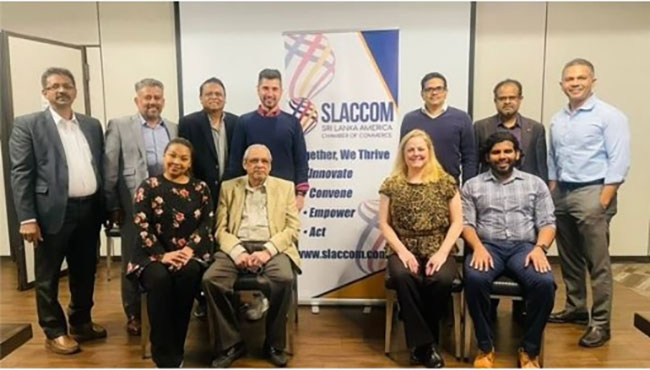
… and dispel misconceptions about Sri Lanka
by Daya Gamage
During the two-and-a-half-decades of foreign affairs work with the U.S. Department of State assigned to its Colombo diplomatic post as a Foreign Service National, this writer saw how trade, commerce, investment, aid – both economic as well as military – were well tied to diplomacy and correct understanding of both nations, and the importance of clearing perceived misunderstandings and obstacles.
In 1987, a couple of months before the Vadamarachchi Offensive to combat the separatist LTTE, the US Department of Defense administratively directed several US arms manufacturing companies to refrain from selling military equipment to Sri Lanka requested by the Jayewardene administration. This decision was based on two documents jointly written by the US National Security Agency and the State Department in 1984 and 1986 which determined that such military sales could be used against the minority Tamils and that the Tamil-majority North-East needs a political solution with devolved power structure under a federal setup.
When the Sri Lanka America Chamber of Commerce, in which this writer is a founder director, launched by a group of professional Sri Lankan expatriates in Las Vegas, Nevada as a US national entity, commenced its operations, clearly found that the two areas – promoting trade-commerce-investment, and diplomacy – are even more inter-twined because of misconceptions Washington has toward Sri Lanka’s governance and rule of law.
Ascertaining the ‘road blocks’, while focusing on trade and commerce, the Chamber entrusted itself with broad diplomatic assignment to strengthen rapport with lawmakers in the U.S. Congress and develop new contacts even with policymakers in Washington, especially the US Departments of Commerce and State.
While identifying possible investors, the president of the Chamber Saje Sedera in fact took an American billionaire to the then Sri Lanka president Gotabaya Rajapaksa when he was visiting his son in Los Angeles as one of the initial moves to activate trade and investment between the two nations.
Meanwhile, three Board Members of the Chamber met officials of the Board of Investment (BOI) for discussions in the Sri Lankan capital Colombo.
Two senior officials of the US Department of Commerce flew to Las Vegas, Nevada to have a discourse with officials of the Chamber on investments in the newly launched Colombo Port City. Two officials from the Sri Lanka embassy in Washington D.C. and Consulate in Los Angeles too attended.
The two US officials and the Chamber were aware that in 2002, Sri Lanka and the U.S. signed a Trade and Investment Framework Agreement (TIFA), which facilitates bilateral discussions to resolve frictions at an early stage. Despite holding more than a dozen TIFA meetings Sri Lanka is still not on the U.S.’ radar for a Free Trade Agreement (FTA).
The two senior officials of the South & Central Asia Division of the Commercial Law Development Program (CLDP) of the U.S. Department of Commerce were in Nevada, to ascertain the feasibility of establishing a better flexibility for trade, commerce and investment between the two countries. They had already met with Sri Lanka’s finance minister and had discussions with the Econ-Commercial Division of the American Embassy in Colombo.
During an interview in August 2021, the then US Ambassador, Alaina B. Teplitz, “expressed concern that the government should create the best possible business environment to attract investment to Port City” and warned against poor practices or even illicit finance like money laundering and corruption. The Chamber officials discussed the above aspect with the Commerce Department representatives.
With all these initial efforts, the Chamber officials found that without effective diplomacy with US lawmakers and policymakers such endeavours could face obstacles. Sri Lankan diplomats on the American soil – all these years – and the authorities in Colombo had failed to achieve this task.
Focusing deep into the obstacles, the professionals in the Sri Lanka America Chamber of Commerce found:
U.S. policy was based on an inadequate understanding of the underlying causes of the civil war—an understanding that does not include unwilling to adapt to the post-independence democratic order; the origins and dynamics of two competing nationalisms; demographic and economic pressures in an island state; and the imperative in a young democratic system of policies to expand economic opportunity to the disadvantaged majority of all ethnic communities domiciled in the 70% of the rural sector. A biased understanding of the separatist struggle led to a misguided strategy for constraining the violence, negotiating a ceasefire, and imposing a political resolution based on a more decentralised political structure. U.S. bilateral policy was driven astray also by the common narratives of well-meaning but naïve international organizations and human rights ideologues that seized on the Sri Lankan conflict to burnish their credentials as arbiters of international morality.
The SL-US Chamber further found that there has been a perverse lack of appreciation internationally for the threat that a dictatorial, criminal, terrorist organization posed to the security of the great majority of Sri Lankans, including Tamils. Tragically, the U.S.’ simplistic perception of an ethnic majority oppressing a righteously rebellious minority prolonged the bloodshed, alienated a historically reliable partner, weakened a beleaguered democracy, and strengthened the influence of U.S. antagonists in the region.
In an official notification dated October 21 by the Sri Lanka embassy in Washington to two members of the Sri Lankan expatriates, one to this writer, and the other the president of the Chamber Sanje Sedera, provided a list of US Members of Congress Sri Lanka ambassador to Washington Mahinda Samarasinghe had met since his arrival in Dec 2021 obviously the dialogues were to apprise the ‘correct’ situation in Sri Lanka.
Subsequent developments showed that the embassy had failed to adequately provide ‘Sri Lanka’s true story’ to the American lawmakers.
In late Sept this year, two US House Members the ambassador had previously met, signed an official letter, with another six members, to US Secretary of State Antony Blinken urging him to “investigate and hold accountable alleged perpetrators of war crimes during the Sri Lankan Civil War, including former Sri Lankan President Gotabaya Rajapaksa and his family. We also urge you to use all diplomatic tools available, including sanctions, for the State Department to hold accountable those who are credibly alleged to have been responsible for gross human rights violations”.
Ambassador Samarasinghe, according to the official letters sent to the two Nevada Sri Lankan expatriate activists, had met Congressman Henry “Hank” Johnson twice. He was one of the signatory to the letter addressed to Blinken. Another signatory to the letter was Congressman Bill Johnson, Ambassador Samarasinghe states he had met, who too wanted war crimes investigation. What was not mentioned by the US Congressmen in the letter the crimes committed by the terrorist LTTE which was designated by the State Department in 1997 as a Foreign Terrorist Organization (FTO). In 2010, US Supreme Court determined that “Material Support’ to a terrorist organization is amount to helping a terrorist organization – in this case LTTE and PKK- violating US Statutes. US lawmakers were not apprised that there are several such ‘material supporters’ living on American soil. Looks like the signatories were unaware that a terrorist organization had committed war crimes, and that this organisation – well connected to a global network – threatened the sovereignty and territorial integrity of a friendly nation for 26 long years, and that it used unarmed innocent Tamils as ‘human shield’ endangering their lives. This is just one example how Sri Lanka diplomacy has failed to change the ‘mind-set’ of American lawmakers and policymakers.
The expatriate officials of the Chamber fully understood the handicap Sri Lanka was facing in its foreign relations to undertake discourses with US lawmakers with the sole intention of bringing Sri Lanka out of this political stalemate while discussing trade and commerce.
The Congressmen’s letter to Secretary Blinken further declares: “Only by bringing justice and redress to victims of past human rights violations during the decades-long civil war will Sri Lanka be able to fully address its current economic crisis and political situation. The United States must remain committed to holding perpetrators accountable and work to establish an international justice mechanism for war crimes and crimes against humanity from the Sri Lankan Civil War.”
A Zoom meeting was initiated by the Chamber on December 14, 2021 bringing in SL ambassador Mahinda Samarasinghe and US Congresswoman Susie Lee focusing on socio-economic diplomacy between the two nations. Ms. Lee declared the importance of strengthening the bonds between the two nations and said she was prepared to work with the Congress to assist Sri Lanka in whatever manner, a prime target of the expatriates handling the Chamber. Sri Lankan expatriates never saw the Sri Lankan diplomats reaching them to have a coordinated effort to remove the tarnished image of Sri Lanka in Washington.
The Sri Lankan expatriates in the State of Nevada who founded the Chamber of Commerce – working hand-in-hand with Sri Lanka’s premier civic organization in Las Vegas, maintaining a constant rapport with the Sri Lanka Foundation in Los Angeles, keeping in touch with US lawmakers and policymakers, taking into account Washington’s misunderstanding of social developments and the structural changes in Sri Lanka endeavour to perform certain duties Sri Lankan authorities and her overseas representatives so far failed as facilitators to disseminate a better view of Sri Lanka toward opening better opportunities for trade, commerce and investments.
(The writer is a Board Member of the Sri Lanka America Chamber of Commerce in US and a Trustee of the Sri Lanka America Association in the State of Nevada)


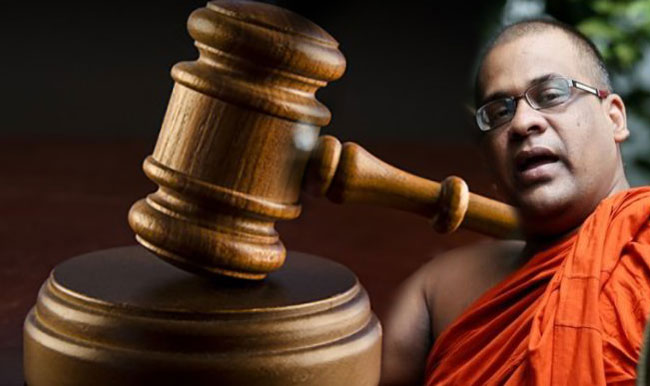
Ven. Galagoda Aththe Gnanasara Thero was not at his temple in Rajagiriya when prison officials visited the premises yesterday to take steps following the Supreme Court ruling that nullified the presidential pardon granted to him, police sources said.
Prison officials who visited the temple on Nawala Road, Rajagiriya, were reportedly informed by those present that the Thero’s whereabouts were unknown. The development comes a day after the Supreme Court declared former President Maithripala Sirisena’s 2019 pardon of Gnanasara Thero null and void.
The three-member Supreme Court bench comprising Justices Janak De Silva, Dr. Sobhitha Rajakaruna and Sampath B. Abayakoon held that the pardon was arbitrary, violated the public trust and principles of natural justice, and was made beyond the proper exercise of the President’s constitutional discretion.
The case arose from Gnanasara Thero’s conduct at the Homagama Magistrate’s Court in January 2016 during proceedings relating to the disappearance of journalist and political cartoonist Prageeth Eknaligoda.
The Court of Appeal convicted him on four counts of contempt of court in 2018 and imposed concurrent prison terms amounting to six years. He had served about nine months when Sirisena granted him a presidential pardon on May 23, 2019.
The Supreme Court found that although Article 34 empowers the President to grant pardons, that power is held in trust for the people and is subject to constitutional limitations and judicial review. The Court concluded that Sirisena had effectively acted on the recommendation of the Additional Secretary (Legal) without demonstrating that he had independently considered the relevant material.
Justice De Silva held that the pardon was “arbitrary”, violated public trust and the rules of natural justice, and was ultra vires the President’s powers. The Court consequently found that the decision violated the fundamental right to equality guaranteed by Article 12(1) of the Constitution.
The ruling effectively restores the legal position under the original conviction, leaving Gnanasara Thero without the benefit of the 2019 pardon. The Supreme Court also clarified that a pardon does not erase a conviction or sentence, but merely relieves an offender from serving the sentence to the extent specified in the pardon.
Gnanasara Thero, the General Secretary of the Bodu Bala Sena, had been convicted over his conduct during proceedings concerning the disappearance of Eknaligoda, who went missing in January 2010 and has not been located.
Sandhya Eknaligoda, Prageeth Eknaligoda’s wife, was among those who challenged the presidential pardon before the Supreme Court, alongside the Centre for Policy Alternatives and its Executive Director Dr. Paikiasothy Saravanamuttu.
The detailed account of the judgment indicates that the Court’s ruling primarily nullified the pardon and restored the legal effect of the original sentence, with the implementation of the sentence falling to the relevant authorities.
Police sources said that the Supreme Court, however, did not permanently close the door on executive clemency. It held that a future President could grant Gnanasara Thero another pardon, provided the power is exercised lawfully and after proper consideration of all relevant material.
The Supreme Court has so far overturned three presidential pardons granted to two former Presidents. In January 2024, the Court declared former President Gotabaya Rajapaksa’s pardon of former MP Duminda Silva unlawful and invalid. In June 2024, it invalidated two pardons granted by former President Maithripala Sirisena to Royal Park murder convict Jude Shramantha Anthony Jayamaha — the first in May 2016, which commuted his death sentence to life imprisonment, and the second in October 2019, which released him from prison. Jayamaha, who was convicted of the murder of 19-year-old Yvonne Johnson, remains at large. Most recently, on September 10, 2026, the Supreme Court declared Sirisena’s 2019 pardon of Ven. Galagoda Aththe Gnanasara Thero null and void, ruling that it was arbitrary and inconsistent with the Constitution.

Parliament is scheduled to debate the Twenty-Second Amendment to the Constitution Bill and the Judicature (Amendment) Bill on September 24 and 25, subject to the Speaker’s announcement following the delivery of the Supreme Court determination on petitions filed against the Bills.
The programme for the Parliamentary Week from September 22 to 25 was decided at a meeting of the Committee on Parliamentary Business held on Thursday (10) under the chairmanship of Speaker Dr. Jagath Wickramaratne.
On each sitting day, Parliamentary Business under Standing Orders 22(1) to 22(6) will be taken up from 9.30 am to 10 am, followed by Questions for Oral Answers from 10 am to 11 am Questions under Standing Order 27(2) will be taken up from 11 am to 11.30 am.
On Tuesday (22), the Orders published in Extraordinary Gazette No. 2497/37 under the Petroleum Resources Act and the Promotion of Export Agriculture (Amendment) Bill will be debated from 11.30 am to 5 pm.
The Tredso Development Foundation (Incorporation) Bill, a Private Member’s Bill, will then be taken up for Second Reading before being referred to the Legislative Standing Committee.
An Opposition motion at the Adjournment Time will follow.
On Wednesday (23), the Chartered Institute of Media Professionals of Sri Lanka Bill will be debated from 11.30 am to 5 pm, followed by Questions at the Adjournment Time.
The Second Reading debate on the 22nd Amendment Bill and the Judicature (Amendment) Bill is scheduled for 11.30 am to 7 pm on Thursday (24) and Friday (25).

Two children aged 11 and 17 were mistakenly killed and their 55-year-old father injured in an early morning hand grenade attack on Sirisangabo Mawatha on Friday. Police investigations later revealed that the attackers targeted the wrong house during an ongoing underworld clash.
Three police teams have been deployed to investigate the attack, which occurred at around 3 am.
According to police, a man who arrived near the house in a three-wheeler knocked on the front door before throwing a grenade into the premises and fleeing.
The victims were identified as 17-year-old Kasun Rashmika and 11-year-old Duminda Gihan. Their 56-year-old father, Nalin Thusantha Perera, was seriously injured and admitted to the Kalubowila Teaching Hospital.
Police said the injured man’s brother was allegedly a close associate of a drug trafficker known as ‘Sando’ and had also been accused of involvement in drug trafficking.
The brother lives in a house adjoining the one targeted in the attack, and police suspect the grenade may have been thrown at the wrong house.
Police are also investigating information that the attack was allegedly carried out at the direction of several overseas-based drug traffickers, identified as Pandithage Shantha Kumara alias ‘Kos Malli’, Samantha Perera alias ‘Chuwa Samantha’, ‘Kudu Avishka’ and ‘I.D.’
Police said the attack was believed to be linked to an ongoing conflict between two underworld factions, which have targeted each other’s associates in shootings and grenade attacks. More than 20 people have reportedly been killed in such attacks.
Security agencies are also investigating alleged links between one faction and overseas-based criminals including Kanjipani Imran, Unakuruwe Shantha, Dubai Gagana and Handaya.
Security agencies have also received information that overseas-based criminals identified as Kanjipani Imran, Unakuruwe Shantha, Dubai Gagana and Handaya are allegedly behind the supply of firearms and drugs to the faction associated with Kos Malli and Chuwa Samantha.

Death toll from Philippines ferry fire rises to 76, with more still missing

Anthropic boss Dario Amodei calls for AI development to slow down

It’s spin vs spin as India and Sri Lanka battle for Asia Cup title

Atmospheric conditions are favorable for afternoon thundershowers in most parts of the Island today [13]

Gnanasara Thero absconding after SC ruling

House to debate 22A, Judicature Bill next week

‘Dates have the highest sugar content to fight Coronavirus’

Sunday Island 27 December – Headlines

#SundayIsland 17th December – Headlines

Sunday Island – 28th March

Sunday Island Headlines – 21 March

Sunday Island – 21st February – Headlines
-

 Sports3 days ago
DDS set to lose Test captaincy
-

 Features7 days ago
After the parade: What a traffic OIC’s walk-out tells us
-

 Editorial7 days ago
Arrests as theatre
-
 News6 days ago
Thailand shuts door on undesirables from Sri Lanka
-

 Latest News7 days ago
Harshitha’s composed knock seals Sri Lanka’s semi-final berth
-

 News3 days ago
Sri Lanka faces new grid challenge as rooftop solar surges: former CEB GM
-
 Business6 days ago
CEB successor company breaks into top three in competitive BESS tender
-

 News7 days ago
‘Choka Malli’ slips out of country before travel ban