
News
SL expatriates in US use ‘diplomatic tool’ to promote trade-commerce-investments

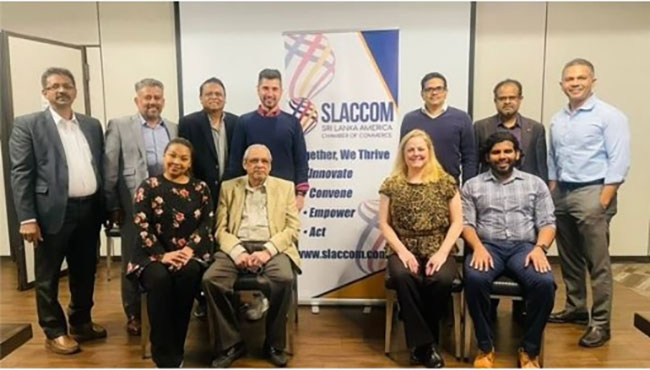
… and dispel misconceptions about Sri Lanka
by Daya Gamage
During the two-and-a-half-decades of foreign affairs work with the U.S. Department of State assigned to its Colombo diplomatic post as a Foreign Service National, this writer saw how trade, commerce, investment, aid – both economic as well as military – were well tied to diplomacy and correct understanding of both nations, and the importance of clearing perceived misunderstandings and obstacles.
In 1987, a couple of months before the Vadamarachchi Offensive to combat the separatist LTTE, the US Department of Defense administratively directed several US arms manufacturing companies to refrain from selling military equipment to Sri Lanka requested by the Jayewardene administration. This decision was based on two documents jointly written by the US National Security Agency and the State Department in 1984 and 1986 which determined that such military sales could be used against the minority Tamils and that the Tamil-majority North-East needs a political solution with devolved power structure under a federal setup.
When the Sri Lanka America Chamber of Commerce, in which this writer is a founder director, launched by a group of professional Sri Lankan expatriates in Las Vegas, Nevada as a US national entity, commenced its operations, clearly found that the two areas – promoting trade-commerce-investment, and diplomacy – are even more inter-twined because of misconceptions Washington has toward Sri Lanka’s governance and rule of law.
Ascertaining the ‘road blocks’, while focusing on trade and commerce, the Chamber entrusted itself with broad diplomatic assignment to strengthen rapport with lawmakers in the U.S. Congress and develop new contacts even with policymakers in Washington, especially the US Departments of Commerce and State.
While identifying possible investors, the president of the Chamber Saje Sedera in fact took an American billionaire to the then Sri Lanka president Gotabaya Rajapaksa when he was visiting his son in Los Angeles as one of the initial moves to activate trade and investment between the two nations.
Meanwhile, three Board Members of the Chamber met officials of the Board of Investment (BOI) for discussions in the Sri Lankan capital Colombo.
Two senior officials of the US Department of Commerce flew to Las Vegas, Nevada to have a discourse with officials of the Chamber on investments in the newly launched Colombo Port City. Two officials from the Sri Lanka embassy in Washington D.C. and Consulate in Los Angeles too attended.
The two US officials and the Chamber were aware that in 2002, Sri Lanka and the U.S. signed a Trade and Investment Framework Agreement (TIFA), which facilitates bilateral discussions to resolve frictions at an early stage. Despite holding more than a dozen TIFA meetings Sri Lanka is still not on the U.S.’ radar for a Free Trade Agreement (FTA).
The two senior officials of the South & Central Asia Division of the Commercial Law Development Program (CLDP) of the U.S. Department of Commerce were in Nevada, to ascertain the feasibility of establishing a better flexibility for trade, commerce and investment between the two countries. They had already met with Sri Lanka’s finance minister and had discussions with the Econ-Commercial Division of the American Embassy in Colombo.
During an interview in August 2021, the then US Ambassador, Alaina B. Teplitz, “expressed concern that the government should create the best possible business environment to attract investment to Port City” and warned against poor practices or even illicit finance like money laundering and corruption. The Chamber officials discussed the above aspect with the Commerce Department representatives.
With all these initial efforts, the Chamber officials found that without effective diplomacy with US lawmakers and policymakers such endeavours could face obstacles. Sri Lankan diplomats on the American soil – all these years – and the authorities in Colombo had failed to achieve this task.
Focusing deep into the obstacles, the professionals in the Sri Lanka America Chamber of Commerce found:
U.S. policy was based on an inadequate understanding of the underlying causes of the civil war—an understanding that does not include unwilling to adapt to the post-independence democratic order; the origins and dynamics of two competing nationalisms; demographic and economic pressures in an island state; and the imperative in a young democratic system of policies to expand economic opportunity to the disadvantaged majority of all ethnic communities domiciled in the 70% of the rural sector. A biased understanding of the separatist struggle led to a misguided strategy for constraining the violence, negotiating a ceasefire, and imposing a political resolution based on a more decentralised political structure. U.S. bilateral policy was driven astray also by the common narratives of well-meaning but naïve international organizations and human rights ideologues that seized on the Sri Lankan conflict to burnish their credentials as arbiters of international morality.
The SL-US Chamber further found that there has been a perverse lack of appreciation internationally for the threat that a dictatorial, criminal, terrorist organization posed to the security of the great majority of Sri Lankans, including Tamils. Tragically, the U.S.’ simplistic perception of an ethnic majority oppressing a righteously rebellious minority prolonged the bloodshed, alienated a historically reliable partner, weakened a beleaguered democracy, and strengthened the influence of U.S. antagonists in the region.
In an official notification dated October 21 by the Sri Lanka embassy in Washington to two members of the Sri Lankan expatriates, one to this writer, and the other the president of the Chamber Sanje Sedera, provided a list of US Members of Congress Sri Lanka ambassador to Washington Mahinda Samarasinghe had met since his arrival in Dec 2021 obviously the dialogues were to apprise the ‘correct’ situation in Sri Lanka.
Subsequent developments showed that the embassy had failed to adequately provide ‘Sri Lanka’s true story’ to the American lawmakers.
In late Sept this year, two US House Members the ambassador had previously met, signed an official letter, with another six members, to US Secretary of State Antony Blinken urging him to “investigate and hold accountable alleged perpetrators of war crimes during the Sri Lankan Civil War, including former Sri Lankan President Gotabaya Rajapaksa and his family. We also urge you to use all diplomatic tools available, including sanctions, for the State Department to hold accountable those who are credibly alleged to have been responsible for gross human rights violations”.
Ambassador Samarasinghe, according to the official letters sent to the two Nevada Sri Lankan expatriate activists, had met Congressman Henry “Hank” Johnson twice. He was one of the signatory to the letter addressed to Blinken. Another signatory to the letter was Congressman Bill Johnson, Ambassador Samarasinghe states he had met, who too wanted war crimes investigation. What was not mentioned by the US Congressmen in the letter the crimes committed by the terrorist LTTE which was designated by the State Department in 1997 as a Foreign Terrorist Organization (FTO). In 2010, US Supreme Court determined that “Material Support’ to a terrorist organization is amount to helping a terrorist organization – in this case LTTE and PKK- violating US Statutes. US lawmakers were not apprised that there are several such ‘material supporters’ living on American soil. Looks like the signatories were unaware that a terrorist organization had committed war crimes, and that this organisation – well connected to a global network – threatened the sovereignty and territorial integrity of a friendly nation for 26 long years, and that it used unarmed innocent Tamils as ‘human shield’ endangering their lives. This is just one example how Sri Lanka diplomacy has failed to change the ‘mind-set’ of American lawmakers and policymakers.
The expatriate officials of the Chamber fully understood the handicap Sri Lanka was facing in its foreign relations to undertake discourses with US lawmakers with the sole intention of bringing Sri Lanka out of this political stalemate while discussing trade and commerce.
The Congressmen’s letter to Secretary Blinken further declares: “Only by bringing justice and redress to victims of past human rights violations during the decades-long civil war will Sri Lanka be able to fully address its current economic crisis and political situation. The United States must remain committed to holding perpetrators accountable and work to establish an international justice mechanism for war crimes and crimes against humanity from the Sri Lankan Civil War.”
A Zoom meeting was initiated by the Chamber on December 14, 2021 bringing in SL ambassador Mahinda Samarasinghe and US Congresswoman Susie Lee focusing on socio-economic diplomacy between the two nations. Ms. Lee declared the importance of strengthening the bonds between the two nations and said she was prepared to work with the Congress to assist Sri Lanka in whatever manner, a prime target of the expatriates handling the Chamber. Sri Lankan expatriates never saw the Sri Lankan diplomats reaching them to have a coordinated effort to remove the tarnished image of Sri Lanka in Washington.
The Sri Lankan expatriates in the State of Nevada who founded the Chamber of Commerce – working hand-in-hand with Sri Lanka’s premier civic organization in Las Vegas, maintaining a constant rapport with the Sri Lanka Foundation in Los Angeles, keeping in touch with US lawmakers and policymakers, taking into account Washington’s misunderstanding of social developments and the structural changes in Sri Lanka endeavour to perform certain duties Sri Lankan authorities and her overseas representatives so far failed as facilitators to disseminate a better view of Sri Lanka toward opening better opportunities for trade, commerce and investments.
(The writer is a Board Member of the Sri Lanka America Chamber of Commerce in US and a Trustee of the Sri Lanka America Association in the State of Nevada)


Of 180 member crew, 30 rescued by Sri Lanka Navy
Iran warship IRIS Dena (F75), returning home after participating in the Indian International Fleet Review, and MILAN 2026 international naval exercises, has been sunk off Sri Lanka. The US, Russia and Iran were among 74 participants.
Speculation is rife that the US attacked the vessel in international waters as part of the continuing offensive action under Operation Epic Fury, launched on 28 February. Before the attack in the Indian ocean, President Trump declared that the Iranian Navy Headquarters and nine Navy vessels had been destroyed.
The ill-fated Moudge-class frigate participated in the Indian exercises with the US Navy’s Arleigh Burke-class guided-missile destroyer USS Pinckney (DDG-91) and the Marshal Shaposhnikov, a Udaloy-class frigate of the Russian Navy. Sri Lanka also participated in the exercises. SLNS Sagara and Israeli built Fast Missile Vessel Nandimithra represented Sri Lanka. Forty two warships and submarines and 29 aircraft had been involved.
At the time of the attack, the domestically built vessel was crewed by 180 officers and men.
The US Embassy here did not respond to The Island media query whether the US sank IRIS Dena . The Island was unable to get in touch with Iranian Ambassador in Colombo Alireza Delkhosh though he earlier indicated his availability later in the day.
Minister of Foreign Affairs, Foreign Employment and Tourism, Vijitha Herath, told the Parliament yesterday that the Sri Lanka Navy and the Sri Lanka Air Force had acted in less than an hour of receiving the distressed signal at 5.08 am.
According to the Minister, the first naval craft was dispatched by 6 am, followed by a second vessel at 7 am, while Air Force units joined the mission, including the deployment of a surveillance aircraft to support search operations.
Approximately 180 personnel were believed to have been on board the stricken vessel. Of them, around 30 were reported to be in critical condition.
“To save the lives of those 30 persons, we intervened immediately,” Minister Herath said, adding that the rescued crew members were being transported to Karapitiya Hospital for urgent medical treatment. Some had already arrived by the time of his statement.
SLPP MP Namal Rajapaksa asked whether the Iranian ship had been attacked within Sri Lanka’s Exclusive Economic Zone (EEZ).
Responding to questions raised by Opposition MPs, including NDF Badulla District MP Chamara Sampath Dassanayake, who alleged that the Iranian vessel may have been struck in Sri Lankan waters, the Minister said the ship had been outside Sri Lanka’s maritime boundary when it issued the distress call.
MP Dassanayake queried whether the frigate had been hit as part of the ongoing military escalation involving the United States and Israel against Iran. There was no immediate confirmation from the government regarding the cause of the emergency.
Minister Herath stressed that Sri Lanka’s intervention was guided solely by humanitarian considerations and international obligations.
“We are bound by the International Convention on Maritime Search and Rescue (SAR) of 1979, which we have signed,” he told Parliament.
Under the convention, a signatory state is required to respond to maritime emergencies, regardless of nationality, the cause of the incident, or whether it occurs beyond its own territorial waters.
“According to this convention, if a vessel, or its crew, encounters danger beyond our territorial limits, we are obligated to intervene and protect those lives on humanitarian grounds,” Minister Herath said, adding Sri Lanka had acted immediately to prevent loss of life and had taken all urgent and necessary measures as a responsible state.
The Minister noted that the incident highlighted broader regional security vulnerabilities in maritime safety amid escalating tensions in the region. “A regional military situation would also have an impact on our country. The government’s position is that a negotiated solution must be pursued,” he said.
He also disclosed that President Anura Kumara Dissanayake had held a telephone discussion on Tuesday night with the leadership of the United Arab Emirates regarding the evolving regional situation.
Rescue operations were continuing at the time of going to press.
By Saman Indrajith and Shamindra Ferdinando
News
Justice Kumudini complains of male domination at senior levels, absence of a woman head of BASL

Judge of the Supreme Court Justice Kumudini Wickramasinghe has recently presented a stark analysis of the legal profession’s gender disparity, noting that in spite of women entering the legal field in substantial numbers, their representation dwindles at senior levels. She has highlighted critical statistics and the fact that only two women currently serve in the Supreme Court, none in the Court of Appeal, and that there has never been a woman President of the Bar Association of Sri Lanka (BASL).
“Inclusive leadership is not satisfied by entry-level participation,” Justice Wickramasinghe said. “It concerns who occupies the apex of institutional authority, who shapes doctrine, who speaks for the profession. These figures are not merely statistics; they are indicators of work yet unfinished.”
Justice Wickramasinghe said so at a seminar organised on the eve of International Women’s Day by the Bar Association of Sri Lanka (BASL), in collaboration with the Sri Lanka Women Lawyers’ Association (SLWLA). She underscored the need to address the systemic barriers preventing women from reaching the apex of the legal profession. Justice Wickramasinghe addressed the gathering as the Chief Guest.
BASL President Rajeev Amarasuriya, in his address, framed inclusivity not as charity or tokenism, but as “structural fairness.” He raised an important question being ‘who bears the responsibility of inclusivity’ and addressed the vital role of leadership in inclusivity. Furthermore, Amarasuriya challenged the profession to address the “gap between what we see coming into the profession and what we see at the top,” and clarified that such disparity did not stem from a lack of competence or commitment but from deep rooted practices and structural issues.
A dynamic panel discussion, moderated by Attorney-at-Law Tanushka Gunawardane, explored the multifaceted nature of inclusive leadership. The panel featured Justice Wickramasinghe, Constitutional Council Member Professor Wasantha Seneviratne (joining online), Senior Instructing Attorney Shiranthi Gunawardhana, and corporate leader Yanina Weerasinghe.
Professor Wasantha Seneviratne distinguished between mere representation and true participation, stating that inclusion becomes meaningful only when women have the “agency and authority to make decisions.” She emphasised that inclusive leadership is both a moral obligation and a pragmatic governance strategy.
Senior Instructing Attorney Shiranthi Gunawardhana shared personal anecdotes from her 50-year career, urging senior lawyers to act as mentors rather than gatekeepers. She stressed the importance of creating space for young female lawyers by offering flexibility and support to help them balance professional and personal responsibilities.
Yanina Weerasinghe, Head of Legal at Brandix, argued that true inclusion is measured by influence, not optics. “Diversity is being present; inclusivity is being influential,” she explained, warning against tokenism and calling for “cerebral opportunities” where women are selected, based on talent, and given a genuine voice in decision-making.
Justice Wickramasinghe addressed the relationship between judicial hierarchy and inclusion, asserting that authority and accessibility can coexist. “A judge can be firm in decisions while remaining approachable,” she said, adding that power exercised with transparency and humility strengthens, rather than weakens, institutional legitimacy.
The seminar also heard from Dilani Yatawaka, Managing Director/CEO of Ideal Motors, who shared her perspective as a female leader in the male-dominated automotive sector. She reinforced the critical role of supportive superiors and societal encouragement to enable women to ascend the career ladder while managing family responsibilities.
BASL Women Lawyers’ Professional and Career Development Committee Chair Indika Nagaratne Koththagoda in her welcome address said that the distinguished gathering was honoured to have Her Ladyship Justice Kumudini Wickramasinghe, Judge of the Supreme Court of Sri Lanka, as the Chief Guest and a key panellist and also welcomed the other panellists Attorneys-at-Law Professor Wasantha Seneviratne, Ms. Shiranthi Gunawardena and Yanina Weerasinghe for agreeing to share their insights on the subject during the ensuing panel discussion to be moderated by Attorney-at-Law Ms. Tanushka Gunawardane.
In her closing remarks, Nalani Manatunga, Co-Chairperson of the BASL Women Lawyers’ Professional and Career Development Committee, challenged the audience to reflect on the true meaning of leadership. “A position gives authority, but leadership gives direction,” she said. “Inclusive leadership is not about occupying space; it’s about creating space. Let our leadership not be measured by the chairs we occupy, but by the doors we leave open.”

A crisis was prevailing at the Government Printing Department due to the absence of a permanent Government Printer, Parliament was told yesterday, raising concerns over confidentiality, quality control and national security.
NDF MP Ravi Karunanayake demanded to know what steps the government had taken to fill the long-standing vacancy at the department, describing the situation as a serious administrative lapse.
“The Government Printing Department is a very important and closed service category institution. However, it has been functioning without a permanent Government Printer for some time,” Karunanayake said.
The MP pointed out that the department handles highly sensitive material, including documents related to defence and national security, as well as other classified publications.
“The non-availability of a permanent Government Printer affects the quality, confidentiality and sustainability of the work there. Has the Government conducted an audit on the possible issues arising from this situation? What immediate action has been taken to resolve this crisis?” he asked.
Responding on behalf of the Government, Prime Minister Dr Harini Amarasuriya said the vacancy had been filled on a temporary basis following a Cabinet decision.
She said an experienced officer from the Sri Lanka Administrative Service had been appointed on contract as Acting Government Printer to ensure operational continuity and maintain security standards in relation to sensitive printing tasks.
The Prime Minister acknowledged that the issue reflected broader systemic weaknesses in public service recruitment and professional development that had persisted for years.
“To bridge these gaps, the Government is initiating specialised training programmes and offering international scholarships for high-performing students to build future technical capacity,” she said.
Chief Government Whip and Health and Mass Media Minister Dr Nalinda Jayatissa said that under existing service minutes, more than two decades of experience were required for an officer to qualify for the top post, and that there were currently no internal candidates eligible for appointment.
He said that the department was facing a leadership crisis and administrative instability due to the lack of a permanent, qualified Government Printer.
By Saman Indrajith

England elect to field first at Wankhede

Iran denies its drones hit airport in Azerbaijan’s exclave as war widens

Daren Sammy issues plea as West Indies remain stuck in Kolkata hotel

Nepal election 2026: When will we get the results?

‘It’s so good to be home’ – passengers on Dubai-Dublin flight

India’s momentum meets Wankhede’s memory in big semifinal bout

‘Dates have the highest sugar content to fight Coronavirus’

Sunday Island 27 December – Headlines

#SundayIsland 17th December – Headlines

Sunday Island – 28th March

Sunday Island Headlines – 21 March

Sunday Island – 21st February – Headlines
-

 Features4 days ago
Brilliant Navy officer no more
-
 Opinion7 days ago
Jamming and re-setting the world: What is the role of Donald Trump?
-
 Features7 days ago
An innocent bystander or a passive onlooker?
-

 Opinion4 days ago
Sri Lanka – world’s worst facilities for cricket fans
-

 Business7 days ago
An efficacious strategy to boost exports of Sri Lanka in medium term
-

 Business1 day ago
Cabinet nod for the removal of Cess tax imposed on imported good
-
 Features5 days ago
Overseas visits to drum up foreign assistance for Sri Lanka
-

 Features4 days ago
A life in colour and song: Rajika Gamage’s new bird guide captures Sri Lanka’s avian soul