
News
SJB promises digital public infrastructure and targeted subsidies within 90 days of coming to power


Within 90-days of coming to power, the Samagi Jana Balawegaya (SJB) will usher in digital public infrastructure which will determine how much a person should pay for fuel based on their economic capacity, Dr. Harsha de Silva, Chairman, Committee on Public Finance (COPF) and SJB MP said.
“Essentially this is a QR code. You go to the shed, present the QR code and make the payment. Let’s say the price of fuel is 400 rupees a litre, the computer system will calculate the subsidy you deserve because of your economic status and transfer that subsidy to your bank account immediately,” he said.
Dr. de Silva said this is one example of targeted subsidies under an SJB administration and they have already prepared the necessary technical infrastructure to implement these complex projects.
“This is a way to reduce prices of goods to selected groups of people. Within three to six months, the SJB government will usher in reforms that will benefit people directly,” he said.
He added that SJB leader Sajith Premadasa told Peter Breuer, Senior IMF Mission Chief for Sri Lanka, that economic reforms must run parallel with significant relief for the people.
He said that the IMF delegation met Premadasa in late July when they visited Sri Lanka.
“We need social justice. Reform with relief is our framework. I also explained, in length, to the IMF delegation what we need to change the current agenda,” he said.
Dr. de Silva said that SJB was never opposed to IMF reforms and that it was he who urged the Gotabaya Rajapaksa administration to start discussions with the IMF in 2020.
“However, we do not think Sri Lanka should implement everything the IMF says. There is a lot that needs to change, and we need to talk to the people to get them on board the proposed reforms,” he said.
The SJB MP said they also stood for the independence of the Central Bank and supported the government’s reforms to minimise political influence on bank officials. Sri Lanka will hold presidential elections on 21 September and whoever comes to power will need to decide whether they would continue the IMF programme, he said.
“The next president will have to decide what changes need to be carried out, if the IMF programme is to continue. Some changes will be non-negotiable for the IMF and can lead to a collapse in the negotiation process,” he said.
Dr. de Silva said any attempts to repeal the independence given to the Central Bank would lead to a collapse in the agreement with the IMF.
“We spoke with the IMF delegation about that too. They asked how long it would take us to form a cabinet, if we win the 21 September election. We spoke about the short-term fixes that are needed to uplift the people. The IMF has two types of agreements. One is called the standby agreement, which provides short-term financial assistance to countries facing balance of payment problems. The other is the Extended Fund Facility (EFF). This provides financial assistance to countries facing serious medium-term balance of payments problems because of structural weaknesses that require time to address. To help countries implement medium-term structural reforms, the EFF offers longer programme engagement and a longer repayment period,” he said.
The EFF in Sri Lanka proposed to stabilise the economy by increasing taxes. The SJB MP said that this is an unfair demand because a democratically elected new government needs space to carry out its economic policies.
“If that policy is in conflict with the IMF and how we can solve that is a political issue. We have the right. Secondly, even if we agree with the IMF policies, we can agree with the short term economic objectives. We need to ensure that the economy blossoms in the medium and long term, to increase it to 10 percent. We can’t achieve these with these restrictive measures,” he said.
The SJB MP said not all debt is the same. There is a difference between local debt and dollar debt. “In the same way growth is achieved by shielding local industries from global competition and the other way to achieve growth is by exporting globally competitive products. For example, under Mahinda Rajapaksa the economy grew by 9 percent, due to the massive construction that took place in Hambantota. However, this was not sustainable and didn’t lead to any competitiveness in the economy,” he said.
Dr. de Silva said most Sri Lankans do not consume adequate quantities of food. SJB wants to ensure that the price of food drops, so people can eat. “About 40 percent of our produce is wasted before they enter the retail market. If we can reduce this, this will be a solution itself. We can build climate-controlled warehouses across the country,” he said.
Commenting on the debt restructuring with commercial debt holders, the SJB MP said that any agreement with the private bond holders must be just and must not come at the expense of the Sri Lankan people.
“I told the IMF that the Employment Provident Fund (EPF) was heavily targeted during domestic debt restructuring. The government, until the very end, said they will not touch EPF funds. This was done at the behest of commercial debt holders. Now the government is going to agree to issue a Macro Linked Bond (MLB). In reality, only in 2028 will we decide how much of a haircut on international debt we will receive. Right now, the government says the haircut will be 28 percent, but 90 percent of commercial debt holders believe that the haircut will be less than 15 percent. They think that the way things are going, the economy will develop, and they will profit from that,” he said.
Dr. de Silva said that bi-lateral creditors have told the government that if they are giving significant concessions to commercial debt holders, they too will take back some of the concessions given to Sri Lanka, i.e., introduce a claw back clause. A clawback clause is a way for a company to reclaim compensation payments based on preset criteria. Bilateral creditors have not asked for such a clawback clause in the history of debt restructuring, he said.
“We told the IMF that we will bring a clawback clause for the EPF too. The IMF didn’t ask us to restructure domestic debt. Sri Lanka is also the only country that placed the onus of debt restructuring on workers pensions. Sri Lankans have suffered and if we make progress, the benefits of the hard work must not only go to bilateral and commercial creditors. (RK)


Allegation of doing business with state:
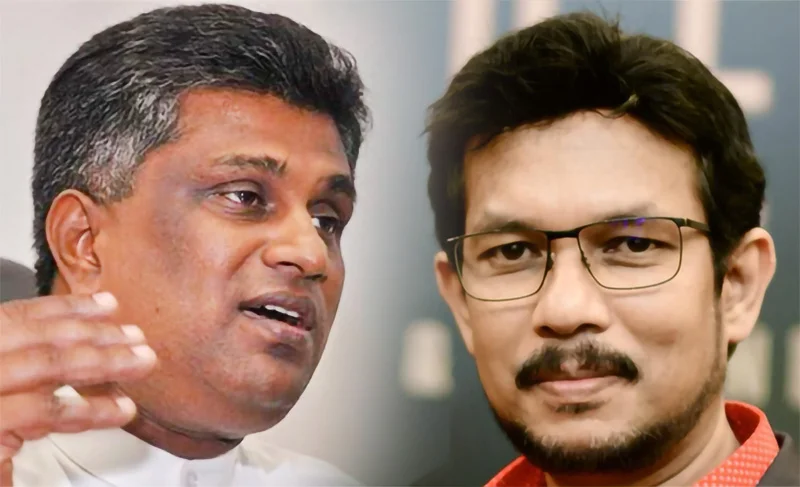
Civil society activist Oshala Herath has said that regardless of the political party one represents, all members of Parliament should abide by the law of the land. Herath said so when The Island sought his response to a report that he was planning to move court against Deputy Minister Eranga Weeraratne, Deputy Minister of Digital Economy, accused of holding the top positions at Omobio (Pvt.) and Eimsky Business Solutions (Pvt.) Ltd., at the time of the nominations, and took oaths as a National List MP of the NPP government.
President Anura Kumara Dissanayake is the Minister of Digital Economy, in addition to being Minister of Defence and Finance.
Herath is the Chairman of Abhinawa Niwahal Peramuna. Herath, whose legal challenge to SJB MP Diana Gamage over her citizenship issue, led to her removal from Parliament by the Supreme Court on 08 May, last year. He said the latest case underscored the responsibility on the part of political parties to ensure transparency in the nomination process as well as in the finalisation of National List.
Herath pointed out that the court rulings on petitions filed by him against two serving MPs were pending. He moved court against Jaffna District Independent MP Ramanathan Archchuna for handing over nominations to contest the 2024 November parliamentary elections without resigning from his post as a government medical officer. He also moved court against Minister of Rural Development, Social Security and Community Empowerment, Dr. Upali Pannilage, alleging that he had been an employee of the University of Ruhuna at the time he was declared an MP and subsequently appointed as a Cabinet Minister.
Our efforts to contact Deputy Minister Weeraratne were in vain. Our calls went unanswered.
Pointing out that there were many attorneys-at-law in the current Parliament, Herath emphasised the responsibility on their part to take up the issue. The Speaker should, on his own, inquire into such allegations in addition to the Parliamentary Privileges Committee stepping in, Herath said. Responding to another query, Herath said that such violations as well as cases of conflict of interests were far more serious than the recent controversy over NPP National List MP Asoka Ranwala’s educational qualifications.
SJB MP Ajith P. Perera told The Island that the Deputy Minister concerned admitted in Parliament that he had held top posts in the companies mentioned at the time he took oaths as an MP. Therefore, there couldn’t be any ambiguity with regard to his fault. Perera said that the conflict of interest issue involving NPPer was far more serious.
Referring to the issue at hand that had been first raised by SJB lawmaker Amila Prasad Siriwardena in Parliament during committee stage of the debate on the 2026 Budget, Attorney-at-Law Perera said that Weeraratne’s companies were engaged in mega business deals with the government. Declaring that they had secured contracts for government projects since 2019, Perera said that one of the companies Weeraratne was involved in had recently won a major contract from the incumbent government regarding the electronic ticketing system.
Kalutara District MP called for a comprehensive inquiry into the issue as the NPP had come to power, accusing all other political parties of waste, corruption, irregularities and mismanagement of state funds. MP Perera queried whether the current dispensation followed proper procedures in selecting Weeraratne’s company for the ticketing project
Both Herath and Perera urged the JVP and NPP to look into what they called the Weeraratne affair.
Over the years, several MPs had been disqualified to hold parliamentary seats. Dr. Rajitha Senaratne is one of them. When the Court of Appeal dismissed Dr. Senaratne from Parliament for being a supplier to the government, Ranil Wickremesinghe brought him back to Parliament, through the National List.
MP Perera said that since the last parliamentary election, the NPP had been embroiled in many controversies, including the release of 323 containers from the Colombo Port, in January this year, followed by signing of seven Memorandums of Understanding (MoUs)/agreements with India in April.
By Shamindra Ferdinando
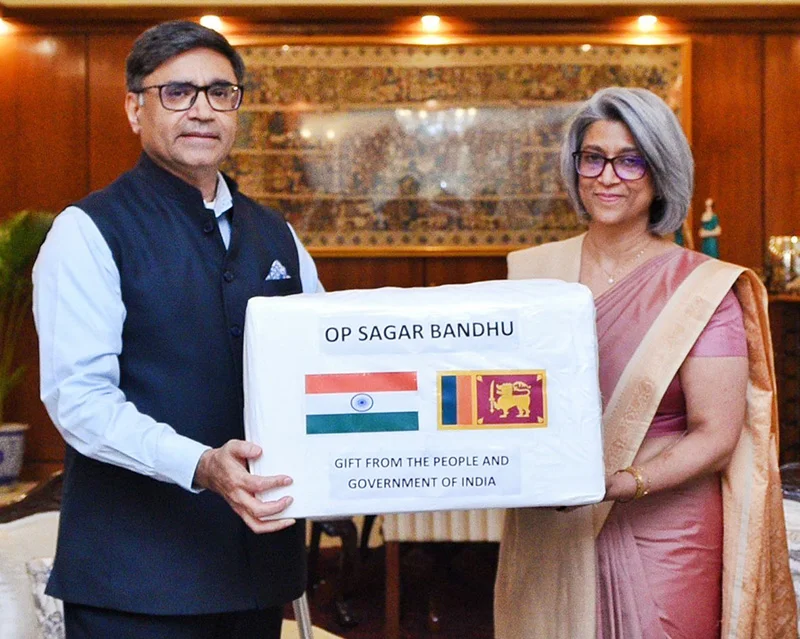
The government has appealed to India for immediate help to overcome the serious shortage of life-saving drugs and injections.
The Sri Lankan High Commission in New Delhi confirmed the appeal made by the government. The following is the text of statement issued by the Sri Lankan mission in New Delhi: “The Foreign Secretary of India, Vikram Misri, over the weekend handed over a consignment of urgently required essential medicines to Sri Lanka’s High Commissioner to India, Mahishini Colonne, in New Delhi. The assistance, extended in response to a request from the Government of Sri Lanka, forms part of Operation Sagar Bandhu, India’s humanitarian mission supporting Sri Lanka’s relief, recovery, and reconstruction efforts following the devastating Cyclone Ditwah.
The consignment consists of over 400 boxes of life-saving medicines and injections, which will be airlifted to Colombo by an Indian Air Force C-17 aircraft, alongside further additional relief assistance from India.
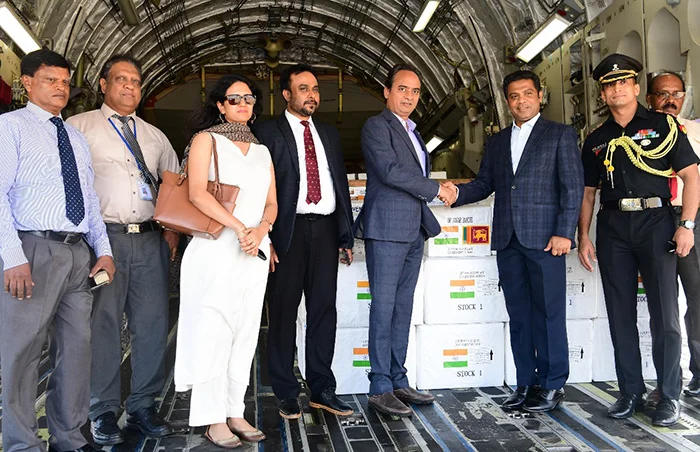
Deputy Indian High Commissioner Pandey shaking hands with Health Minister Dr. Nalinda Jayathissa
Foreign Secretary Misri reiterated the condolences of the Government and people of India for the tragic loss of lives and the extensive damage to infrastructure caused by the Cyclone. He reaffirmed India’s steadfast commitment to supporting Sri Lanka’s immediate humanitarian needs as well as rebuilding and reconstruction efforts. He also highlighted India’s readiness to work with Sri Lanka on a mix of initiatives tailored to the needs of affected communities.
High Commissioner Colonne conveyed the sincere appreciation of the President, Government, and people of Sri Lanka for India’s timely, continuous, and sustained support, and handed over to the Foreign Secretary, a letter of gratitude from the President of Sri Lanka to the Prime Minister of India.
Describing the extensive nature of the damage, the High Commissioner appreciated the ongoing and consistent engagement of the Indian High Commission in Colombo, in collaboration with government officials and local authorities in coordinating relief, rescue, and recovery efforts.
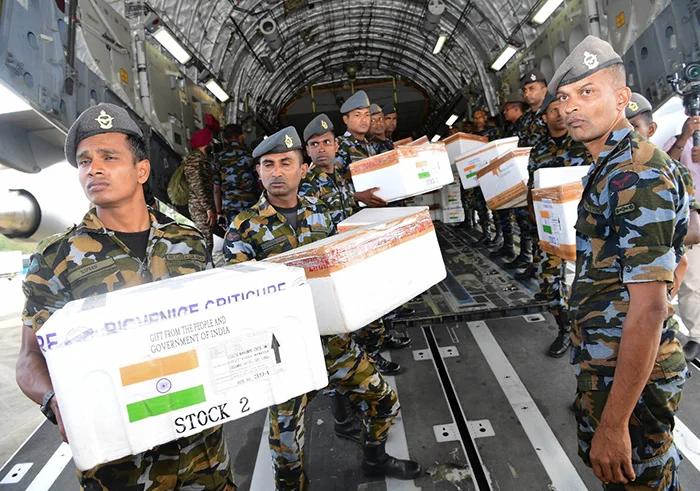
SLAF personnel unloading medicine from IAF transport plane
The High Commissioner also requested India’s support in sharing its expertise and leadership in enhancing disaster-response capabilities and disaster-resilience frameworks, especially lessons from Odisha and Andhra Pradesh, both globally recognized for their advanced disaster resilience frameworks. Apart from this support that is under discussion, the New Delhi-based Coalition for Disaster Resilient Infrastructure (CDRI) has also been requested to undertake a visit to Sri Lanka to explore avenues for strengthening Sri Lanka’s disaster resilient infrastructure capacities. Noting the importance of having an effective and real-time warning system, efforts are being made to deploy a team to explore the establishment of an early warning system that would provide real-time geo-targeted alerts to citizens.
The High Commissioner reiterated Sri Lanka’s gratitude to the Government and people of India for their continued solidarity under Operational Sagar Bandhu, reaffirming the strength of the longstanding partnership between the two nations.”
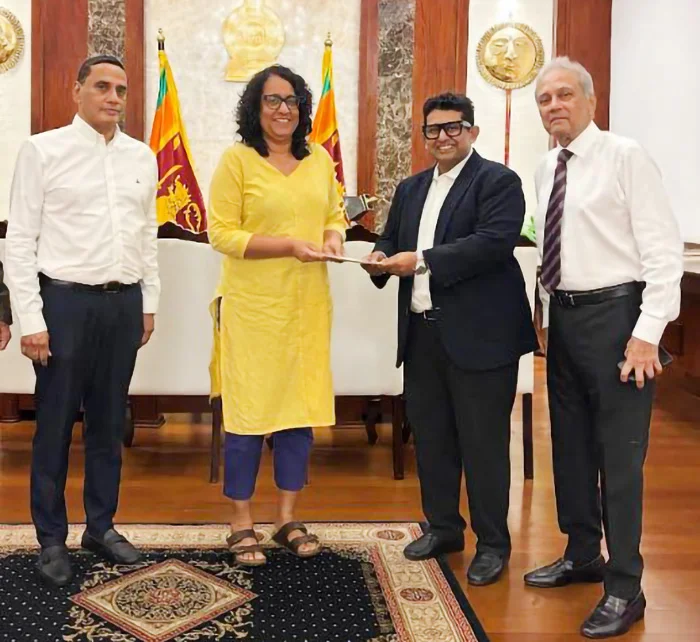
The George Keyt Foundation (GKF) has extended meaningful support to the Government of Sri Lanka’s disaster relief efforts following the severe devastation caused by Cyclone Ditwah.
The text of the press release issued by the GKF: “In 2023, the Foundation undertook its first major fundraiser in recent years by issuing 30 numbered limited edition prints of Kangodi Rangi, a painting by George Keyt entrusted to the Foundation. Twenty-eight prints were acquired by donors to support charitable causes, while another was gifted to the President’s collection. Print Number 1 of 30 was retained to support the Foundation’s long-term priorities.
In light of the unprecedented impact of Cyclone Ditwah and the urgent national need for disaster assistance, the trustees unanimously resolved to seek a donor for Print Number 1 of 30, with clear disclosure that the proceeds would be channeled directly to the Government’s disaster relief programme. This appeal received an immediate response, resulting in a private donation of Rs. 3 million.
The contribution was formally handed over to Prime Minister Harini Amarasuriya for utilisation in the Government’s ongoing relief and recovery efforts.
The George Keyt Foundation is honoured to support the people of Sri Lanka at this critical moment and reaffirms its commitment to serving national needs while preserving and promoting the artistic legacy of George Keyt.

Akbar Brothers crowned MBSA A-Division champions

Several spells of showers will occur in the Northern, North-Central, Eastern, Uva and Central provinces

Bondi Beach gunmen who killed 15 after targeting Jewish celebration were father and son, police say

Govt. urged to take action against deputy minister

India sends stock of life-saving medicines

George Keyt Foundation contributes to national disaster relief efforts

‘Dates have the highest sugar content to fight Coronavirus’

Sunday Island 27 December – Headlines

#SundayIsland 17th December – Headlines

Sunday Island – 28th March

Sunday Island Headlines – 21 March

Sunday Island – 21st February – Headlines
-
 Features6 days ago
Finally, Mahinda Yapa sets the record straight
-
 News7 days ago
Cyclone Ditwah leaves Sri Lanka’s biodiversity in ruins: Top scientist warns of unseen ecological disaster
-
 Features6 days ago
Handunnetti and Colonial Shackles of English in Sri Lanka
-
 Business4 days ago
Cabinet approves establishment of two 50 MW wind power stations in Mullikulum, Mannar region
-
 News5 days ago
Gota ordered to give court evidence of life threats
-

 Features5 days ago
Cliff and Hank recreate golden era of ‘The Young Ones’
-
 Features7 days ago
An awakening: Revisiting education policy after Cyclone Ditwah
-
 Opinion6 days ago
A national post-cyclone reflection period?