
Features
Sincerity needed, not one-off initiatives to reconcile


By Jehan Perera
The ongoing session of the UN Human Rights Council in Geneva is proof enough that the international quest for justice and accountability in Sri Lanka is continuing. UN Human Rights High Commissioner Volker Turk, who presented the annual report, noted that “In Sri Lanka, although the government has regrettably rejected aspects of the Council’s resolutions related to accountability, it has continued to engage with our presence on the ground. Sri Lanka has received a dozen visits by mandate holders in the past decade and I encourage the authorities to implement their recommendations.” The change in the presidency from Gotabaya Rajapaksa to Ranil Wickremesinghe has made no difference to the expectations of the international community and to the demands placed on the government.
Coinciding with the events unfolding at the UNHRC session in Geneva, there was a launch of a report on the past investigations into mass graves and on missing persons in Sri Lanka by five leading civil society organisations. Civil society activist Brito Fernando, long time founder of Families of the Missing said that “After three decades and twenty attempted exhumations, only a handful of bodies have ever been identified and returned to families. We all know tens of thousands of bodies lie in shallow graves all over the island, so we can’t describe this dismal rate of progress as bad luck – it’s a clear lack of political will.” There has been significant media coverage of this event which reflect the pain and agony of those who suffered the loss of their loved ones during the war—and also during the JVP insurrection which also has left a legacy of mass graves.
One of the most positive features of the post-war period has been the willingness of the media to take up controversial issues of human rights violations. The Island newspaper not only gave front page coverage to the launch of the publication on the missing persons, it also clarified with the Canadian mission in Colombo regarding the stance of its government on the charge of genocide leveled against the Sri Lankan government. Canadian Prime Minister Justin Trudeau pointed out that the Canadian Parliament in May 2022 unanimously adopted a motion to make May 18 Tamil Genocide Remembrance Day. The Canadian High Commission reiterated that this statement to mark the first Tamil Genocide Remembrance Day reflected the Canadian stand and that Canada will not stop advocating for the rights of the victims and survivors of the Sri Lanka conflict, as well as for all in Sri Lanka who continue to face hardship.
UPHILL TASK
The government’s position has been that it is continuing its focus on the long-term measures towards reconciliation and accountability within the framework of the constitution and that it opposes international mechanisms that would erode national sovereignty. Since the first UNHRC resolution brought against Sri Lanka in 2009, the year the war ended bloodily on the military battlefield, successive governments have either sought to defeat them, and indeed succeeded the first time when then ambassador Dr Dayan Jayatilleka led the Sri Lankan team in Geneva. But when the government of President Mahinda Rajapaksa failed to implement the promises it had made, including the recommendations of the Lessons Learnt and Reconciliation Commission it had set up, the tide turned and Sri Lanka was at the receiving end of more resolutions.
The only time that the Sri Lankan government sought to collaborate with the international community on the issue of UNHRC resolutions was when (then) Prime Minister Ranil Wickremesinghe led the government in 2015 and agreed to co-sponsor the updated resolution. The government accepted a range of recommendations, ranging from the vetting of security forces personnel, getting those accused of human rights violations to be removed from the security forces and setting up special courts with international participation to look into questions of accountability. During that period the government made some attempts to deal with issues facing the people, such as returning land to them and reducing the military role in civilian life. But institutions it set up, such as the Office on Missing Persons soon lost credibility due to the limited nature of their work. There was resistance to probing the past from within the governmental system and larger society itself who saw, and continue to see, the security forces as having performed a necessary service to the country to end the war and preserve its unity and sovereignty.
A few months ago, the international media reported that in Spain volunteers and forensic archaeologists exhumed 53 bodies from shallow graves in the Basque town of Orduna that were dug in 1941, as part of a process of healing the country’s wounds from the dictatorship era. More than 500,000 people were killed during the 1936-1939 Spanish civil war. Historians estimate more than 100,000 people remain missing, many in unmarked mass graves. It took the government more than 80 years to approve a law in 2020 to finance exhumations from the unmarked graves as part of a wider effort to find out the truth about the dictatorship’s crimes and heal wounds still open four decades after former President Francisco Franco’s death. To this day, Spain continues to have unhealed wounds and divisions from its civil war that have contributed to Basque separatism.
MAGIC BULLET
The binding elements in any society are justice and accountability in which people feel they are treated fairly and will have justice if they are not treated so especially by the government. The international community is led by Western countries that have achieved high levels of development and prosperity. The western countries have created societies that work in the interests of their people and are just to them to a greater rather than lesser extent. Therefore, the guidelines they hold out to Sri Lanka ought to be followed as we lag behind in development, justice and prosperity. In her oral update to the UNHRC, Deputy High Commissioner for Human Rights Nada Al-Nashif noted that “What is needed is a coherent plan that connects the different elements of truth, redress, memorialisation, accountability and creates the right enabling environment for a successful and sustainable transitional justice process.”
The government’s response to these pressures from the international community is to revive and strengthen the mechanisms already in place such as the Office on Missing Persons. Under new leadership the OMP is building its capacity with support from both the international community and CSOs. The government is also continuing the process of returning land to the people. This is accompanied by efforts to increase the role of the Office for Reparations in offering financial and symbolic compensation to families of the missing and victims of human rights violations. But the main instrument in the government’s arsenal appears to be the proposed Truth and Reconciliation Commission. The TRC draft is to be shared with the diplomatic community by next month. Minister of Justice Dr Wijeyadasa Rajapakshe has said that once the TRC draft receives parliamentary approval, it will be implemented by December 2023.
According to Tamil leaders who have seen the draft of the proposal, the TRC will not provide the solution to the problem of accountability. It does not include holding perpetrators of crimes to account. Such a level of accountability cannot be expected at this time when those leading the government both openly and covertly are those who played key roles in suppressing the insurrections of the past. It is not reasonable to expect government leaders to self-indict themselves or to pave the way to such indictments and prosecutions. Any targeting of the security forces will also lead to a division in society, much like has existed in Spain over the past 80 years, and can lead to the popular vote going against such a government leadership. Indeed, this happened in 2019, when former President Gotabaya Rajapaksa made the rejection of the co-sponsored UNHRC resolution his battle cry and swept into power on ethnic majority Sinhalese votes.
The role of a TRC at the present time will need to be accepted as a limited one, in which the truth will be ascertained, both what happened to the missing persons as individuals and addressing the accusation of genocide in the larger picture which is gaining international traction with the passage of time. There is a great need to create awareness about the past, both in Sri Lanka and abroad, in order not to repeat the mistakes of the past. The TRC will not be the magic bullet or provide the answer to the UNHRC resolutions which will need to be addressed In multiple other ways in a process of change. Sincerity needs to accompany that process.

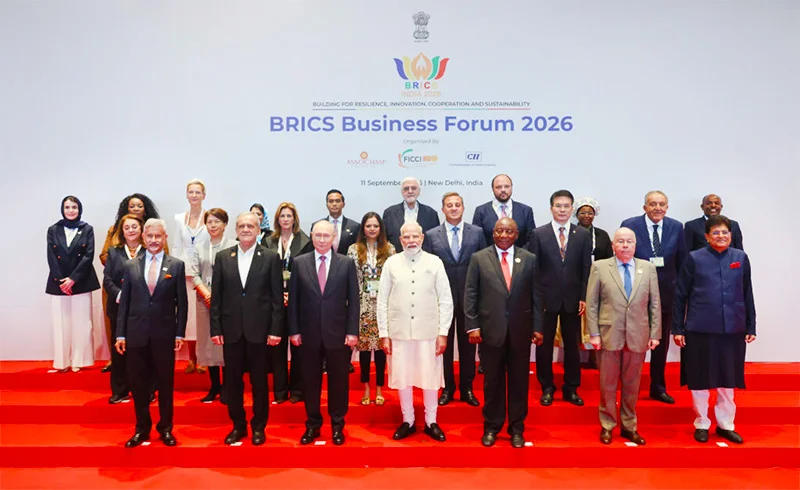
 A principal highlight of the recently concluded BRICS 2026 summit in New Delhi was the grouping’s unambiguous championing of the empowerment of ordinary people everywhere. This was yet another notable coming together of Southern governments over matters of common concern alright but it was the grouping’s people-oriented thinking that struck the impartial commentator as particularly important this time around.
The latter accent merits underscoring in view of the widespread perception that Southern oriented international organizations, such as the Non-aligned Movement (NAM), have had their day, so to speak. However the BRICS summit not only re-affirmed NAM principles but gave proof of its willingness to complement the main undertakings of NAM. Accordingly, causes such as South-South cooperation, international economic and social equity, multilateralism, international peace and the need to uphold the current UN-centred world order received resounding and fresh emphasis.
Particularly encouraging for those espousing Southern development concerns was the stressing of the historic ‘Bandung Principles’ in the New Delhi Declaration which crowned the summit deliberations. As is known, it was the ‘Bandung Spirit’ of 1955 that paved the way for the establishment of NAM and South-South cooperation in a major way. As such the ‘Spirit’ was primary in helping to reshape international development discourse and in giving it a pro-people bent. That is, development correctly conceived was birthed.
The New Delhi Declaration said in this regard: ‘We recall the 1955 Asian-African Conference in Bandung, Indonesia that proclaimed general principles, including equality, independence, non-intervention and mutual benefit. We stress that the Bandung Sprit serves as a reference in the pursuit of a fairer, more inclusive, and representative multilateral system.’
‘Geopolitics’ was not glossed over or ignored in New Delhi, but it is quite forgotten by some sections of opinion in particularly Sri Lanka that BRICS, while being an important Southern counter-balance in terms of power to the global North is also essentially about international economic growth with equity. The New Delhi summit helped to put right this conceptual imbalance in what groupings such as BRICS ought to be thinking and doing.
Even more precisely, people should be at the heart of development and in the exertions and preoccupations of international organizations claiming to represent the South. Southern governments equipped with economic and military might in particular remain important but it is people’s empowerment that ought to be the overriding consideration.
The latter concerns help stress the cruciality of democratic development since it is the latter that facilitates best the well being of people. Unfortunately, BRICS happens to be top-heavy with authoritarian governments that could deliver economic growth but not equity. It is fully representative, participatory governance that could best deliver to the people their essential needs and not totalitarian governments.
This is a complex dilemma for BRICS. It could be resolved somewhat by admitting more and more pro-people, democratic states into the BRICS fold to counter-balance the power and influence of authoritarian states. At present among the principal BRICS countries its only India that meets most of the criteria for democratic development.
Hopefully, more and more Southern democracies would see it fit to join BRICS in consideration of the latter’s potential to be a prime ‘economic powerhouse’ of the world. Equally hopefully, people’s empowerment in the true sense would come to be valued as a crucial merit for BRICS membership. It is relevant to stress that the fulfillment of the fundamental rights of a people is integral to their complete empowerment.
A grave negative fallout from the Trump administration’s current militarism is that more and more states world wide would come to value military heft over people’s empowerment. Consequently, the preference for military power could lead to countries wanting BRICS membership for the wrong reasons. That is, security through collective armed might would come to matter over all else and the world would be rendered an increasingly ‘dangerous place’.
But thinking people would expect from BRICS a more responsible role in world affairs and prefer to have from it inspirational guidance in democratic development, correctly understood.
A commitment by BRICS at the summit of considerable importance to world peace that should not be underplayed is its commitment to the UN system and the strengthening of International Law. The relevant quote from the Declaration spoke of BRICS’ ‘Commitment to strengthening multilateralism and multi-polarity and upholding International Law, including the Purposes and Principles of the Charter of the United Nations.’
Coming at a time when the UN is seen by some as a spent force, lacking effectiveness, the above endorsement of the UN Charter and International Law is of crucial significance. This amounts to solidly upholding the post World War Two order despite current largely rhetorical assertions that it is fast unraveling.
While UN reform remains a compelling necessity, the endorsement of the UN-centred order holds out the possibility of some of the BRICS heavyweights, who are currently acting in violation of International Law, eventually getting back to conduct that would be more in keeping with the requirements of International Law.
The UN could put these developments to constructive use by redoubling its efforts to work out diplomatic solutions to the current conflicts and wars that are showing no signs of being receptive to fresh peace efforts.
Two of these theatres of conflict are the Middle East and the Ukraine. While the US, Israel, Russia and Iran would need to be engaged by the UN with exceptional persuasive power to sort out the conflicts where they have come to feature directly and indirectly, the relevant BRICS members’ commitments to world peace and multilateralism could be used as instruments of moral pressure perhaps to induce them to get onto the path of peaceful conflict resolution.
The wide consensus among the BRICS powers amounts to their scoring a significant political victory over the US and its allies. Their espousal of international peace and the UN Charter exposes the US as being at cross purposes with peace-oriented and democratic sections world wide. Specifically, the moral and intellectual poverty of the Trump administration is being revealed glaringly.
This does not amount to a condemnation of the people of the US perse. It is just that some of them have voted quite unwisely. As a first step towards correcting this situation they could make good use of the upcoming mid term elections to register their strong disapproval of the Trump administration and the political extremists among the US Right. Course correction is not impossible.
by Mahil Dole
Senior Superintendent of Police (Retd.)
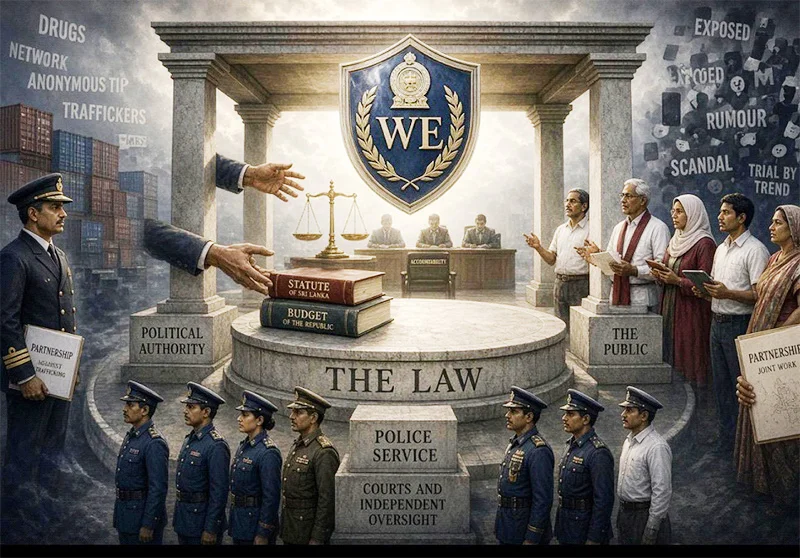
Sri Lanka Police has just marked 160 years. The parades were in order. The sentence that should have followed them has not been written with enough force. A police service that is pulled by politics, rewarded for individual glory and tried every night on social media cannot protect a country that is now a maritime hinge for international narcotics and financial crime. The political authority must decide, not in a speech, but in conduct, whether this force belongs to the law or to the loudest faction of the week.
That is not a plea. It is a warning.
The political hierarchy and the police hierarchy now agree that the service needs a new outlook, beginning with the uniform. The cut and the kit are not yet settled. That conversation is overdue. Criminals have moved into containers, encrypted apps and international logistics. An officer equipped for a quieter decade is less able to detect, and less able to come home.
Sophistication of kit is essential. Body-worn cameras, communications and protective equipment that match the threat are not luxuries. They keep a policeman alive.
If the first decision of this compact is only what the officer will wear, the wrapping will be modern and the person untouched. The priority is not a new silhouette. It is a different person inside the uniform.
The officer is a human being
He and she is a product of this complicated society. The fractures that run through the village, the school and the social-media feed run through the recruit. Communal suspicion, religious identity and ethnic memory are not checked at the armoury gate. The question treated as delicate is operational: is this officer mentally geared for ordinary crime and for communal, religious and ethnic conflict?
What is his stand if he belongs to one community and is sent into a dispute involving another? How will the parties look at him? How will the media frame the first photograph? That decides whether a crowd sees the law or “the other side.” We are all Sri Lankans. The sentence is easy on a Police Day banner. It is hard at a junction when rumour is already ahead of the patrol.
Every officer, from constable to gazetted rank, must be trained for these issues as deliberately as for a baton. Not one lecture at Katukurunda: recurring, scenario-based work on mixed neighbourhoods, mixed complainants, and keeping personal faith out of the method of work. The media will hunt the communal angle; parties to a conflict will hunt the ethnic one. The only answer that holds is an officer whose first identity on duty is Sri Lankan and whose first loyalty is the law.
That is “We.” Assuming the uniform dissolves identity is how a single incident becomes a national story.
What they have been is not what they can remain
From the 1866 ordinance this service has been the state’s civilian arm, colonial order-keeping, post-independence law and order, then a wartime partner that buried its dead beside the armed forces. Specialised units were built for terrorism, organised crime and financial intelligence. The same institution was used as a residual army, a political instrument and a promotion marketplace. Loyalty too often attached to a person, not to the law. Easter Sunday made the price visible. So did every file that moved, or stalled, according to who was in office.
A history of sacrifice does not excuse a present of capture. It makes the capture more shameful.
What they are today
On paper the force is large, some 79,000 authorised, 609 stations. On the ground it is thin. More than 4,300 officers have left since 2020. Vacancies exceed 30,000. Shifts of twelve to eighteen hours are still treated as normal. Distress is still logged as discipline rather than welfare. That is waste, not toughness.
Crime has two faces, and both strike national security. Gang violence over narcotics still produces shootings. Sri Lanka also sits on feeder routes moving Afghan and Pakistani product toward other markets. Harbour and high-sea detections in the hundreds of kilograms are no longer rare. Ice hidden in towels at Colombo Port; heroin pulled from multi-day trawlers; scam compounds and frozen assets in the billions of rupees, these are not “ordinary crime.” They buy influence and fund the next consignment.
The third battlefield is information. Reels and anonymous accounts impersonate officers, launder rumour as fact, and reward the man who seeks a following. Inside the service the culture still teaches “I”: my file, my photograph, my briefing. Rank is being treated as a prize. It is a trust.
The container that became a campaign
Late August 2026, officers opened containers at the Colombo International Container Terminal and recovered some 463 to 472 kilograms of crystal methamphetamine, concealed in towels, originating from Pakistan and valued in the billions of rupees. Suspects including foreign nationals were arrested. The United States DEA publicly associated itself with the intelligence. The criminal case sits with the Central Crime Investigation Bureau.
That is a success. It should have been protected as a success.
Instead, an internal process review, ordered by the Inspector General into how information moved between bureaux, was translated on social media into another story: that the IGP and Senior DIG Ranmal Kodituwakku were being “chambered” over the detection. An Opposition MP warned, correctly, that putting the officers who delivered the raid under a public microscope will teach the service the wrong lesson.
State the distinction without apology. A criminal file is about the network and the money. A process file is about timelines and chain of custody. A blog is neither. Collapsing a Senior DIG’s recorded statement into “the hierarchy is in the dock” is not accountability. It is a gift to those who packed the towels. After a half-tonne interdiction, a process review is normal; leaking it as a morality play is not. Complete the inquiry on the record. If negligence is found, deal with it. If not, say so. Half-spoken files let rumour colonise the institution.
Training, technology and a mind that can bear the load
The IGP and the hierarchy must stop treating training as a calendar ornament. Immediate programmes are required, not next year’s paper.
First
, the evolving issues: communal and religious tension, narrative operations, child and women protection, financial and cyber crime, harbour interdiction, the law of arrest.
Second
, the technologies: digital evidence, data protection under the Personal Data Protection Act, disciplined open-source work, body-worn cameras that protect the public and officers alike.
Third
, mental health as operational infrastructure, counselling an Inspector can use without becoming a Legal Division case, and early recognition of burnout before it becomes a headline.
Incentives must follow: allowances for certified competencies, promotion credit for courses applied, not for attendance photographs. Asking for sophistication at the port with no path to acquire it is theatre.
A new uniform that can carry a camera, worn by an officer unprepared for the society he polices, is a costume. The station, the cell, the unseen hour Look next at where this officer lives and works. Many stations are old, congested and unhygienic. Living standards on duty are low. You cannot demand a different person in the uniform and house him as if he were expendable.
Cells are a particular failure of command. Too many sit out of sight of the men on duty. They are dilapidated. What happens inside goes unnoticed until a death, an assault or an escape. That is a design of our own buildings, not a secret of the underworld. A cell that cannot be seen cannot be defended in court or in conscience. Refurbish, fix sightlines, monitor what the Constitution requires, and treat an escape as a failure of supervision before it becomes a press note.
These are not welfare extras. They are the conditions under which evidence is kept, suspects are held, and officers decide whether the job is still worth the family cost.
The health of the officer is the health of the public
One of the first duties of the hierarchy is the health of the policeman and his family. A sick officer with a sick child is not “uncommitted.” He is a risk to himself, to the next raid, and to the citizen at the counter. Police hospitals are few. Officers in rural stations cannot reach them in time. The IGP should not wait for a building programme. Speak to the health authorities now. Arrange priority access for officers and their families at government hospitals. Dedicated wards or reserved beds are not a privilege class. They are the minimum owed to people sent into harm, and into other people’s crises, at every hour.
Good health is a good mind. A good mind is good care for the people. No uniform compensates for an officer who has not slept, has not been treated, and cannot reach a Police hospital.
What they must be tomorrow
The country does not need more decoration. It needs a service the public can approach without fear and that no politician can casually redirect: intelligence-led against networks that threaten the state; digitally capable and legally bounded; trained for communal heat as well as narcotics; housed and treated as human beings; collectively minded. We hold the ground, not I cleared the file.
The constable at the junction and the analyst tracing a hawala chain are the same institution. National security is not a specialist’s private property.
To the policymakers and the political authority
You have agreed with the Police hierarchy on a new outlook. Use it for more than cloth.
Independence is not the IGP’s personal autonomy. It is the institution’s ability to apply the law without fear or favour, and still answer to the law. You cannot have that and also have a Police summoned, transferred or publicly undermined according to the needs of the week.
Appointment and removal of the Inspector General must remain a process, not patronage. The National Police Commission must exercise its powers over promotions, transfers and discipline without being hectored from the gallery. Cabinet sets policy and budget. It does not choose Tuesday’s suspect. Comment from the House on the guilt of named officers while a file is open is not oversight. It is interference under another name.
If you want an apolitical Police, stop using internal inquiry as a factional weapon and social media as a substitute bench. Different treatment of files is the old disease. Naming it only when the officer is someone you dislike is the same disease.
Then fund what a new uniform implies: immediate training, habitable stations, cells that can be seen, and a health arrangement with the Ministry of Health that does not leave a rural sergeant’s family outside the gate. Announcing kit and withholding living conditions is not reform. It is dressing the service for a photograph.
The public has a part. Distinguish error from crime. Cooperate with the officer who is fair; demand consequences where he is not. In conflict, look at the uniform as the law, not as a census of name, faith or village. Do not outsource judgement to an anonymous account.
The stand It is not I. It should be We.
A new uniform will not make an officer Sri Lankan. Training, health, housing, an apolitical file, and a command that treats him as a human being might. A service that thinks in individual glory will be outrun by networks that think in systems. A political class that thinks in capture will keep receiving detections and wondering why the pipeline never closes. A country that argues about the cloth while the person inside it is exhausted, untrained for communal fire, and unseen in a dilapidated cell block is not preparing for tomorrow. It is rearranging the wardrobe.
The law cannot serve two masters. Neither can the uniform, old or new.
(This analysis is offered in the interest of national security, institutional reform, and public safety)
Mahil Dole, SSP (Retd.), served as Deputy Director in charge of the Counter-Terrorism Desk of the State Intelligence Service and later as Intelligence Coordinator to the Inspector General of Police. He is a former Member of the Sri Lanka Wakfs Board and author of Security Beyond Enforcement: Practical Approaches for a Safer Nation. Email – mahildole54@gmail.com
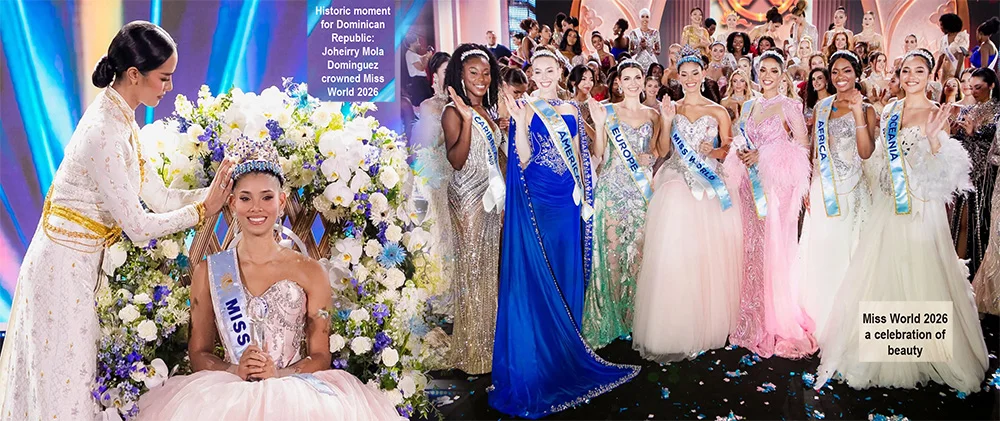
 History was made under the lights on 05th September, as Joheirry Mola Dominguez, of the Dominican Republic, was crowned Miss World 2026 by outgoing queen Suchata Chuangsri of Thailand at April 2nd Square in Nha Trang, Vietnam.
It is only the second Miss World title for the Dominican Republic; 44 years after Mariasela Álvarez’s win in 1982. Reports described it as an “emotional and historic moment” for the nation.
Joheirry, 24, beat 110 other delegates to take the crown.
A dedicated educator and community advocate, she holds a degree in Business Management and Administration from Universidad Iberoamericana. She is Founder and President of “Voices of Tomorrow”, an initiative expanding access to English education for children in vulnerable communities. She also teaches Literature and Social Studies in English, and works as a correspondent for Univision New York’s Ventana a Quisqueya.

Her advocacy won hearts
It was her advocacy that won hearts.
“My Beauty With a Purpose is to take English programmes to kids in vulnerable communities,”
she said at the Grand Final. “Because I believe that when they know this language, the opportunities, the doors that can open to their life, it’s huge. English is a tool that will stay with them and benefit them for the rest of their lives.”
Spain’s Elisabeth Reynés finished 1st Runner-Up, while Malaysia’s Taanusiya Chetty, also winner of Beauty With a Purpose, took 2nd Runner-Up.
The Top 6 included Vietnam’s Le Nguyen Bao Ngoc, Eritrea’s Snit Habteab, and South Africa’s Romanda Hombir.
The 75th Anniversary edition, hosted for the first time in Vietnam, was a spectacle before 20,000 spectators. Staged on a 110+ meter outdoor platform by Nha Trang beach, the square was lit up with huge LED screens and high-power sound.
Even heavy rain during the Americas & Caribbean segment couldn’t dampen spirits. Umbrellas and raincoats popped up and the show resumed 15 minutes later. Nobody left. That’s dedication.
With 111 ambassadors, cultural dances, ao dai performances, and the seaside backdrop, officials called it a celebration of beauty, talent, confidence, and social responsibility.
With 20,000 people, rain or shine, screaming, cheering, live-streaming, waving flags… it was, indeed, pure Miss World magic.
For Sri Lanka, Prathibha Liyanaarachchi did not make the Top 40 at the 73rd Miss World Festival, but she reached the finalist stages of four fast-track events — Top Model, Talent, Sports, and Beauty With a Purpose.
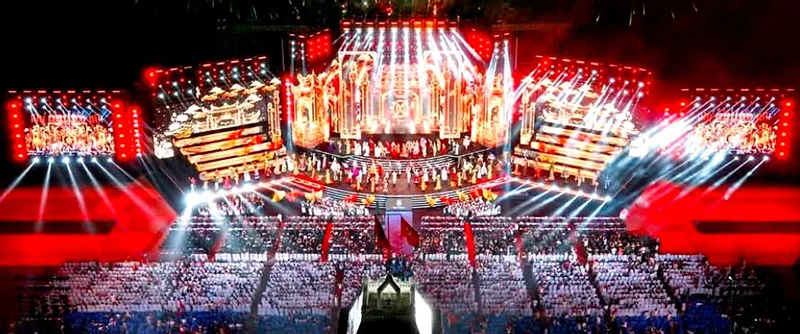
Miss World magic: The square was lit up with huge LED screens and high-power sound

Showers in most parts of the island today (17)

US embassy won’t comment on IGP’s probe into joint drug raid

Gnanasara Thera declares outside High Court that he wouldn’t flee

Namal further remanded

22A: LAWASIA questions compostion of five-judge bench

Sri Lanka’s lifestyle coffee culture boom and the two faces of its economy

‘Dates have the highest sugar content to fight Coronavirus’

Sunday Island 27 December – Headlines

#SundayIsland 17th December – Headlines

Sunday Island – 28th March

Sunday Island Headlines – 21 March

Sunday Island – 21st February – Headlines
-

 Sports6 days ago
DDS set to lose Test captaincy
-

 News6 days ago
Sri Lanka faces new grid challenge as rooftop solar surges: former CEB GM
-

 Latest News6 days ago
Shafali, Deepti power India into sixth T20 Asia Cup final
-

 News4 days ago
Gnanasara Thero absconding after SC ruling
-

 Latest News5 days ago
Sri Lanka thwart Fatima Sana challenge to secure Asia Cup final spot
-

 News5 days ago
Ammunition cache found in old Kandy bungalow
-

 Editorial6 days ago
A flight of fancy
-

 News5 days ago
Green Climate Fund (GCF) Regional Dialogue for East and South Asia will be held from 14 to 17 September 2026 at Cinnamon Life at City of Dreams Hotel, Colombo