
Editorial
Self-serving love


Tuesday 4th July, 2023
Some SLPP grandees would have the public believe that they are opposed to the government’s domestic debt restructuring (DDR) programme because it has adversely affected the working class and exempted the super-rich. SLPP MP Namal Rajapaksa has gone on record as saying that he is averse to the DDR scheme, and that is why he absented himself when it was put to the vote in Parliament on Saturday.
If Namal is actually opposed to the DDR programme, will he explain why he did not vote against it in Parliament instead of making himself scarce? The same goes for his father, former President Mahinda Rajapaksa, who was also absent during Saturday’s crucial vote. Interestingly, the other members of the Rajapaksa family had no qualms about voting for the DDR strategy!
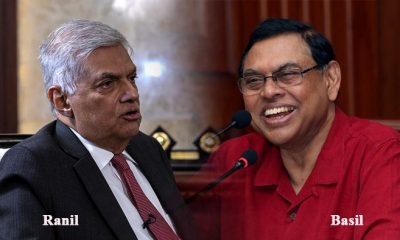
Basil Rajapaksa controls the SLPP, as is public knowledge, and its MPs would not have voted for the DDR plan on Saturday if he had not asked them to do so. It would not have been possible for the government to engineer some defections from the Opposition without his support. Is there a split in the Rajapaksa family over the DDR plan? The answer, we believe, is in the negative. There is reason to believe that the Rajapaksas are fully supportive of the DDR programme, but some of them are opposing it in a bid to deflect public opprobrium from their family; they are running with the public and hunting with the government.
The Rajapaksas have no love for the workers’ superannuation funds. One may recall that in 2011, the then Mahinda Rajapaksa government sought to ‘restructure’ the EPF, to all intents and purposes, at the expense of workers on the pretext of introducing a private sector pension scheme. It claimed that most workers wasted their savings after retirement, and the proposed pension scheme was intended to make their future secure. But the private sector trade unions accused that regime of trying to dip into the EPF to raise funds for wasteful projects by preventing the retiring workers from withdrawing their super in lump sum payments. In June 2011, workers launched a protest, pointing out that the proposed pension scheme would provide no significant benefits to them, and a Free Trade Zone worker was killed in police shooting. The controversial pension scheme was shelved thereafter.
Allegations abound that during the Mahinda Rajapaksa regime (2005-2015) the EPF suffered huge losses as it was abused to carry out pump-and-dump operations. One of the main election promises of the Yahapalana leaders was to probe those rackets and bring the culprits to justice. But they reneged on that promise, after being ensconced in power, and today ‘the robbers’ and ‘the cops’ are unashamedly sharing power. So much for the Rajapaksas’ love for the EPF and workers.
It is being argued in some quarters that domestic debt should have been restructured at the expense of ‘the rich’ and not the EPF. There is no gainsaying that the workers’ interests must be safeguarded, and the EPF, etc., should not be unfairly burdened with the cost of reviving the economy. The fact however remains that the interests of their employers who contribute to the EPF must also be protected; entrepreneurs must not be sucked dry, so to speak, simply because they are wealthy lest their businesses should go belly up, causing job losses and a drastic drop in EPF contributions.
Hence the need to ensure that the interests of the employee and the employer both are taken care of. If private Treasury bond/bill holders are adversely affected by debt restructuring, there will be a severe erosion of public trust in government securities, and it will stand in the way of raising funds at future Treasury bond/bill auctions. This, however, does not mean the big businesses that have defaulted on bank loans to the tune of billions of rupees should be given kid-glove treatment; they must be severely dealt with according to the law, and the banks must be allowed to do everything in their power to recover their money without passing their losses on to other customers.
If the government cares to cast the tax net wide, streamline tax collection, rid the Customs, the Excise Department, etc., of malpractices, recover heavy losses that racketeers cause to the public purse, eliminate corruption and waste, then the state revenue will increase, bringing down the debt-to-GDP ratio; the government will not be overly dependent on debt restructuring measures that adversely impact the superannuation funds, etc.








Another May Day was drawing to a close, and the moon was waxing at the time of writing. A rare overlap of the International Labour Day and Poya, this year, left the public confused, with the second Poya in the current month being officially declared Vesak. Opinion is however divided on the issue. It is being argued in some quarters that Vesak fell yesterday. The ongoing debate on this issue is not likely to fizzle out.
On watching various political circuses that passed for the International Labour Day events yesterday, one might have recalled the closing line of an epigram that mocks the writers who display technical control but not substance or vitality: “They use the snaffle and the curb all right/But where’s the bloody horse?” As for this year’s main International Labour Day events in Sri Lanka, one might have asked oneself: “Where’s the bloody worker?”
Yesterday’s May Day events were full of theatrics, and the worker as well as his cause was only an excuse for politicians to bellow rhetoric and score political points. Their May Day rally themes and sloganeering effectively gave away their political game.
The SJB’s May Day rally, held under the theme, Pacha Madiwata Horu (“Lies and Theft”), in Colombo, was a frontal propaganda attack on the government. It had little or nothing to do with workers’ cause. Lies and theft are bound to continue under future governments as well in this country, and propaganda attacks alone will not serve any purpose for workers. The SJB is an offshoot of the UNP, which crushed workers’ struggle in a brutal manner. In 1980, a powerful UNP government unflinchingly sacked tens of thousands of strikers overnight. The suppression of labour rights is part of the SJB’s political legacy. The SJB invited the UNP to join its May Day rally yesterday, as part of a plan to form a common electoral front, but the latter opted to take part in religious activities instead.
The JVP-led NPP’s main May Day rally was held in Nuwara Eliya yesterday under the theme, People’s Power for A People’s Government. The people, especially workers, enabled the incumbent government to secure a two-thirds majority in Parliament, expecting it to eliminate corruption and waste, develop the country and improve their lot. But the JVP/NPP leaders are riding roughshod over trade unions and even issuing veiled threats to resort to mass sackings to crush strikes. They have apparently borrowed a leaf out of the LSSP’s book in suppressing trade union struggles. One may recall that the LSSP, which emerged powerful with the help of trade unions, broke a bank employees’ strike in 1972 under the SLFP-led United Front government.
The NPP government has read protesting doctors the riot act. It chose to wear down the Government Medical Officers’ Association (GMOA) during a recent trade union battle. Time was when the JVP leaders shouted slogans, such as Death to imperialism––Liberation to the People and Death to Capitalism––Victory to Socialism. The JVP’s 36-page Revolutionary Policy Declaration with its founder Rohana Wijeweera’s imprimatur is full of promises to safeguard workers’ interests; it carries a quotation from The Communist Manifesto on its back cover. But today, the JVP-led NPP has prioritised the interests of the rich and the corporate sector over those of the ordinary people and workers. Some big-time rice millers are importing Rolls-Royces and helicopters while paddy farmers are pawning their valuables, unable to recover production costs due to exploitation at the hands of the millers’ Mafia and the soaring prices of agricultural inputs. The government has allowed the millers to fleece rice consumers as well.
The promised biannual salary revisions have become pie in the sky for state employees, and their private sector counterparts’ predicament is even worse. The NPP government did not care two hoots about workers’ views and protests, when it dismembered the Ceylon Electricity Board. What the JVP/NPP has done to trade unions, after being ensconced in power, is a textbook example of kicking the ladder.
Workers’ woes remain unaddressed, but the May Day political circuses go on, with politicians shedding copious tears for the working class.

Saturday 2nd May, 2026
The government and some Opposition parties held big rallies purportedly to mark May Day yesterday. The JVP/NPP staged as many as 21 such events across the country, and the SJB rally took place in Colombo. Not to be outdone, the SLFP also held its May Day rally in Colombo. Those spectacles must have cost a fortune each. Where did the funds come from?
Both the government and the Opposition never miss an opportunity to declare their commitment to upholding transparency and other good governance principles. So, they should be able to disclose the costs of the aforementioned mega events, attended by thousands of their supporters, and how they raised funds. They must do so because anti-social elements use colossal amounts of black money to bankroll election campaigns and political events in return for favours from politicians. There is said to be no such thing as a free lunch in politics.
Following the assassination of upright High Court Judge Sarath Ambeypitiya in 2004, this newspaper reported that Kudu Nauffer, a notorious drug dealer, who ordered the killing, had sponsored food and beverages served at a judicial officers’ function. This shows how widespread the tentacles of the underworld are. Besides criminals, other moneybags also lavish funds on political parties and their leaders and leverage the quid pro quo to cut corrupt deals.
There have been instances where some political parties resorted to illegal operations to raise funds for elections, the 2015 Treasury bond scams being a case in point. The UNP could not pay its water and telephone bills at Sirikotha while it was out of power, but after the ouster of the Rajapaksa government in January 2015, its war chest overflowed, and the UNP candidates went on a spending spree during the 2015 general election campaign. A group of businessmen who financed the SLPP’s campaign events gained from the sugar tax scam in 2020. They made a killing at the expense of the state coffers. It is alleged that some financiers of the JVP/NPP benefited from the green-channelling of 323 red-flagged freight containers in the Colombo Port in January 2025. Another allegation is that the current government is beholden to the wealthy rice millers, known to shower funds on politicians, especially during elections.
Hence, the need for pressure to be ramped up on the government and the Opposition to reveal the costs of their political dog and pony shows on May Day and how funds were raised for them.
A large number of government politicians including President Anura Kumara Dissanayake attended the JVP/NPP’s main May Day rally in Nuwara Eliya yesterday. In doing so, they gave the lie to their claim that they had decided against holding a May Day rally in Colombo in view of the fuel crisis. Their supporters were bussed to Nuwara Eliya as well as other venues. VIP travel and security cost the public an arm and a leg. Will the government reveal the costs of transport, accommodation and security for the JVP/NPP leaders?
The government insists that it was wrong for Ranil Wickremesinghe to use state funds for a visit to a university in the UK, while he was the President. If so, it must be equally wrong for President Dissanayake to spend state funds on domestic travel to attend political events, from which no benefits accrue to the public.

Friday 1st May, 2026
Two full moon Poya days fall in May 2026, and there are two schools of thought about when Vesak should be observed. One insists that Vesak should be celebrated today, and the other is of the view that Vesak falls on 30 May. This difference of opinion has given rise to some confusion in the minds of the public and even protests in some quarters. The government has said its decision to observe Vesak on 30 May was taken on the recommendation of the Maha Sangha. This issue has come about and drawn so much attention because the International Workers’ Day, known for grand political events in this country, also falls today.
The overlap of Poya and May Day this year has been a blessing for some political parties that are not strong enough to stage shows of strength today. They have declared that they do not want to engage in political activities on a day of religious significance and therefore will not hold May Day rallies. Even if Poya had not fallen today, they would not have been able to hold successful May Day rallies.
Among the political parties that have decided against holding rallies today are the SLPP and the UNP, which has also used Poya as an excuse for turning down the SJB’s invitation to hold a joint May Day event. The UNP has written to the SJB that it will perform religious observances today in keeping with the late President Ranasinghe Premadasa’s policy that the UNP should not hold May Day rallies if the International Workers’ Day coincides with Poya. The subtext of its letter is that Sajith Premadasa, who leads the SJB, does not follow his late father’s policy.
The convergence of Poya and May Day has deprived the JVP/NPP of an opportunity to make a display of its political strength while it is reeling from several scandals and the Opposition is on the offensive. It has opted to hold May Day rallies at the district level. But they will not be as effective as a mammoth May Day rally in Colombo in boosting the morale of the rank and file of the JVP/NPP and sending a message to the Opposition that the government is far from weak.
JVP General Secretary Tilvin Silva has said the JVP/NPP decided not to bring its members to Colombo for a May Day rally in view of the current fuel crisis. This is not an implausible excuse in that the government would have drawn heavy criticism if it had held a political rally in Colombo while urging the public to use fuel sparingly. It would also have been criticised if it had held a grand May Day event in Colombo on a Poya Day.
No political issue would have arisen today if the workers’ day had not been politicised. Those which pass for labour day celebrations are shameful displays of workers’ servility to political leaders who have a viselike grip on the labour movement. Of course, there have been progressive, visionary politicians as well as independent labour leaders who championed the workers’ cause wholeheartedly and made a tremendous contribution towards the protection of labour rights. Those leaders must be remembered today, but unfortunately trade unions have become appendages of political parties, serving the interests of politicians rather than those of workers. These political trade unions are the bane of the labour movement. Political agendas of the parties controlling trade unions will continue to take precedence over workers’ interests unless the labour movement is liberated from the clutches of politicians. Trade unions have a pivotal role to play in helping the country achieve progress, but their political affiliations have prevented them doing so.
What workers, trade unionists and the politicians who claim to champion labour rights should do today, when a day of religious significance to Buddhists falls, is to remind themselves of the Buddha’s teaching on work, based on three main principles––doing no harm through one’s livelihood, earning honestly and using wealth responsibly and ethically.

‘Dates have the highest sugar content to fight Coronavirus’

Sunday Island 27 December – Headlines

#SundayIsland 17th December – Headlines

Sunday Island – 28th March

Sunday Island Headlines – 21 March

Sunday Island – 21st February – Headlines
-
 News4 days ago
Treasury chief’s citizenship details sought from Australia
-

 News6 days ago
BIA drug bust: 25 monks including three masterminds arrested
-

 News3 days ago
Rooftop Solar at Crossroads as Sri Lanka Shifts to Distributed Energy Future
-

 News6 days ago
Banks alert customers to phishing attacks
-
 News5 days ago
Govt. assures UN of readiness to introduce ‘vetting process’ for troops on overseas missions
-
 News2 days ago
“Three-in-one blood pressure pill can significantly reduce risk of recurrent strokes”
-
 Business5 days ago
ADB-backed grid upgrade tender signals next phase of Sri Lanka’s energy transition
-

 News4 days ago
Central Province one before last in AL results