
News
Sectoral Oversight Committee exposes CEB costing trick to make huge profits


By Rathindra Kuruwita
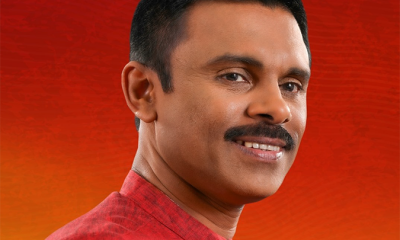
The Ceylon Electricity Board (CEB) has significantly overestimated the cost of electricity production and transmission for 2024 and this is reflected in their estimated cost of production, says MP Gamini Waleboda, head of the Sectoral Oversight Committee on Alleviating the Impact of the Economic Crisis.
The overestimation is around Rs 140 billion, Waleboda has said, adding that the CEB has recently presented the estimated costs for 2024 to the Public Utilities Commission of Sri Lanka (PUCSL).
“When we look at the cost of production, we see that it has been overestimated by about Rs 80 billion,” he said.
MP Waleboda said that the CEB had also increased the estimated cost of transmission. Over 98 percent of households were connected to the national grid, he said.
“If you look at the cost of transmission in the recent past, it has hovered between 55 and 67 billion rupees. The cost of Rs 67 billion was when we were dramatically expanding the coverage. Now, the network is mature. This year the CEB says the cost of transmission is Rs 132 billion rupees,” he said.
MP Waleboda said that CEB had also significantly overestimated the cost of financing. The CEB’s calculation ran counter to the principles of accounting, he said.
“They have calculated the interest rate using the rates that were prevalent at the height of the economic crisis. This has to decrease. The CEB has also calculated depreciation of assets that have been fully depreciated. This is imaginary expenditure. There are many instances of double counting. The CEB has no proper cost accounting mechanism and therefore officials and policy makers parrot out numbers that someone comes up with,” MP Waleboda said.
Waleboda said the minister of power and energy, Kanchana Wijesekera and senior CEB officials had taken the recommendations of the Sectoral Oversight Committee on Alleviating the Impact of the Economic Crisis as a personal affront.
“We are actually trying to help him because the minister needs correct data to make the right decisions. The overestimation is around Rs 140 billion. In 2023, the CEB made a profit of over Rs 50 billion. It made a monthly profit of about Rs 15 billion rupees in January and February 2024.”
Waleboda said the CEB and the Ceylon Petroleum Corporation (CPC) were now profit-making enterprises. However, they were making profits at the expense of macroeconomic sustainability. The two institutions have gone beyond the breakeven point and are now making tens of billions of rupees in profit, the MP said.
“However, the social and macro-economic impact have been adverse. The education of millions of children is adversely affected when a million households are taken off the grid. The manufacturing and agricultural sectors are suffering because of high power and energy costs. To make the CEB profitable, we have undermined our macroeconomic stability, economic expansion, and social wellbeing,” he said, noting that the government must take a holistic view of the economy. The CEB is a part of a wider system and if everything else collapses, the CEB can only last for a short period, he said.
The Sectoral Oversight Committee on Alleviating the Impact of the Economic Crisis had met representatives of organisations that earned foreign currency and all manufacturers that produced for the domestic market, he said.
“We are not asking the CEB to continue supplying electricity below cost. We are asking the government to help our manufacturers and the poorest segments. If we ignore the tragedy that unfolds among the lowest strata of society, we will only be asking for a massive social crisis in the coming years,” Waleboda said.
The MP said the Central Bank (CBSL) could do a lot more to help the economy. The CBSL was implementing IMF policies, and losing its grip on the financial sector, Waleboda said.
“Financial institutions are paying a single digit interest for savings, but the interest rates for borrowing are in double digits, over 16 percent in many cases. The banks are making tremendous profits. The CBSL has reduced policy rates several times, but the banks have not passed the benefit on to borrowers. Not even state banks are reducing their loan interests,” he said.
However, the CBSL had played a pivotal role in controlling and reducing inflation which was around 70% in late 2022, Waleboda said.
“There is a lot of talk on making the CBSL independent. This should not mean it should carry out the IMF or ADB programme or act according to the whims of the few people on the monetary board. The CBSL must come up with a monetary policy that is sustainable in the long term and leads to economic development,” MP Weleboda said, noting that according to their calculations millions of US dollars that should be brought back to Sri Lanka are parked in foreign countries by exporters. “The country loses at least 1.2 billion dollars a year because of this, and this is around the income generated by the IT industry”, he said, “There should be an institution to keep a tab on these things.”





Bus fares have been increased by 12.19% with effect from midnight today [23rd March 2026].
The minimum fare will be increased from Rs 27 to Rs 30 while the maximum fare of Rs2159/- will be increased to 2422/-
Latest News
Public will not be served as Computer system failure at Department of Registration of Persons

The Acting Commissioner General of Registration of Persons has announced that due to an unexpected failure of the computer system of the Department of Registration of Persons, all services, including the one day service will not be held on Tuesday (24th March) at the Head Office and all Provincial offices.

Latest News
Heat Index at Caution Level in the Western, Sabaragamuwa, Southern and North-western provinces and in Anuradhapura, Mannar and Vavuniya districts
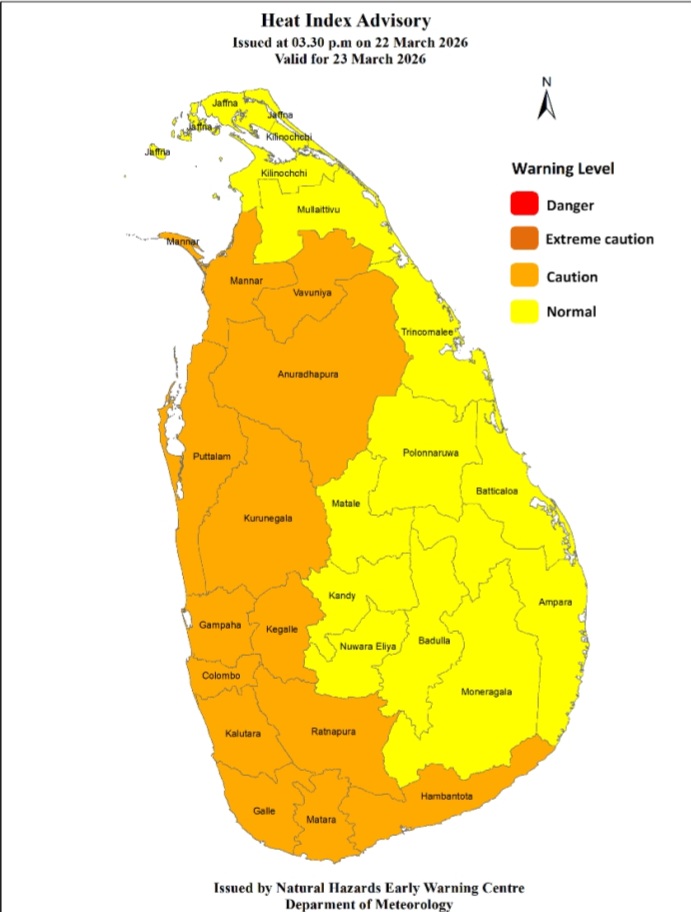
Warm Weather Advisory
Issued by the Natural Hazards Early Warning Centre of the Department of Meteorology
at 3.30 p.m. on 22 March 2026, valid for 23 March 2026.
The Heat index, the temperature felt on human body is likely to increase up to ‘Caution level’ at some places in the Western, Sabaragamuwa, Southern and North-western provinces and in
Anuradhapura, Mannar and Vavuniya districts.
The Heat Index Forecast is calculated by using relative humidity and maximum temperature and this is the condition that is felt on your body. This is not the forecast of maximum temperature. It is generated by the Department of Meteorology for the next day period and prepared by using global numerical weather prediction model data.

Effect of the heat index on human body is mentioned in the above table and it is prepared on the advice of the Ministry of Health and Indigenous Medical Services.
ACTION REQUIRED
Job sites: Stay hydrated and takes breaks in the shade as often as possible.
Indoors: Check up on the elderly and the sick.
Vehicles: Never leave children unattended.
Outdoors: Limit strenuous outdoor activities, find shade and stay hydrated.
Dress: Wear lightweight and white or light-colored clothing.
Note:
In addition, please refer to advisories issued by the Disaster Preparedness & Response Division, Ministry of Health in this regard as well. For further clarifications please contact 011-7446491.

Two killed when Air Canada jet hits fire truck at NYC’s LaGuardia Airport

Bus fares increased by 12.19% from midnight today [23]
Public will not be served as Computer system failure at Department of Registration of Persons

Trump says he is postponing strikes on Iran power plants after ‘productive’ talks on ending war

Asia stocks slide as US and Iran threaten to escalate war

Heat Index at Caution Level in the Western, Sabaragamuwa, Southern and North-western provinces and in Anuradhapura, Mannar and Vavuniya districts

‘Dates have the highest sugar content to fight Coronavirus’

Sunday Island 27 December – Headlines

#SundayIsland 17th December – Headlines

Sunday Island – 28th March

Sunday Island Headlines – 21 March

Sunday Island – 21st February – Headlines
-

 News6 days ago
CIABOC questions Ex-President GR on house for CJ’s maid
-

 News7 days ago
Sri Lankan marine scientist Asha de Vos honoured at UNGA opening
-

 News7 days ago
Australian HC debunks misleading travel risk claims for Sri Lanka
-

 News5 days ago
Bailey Bridge inaugurated at Chilaw
-

 News5 days ago
Pay hike demand: CEB workers climb down from 40 % to 15–20%
-
 News4 days ago
CIABOC tells court Kapila gave Rs 60 mn to MR and Rs. 20 mn to Priyankara
-

 Editorial6 days ago
Couple QR-based quota with odd-even rationing
-

 News3 days ago
Colombo, Oslo steps up efforts to strengthen bilateral cooperation in key environmental priority areas