
Sports
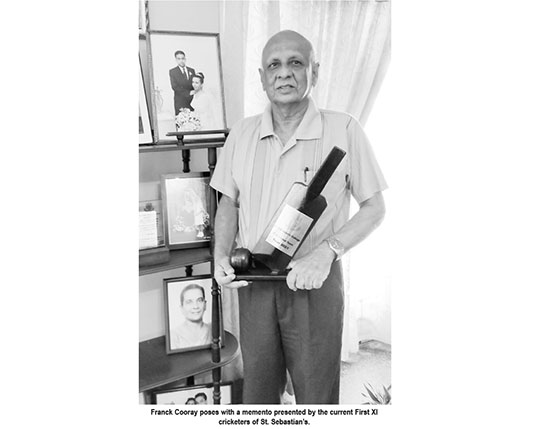
Sebs’ cricket stalwart Cooray retires after more than three decades of service

by Reemus Fernando
Franklyn Cooray, the former Sri Lanka Schools Cricket Association official, retired as the Master in Charge of Cricket of St. Sebastian’s College, Moratuwa after completing more than three and half decades of yeoman service recently. Franklyn Cooray who was popular in cricket circles as Frank Cooray, was the longest serving team official at the time of his retirement. During his 37 year association with schools cricket, Cooray witnessed the evolution of First XI cricket from mere Traditional matches to present day tournaments of varying divisions and was involved in St. Sebastian’s cricket as a coach and Master in Charge guiding the destiny of many future national cricketers.
Cooray played First XI cricket for St. Sebastian’s from 1962 to 1966 and was among the very few Sebs cricketers of his era to have tasted Big Match success. He captained all age group teams of St. Sebastian’s. After leaving school he worked at the Irrigation Department as a Senior Technical Officer and played in the Government Services ‘A’ Division Cricket tournament until making a premature retirement in 1983.
He was entrusted with the responsibility of training cricketers of St. Sebastian’s in 1984 by Rev. Bro. Nimal Gurusinghe, when coaching was voluntary. Three years later Cooray was included in the tutorial staff by Rev. Bro. Granville Perera. He was the coach cum Master in Charge of St. Sebastian’s from 1987 to 1994 and held the latter position until his retirement this year.
During his tenure as a coach, Cooray provided guidance at different levels to several Sebs who later became household names. Of them Dulip Mendis, Roger Wijesuriya, Susil Fernando, Romesh Kaluwitharana and Sajeewa de Silva went on to play Test cricket. “Kaluwitharana was coached by Brother Gurusinghe before he came under my supervision at senior level,” Cooray recalled in an interview with The Island.
Cooray was the Master in Charge of Cricket when the likes of Prasanna Jayawardena, Dinusha Fernando, Vishwa Fernando, Amila Aponso, Avishka Fernando and Oshada Fernando learnt their ABC of cricket at St. Sebastian’s.
While being the MIC, Cooray was also entrusted with the responsibility of the curator after a turf wicket was laid at the St. Sebastian’s ground in 1990.
He was selected to SLSCA Executive Committee in 1988 and a year later became the Under-19 tournament secretary, a position he held until 2006. He was among the leading officials of SLSCA who were instrumental in introducing the two-day league tournament and the Under-19 tournament structure with three Divisions. As of late it has undergone many changes.
However he was against introducing the points system that determined winners on first innings points. “That system would promote the culture of playing for trophies. I never encouraged the point system for first innings wins. We gave points only for outright victories. During our time we hardly batted after tea. We would try to score as much as possible in the morning and declared and get the opposition to bat in the afternoon. That way we would try to win outright. That was lost after the points system was introduced,” opined Cooray.
Cooray also lamented the absence of natural stroke play among present day cricketers. “Players going for their natural strokes is something that we are missing greatly these days. You must encourage batsmen to go for their natural strokes,” said Cooray.
He was the Under-19 tournament secretary of the SLSCA at a time when computers were yet be utilized for calculation of points and to make points tables of the league tournaments. Yet as schools cricket reporters would recall he was readily available with a near accurate points table of the tournament at the end of every week during the schools cricket season.
Apart from holding the Under-19 tournament secretary position, Cooray also held the junior national coach position briefly. He was the coach of the Sri Lanka Under-15 side that toured England for the Under-15 Lombard World Challenge.
His contribution to cricket was recognized by the International Cricket Council in 2009 when he was presented with a medal during its Centenary Medals Presentation for Volunteers.
As he steps in to retirement with loads of fond memories from cricket, Cooray thanked former administrators of St. Sebastian’s Rev. Bro. Nimal Gurusinghe and Rev. Bro. Granville Perera, late Rev. Fr. Bonnie Fernandopulle who made it possible for him to take up coaching and cricket administration and coaches including Kanishka Perera who helped during his tenure.


Ali Khan the USA fast bowler of Pakistan origin, has claimed in a caption to a story on Instagram that he has been “denied” an Indian visa. USA are scheduled to play India in Mumbai on February 7, the opening day of the 2026 T20 World Cup.
Khan, who is currently in Colombo for a USA training camp, posted on Tuesday without giving any further details. ESPNcricinfo has approached the USA team manager for comment.
USA are yet to announce their squad for the 2026 T20 World Cup but it is expected the final 15 will be chosen from the 18 that are at the camp in Sri Lanka. It is understood that the squad will be picked by the USA coaching group, while the team administration and logistics are being overseen by the ICC, which took charge following the suspension of USA Cricket late last year.
Khan, 35, is one of three USA players of Pakistan origin currently at the camp in Colombo; Ehsan Adil – who has played three Tests for Pakistan – and Mohammad Mohsin are the other two. The ICC has made no official comment on the situation but is understood to be trying to facilitate the matter and is confident it will be resolved.
A number of associate teams in the tournament – Oman, UAE and Italy – will be looking on with interest, given their squads are likely to include a number of players of Pakistan origin, or with Pakistani nationality.
ESPNcricinfo understands that England’s two squad members of Pakistan heritage, Adil Rashid and Rehan Ahmed, are both still awaiting their visas. While the matter is expected to be resolved in time for the tournament, their situation is complicated by the need to apply in-person. Rehan is currently in Australia at the BBL, while Rashid is in Dubai.
Last September, the ICC had informed all participating teams that securing visas to India and Sri Lanka, the co-hosts of the T20 World Cup, would be the responsibility of the respective boards but it would facilitate paperwork if needed. In the case of USA, with the suspension of USAC, that responsibility would lie with the ICC.
Worsening diplomatic and political ties between India and Pakistan have made visas an complicated issue in recent years, even for players who are nationals of other countries. England’s Shoaib Bashir and Saqib Mahmood had faced delays in obtaining visas but were granted them eventually, as was the case with Australia’s Usman Khawaja. The visas for the Pakistan team were also delayed ahead of their travel to India for the 2023 ODI World Cup.
USA, who got a direct entry for the 2026 T20 World Cup after making the Super Eights stage in the 2024 tournament, are scheduled to play three of their four group A matches in India. Their first match is against defending champions India on the opening day (February 7) of the T20 World Cup in Mumbai, followed by Pakistan in Colombo (February 10) and then two matches in Chennai – against Netherlands (February 13) and Namibia (February 15).
[Cricinfo]
Under 19 Cricket
Kavith de Silva with a half century (78) and Hashmika Nethshan and Dasun Nethsara with valuable knocks of 40s helped Maris Stell post 270 runs against St. Aloysius’ on day one of the Under 19 cricket encounter at Karandeniya on Tuesday.
For St. Aloysius’ Dulsath Nimviru and Oshada Devinda took four wickets each.
Meanwhile the Under 19 Division I tier B match between Ananda and Isipatana ended in a no decision.
Match Scores
Maris Stella post 270 at Karandeniya
Scores
Maris Stella 270 all out in 79.1 overs (Hansaka Perera 29, Kavith de Silva 78, Hashmika Nethshan 45, Dasun Nethsara 41, Ameesha Fernando 25; Dulsath Nimviru 4/100, Oshada Devinda 4/68)
St. Aloysius’ 54 for 2 in 16 overs
(Gimhan Hansaka 34; Savindu Sathsara 2/15)
No decision at Ananda Mawatha
Scores
Ananda 204 for 9 decl. in 64.2 overs
(Danindu Sellapperuma 21, Himira Kudagama 43, Lithma Perera 28, Binara Umayanga 39, Rashan Dilaksha 29; Tharindu Naveen 2/21, Dasith Senal 3/56)
Isipatana 110 for 5 in 46 overs (Navindu Umeth 48, Dewshan Deneth 23; Himira Kudagama 4/23) (RF)
Latest News
Harmanpreet masterclass seals second-highest chase in WPL, Mumbai Indians go 8-0 against Gujarat Giants

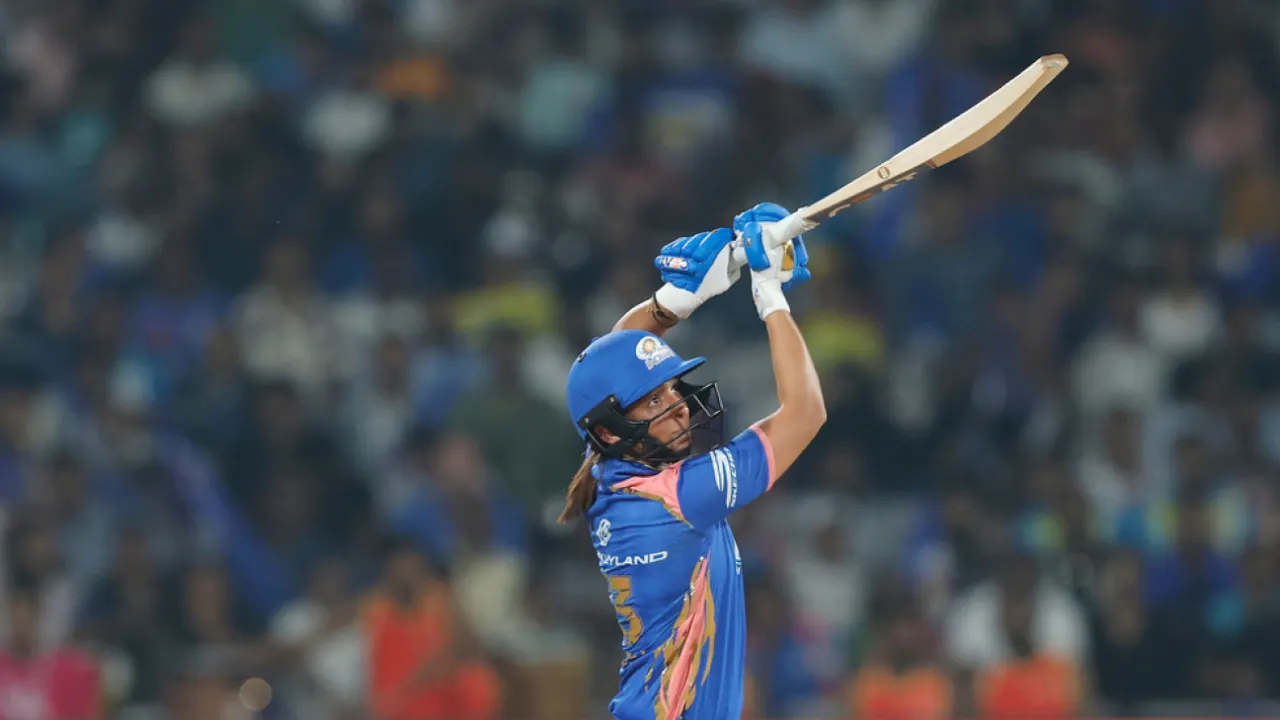
Captain Harmanpreet Kaur’s unbeaten 71 off 43 balls powered Mumbai Indians (MI) to a seven-wicket win over Gujarat Giants [GG], as they chased down 193, the second-highest successful chase in WPL history.
Harmanpreet paced the chase to near perfection, finding support from Amanjot Kaur and Nicola Carey, as MI extended their perfect head-to-head record against Giants to 8-0. MI also maintained their remarkable streak of never losing a WPL match when Harmanpreet scores a fifty, this being the 10th such instance.
Giants began briskly after being put in, with Sophie Devine and Beth Mooney taking on the returning Hayley Matthews for four boundaries in the second over. Devine got an early reprieve, when Shabnim Ismail induced an edge in the opening over and wicketkeeper G Kamalini put down the chance. The miss proved inconsequential as Ismail struck again in the third over, this time having Devine nick behind for 8, with Kamalini holding on.
With Anushka Sharma sidelined through injury, Kanika Ahuja was promoted to No. 3. She ensured the momentum did not dip, getting off the mark with a powerful drive through the covers, and combining with Mooney to inflict damage. After Mooney’s departure, she continued the same alongside Ash Gardner. The pair carried Giants to 99 for 3 at the end of 10th over. Gardner fell in the 10th over and Ahuja followed in the 11th, but Giants had laid a solid platform by then.
MI clawed their way back into the contest after Ahuja’s dismissal. Ayushi Soni, brought in for Anushka, struggled to find fluency, while her partner Georgia Wareham continued to find the gaps regularly. Soni was on 7 off 10 balls at the end of the 16th over when she retired out, becoming the first player in WOL to do so. The move paved the way for Bharti Fulmali, who ensured it paid dividends.
Fulmali survived two lbw appeals in the 17th over from Amanjot, both overturned in her favour. She then launched a late onslaught, taking on Carey with two fours and a six in the 19th, before going even harder in the final over. Fulmali smashed two fours and two sixes off Amanjot as Giants plundered 39 runs across the last two overs, finishing on 192.
Hayley Matthews returned to the top of the order after missing the first two matches with injury. Despite losing her opening partner Kamalini in the third over, she ensured MI made a positive start. However, her stay was short-lived, ending on 22 off 12 balls. That dismissal brought Harmanpreet and Amanjot together, and the pair began to rebuild.
Amanjot soon found her rhythm, unfurling a flurry of boundaries against Wareham and Tanuja Kanwar, while Harmanpreet ticked along at better than run-a-ball through the first 10 overs.
Once set, Amanjot shifted gears, taking on Renuka Singh and Gardner with a series of cleanly struck sixes. The breakthrough for Giants came through Devine, whose slower ball accounted for Amanjot and ended a 72-run partnership.
Harmanpreet, though, remained unfazed and continued to dictate terms, with Carey joining her at a stage when MI required 84 off 48 balls.
Carey swung the momentum decisively in the 16th over, hammering five boundaries off Renuka, who continued to struggle for accuracy. The over slashed the equation to 39 needed off 24 balls.
Harmanpreet soon brought up her half-century off 33 deliveries, and Giants compounded their woes with a series of fielding lapses, putting down three chances of her.
Harmanpreet made them pay, pouncing on the width offered by wayward bowling to keep the chase firmly on track. With four needed off five balls, she sealed the contest by hitting a boundary, through the gap between deep square leg and deep midwicket.
Brief scores:
Mumbai Indians Women 193 for 3 in 19.2 overs (Gunalan Kamalini 13, Hayley Maththews 22, Amanjot Kaur 40, Harmanpreet Kaur 71*, Nicola Carey 38*; Renuka Singh 1-39, Kashvee Gautam 1-33, Sophie Devine 1-29) beat Gujarat Giants Women 192 for 5 in 20 overs (Beth Mooney 33, Kanika Ahuja 35, Ashleigh Gardner 20, Georgia Wareham 43*, Ayushi Sani 11, Bharti Fulmali 36*; Shabnim Ismail 1-25, Hayley Maththews 1-34, Nicola Carey 1-36, Amelia Kerr 1-40 ) by seven wickets
[Cricinfo]

Doctors threaten strike

Chandrasekar alleges extremists in South and North hinder development

Pakistan HC in Colombo hosts special reception in honour of SAARC Woman of the Year Musarrat Misbah

Port City Colombo secures USD 300 mn FDI commitment for Phase II development

NPP’s national electricity policy blatantly unfair: Sajith

MP Amarakeerthi murder verdict to be announced on 11 Feb.

‘Dates have the highest sugar content to fight Coronavirus’

Sunday Island 27 December – Headlines

#SundayIsland 17th December – Headlines

Sunday Island – 28th March

Sunday Island Headlines – 21 March

Sunday Island – 21st February – Headlines
-

 Business4 days ago
Dialog and UnionPay International Join Forces to Elevate Sri Lanka’s Digital Payment Landscape
-
 News4 days ago
Sajith: Ashoka Chakra replaces Dharmachakra in Buddhism textbook
-

 Features4 days ago
The Paradox of Trump Power: Contested Authoritarian at Home, Uncontested Bully Abroad
-

 Features4 days ago
Subject:Whatever happened to (my) three million dollars?
-

 News4 days ago
Level I landslide early warnings issued to the Districts of Badulla, Kandy, Matale and Nuwara-Eliya extended
-

 Business1 day ago
New policy framework for stock market deposits seen as a boon for companies
-

 Opinion6 days ago
The minstrel monk and Rafiki, the old mandrill in The Lion King – II
-

 News4 days ago
65 withdrawn cases re-filed by Govt, PM tells Parliament