
News
Seasonal Swings in Sri Lanka’s Mango Market: A Balancing Act with Economic Insights

By Chandula Idirisinghe
- Sri Lanka’s mango industry, deeply woven into the cultural fabric and dietary needs of Sri Lanka, is thriving with a 12.2% production boost and a 5% yield improvement over the past two decades.
- Yet, the industry is characterized by drastic seasonal price swings. Prices are currently low, and another significant drop is expected between September and January, mirroring last year’s 70% plunge in Karthakolomban mango prices.
- Regional production concentration has led to price disparities nationwide, highlighting the need for better demand and supply management.
- The blog suggests a dynamic, multi-pronged strategy to tackle seasonality over the price disparity based on an IPS study on developing food loss reduction pathways through smart business practices in mango value chains: promoting value-added products, optimizing logistics and storage, forming farmer clusters, and tapping into export markets.
Growth and Distribution of Sri Lanka’s Mango Cultivation
Mango is the most widely cultivated fruit crop after bananas in Sri Lanka. According to the Department of Census and Statistics (2023), the average mango cultivation area over the past five years (2018-2023) has expanded by 6.9%, reaching 28,372 hectares, compared to the 2002-2007 average. Furthermore, national mango fruit production has demonstrated a remarkable rise of 12.2%, with an increase per hectare of mango fruit production by 5% (Figure 1).

Source: Author’s calculations based on DCS (2023)
Sri Lanka boasts a longstanding tradition of mango cultivation. Mangoes are the third-highest consumed fruit in terms of value, following only bananas and papayas. The traditional cultivars ‘Betti’, ‘Karthacolomban’, ‘Vellaicolomban’, ‘Kohu’, and ‘Willard’, and the modern cultivar ‘TomEJC’ have become dominant players within Sri Lankan wholesale/ retail markets.
Over the past two decades, the geographical distribution of mango cultivation has undergone a notable transformation. Nearly two-thirds (65.36%) of mango cultivation in Sri Lanka is currently concentrated in just nine districts. While Kurunegala historically held the dominant position as the leading producer, recent years have witnessed a significant decline in the mango-cultivated areas. Anuradhapura and Monaragala have experienced significant growth, with Anuradhapura surpassing Kurunegala as the current leader in terms of cultivation area.
Witnessing a noteworthy expansion into international markets, fresh mango fruit exports have exhibited a significant upward trajectory since 2017, reaching 374 metric tons by 2022. Dried mango exports followed similar growth, experiencing a notable rise from 2019 to 2021, resulting in 63 metric tons exported in 2022. Despite the recent progress in Sri Lanka’s mango production, fueled by innovative, high-yielding cultivars tailored to specific regions, a persistent challenge remains: the seasonality of production.
The Seasonality Factor and Its Economic Impact
In Sri Lanka, mango production exhibits two distinct production peaks over the year, which pave the way for drastic seasonal price fluctuations. Mango trees in the wet and intermediate zones typically bloom from January to March, with peak harvests from April to July (Yala Season). Conversely, in the dry zone, blooming occurs from July to September, with peak harvests from October to January (Maha season). These regional variations in blooming and harvesting periods are influenced by Sri Lanka’s diverse climatic conditions, primarily by its varying rainfall patterns.
This seasonality creates classic supply and demand imbalances, marked by distinct dual peaks and troughs in prices each year, with the highest fluctuations observed over the past two years (Figure 2). For instance, price data from 2023 shows that even popular cultivars like Karthakolomban can experience significant price drops. During the off-season in September, prices peaked at 252.1 Rs/kg when mangoes were less available. However, by the next peak harvesting time in December, prices had dropped by as much as 70%, reaching 71.2 Rs/kg as the market became saturated with mangoes.
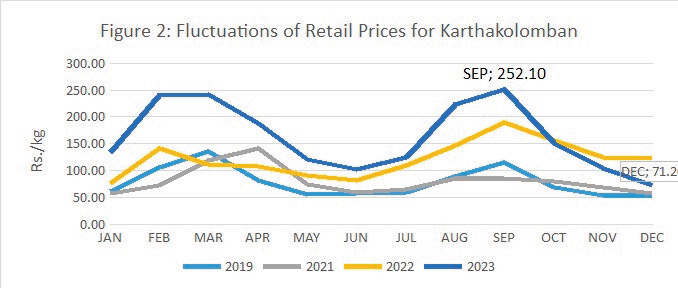
Source: Author’s compilation based on Price data from Hector Kobbekaduwa Agrarian Research and Training Institute (HARTI)
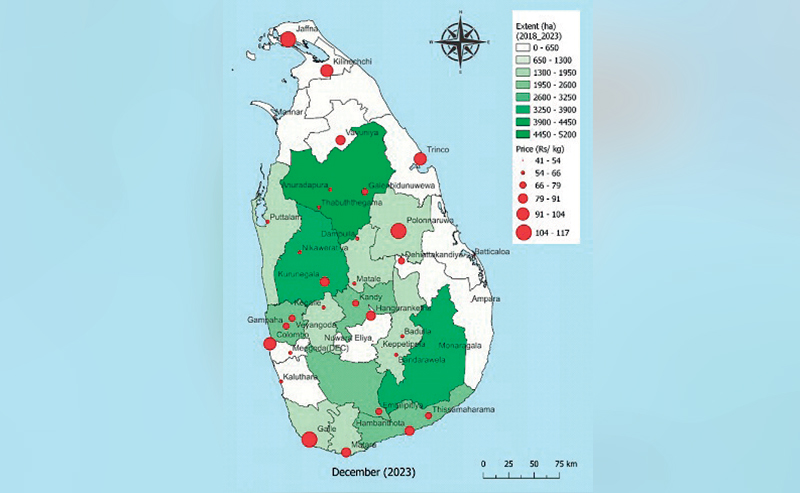
Moreover, Sri Lanka’s mango market shows notable nationwide price disparities – for the same cultivar – alongside seasonal price fluctuations. The mango harvest from wet and intermediate zones saturates their regional markets from April to July, while markets in dry zones are saturated from October to January. Figure 3 illustrates how markets in dry zones are flooded with the harvest, resulting in low mango prices in most dry zone areas and comparatively high prices in wet and intermediate zones.
Figure 3: Fluctuation of Karthakolomban Mango Prices During a Peak Harvest Across the Country (December 2023)
Despite investing in high-yielding cultivars, growers face unpredictable income due to fluctuating market prices, creating financial strain for them. Conversely, on the consumer side, price volatility disrupts purchasing behaviour. During off-seasons, limited availability and high prices can restrict their access to mangoes, particularly for low-income households. This not only impacts dietary choices but also undermines the mango fruit’s role as an affordable source of essential vitamins and minerals.
Way Forward: A Multi-Pronged Approach
A strategic and coordinated approach involving all value chain actors—from growers to consumers—can effectively stabilize price levels, mitigate growers’ financial hardships, and ensure affordable fruit availability year-round.
Rerouting Demand to Value-Added Products: Promoting value-added products such as pulp, jams, dried slices, and chutneys, produced utilizing surplus mango fruit from peak seasons, assists in meeting year-round demand while mitigating heightened demand for fresh mangoes during off-seasons.
Logistics and Distribution Network Optimization: A strengthened distribution network with improved cold chain facilities can mitigate price disparities and ensure nationwide availability of mangoes at fair prices. This involves identifying key production districts, improving infrastructure, streamlining transportation routes, establishing efficient market linkages, and enhancing access to market information. Further, buffer stocking curbs the excessive volatility of prices of fresh mangoes by regulating the gradual movement of fresh mangoes into and out of the markets.
Establishment of Farmer Clusters: Building on a strong foundation, Sri Lanka has already established successful farmer clusters for commercial mango production, such as those under the ‘Nucleus Estates’ initiative by the Agriculture Sector Modernization Project (ASMP) and Lanka Fruit and Vegetable Producers, Processors and Exporters Association (LFVPPEA). Farmer clusters foster sharing knowledge and supply opportunities, and pooling of resources, thereby leveraging growers with economies of scale, amplifying their collective voice, and ensuring a consistent supply.
Untapping Export Potential: Several global markets, like the EU, USA, Middle East, and Australia, hold significant export potential for Sri Lankan mangoes. Meeting their stringent quality standards requires a multi-faceted approach: improving orchard management with Good Agricultural Practices (GAP), Integrated Pest Management (IPM) and training on post-harvest handling and quality control compliance with international regulations. IPS, in collaboration with LFVPPEA, has already supported commercial mango growers in harnessing export potential through training and capacity building under an Australian Centre for International Agricultural Research (ACIAR) project (CS/2020/193).
This blog is based on an ongoing IPS study conducted under the ACIAR-funded project ‘Developing food loss reduction pathways through smart business practices in mango and tomato value chains in Pakistan and Sri Lanka’.
Link to original blog: https://www.ips.lk/talkingeconomics/2024/07/09/seasonal-swings-in-sri-lankas-mango-market-a-balancing-act-with-economic-insights/
Chandula Idirisinghe is a Research Assistant working on Agriculture and Agribusiness Development at the Institute of Policy Studies of Sri Lanka (IPS). He holds a BSc (Hons) in Agricultural Technology and Management, specialising in Applied Economics and Business Management from the Faculty of Agriculture, University of Peradeniya. His research interests include agricultural policies and institutions; agricultural productivity; agribusiness value chains; food security and environmental and natural resource policies.

News
GMOA warns of trade union action unless govt. urgently resolves critical issues in health sector

Influx of substandard drugs is of particular concern
The Government Medical Officers’ Association (GMOA) has warned of renewed and intensified trade union action if the government fails to fulfil its promise to resolve the ongoing crisis in the health sector within the next few days.
GMOA Executive Committee member Dr. Prasad Colombage said his association was hopeful that commitments made by the government, including those formally stated by the Minister of Health in Parliament and recorded in the Hansard, would be implemented.
He called for urgent remedial action in view of the influx of substandard medicines into the country, patient deaths linked to such drugs, difficulties faced by doctors in prescribing medicines, and disruptions to patient care services caused by the continued migration of medical professionals. These factors, he warned, had placed patients’ lives at serious risk.
Dr. Colombage said discussions had already been held with all relevant authorities, including the President and the Minister of Health. He expressed hope that swift solutions would be forthcoming based on agreements reached at discussions. However, he cautioned that the GMOA would not hesitate to resort to strong trade union action if tangible progress was not seen in the coming days.
Meanwhile, the Federation of Medical and Civil Rights Professional Associations yesterday (01) handed over a special memorandum to President Anura Kumara Dissanayake, calling for immediate action to resolve the deepening crisis in the health sector.
Federation President, Consultant Dr. Chamal Sanjeewa, said Sri Lanka’s health system was currently facing a severe crisis and had sought an opportunity to hold discussions with the President on the matter.
The memorandum calls for the President’s direct and immediate intervention on several key issues, including the Indo–Sri Lanka health agreement, shortages of essential medicines including cancer drugs, continued allegations surrounding the administration of the Ministry of Health, reported irregularities at the National Hospital, Colombo, and the absence of an internationally accredited quality control laboratory for the National Medicines Regulatory Authority to test medicines. The Federation has also requested a meeting with the President to discuss these concerns in detail.
By Sujeewa Thathsara ✍️

Sri Lanka’s latest elephant census must result in immediate policy action, not remain a paper exercise, Centre for Environmental Justice (CEJ) Managing Director Dilena Pathragoda warned, as nearly 400 wild elephants have already died in 2025 alone amid escalating human–elephant conflict.
With the national elephant population estimated at around 5,879, Pathragoda said the figures would be meaningless unless they shape land-use planning, habitat protection and enforcement.
“As of mid-December, close to 397 elephants have died in 2025, mostly due to shootings, electrocution, train collisions and other human-related causes,” he told The Island. “When deaths continue at this scale, census numbers alone offer little reassurance.”
Official data show that 388 elephants died in 2024, while 2023 recorded a staggering 488 deaths, one of the highest annual tolls on record. Conservationists warn that the trend reflects systemic failure to secure habitats and elephant corridors, despite repeated warnings.
“An elephant census should not end with a headline figure,” Pathragoda said. “If these statistics do not influence development approvals, infrastructure planning and land-use decisions, they fail both elephants and rural communities.”
Elephant populations remain unevenly distributed, with higher densities in the Mahaweli, Eastern and North Western regions, while other areas face sharp declines driven by habitat fragmentation and unplanned development.
Pathragoda said recurring fatalities from gunshots, illegal electric fences, improvised explosive devices along with poisonings and rail collisions expose the limits of short-term mitigation measures, including ad hoc fencing projects.
“The crisis is not a lack of data, but a lack of political will,” he said, calling for binding conservation policy, transparent environmental assessments and accountability at the highest level.
He urged authorities to treat elephant conservation as a national governance issue, warning that failure to act would only see future censuses record further decline of these majestic animals.
“Elephants are part of Sri Lanka’s natural heritage and economy,” Pathragoda said. “Ignoring these warning signs will come at an irreversible cost.”
By Ifham Nizam ✍️

The Ministry of Education has yet to clarify whether school hours will be extended by 30 minutes from next Monday (05) under the proposed new education reforms, Ceylon Teachers’ Union (CTU) General Secretary Joseph Stalin has said.
Stalin told The Island that the Ministry should reconsider the planned reforms, warning that decisions taken without adequate study and consultation could have serious repercussions for nearly four million schoolchildren.
He said the Education Ministry had announced that education reforms would be implemented in Grades from 1 to Grade 6, but it had not said anything about the Grades above 6. This lack of clarity, he said, had created confusion among teachers, parents and students.
Stalin also noted that although learning modules had been issued, students are required to obtain photocopies based on the codes introduced in these modules. However, the Ministry had not revealed who would bear the additional financial burden arising from those costs, raising further concerns over the practical implementation of the reforms.
by Chaminda Silva ✍️

Over 400,000 Russians killed, wounded for 0.8 percent of Ukraine in 2025

SCG curator ‘really happy’ with pitch for final Ashes Test

Showery condition is expected to enhance in the Eastern, Northern and Uva provinces during the coming days, due to the development of a low-level atmospheric disturbance to the East of Sri Lanka

GMOA warns of trade union action unless govt. urgently resolves critical issues in health sector

Elephant census urged as death toll nears 400

CTU raises questions about education reforms

‘Dates have the highest sugar content to fight Coronavirus’

Sunday Island 27 December – Headlines

#SundayIsland 17th December – Headlines

Sunday Island – 28th March

Sunday Island Headlines – 21 March

Sunday Island – 21st February – Headlines
-

 Sports5 days ago
Gurusinha’s Boxing Day hundred celebrated in Melbourne
-

 News3 days ago
Leading the Nation’s Connectivity Recovery Amid Unprecedented Challenges
-

 Sports6 days ago
Time to close the Dickwella chapter
-

 Features4 days ago
It’s all over for Maxi Rozairo
-

 News6 days ago
Environmentalists warn Sri Lanka’s ecological safeguards are failing
-

 News4 days ago
Dr. Bellana: “I was removed as NHSL Deputy Director for exposing Rs. 900 mn fraud”
-

 News3 days ago
Dons on warpath over alleged undue interference in university governance
-

 Features6 days ago
Digambaram draws a broad brush canvas of SL’s existing political situation