
Latest News
Scientists find ‘strongest evidence yet’ of life on distant planet


Scientists have found new but tentative evidence that a faraway world orbiting another star may be home to life.
A Cambridge team studying the atmosphere of a planet called K2-18b has detected signs of molecules which on Earth are only produced by simple organisms.
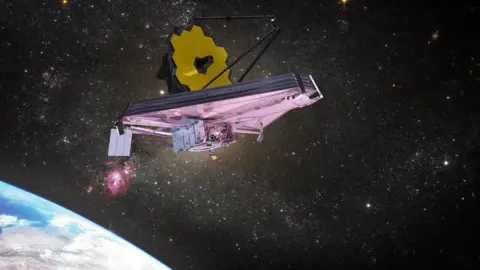
This is the second, and more promising, time chemicals associated with life have been detected in the planet’s atmosphere by Nasa’s James Webb Space Telescope (JWST).
But the team and independent astronomers stress that more data is needed to confirm these results.
The lead researcher, Prof Nikku Madhusudhan, speaking at his lab at Cambridge University’s Institute of Astronomy said that he hopes to obtain the clinching evidence soon.
“This is the strongest evidence yet there is possibly life out there. I can realistically say that we can confirm this signal within one to two years.”
K2-18b is two-and-a-half times the size of Earth and is 700 trillion miles, or 124 light years, away from us – a distance far beyond what any human could travel in a lifetime.
JWST is so powerful that it can analyse the chemical composition of the planet’s atmosphere from the light that passes through from the small red Sun it orbits.
The Cambridge group has found that the atmosphere seems to contain the chemical signature of at least one of two molecules that are associated with life: dimethyl sulphide (DMS) and dimethyl disulphide (DMDS). On Earth, these gases are produced by marine phytoplankton and bacteria.
Prof Madhusudhan said he was surprised by how much gas was apparently detected during a single observation window. “The amount we estimate of this gas in the atmosphere is thousands of times higher than what we have on Earth,” he said. “So, if the association with life is real, then this planet will be teeming with life,” he added.
Prof Madhusudhan went further: “If we confirm that there is life on K2-18b, it should basically confirm that life is very common in the galaxy.”
He told BBC Radio 5Live on Thursday: “This is a very important moment in science, but also very important to us as a species. “If there is one example, and the universe being infinite, there is a chance for life on many more planets.”
Dr Subir Sarkar, a lecturer in astrophysics at Cardiff University and part of the research team, said the research suggests K2-18b could have an ocean which could be potentially full of life – though he cautioned scientists “don’t know for sure”.
He added that the research team’s work will continue to focus on looking for life on other planets: “Keep watching this space.”
There are lots of “ifs” and “buts” at this stage, as Prof Madhusudhan’s team freely admits.
Firstly, this latest detection is not at the standard required to claim a discovery.
For that, the researchers need to be about 99.99999% sure that their results are correct and not a fluke reading. In scientific jargon, that is a five sigma result.
These latest results are only three sigma, or 99.7%. Which sounds like a lot, but it is not enough to convince the scientific community. However it is much more than the one sigma result 0f 68% the team obtained 18 months ago. which was greeted with much skepticism at the time.
But even if the Cambridge team obtains a five sigma result, that won’t be conclusive proof that life exists on the planet, according to Prof Catherine Heymans of Edinburgh University and Scotland’s Astronomer Royal, who is independent of the research team.
“Even with that certainty, there is still the question of what is the origin of this gas,” she told BBC News.
“On Earth it is produced by microorganisms in the ocean, but even with perfect data we can’t say for sure that this is of a biological origin on an alien world because loads of strange things happen in the Universe and we don’t know what other geological activity could be happening on this planet that might produce the molecules.”
That view is one the Cambridge team agree with. They are working with other groups to see if DMS and DMDS can be produced by non-living means in the lab.
“There is still a 0.3% chance that it might be a statistical fluke,” Prof Madhusudhan said.
Suggesting life may exist on another planet was “a big claim if true”, he told BBC Radio 4’s Today programme, adding: “So we want to be really, really thorough, and make more observations, and get the evidence to the level that there is less than a one-in-a-million chance of it being a fluke.”
He said this should be possible in “maybe one or two years”.
Other research groups have put forward alternative, lifeless, explanations for the data obtained from K2-18b. There is a strong scientific debate not only about whether DMS and DMDS are present but also the planet’s composition.
The reason many researchers infer that the planet has a vast liquid ocean is the absence of the gas ammonia in K2-18b’s atmosphere. Their theory is that the ammonia is absorbed by a vast body of water below.
But it could equally be explained by an ocean of molten rock, which would preclude life, according to Prof Oliver Shorttle of Cambridge University.
“Everything we know about planets orbiting other stars comes from the tiny amounts of light that glance off their atmospheres. So it is an incredibly tenuous signal that we are having to read, not only for signs of life, but everything else,” he said.
“With K2-18b part of the scientific debate is still about the structure of the planet.”
Dr Nicolas Wogan at Nasa’s Ames Research Center has yet another interpretation of the data. He published research suggesting that K2-18b is a mini gas giant with no surface.
Both these alternative interpretations have also been challenged by other groups on the grounds that they are inconsistent with the data from JWST, compounding the strong scientific debate surrounding K2-18b.
Prof Chris Lintott, presenter of the BBC’s The Sky at Night, said he had “great admiration” for Prof Madhusudhan’s team, but was treating the research with caution.
“I think we’ve got to be very careful about claiming that this is ‘a moment’ on the search to life. We’ve [had] such moments before,” he told Today.
He said the research should be seen instead as “part of a huge effort to try and understand what’s out there in the cosmos”.
Prof Madhusudhan acknowledges that there is still a scientific mountain to climb if he is to answer one of the biggest questions in science. But he believes he and his team are on the right track.
“Decades from now, we may look back at this point in time and recognise it was when the living universe came within reach,” he said.
“This could be the tipping point, where suddenly the fundamental question of whether we’re alone in the universe is one we’re capable of answering.”
The research has been published in The Astrophysical Journal Letters.
[BBC]

Latest News
Heat Index likely to increase up to ‘Caution level’ at some places in the Western, Sabaragamuwa, Southern, North-western, Northern and North- central provinces and in Monaragala district
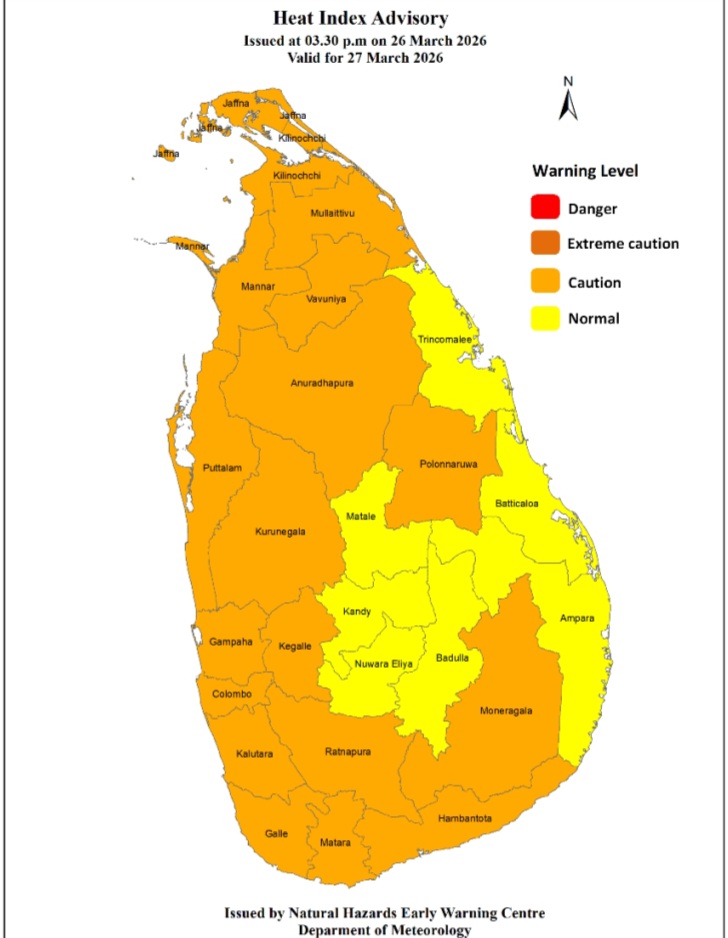
Warm Weather Advisory
Issued by the Natural Hazards Early Warning Centre of the Department of Meteorology
Issued at 3.30 p.m. on 26 March 2026, valid for 27 March 2026.
Thw Heat index, the temperature felt on human body is likely to increase up to ‘Caution level’ at some places in the Western, Sabaragamuwa, Southern, North-western, Northern and North-
central provinces and in Monaragala district.
The Heat Index Forecast is calculated by using relative humidity and maximum temperature and this is the condition that is felt on your body. This is not the forecast of maximum
temperature. It is generated by the Department of Meteorology for the next day period and prepared by using global numerical weather prediction model data.

Effect of the heat index on human body is mentioned in the above table and it is prepared on the advice of the Ministry of Health and Indigenous Medical Services.
ACTION REQUIRED
Job sites: Stay hydrated and takes breaks in the shade as often as possible.
Indoors: Check up on the elderly and the sick.
Vehicles: Never leave children unattended.
Outdoors: Limit strenuous outdoor activities, find shade and stay hydrated.
Dress: Wear lightweight and white or light-colored clothing.
Note:
In addition, please refer to advisories issued by the Disaster Preparedness & Response Division, Ministry of Health in this regard as well. For further clarifications please contact 011-7446491
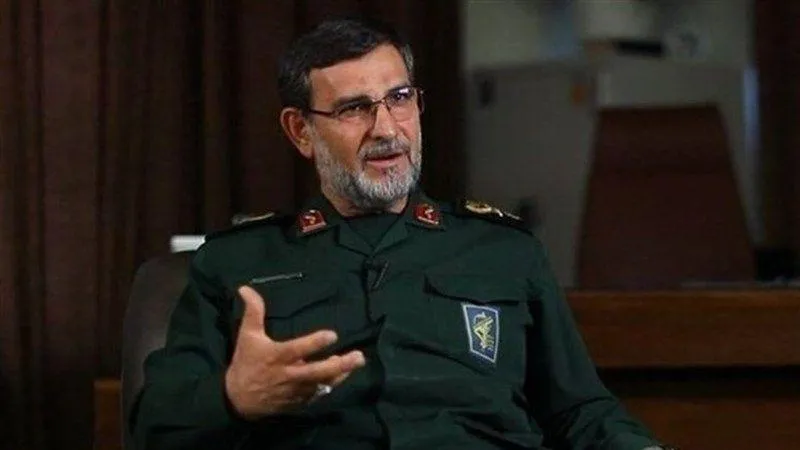
Israel says it has killed the Iranian navy chief overseeing what is a near-total blockade of the Strait of Hormuz.
Alireza Tangsiri, head of the Islamic Revolutionary Guards Corps (IRGC) navy, was “directly responsible for the terrorist act of bombing and blocking the Strait of Hormuz”, and has been “blown up”, according to Israel’s defence minister Israel Katz.
He added that a number of other “senior Navy command officials” have also been killed. Iran has not yet commented.
Since the start of the war on 28 February, Israel has assassinated several top Iranian officials, including Supreme Leader Ayatollah Ali Khamenei and security chief Ali Larijani.
Effectively blockading the Strait of Hormuz – the thin waterway between Iran, the United Arab Emirates (UAE) and Oman, through which around 20% of the world’s oil and liquefied natural gas normally passes – has been a key pillar of Iran’s strategy in the war.
Oil prices have consequently shot up, placing a direct price of the war on consumers in not only the US and Israel but across the world.
In recent weeks, an X account attributed to Tangsiri and cited by Iranian media has posted frequently about the Hormuz blockade, writing that “no vessel associated with the aggressors against Iran has the right to pass through”.
Tangsiri was appointed as the commander of the Navy in 2018, having previously served as deputy commander since 2010. In 2019, he was sanctioned by the US Treasury along with other IRGC commanders after Iran shot down a US surveillance drone near the strait.
Israeli Prime Minister Benjamin Netanyahu described Tangsiri as an individual with “a great deal of blood on his hands” and said his assassination was “yet another example of the co-operation between us and our friend, the United States, toward the common goal of achieving the objectives of the war”.
US Central Command said in a statement Tangsiri’s death “makes the region safer” and that the IRGC’s navy “is on an irreversible decline”. It also called on serving members of the IRGC to abandon their posts and return home “to avoid further risk of unnecessary injury or death”.
Israel’s military said in a statement posted on X that the head of the IRGC Navy’s intelligence directorate, Behnam Rezaei, was also “eliminated”.
(BBC)
Latest News
A strong Technical and Vocational Education and Training (TVET) system equips individuals with practical, relevant, and future-oriented skills helping to innovate responsibly towards a greener and sustainable future – PM
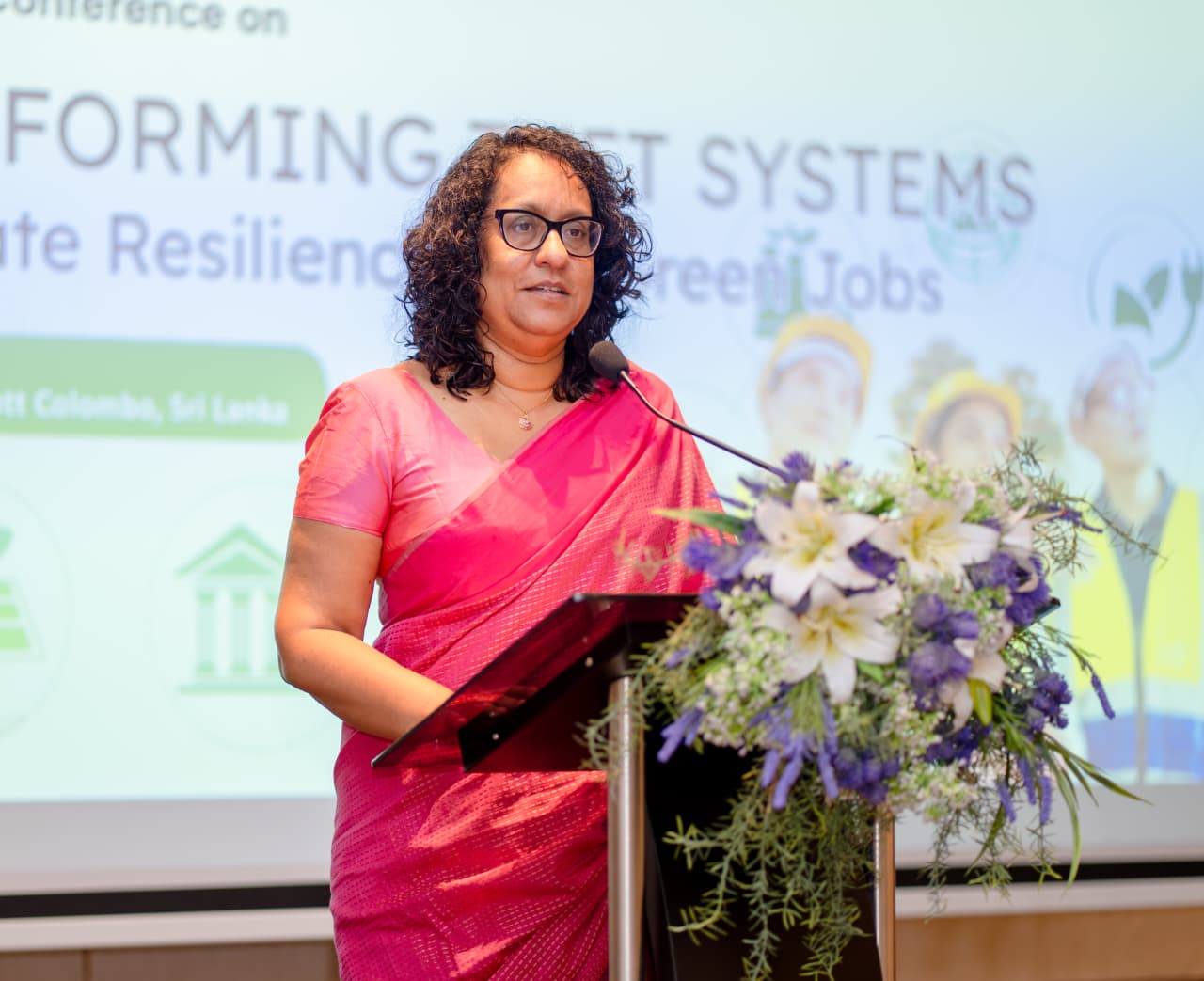
The Prime Minister, Minister of Education, Higher Education and Vocational Education Dr. Harini Amarasuriya participated as the Chief Guest in the international conference on ’Transforming TVET Systems for climate resilience and green jobs’ organized by Colombo Plan Staff College, Philippines together with the Ministry of Education, Higher Education and Vocational Education Sri Lanka on 24 th of March at Courtyard by Marriott Colombo, Sri Lanka.
The Conference serves as the flagship event of the five-day Regional Programme on “Transforming TVET for a Digital, Green, and Inclusive Economy” (23-27 March 2026), which continues throughout the week, bringing together representatives from CPSC member countries including Bhutan, Fiji, Malaysia, Maldives, Myanmar, Nepal, Philippines, Thailand, Pakistan, and Sri Lanka, fostering high-level dialogue and knowledge sharing on climate-resilient and green skills development.
The Conference features technical and plenary sessions on climate-responsive TVET systems, green skills development, national policy frameworks, and emerging technologies shaping industry transformation.
Addressing at the event, the Prime Minister emphasized the role of Technical and Vocational Education and Training (TVET) that equips individuals with practical, relevant, and future-oriented skills in addressing climate change and shaping a sustainable future.
The Prime Minister reaffirmed that this transformation remains a national priority for Sri Lanka. She stressed that education must go beyond knowledge dissemination to empower individuals with opportunities, dignity, and the capacity to contribute meaningfully to society.
She further emphasized the need to integrate environmental sustainability into education and training systems by embedding green skills in curricula, investing in modern training facilities, promoting innovation, and fostering collaboration between training institutions and emerging green industries.
Highlighting the importance of ensuring equity the Prime Minister further stated, that opportunities arising from the green transition must be accessible to all, including youth, young women, people with special needs, and marginalized communities.
Reaffirming Sri Lanka’s commitment to working closely with regional and international partnerships, the Prime Minister emphasized the importance of transforming them to actual benefits and partnerships.
The occasion was attended by the Secretary to the Ministry of Education, Higher Education and Vocational Education Nalaka Kaluwewa, Additional Secretary (Vocational Training) Ms. Samanthi Senanayake Director General Colombo Plan Staff College Prof. Dr. Suresh K. Dhameja , TVET administrators, institutional leaders, policymakers, instructors, industry representatives, and international delegates from across the region and seniors officials and officials from Ministries.
(Prime Minister’s Media division)

Showers may occur at a few places in the Sabaragamuwa province and in Galle, Matara, Kalutara and Nuwara-Eliya districts in the evening

Energy Minister indicted on corruption charges ahead of no-faith motion against him

Over 1000 complaints of misuse of QR quotas

Fuel bowser operators demand 25% hike in haulage charges

Charge sheet issued against former NIE Director for contempt of court

Sallay sent back to CID after being discharged from National Hospital

‘Dates have the highest sugar content to fight Coronavirus’

Sunday Island 27 December – Headlines

#SundayIsland 17th December – Headlines

Sunday Island – 28th March

Sunday Island Headlines – 21 March

Sunday Island – 21st February – Headlines
-

 News2 days ago
Senior citizens above 70 years to receive March allowances on Thursday (26)
-

 Features4 days ago
Trincomalee oil tank farm: An engineering marvel
-

 Business1 day ago
Dialog Unveils Dialog Play Mini with Netflix and Apple TV
-

 Features4 days ago
The scientist who was finally heard
-

 News1 day ago
US dodges question on AKD’s claim SL denied permission for military aircraft to land
-

 News2 days ago
Japanese boost to Sri J’pura Hospital, an outright gift from Tokyo during JRJ rule
-

 News2 days ago
CEB Engineers warn public to be prepared for power cuts after New Year
-

 News6 days ago
Colombo, Oslo steps up efforts to strengthen bilateral cooperation in key environmental priority areas