
Features
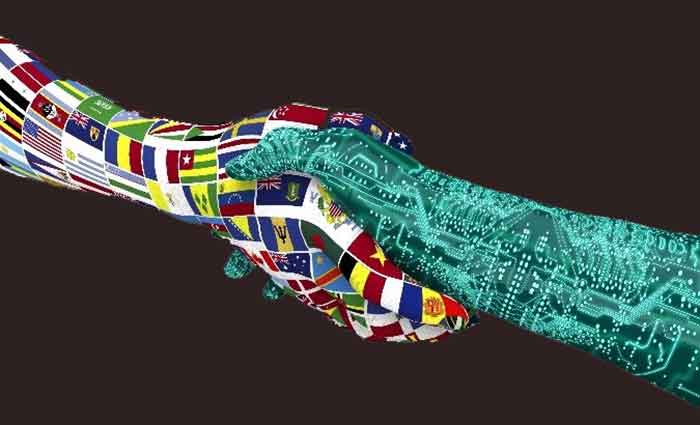
Science Diplomacy as a powerful tool for national unity and friendship among nations – I

By EMERITUS PROFESSOR RANJITH SENARATNE,
Chairman, National Science Foundation and former General President,
Sri Lanka Association for the Advancement of Science
The global order in a state of flux
Rapid economic and political changes in emerging economies and developing countries have an impact on the existing world order that is gradually moving from a Western-centred international system to a multi-centred one. Some lesser powers that were previously on the periphery of international politics now seek to gain more power and build international reputations.
They deploy various tools, including diplomatic ones, that were not available or not applicable before. However, this cannot happen immediately as the traditional great powers continue to try to maintain their leadership. Therefore, it is crucially important to understand how the rise of emerging and developing countries of the Global South may shape and influence the world order.
With many regional powers emerging on the canvas of international politics, there is growing importance of middle powers, from Turkey and Brazil to South Korea and Australia. Today, the middle powers are significantly more influential than they once were. The resulting multipolar systems are often unbalanced, with two or three big powers and several middle powers all jockeying for position. Here Science Diplomacy becomes a critically important tool for the decision-makers to navigate world politics.
Emergence of alliances and regional groups and game-changing initiatives
Since 1945 a proliferation of regional organizations has been one of the most significant developments in the realm of contemporary international relations. Regional organizations could play a significant role in shaping the global political landscape, enabling nations to collaborate and address common challenges and issues collectively and effectively. South Asian Association for Regional Cooperation (SAARC), Association of Southeast Asian Nations (ASEAN), The Bay of Bengal Initiative for Multi-Sectoral Technical and Economic Cooperation (BIMSTEC) and Indian Ocean Rim Association (IORA) are some of the key regional organizations of significance.
In addition, BRICS, developing economies, emerging economies and the Global South are some of the other alliances or groups that will affect the balance of power between global powers. Emerging powers feel that they are insufficiently represented on the global agenda and are demanding a greater voice in international affairs; they have become increasingly assertive in their demands that they should have a place at the table where matters affecting the world are discussed and decisions are made. Their demands are based on their growing economic and political significance and clout at regional, continental and global levels.
In addition, the Belt and Road Initiative (BRI). unveiled by China in 2013. is an ambitious effort to deepen regional cooperation and improve connectivity on a trans-continental scale. While the scope of the initiative is still taking shape, the BRI consists primarily of the Silk Road Economic Belt, linking China to Central and South Asia and onwards to Europe, and the New Maritime Silk Road, linking China to the nations of South East Asia, the Gulf countries, North Africa, and on to Europe.
Six other economic corridors have been identified to link other countries to the Belt and the Road. As of August 2023, 155 countries have been listed as having signed up to the BRI. The participating countries include almost 75% of the world’s population and account for more than half of the world’s GDP, so that the BRI will have far-reaching impacts and ramifications, opening up a host of new opportunities, as well as challenges in the global landscape. Amidst these dynamics, the global economic centre of gravity is shifting from N. America towards Asia again, and this will also create reverberations across the world.
Complex global challenges demand a transdisciplinary and transnational systems approach
Today, the world must come to grips with a myriad of formidable challenges and threats such, as climate change, poverty, disaster vulnerability, glaring inequalities, food, water, energy and cyber insecurity, pollution and use of marine resources and air space to name, but a few. They are complex, multi-faceted and multi-dimensional, and thus cannot be addressed effectively through mono-disciplinary interventions. Tackling them demands an interdisciplinary, transdisciplinary, multi-sectoral and transnational systems approach where cooperation between specialists with diverse backgrounds in both the natural and social sciences across territorial boundaries and community engagement are imperative.
Besides, there is growing recognition that new approaches and different types of expertise are needed to renew science. Therefore, in a globalized environment, no country can be independent of or insulated from what is happening elsewhere; all countries have become interdependent and interconnected. This is sadly evident from the current conflicts between Russia and Ukraine and Israel and Palestine.
They affect not only Europe and West Asia, but the whole world as countries are connected by innumerable supply chains and value chains that account for about 70% of international trade. Hence, the need of the hour is to accept and recognize the oneness of humanity and all nations ought to work in unison so as to achieve the 17 SDGs by sharing their knowledge, experience and expertise for the benefit of humanity.
Relevance of Science Diplomacy in a fractured, turbulent and conflict-ridden world
Unlike in some other fields, in the case of scientific endeavours, nations must set aside political and other differences and collaborate to advance the best interests of their citizens. Even countries outside the diplomatic mainstream could play new and significant roles in world affairs through the efforts of their scientists even when they come from adversarial nations. This is imperative as the effectiveness of hard, soft and smart power has been waning in the recent past.
Therefore, the time is ripe for Science Diplomacy (SD) as practically every major issue, whether global or national in scale, features S&T either as a factor in understanding the underlying cause of the issue or in contributing to its remedy. In addition, the relevance and potential applications of SD are progressively increasing as the world is becoming multipolar, with alliances being formed around specific interests and issues.
Though SD is not new, it has never been more important than now. Many of the defining challenges of the 21st century — from climate change and food security, to poverty reduction and nuclear disarmament — have scientific dimensions. No one country will be able to solve these problems on its own. The tools, techniques and tactics of foreign policy need to adapt to a world of increasing scientific and technical complexity.
There is no unified definition for SD, but it can be defined as a set of policies and practices that combines foreign policy and science, and which provides conditions for transnational cooperation in science and mobilization of resources, bringing scientists from around the world closer together. Thus, a SD framework may lead to more equitable and sustainable collaboration between the North and the South, but it is no panacea for all the issues encountered in transnational collaboration.
SD was described at the turn of this millennium as a set of practices by which the work of diplomats and foreign ministries come into contact with that of researchers through various initiatives such as intergovernmental S&T cooperation agreements, the integration of scientific expertise into international negotiations, and the use of S&T achievements to improve the image and positioning of the nations in the world, especially though the use of the soft power of science. Diplomacy and SD can be synergistic and S&T, being the backbone of all developed economies, has a great potential to be used as a smart diplomatic resource which can open up new diplomatic frontiers.
SD can, therefore, be conceptualized as the set of practices at the intersection of science and foreign policy to advance national interests and address global challenges. It could also be used to promote social cohesion, ethnic harmony and national unity. It does not exist in a vacuum, but is embodied in the foreign policy-making and behaviour of national, sovereign states. In order for the S&T diplomacy in foreign relations to be effective, it should have the following three basic elements:
It should be of mutual benefit leading to a win-win situation for the parties involved
There should be synergistic effect between diplomacy and science diplomacy.
Where possible, the more powerful partner should support the foundation of S&T though overseas development assistance.
Effective science advice is not possible unless there is a strong independent science base that government advisers can call on. And it is not just academics that are needed—often, the expertise lies in industry or in government laboratories. Scientific advice should be published so that the public and the scientific community can provide constructive critique. This is, ultimately, the very way in which science progresses.
Scientific advice is unlikely to be effective if governments lack scientists. This absence often means that there are not effective mechanisms to absorb recommendations and evaluate policy implications. The lack of scientifically trained individuals in government is striking. Attracting more scientists into government will require new approaches to recruitment and training.
Top-notch scientists with roots in the community will be effective in S&T diplomacy. However, many of our overseas missions do not have a science attaché. While sending competent science attachés to relevant foreign missions, it is necessary to interact with the science attachés of other foreign missions in the country. Vaughn Turekian, Director, Center for Science Diplomacy, AAAS (2010) said that SD could serve as the “pilot light” of international relationships, a light that would keep burning after all other avenues were extinguished.
(To be continued)
(This article is based on the address delivered at the inaugural ceremony of the annual sessions of the Sri Lanka Association for the Advancement of Science as its General President in 2023)

iyadasa Advisor to the Ministry of Science & Technology and a Board of Directors of Sri Lanka Atomic Energy Regulatory Council A value chain management consultant to www.vivonta.lk
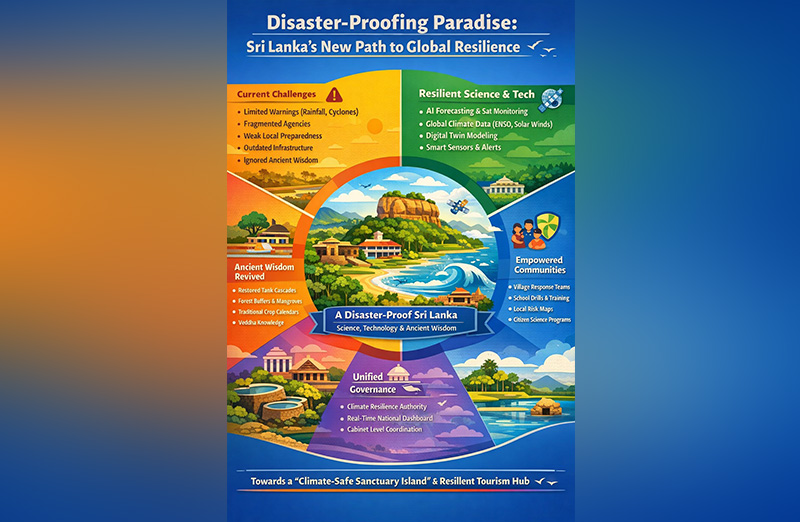
As climate shocks multiply worldwide from unseasonal droughts and flash floods to cyclones that now carry unpredictable fury Sri Lanka, long known for its lush biodiversity and heritage, stands at a crossroads. We can either remain locked in a reactive cycle of warnings and recovery, or boldly transform into the world’s first disaster-proof tropical nation — a secure haven for citizens and a trusted destination for global travelers.
The Presidential declaration to transition within one year from a limited, rainfall-and-cyclone-dependent warning system to a full-spectrum, science-enabled resilience model is not only historic — it’s urgent. This policy shift marks the beginning of a new era: one where nature, technology, ancient wisdom, and community preparedness work in harmony to protect every Sri Lankan village and every visiting tourist.
The Current System’s Fatal Gaps
Today, Sri Lanka’s disaster management system is dangerously underpowered for the accelerating climate era. Our primary reliance is on monsoon rainfall tracking and cyclone alerts — helpful, but inadequate in the face of multi-hazard threats such as flash floods, landslides, droughts, lightning storms, and urban inundation.
Institutions are fragmented; responsibilities crisscross between agencies, often with unclear mandates and slow decision cycles. Community-level preparedness is minimal — nearly half of households lack basic knowledge on what to do when a disaster strikes. Infrastructure in key regions is outdated, with urban drains, tank sluices, and bunds built for rainfall patterns of the 1960s, not today’s intense cloudbursts or sea-level rise.
Critically, Sri Lanka is not yet integrated with global planetary systems — solar winds, El Niño cycles, Indian Ocean Dipole shifts — despite clear evidence that these invisible climate forces shape our rainfall, storm intensity, and drought rhythms. Worse, we have lost touch with our ancestral systems of environmental management — from tank cascades to forest sanctuaries — that sustained this island for over two millennia.
This system, in short, is outdated, siloed, and reactive. And it must change.
A New Vision for Disaster-Proof Sri Lanka
Under the new policy shift, Sri Lanka will adopt a complete resilience architecture that transforms climate disaster prevention into a national development strategy. This system rests on five interlinked pillars:
Science and Predictive Intelligence
We will move beyond surface-level forecasting. A new national climate intelligence platform will integrate:
AI-driven pattern recognition of rainfall and flood events
Global data from solar activity, ocean oscillations (ENSO, MJO, IOD)
High-resolution digital twins of floodplains and cities
Real-time satellite feeds on cyclone trajectory and ocean heat
The adverse impacts of global warming—such as sea-level rise, the proliferation of pests and diseases affecting human health and food production, and the change of functionality of chlorophyll—must be systematically captured, rigorously analysed, and addressed through proactive, advance decision-making.
This fusion of local and global data will allow days to weeks of anticipatory action, rather than hours of late alerts.
Advanced Technology and Early Warning Infrastructure
Cell-broadcast alerts in all three national languages, expanded weather radar, flood-sensing drones, and tsunami-resilient siren networks will be deployed. Community-level sensors in key river basins and tanks will monitor and report in real-time. Infrastructure projects will now embed climate-risk metrics — from cyclone-proof buildings to sea-level-ready roads.
Governance Overhaul
A new centralised authority — Sri Lanka Climate & Earth Systems Resilience Authority — will consolidate environmental, meteorological, Geological, hydrological, and disaster functions. It will report directly to the Cabinet with a real-time national dashboard. District Disaster Units will be upgraded with GN-level digital coordination. Climate literacy will be declared a national priority.
People Power and Community Preparedness
We will train 25,000 village-level disaster wardens and first responders. Schools will run annual drills for floods, cyclones, tsunamis and landslides. Every community will map its local hazard zones and co-create its own resilience plan. A national climate citizenship programme will reward youth and civil organisations contributing to early warning systems, reforestation (riverbank, slopy land and catchment areas) , or tech solutions.
Reviving Ancient Ecological Wisdom
Sri Lanka’s ancestors engineered tank cascades that regulated floods, stored water, and cooled microclimates. Forest belts protected valleys; sacred groves were biodiversity reservoirs. This policy revives those systems:
Restoring 10,000 hectares of tank ecosystems
Conserving coastal mangroves and reintroducing stone spillways
Integrating traditional seasonal calendars with AI forecasts
Recognising Vedda knowledge of climate shifts as part of national risk strategy
Our past and future must align, or both will be lost.
A Global Destination for Resilient Tourism
Climate-conscious travelers increasingly seek safe, secure, and sustainable destinations. Under this policy, Sri Lanka will position itself as the world’s first “climate-safe sanctuary island” — a place where:
Resorts are cyclone- and tsunami-resilient
Tourists receive live hazard updates via mobile apps
World Heritage Sites are protected by environmental buffers
Visitors can witness tank restoration, ancient climate engineering, and modern AI in action
Sri Lanka will invite scientists, startups, and resilience investors to join our innovation ecosystem — building eco-tourism that’s disaster-proof by design.
Resilience as a National Identity
This shift is not just about floods or cyclones. It is about redefining our identity. To be Sri Lankan must mean to live in harmony with nature and to be ready for its changes. Our ancestors did it. The science now supports it. The time has come.
Let us turn Sri Lanka into the world’s first climate-resilient heritage island — where ancient wisdom meets cutting-edge science, and every citizen stands protected under one shield: a disaster-proof nation.

Why is national identity so important for a people? AI provides us with an answer worth understanding critically (Caveat: Even AI wisdom should be subjected to the Buddha’s advice to the young Kalamas):
‘A strong sense of identity is crucial for a people as it fosters belonging, builds self-worth, guides behaviour, and provides resilience, allowing individuals to feel connected, make meaningful choices aligned with their values, and maintain mental well-being even amidst societal changes or challenges, acting as a foundation for individual and collective strength. It defines “who we are” culturally and personally, driving shared narratives, pride, political action, and healthier relationships by grounding people in common values, traditions, and a sense of purpose.’
Ethnic Sinhalese who form about 75% of the Sri Lankan population have such a unique identity secured by the binding medium of their Buddhist faith. It is significant that 93% of them still remain Buddhist (according to 2024 statistics/wikipedia), professing Theravada Buddhism, after four and a half centuries of coercive Christianising European occupation that ended in 1948. The Sinhalese are a unique ancient island people with a 2500 year long recorded history, their own language and country, and their deeply evolved Buddhist cultural identity.
Buddhism can be defined, rather paradoxically, as a non-religious religion, an eminently practical ethical-philosophy based on mind cultivation, wisdom and universal compassion. It is an ethico-spiritual value system that prioritises human reason and unaided (i.e., unassisted by any divine or supernatural intervention) escape from suffering through self-realisation. Sri Lanka’s benignly dominant Buddhist socio-cultural background naturally allows unrestricted freedom of religion, belief or non-belief for all its citizens, and makes the country a safe spiritual haven for them. The island’s Buddha Sasana (Dispensation of the Buddha) is the inalienable civilisational treasure that our ancestors of two and a half millennia have bequeathed to us. It is this enduring basis of our identity as a nation which bestows on us the personal and societal benefits of inestimable value mentioned in the AI summary given at the beginning of this essay.
It was this inherent national identity that the Sri Lankan contestant at the 72nd Miss World 2025 pageant held in Hyderabad, India, in May last year, Anudi Gunasekera, proudly showcased before the world, during her initial self-introduction. She started off with a verse from the Dhammapada (a Pali Buddhist text), which she explained as meaning “Refrain from all evil and cultivate good”. She declared, “And I believe that’s my purpose in life”. Anudi also mentioned that Sri Lanka had gone through a lot “from conflicts to natural disasters, pandemics, economic crises….”, adding, “and yet, my people remain hopeful, strong, and resilient….”.
“Ayubowan! I am Anudi Gunasekera from Sri Lanka. It is with immense pride that I represent my Motherland, a nation of resilience, timeless beauty, and a proud history, Sri Lanka.
“I come from Anuradhapura, Sri Lanka’s first capital, and UNESCO World Heritage site, with its history and its legacy of sacred monuments and stupas…….”.
The “inspiring words” that Anudi quoted are from the Dhammapada (Verse 183), which runs, in English translation: “To avoid all evil/To cultivate good/and to cleanse one’s mind -/this is the teaching of the Buddhas”. That verse is so significant because it defines the basic ‘teaching of the Buddhas’ (i.e., Buddha Sasana; this is how Walpole Rahula Thera defines Buddha Sasana in his celebrated introduction to Buddhism ‘What the Buddha Taught’ first published in1959).
Twenty-five year old Anudi Gunasekera is an alumna of the University of Kelaniya, where she earned a bachelor’s degree in International Studies. She is planning to do a Master’s in the same field. Her ambition is to join the foreign service in Sri Lanka. Gen Z’er Anudi is already actively engaged in social service. The Saheli Foundation is her own initiative launched to address period poverty (i.e., lack of access to proper sanitation facilities, hygiene and health education, etc.) especially among women and post-puberty girls of low-income classes in rural and urban Sri Lanka.
Young Anudi is primarily inspired by her patriotic devotion to ‘my Motherland, a nation of resilience, timeless beauty, and a proud history, Sri Lanka’. In post-independence Sri Lanka, thousands of young men and women of her age have constantly dedicated themselves, oftentimes making the supreme sacrifice, motivated by a sense of national identity, by the thought ‘This is our beloved Motherland, these are our beloved people’.
The rescue and recovery of Sri Lanka from the evil aftermath of a decade of subversive ‘Aragalaya’ mayhem is waiting to be achieved, in every sphere of national engagement, including, for example, economics, communications, culture and politics, by the enlightened Anudi Gunasekeras and their male counterparts of the Gen Z, but not by the demented old stragglers lingering in the political arena listening to the unnerving rattle of “Time’s winged chariot hurrying near”, nor by the baila blaring monks at propaganda rallies.
Politically active monks (Buddhist bhikkhus) are only a handful out of the Maha Sangha (the general body of Buddhist bhikkhus) in Sri Lanka, who numbered just over 42,000 in 2024. The vast majority of monks spend their time quietly attending to their monastic duties. Buddhism upholds social and emotional virtues such as universal compassion, empathy, tolerance and forgiveness that protect a society from the evils of tribalism, religious bigotry and death-dealing religious piety.
Not all monks who express or promote political opinions should be censured. I choose to condemn only those few monks who abuse the yellow robe as a shield in their narrow partisan politics. I cannot bring myself to disapprove of the many socially active monks, who are articulating the genuine problems that the Buddha Sasana is facing today. The two bhikkhus who are the most despised monks in the commercial media these days are Galaboda-aththe Gnanasara and Ampitiye Sumanaratana Theras. They have a problem with their mood swings. They have long been whistleblowers trying to raise awareness respectively, about spreading religious fundamentalism, especially, violent Islamic Jihadism, in the country and about the vandalising of the Buddhist archaeological heritage sites of the north and east provinces. The two middle-aged monks (Gnanasara and Sumanaratana) belong to this respectable category. Though they are relentlessly attacked in the social media or hardly given any positive coverage of the service they are doing, they do nothing more than try to persuade the rulers to take appropriate action to resolve those problems while not trespassing on the rights of people of other faiths.
These monks have to rely on lay political leaders to do the needful, without themselves taking part in sectarian politics in the manner of ordinary members of the secular society. Their generally demonised social image is due, in my opinion, to three main reasons among others: 1) spreading misinformation and disinformation about them by those who do not like what they are saying and doing, 2) their own lack of verbal restraint, and 3) their being virtually abandoned to the wolves by the temporal and spiritual authorities.
(To be continued)
By Rohana R. Wasala ✍️

 ‘Adapt, shrink or die’ – thus runs the warning issued by the Trump administration to UN humanitarian agencies with brute insensitivity in the wake of its recent decision to drastically reduce to $2bn its humanitarian aid to the UN system. This is a substantial climb down from the $17bn the US usually provided to the UN for its humanitarian operations.
Considering that the US has hitherto been the UN’s biggest aid provider, it need hardly be said that the US decision would pose a daunting challenge to the UN’s humanitarian operations around the world. This would indeed mean that, among other things, people living in poverty and stifling material hardships, in particularly the Southern hemisphere, could dramatically increase. Coming on top of the US decision to bring to an end USAID operations, the poor of the world could be said to have been left to their devices as a consequence of these morally insensitive policy rethinks of the Trump administration.
Earlier, the UN had warned that it would be compelled to reduce its aid programs in the face of ‘the deepest funding cuts ever.’ In fact the UN is on record as requesting the world for $23bn for its 2026 aid operations.
If this UN appeal happens to go unheeded, the possibilities are that the UN would not be in a position to uphold the status it has hitherto held as the world’s foremost humanitarian aid provider. It would not be incorrect to state that a substantial part of the rationale for the UN’s existence could come in for questioning if its humanitarian identity is thus eroded.
Inherent in these developments is a challenge for those sections of the international community that wish to stand up and be counted as humanists and the ‘Conscience of the World.’ A responsibility is cast on them to not only keep the UN system going but to also ensure its increased efficiency as a humanitarian aid provider to particularly the poorest of the poor.
It is unfortunate that the US is increasingly opting for a position of international isolation. Such a policy position was adopted by it in the decades leading to World War Two and the consequences for the world as a result for this policy posture were most disquieting. For instance, it opened the door to the flourishing of dictatorial regimes in the West, such as that led by Adolph Hitler in Germany, which nearly paved the way for the subjugation of a good part of Europe by the Nazis.
If the US had not intervened militarily in the war on the side of the Allies, the West would have faced the distressing prospect of coming under the sway of the Nazis and as a result earned indefinite political and military repression. By entering World War Two the US helped to ward off these bleak outcomes and indeed helped the major democracies of Western Europe to hold their own and thrive against fascism and dictatorial rule.
Republican administrations in the US in particular have not proved the greatest defenders of democratic rule the world over, but by helping to keep the international power balance in favour of democracy and fundamental human rights they could keep under a tight leash fascism and linked anti-democratic forces even in contemporary times. Russia’s invasion and continued occupation of parts of Ukraine reminds us starkly that the democracy versus fascism battle is far from over.
Right now, the US needs to remain on the side of the rest of the West very firmly, lest fascism enjoys another unfettered lease of life through the absence of countervailing and substantial military and political power.
However, by reducing its financial support for the UN and backing away from sustaining its humanitarian programs the world over the US could be laying the ground work for an aggravation of poverty in the South in particular and its accompaniments, such as, political repression, runaway social discontent and anarchy.
What should not go unnoticed by the US is the fact that peace and social stability in the South and the flourishing of the same conditions in the global North are symbiotically linked, although not so apparent at first blush. For instance, if illegal migration from the South to the US is a major problem for the US today, it is because poor countries are not receiving development assistance from the UN system to the required degree. Such deprivation on the part of the South leads to aggravating social discontent in the latter and consequences such as illegal migratory movements from South to North.
Accordingly, it will be in the North’s best interests to ensure that the South is not deprived of sustained development assistance since the latter is an essential condition for social contentment and stable governance, which factors in turn would guard against the emergence of phenomena such as illegal migration.
Meanwhile, democratic sections of the rest of the world in particular need to consider it a matter of conscience to ensure the sustenance and flourishing of the UN system. To be sure, the UN system is considerably flawed but at present it could be called the most equitable and fair among international development organizations and the most far-flung one. Without it world poverty would have proved unmanageable along with the ills that come along with it.
Dehumanizing poverty is an indictment on humanity. It stands to reason that the world community should rally round the UN and ensure its survival lest the abomination which is poverty flourishes. In this undertaking the world needs to stand united. Ambiguities on this score could be self-defeating for the world community.
For example, all groupings of countries that could demonstrate economic muscle need to figure prominently in this initiative. One such grouping is BRICS. Inasmuch as the US and the West should shrug aside Realpolitik considerations in this enterprise, the same goes for organizations such as BRICS.
The arrival at the above international consensus would be greatly facilitated by stepped up dialogue among states on the continued importance of the UN system. Fresh efforts to speed-up UN reform would prove major catalysts in bringing about these positive changes as well. Also requiring to be shunned is the blind pursuit of narrow national interests.

Sri Lanka’s economy: A slow healing journey in 2026

Global aid flows in as Lanka rallies relief for Cyclone Ditwah victims

Red Cross launches nationwide cleanup drive after Cyclone Ditwah

Disaster-proofing paradise: Sri Lanka’s new path to global resilience

The minstrel monk and Rafiki the old mandrill in The Lion King – I

Sri Lanka Insurance Corporation General Limited inaugurates business operations for 2026

‘Dates have the highest sugar content to fight Coronavirus’

Sunday Island 27 December – Headlines

#SundayIsland 17th December – Headlines

Sunday Island – 28th March

Sunday Island Headlines – 21 March

Sunday Island – 21st February – Headlines
-
 News7 days ago
Street vendors banned from Kandy City
-

 Sports4 days ago
Gurusinha’s Boxing Day hundred celebrated in Melbourne
-

 News7 days ago
Lankan aircrew fly daring UN Medevac in hostile conditions in Africa
-
 News2 days ago
Leading the Nation’s Connectivity Recovery Amid Unprecedented Challenges
-

 Sports5 days ago
Time to close the Dickwella chapter
-

 Features3 days ago
It’s all over for Maxi Rozairo
-

 News5 days ago
Environmentalists warn Sri Lanka’s ecological safeguards are failing
-

 News3 days ago
Dr. Bellana: “I was removed as NHSL Deputy Director for exposing Rs. 900 mn fraud”