
News
SC ruling on economic meltdown: Lacille wants wrongdoers appropriately dealt with


By Shamindra Ferdinando
One-rime Secretary of the Presidential Commission of Inquiry to Investigate and Inquire into Serious Acts of Fraud, Corruption and Abuse of Power, State Resources and Privileges (PRECIFAC) Lacille de Silva yesterday (17) said that leaders of political parties represented in Parliament should set up a committee to study the landmark Supreme Court ruling on the economic crisis.
On the basis of a thorough examination of the ruling, action should be initiated against those who had been found guilty of economic ruin, regardless of their standing in the society, de Silva said.The prominent civil society activist who had served as Director, Administration of Parliament for over a decade during a turbulent period said that if political leaders genuinely responded to the situation, SC ruling could help Parliament to clean up the mess. “They’ll never get another opportunity like this,” de Silva said.
Lacille de Silva said that the political parties couldn’t ignore the Supreme Court faulted former President Gotabaya Rajapaksa who chaired the Cabinet-of-Ministers (Nov 2019-May 2022) and Finance Ministers, Mahinda Rajapaksa (Nov 2019-June 2021) and Basil Rajapaksa (June 2021-April 2022) and the five-member Monetary Board for the current crisis.
The former House official said so responding to The Island queries regarding political developments in the wake of the SC ruling. Pointing out that Transparency International Sri Lanka (TISL) as one of the petitioners in this case has already underscored the responsibility on the part of Parliament and relevant institutions and ministries to act on the SC ruling, de Silva emphasized that wrongdoers shouldn’t be shielded under any circumstances.
Responding to another query, the ex-House official said that though former President Mahinda Rajapaksa, MP, and MP Namal Rajapaksa commented on the SC ruling, political parties were yet to disclose how they intended to deal with the situation.
“It wouldn’t be an easy task. I know how the powers that be during the Yahapalana administration reacted to investigations undertaken by the PRECIFAC. I was sacked as its Secretary. On a directive given by the then President Maithripala Sirisena, Presidential Secretary P.B. Abeykoon informed me, in writing, of my removal. They didn’t at least give a reason,” de Silva said. “This happened in late Feb or early March 2016,” de Silva said, urging the Parliament to take up the challenge.
The SC ruling meant that the Gotabaya Rajapaksas’ government caused the unprecedented economic crisis, de Silva said, pointing out that the court was told of the need to refer the case to the Commission to Investigate Allegations of Bribery or Corruption (CIABOC).
The SC ruling quoted Upul Jayasuriya, PC, appearing for some petitioners that a proper investigation under the relevant laws relating to Bribery and Corruption would ensure due respect to accountability.
Lacille de Silva said that against the backdrop of the SC ruling the Parliament constitutionally responsible for ensuring financial discipline and enactment of laws should inquire into its failure on its part to identify the impending catastrophe. “Perhaps, statements made by Governor of the Central Bank Dr. Nandalal Weerasinghe before the Committee on Public Accounts (COPA) and Committee on Public Enterprises (COPE) on May 24 and 25, 2022, respectively, should be re-examined. Dr. Weerasinghe didn’t mince his words when he quite rightly and clearly placed the blame on those who were found guilty by the SC on Nov 14, 2023.” Dr. Weerasinghe explained how tax revision declared and implemented in Nov 2019 contarry to the advice of IMF triggered the crisis, de Silva said.
The former House official emphasized that consequent to the SC ruling, Speaker Mahinda Yapa Abeywardena and leaders of political parties represented in Parliament would have to ascertain the requirement for the Parliamentary Select Committee (PSC) on the economic crisis. Noting that Prof. Charitha Herath, the former COPE Chairman, too, has been preparing a report on the continuing crisis, de Silva suggested the government and Opposition should reach consensus on a common action plan.
Referring to the judgment, de Silva said that the Supreme Court was told how the government ignored interventions made by the Central Bank in a bid to initiate a programme with the International Monetary Fund (IMF). The government’s irresponsible response led to the downfall of the economy, the SC was also told.
The IMF according to President’s Counsel Jayasuriya not only denied the last tranche of the IMF programme commenced in 2016 but also refused to grant a relief facility – Rapid Financing Instrument (RFI) – to overcome the ill-effects of the pandemic.








Latest News
Sun directly overhead Beruwala, Gurulubadda, Rakwana, Godakawela, Udawalawe and Thanamalwila at about 12:13 noon today (06)


On the apparent northward relative motion of the sun, it is going to be directly over the latitudes of Sri Lanka during 05th to 15th of April in this year.
The nearest areas of Sri Lanka over which the sun is overhead today (06th) are Beruwala, Gurulubadda, Rakwana, Godakawela, Udawalawe and Thanamalwila at about 12:13 noon.
Latest News
Heat Index at Caution Level in the Western, Sabaragamuwa, Southern, Eastern, North-western, Northern and North-central provinces and in Monaragala district
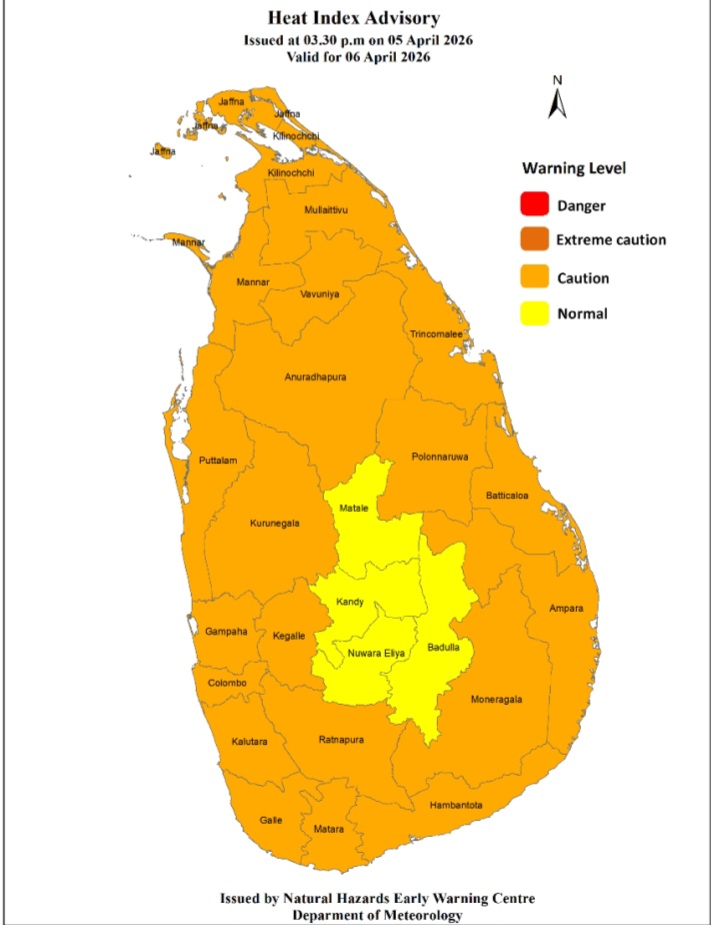
Warm Weather Advisory
Issued by the Natural Hazards Early Warning Centre
Issued at 3.30 p.m. on 05 April 2026, valid for 06 April 2026.
The Heat index, the temperature felt on human body is likely to increase up to ‘Caution level’ at some places in the Western, Sabaragamuwa, Southern, Eastern, North-western, Northern and North-central provinces and in Monaragala district.
The Heat Index Forecast is calculated by using relative humidity and maximum temperature and this is the condition that is felt on your body. This is not the forecast of maximum temperature. It is generated by the Department of Meteorology for the next day period and prepared by using global numerical weather prediction model data.

Effect of the heat index on human body is mentioned in the above table and it is prepared on the advice of the Ministry of Health and Indigenous Medical Services.
ACTION REQUIRED
Job sites: Stay hydrated and takes breaks in the shade as often as possible.
Indoors: Check up on the elderly and the sick.
Vehicles: Never leave children unattended.
Outdoors: Limit strenuous outdoor activities, find shade and stay hydrated.
Dress: Wear lightweight and white or light-colored clothing.
Note:
In addition, please refer to advisories issued by the Disaster Preparedness & Response Division, Ministry of Health in this regard as well. For further clarifications please contact 011-7446491.
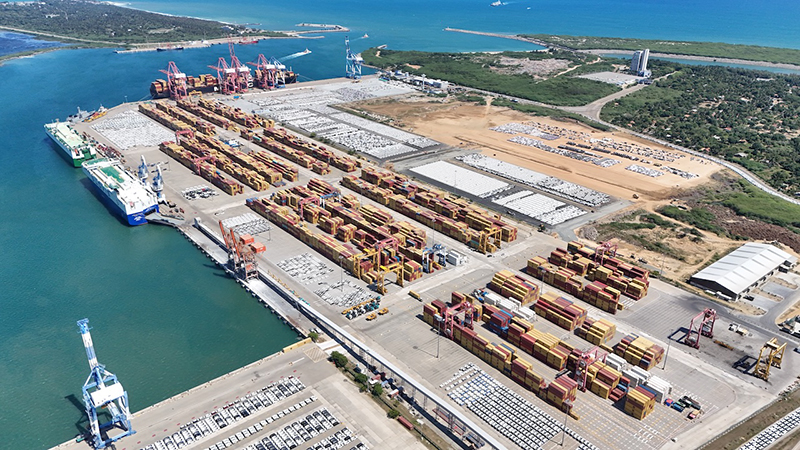
The ongoing West Asia war, triggered by joint Israel-US attack on Iran on 28 Februar, has benefited the China-run Hambantota International Port (HIP).With Iran imposing restrictions on the Strait of Hormuz shipping, in retaliation for unprovoked attack, thereby choking vital shipping routes, particularly for crude oil and refined oil products, HIP situated, along the East-West shipping corridor, has received the anticipated attention.
Soon after the sinking of an unarmed Iranian frigate, just outside Sri Lanka’s territorial waters, in India’s backyard, Indian External Affairs Minister Subrahmanyam Jaishankar categorised HIP as a foreign military base, along with Diego Garcia, Bahrain and Djibouti, where both the US and China maintained major bases.
HIP, in a press release issued on Sunday (05), declared that the Port has significantly expanded its operational capacity, in response to a sharp surge in global shipping volumes, resulting from the West Asia conflict.
The company asserted that the developing situation reinforced its position as a key alternative hub along the East–West shipping corridor.
The port has doubled its Roll-on/Roll-off (RoRo) yard capacity and increased its container yard capacity by 30%, as shipping lines divert operations away from disrupted routes in search of stable and efficient alternatives.
HIP is situated just 10 nautical miles from the main East–West shipping route, allowing vessels to divert with minimal deviation while maintaining schedule integrity.
The Chinese government-owned China Merchant Port Holdings (CMPort) under controversial circumstances acquired controlling interests of the Hambantota port in 2017 during the Yahapalanaya administration. Although the Sri Lankan government repeatedly said that Sri Lanka was paid USD 1.12 bn according to the HIP website CMPort invested $974 mn in the HIP and held 85 percent of the shares.
The 2017 agreement granted CMPort a 99-year lease to develop, manage and operate the Port area. The Supreme Court dismissed a fundamental rights petition filed by lawmaker Vasudeva Nanayakkara pointing out that the original agreements pertaining to the Hambantota port had been signed in 2012 and 2013 during Mahinda Rajapaksa’s tenure as the president when he was a member of the Rajapaksa Cabinet.
The HIP press release quoted CEO of HIP Wilson Qu as having said: “What we are witnessing today is a structural shift in global shipping patterns. At HIP, we have focused on building the capacity and operational agility to respond to such changes. Our ability to scale quickly, combined with our location, allows us to support global shipping lines when reliability becomes critical. Looking ahead, we will continue to invest in infrastructure and capabilities to strengthen Hambantota’s role as a key logistics and transshipment hub in the region.”
The rise in both vehicle transshipment and container volumes has driven yard utilization levels to the highest in HIP’s history, highlighting the scale of ongoing supply chain disruptions and the port’s growing strategic importance in global trade.
To accommodate increased throughput, HIP has rapidly expanded yard space across both cargo segments, enabling it to handle higher volumes while maintaining operational efficiency and minimizing congestion. Expanding capacity within a short time frame in a live port environment presents considerable operational and technical challenges and requires significant investment. However, through close coordination across management, engineering and operational teams, HIP was able to deliver these enhancements in step with rising demand.
The HIP statement added: “The expansion reflects Hambantota International Port’s continued development as a resilient logistics platform in the Indian Ocean, as geopolitical developments reshape established maritime routes and increase demand for alternative hubs. As infrastructure scales in tandem with demand, HIP is increasingly positioned to capture a larger share of regional transshipment volumes while supporting the continuity of global supply chains.”
Amidst the continuing uncertainty caused by war and growing threat to international shipping the Hambantota International Port Group (HIPG) the owning group of HIP recently finalised an agreement to invest USD 108 mn to procure new container handling equipment- six quay cranes, 16 rubber-tyred gantry cranes (RTGs) and 40 trailers, under the initial phase of the port’s Phase II container terminal development.
By Shamindra Ferdinando

Trump threatens ‘hell’ for Iran over Hormuz Strait as deadline approaches

Tim David, Rajat Patidar inflict bruising defeat on Chennai Super Kings

Shami sets up Lucknow Super Giants victory before Pant fifty takes them home

Showers or thundershowers will occur at several places in the Northern, Eastern, North-central, Central and Sabaragamuwa provinces and in Puttalam, Galle and Matara districts after 2.00 p.m.

Sun directly overhead Beruwala, Gurulubadda, Rakwana, Godakawela, Udawalawe and Thanamalwila at about 12:13 noon today (06)

Heat Index at Caution Level in the Western, Sabaragamuwa, Southern, Eastern, North-western, Northern and North-central provinces and in Monaragala district

‘Dates have the highest sugar content to fight Coronavirus’

Sunday Island 27 December – Headlines

#SundayIsland 17th December – Headlines

Sunday Island – 28th March

Sunday Island Headlines – 21 March

Sunday Island – 21st February – Headlines
-

 News5 days ago
2025 GCE AL: 62% qualify for Uni entrance; results of 111 suspended
-

 Features2 days ago
Ranjith Siyambalapitiya turns custodian of a rare living collection
-

 News2 days ago
Global ‘Walk for Peace’ to be held in Lanka
-
 News7 days ago
Tariff shock from 01 April as power costs climb across the board
-

 Business6 days ago
Hour of reckoning comes for SL’s power sector
-

 Editorial5 days ago
Search for Easter Sunday terror mastermind
-

 Features7 days ago
Seychelles … here we come
-

 Opinion7 days ago
Sri Lanka has policy, but where is the data?