
News
Sanjeewa’s body identified by mother and elder sister

By Hemantha Randunu
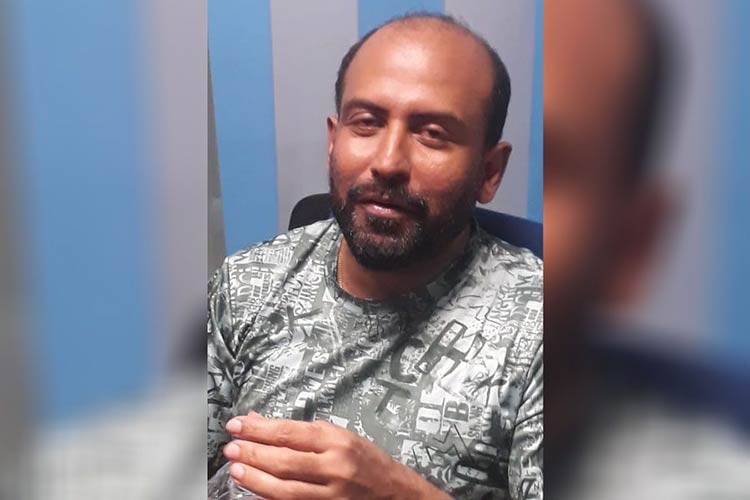
The body of Ganemulle Sanjeewa, who was gunned down inside a Hulftsdorp Magistrate Court on Wednesday, was identified Thursday (20) at the Colombo Judicial Medical Officer’s office by his mother and elder sister, a senior officer from the Keselwatta Police told The Island.
Following the post-mortem examination, his mother took the body to the Jayaratne Funeral Parlour, where it was kept pending final rites at the Borella Cemetery.
Investigations have revealed that Sanjeewa was killed on the orders of an underworld leader, known as Kehelbaddara Padme, who is currently in hiding in Dubai. The killing was carried out by an assassin hired for Rs. 150 million, though it is reported that he had received only an advance payment of Rs. 2 million. Further inquiries indicate that the assassin had been using multiple aliases, including a previously reported Muslim name, which has now been confirmed as false.
Two days before the attack, the assassin reportedly disguised himself as a lawyer and visited Hulftsdorp Magistrate Courtroom No. 05 to observe and plan the execution of the attack.
Alongside him, a woman named Ishara Sewwandi, a known drug trafficker who also posed as a lawyer, visited the court to assess how the murder would be carried out, police investigations have revealed.
Further inquiries indicate that Kehelbaddara Padme’s father, Kehelbaddara Neville, was shot dead in 2018 on the orders of Ganemulle Sanjeewa. Police suspect Sanjeewa’s murder was an act of revenge.
Following the assassination, the assassin fled by a waiting van to the Kalpitiya area, from where he was to be smuggled to India by boat, as planned by Padme.
Ishara Sewwandi, the 25-year-old woman who assisted the assassin, and the assassin himself, are allegedly heavy users of crystal meth (ice), according to police. However, several other analysts on social media pointed out that the careful planning, and the calm execution of the plan do not seem to be indicative of the behaviour of drug addicts.
Investigations have also revealed that the pair had stayed at a hotel in Maradana the day before the attack.
Police have discovered that Kehelbaddara Padme coordinated the murder plot over the phone from Dubai, communicating with the assassin for nearly two weeks. Fake lawyer identification cards were created on Padme’s instructions to allow the assassin and Sewwandi to pose as legal professionals. Authorities are currently investigating those responsible for forging those IDs.
Police media spokesperson and Attorney-at-Law Buddhika Manatunga stated that the assassin operated under multiple aliases, including Mohammed Sherifdeen and Samidu Dilshan Widumanga Kadanaarachchi. The fake lawyer ID he used bore the name Kodikara Kasun Prabath Nishshanka.
The suspect is reportedly a resident of Maharagama and is believed to be responsible for several other murders. Investigations are ongoing into his alleged involvement in additional killings.
Meanwhile, police are examining messages exchanged via the mobile phone used by the shooter in Sanjeewa’s murder. It has also been discovered that someone had visited the hotel where the shooter was staying and handed him a fake lawyer ID with his photograph.
Further inquiries have revealed that after the shooting, the suspect purchased a white outfit from a shop in Nugegoda and discarded the lawyer’s robe he had been wearing in Kochchikade.
Kehelbaddara Padme has reportedly orchestrated a similar attack from overseas in the past.
On the morning of the 19th, Sanjeewa Kumara Samararatne, also known as Ganemulle Sanjeewa, an underworld gang leader, was shot dead inside Courtroom No. 5 at Hulftsdorp.
His post-mortem examination was conducted at the Colombo National Hospital mortuary on the 20th, where forensic experts found multiple bullet wounds on his body, prompting them to conduct a CT scan.
Following the autopsy, the body was to be handed over to Sanjeewa’s wife, according to Ganemulla Police.
The body was temporarily placed at Jayaratne Funeral Parlour in Borella before family members and others paid their final respects.


In terms of the provisions of the Establishments Code on payment of festival advance to government officers, there’s a possibility of obtaining rupees 10,000/- as an advance for celebrating festivals of Theipongal, Ramazan, Sinhala and Hindu New Year, Wesak, Deepavali, and Christmas as well as for pilgrimages (Sri Paada pilgrimage and Hajj pilgrimage).
Provisions have been given to recover the said advance in 08 installments or if required earlier without interest. It has been proposed by the Budget 2026 to increase the said festival advance up to rupees 15,000/-.
Accordingly, the Cabinet of Ministers granted approval to the proposal submitted by the Minister of Public Administration, Provincial Councils and Local governments to revise the relevant provisions so that the festival advance can be increased up to rupees 15,000/- .
As per the approval given by the cabinet meeting held on 02-06-2025, action is being taken at present to offer the underutilized lands/properties of the Sri Lanka State Plantation Corporation, the Janatha Etate Development Board, and the Elkaduwa Plantation Company which are under the Ministry of Plantation and Community Infrastructure which have been identified under stage one to suitable investors.
Accordingly, the Cabinet of Ministers has approved the proposal presented by the Minister of Plantations and Community Infrastructure to provide following lands/properties on a lease basis to the suitable investors for optimal utilization following the prescribed procurement procedure.
• underutilized lands/properties identified under stage two owned by the Sri Lanka State Plantation Corporation, the Janatha Estate Development Board, and the Elkaduwa Plantation
Company,
• The Mawarala watte land and the Tea factory 40.48 hectares in extent, located in Matara District belonging to the Tea Shakthi Fund.
• The underutilized land of 1,541 hectares in extent of Kondachchi Estate is enjoyed by the Sri Lanka Cashew Corporation.
The drafting of the National Fisheries and Aquaculture Policy has commenced with the objective of equitable distribution of the benefits of the fisheries industry and the sustainable management of fisheries and aquaculture. This policy has been updated from time to time according to current requirements. However, steps have not been taken to obtain the approval of the Cabinet of Ministers for that purpose.
According to the policy declaration of the present government, ‘Vistas of Prosperity and Splendor’ the National Fisheries and Aquaculture Policy has been redrafted, updating the aforementioned policy in line with the economic and development objectives of the government.
The recommendations of the Department of National Planning have been received for the drafted policy.
Accordingly, the Cabinet of Ministers has approved the proposal presented by the Minister of Fisheries, Aquaculture, and Marine
Resources to implement the National Fisheries and Aquaculture Policy, integrating it with other relevant policies.

Lanka Premier League draft set to take place on March 22

Trump to meet Venezuelan opposition leader Machado at the White House

Festival advance for government officers to be increased
Providing underutilized lands/properties to suitable investors for optimal utilization.
Implementation of the National Fisheries and Aquaculture Policy

Expressions of Interest called to develop selected locations within the Pelawatte Sugar Factory premises

‘Dates have the highest sugar content to fight Coronavirus’

Sunday Island 27 December – Headlines

#SundayIsland 17th December – Headlines

Sunday Island – 28th March

Sunday Island Headlines – 21 March

Sunday Island – 21st February – Headlines
-

 News3 days ago
Sajith: Ashoka Chakra replaces Dharmachakra in Buddhism textbook
-

 Business3 days ago
Dialog and UnionPay International Join Forces to Elevate Sri Lanka’s Digital Payment Landscape
-

 Features3 days ago
The Paradox of Trump Power: Contested Authoritarian at Home, Uncontested Bully Abroad
-

 Features3 days ago
Subject:Whatever happened to (my) three million dollars?
-

 News2 days ago
Level I landslide early warnings issued to the Districts of Badulla, Kandy, Matale and Nuwara-Eliya extended
-

 News2 days ago
National Communication Programme for Child Health Promotion (SBCC) has been launched. – PM
-

 News3 days ago
65 withdrawn cases re-filed by Govt, PM tells Parliament
-

 Opinion5 days ago
The minstrel monk and Rafiki, the old mandrill in The Lion King – II