
Sports
Sanath Jayasuriya;

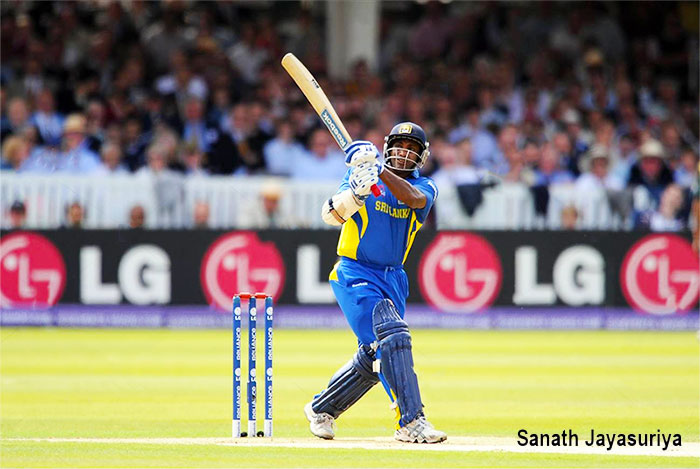
Loved beyond boundaries
by Aravinthan Arunthavanathan
When AB De Villiers strides out to the middle, the crowd at Chinnaswammy stadium in Bengaluru chant ABeee, ABee. When Lasith Malinga is at the top of his mark at the Wankhede in Mumbai, the echelons echo Maliii….Maliii…. AB De Villers and Malinga are top notch members of an elite coterie in international cricket, who are revered outside their land of origin. The membership in this elite circle extends to a select few like Sir Vivian Richards, Sir Ian Botham in the past to Chris Gayle, Kieron Pollard and Kane Williamson at present. The most recent entrant to this club is Kumar Sangakkara who seems to be captivating the English with his charisma. Kumar may seem to the inventors of Cricket that he is more English than most English. Exuding elegance and captivating with charisma Sangakkara has obtained membership in the elite club interestingly post retirement. However, Kumar isn’t the first such Lankan to be adored in an alien land.
Immigration encounters abroad are not the pleasantest of experiences for any traveler. It does not get any worse when you have made an unknown blunder in your documentation and end up in a soup. It was exactly the case for yours truly in Kolkata two years ago. A lengthy delay seemed inevitable. The immigration official was calling his superior to escalate the issue. The line was not reachable. Luckily that day I was wearing a Sri Lankan cricket T Shirt. It’s my go to clothing when travelling because of the comfort more than anything else. Yet that was good enough for us to start a conversation on Cricket. There was no mention about the present but the past. Unsurprisingly the dominance of a dynamite southpaw from down south was the central topic. Thankfully, I remembered the minute details which many would not regarding Sanath Jayasuriya’s exploits against our neighbors. Surprisingly, immigration official reminded me even more. We stuck a cord instantly. The superior was not even needed. The parting words were “Well Afterall you are from Sanath Jayasuriya’s land, pay attention to detail the next time you come.” I do not know Sanath in person, but he was my savior that day. Every time ever since, there hasn’t been a single visit where I haven’t encountered an Indian who adores Sanath’s exploits. The adulation he garners in a cricket loving nation with surplus of home bred demigods is beyond admiration. If Sangakkara connects with English through charisma and class Sanath was blockbuster material in India through brutal butchery and methodical massacring of Indian attacks during his career. Sanath was a villain to India who was too good not to be liked. Those who witnessed it know it.
Sanath’s rise to prominence came at the Kotla in New Delhi in a 1996 World Cup group game. Sanath’s evisceration of the Indian attack announced to the world loud and clear that Sri Lanka were not push overs anymore. The same year Sanath notched his first century against India at a packed Khettharama making a mockery of another Indian total built around a Sachin century. In the years that followed since 1996 every year saw Sri Lanka play India. Often a Sanath century was a highlight. The 151* in Mumbai, 189 in Sharjah were some of the stand outs during this period. However, since relinquishing leadership in 2003, Sanath’s inconsistencies with the bat became a topic of interest. In 2004 with pressure mounting the skipper Marvan Atapattu was adamant Sanath would come good soon during the Asia Cup in Colombo. Soon Sanath delivered a majestic century in losing cause in a must win game for India. The following period saw fluctuating fortunes for Sanath. Despite winning a game with a dislocated shoulder against India in Dambulla, a lean patch in a disastrous tour of India saw him being left out of a Sri Lankan squad for the first time towards end 2005. Sanath soon rose from the doldrums with a magnificent series against the English in 2006 which helped the audience witness the Matara mauler being reborn and serve Sri Lanka with supremacy till the end of the 2007 World Cup. However afterwards it was a plunge for Sanath. In 2008 Sanath’s place was hanging under the knife. A scintillating century for Mumbai Indians against Chennai Super kings in the inaugural IPL had given rays of hope. The Asia Cup in Pakistan in 2008 had the potential to be the end for Sanath if he failed to deliver. A century against a not so strong Bangladesh was never going to suffice in the long run. When Sri Lanka faced India in the final it was do or die for Sanath. The final is a game which is recollected for the Ajantha Mendis magic which scripted one of Sri Lanka’s best comeback wins. However, in the midst of it, the master blaster’s masterclass is often overlooked.
Having taken first lease of the wicket Sri Lanka got off to the worst possible start. Sanath sold down the river, his opening partner the consistent Sangakkara, who by now had taken over the mantle of being Sri Lanka’s leading batsman by sending him back halfway through a single. Despite the early setback Sanath was not deterred. He carried on his signature way flaying Ishant Sharma and RP Singh to all parts of the ground. Trademark square drives over cover, cuts through third man, pulls over square leg coupled with cute glanced down the leg meant Sri Lanka were off to a solid start. Sanath took a particular interest in Irfan Pathan smashing him for more than 15 runs in the eleventh over. However, a cluster for wickets at the other end meant the Indians were all over the Lankans like a rash. India had seen enough of Sanath in the past. Sanath ensured he reminded them of what was in store by galloping to his half century pulling an 86mPH short delivery from Ishant with disdain over square leg for a six. This was a 39-year-old in the twilight of his career smacking a young pace bowler who had wreaked havoc down under only a few months prior. It was not just a shot but a statement of supremacy. Sanath received a stroke of luck immediately afterwards as he survived an ugly cross batted shot off Ishant missing the stumps and RP Singh missing a skier at mid-on. RP Singh would soon rue the miss with what was to follow. What followed was carnage.
Jayausriya greeted Singh in the most disdainful manner dispatching his for two consecutive sixes over the bowler’s head and long off in the 16th over. The next two balls provided no response for the bowler as they were mercilessly manhandled by the master over covers for consecutive boundaries. As if leaving the leg side untouched was a shortcoming Jayasuriya closed the over with a six over square leg. The over fetched 26 runs and MS Dhoni and India knew the game was far from over. RP Singh was not the first Indian bowler to suffer at the hands of Sanath. Manoj Prabakar, Venkatesh Prasad all had suffered the wrath of Sanath’s willow. But what stood out was all of these bowlers belonged to different generation yet were not spared of Sanath’s mauling. A single batsman dishing out the same to bowlers across generations was truly admirable.
A gentle nudge down to square leg off Virender Sehwag helped Sanath to his 27th ODI century. It was a gentle nudge but there was nothing gentle about the knock. The sheer brutality of the knock was proven by the fact that his century came up in the 24th over and the team score was only 150. Sanath had notched 2/3 of the total score. Finally, when Sanath departed in the 36th over for 127 well-made runs he had scored more than 40% of the team total. A knock of such dominance in a final where the rest of the team faltered was true reflection of how good Jayasuriya was. Whilst Mendis dealt the killer punch later in the day Sanath’s contribution was truly magnificent.
This was not the first time, neither was it the last. Sanath would notch up his final international century in 2009 and another 99 the same year when his career was going down south. It was knocks of such nature with dominance that captured the attention of fans even in a passionate country like India. It is no surprise that his deeds are recollected even today with so much of adulation.
Sanath Jayasuriya was good enough to be loved in his own backyard. He was too good, not to be loved beyond the confines of his country. But being accepted to a coterie which cultivated cult following in a cricket mad nation like India, is the true testimony to the greatness Sanath Jayasuriya exhibited. In an era of social media where access to our favorites’ living rooms is just a fingertip, away being adored in foreign lands is still admirable. But to have achieved the same when even on field exploits were accessible only through print media and television was beyond remarkable. Sanath was not only a national but regional asset in his prime. Like the legacy of Richards, Bothams and Tendulkars, the legacy of Jayasuriya will live forever and we as Sri Lankan fans were truly blessed to have existed in an era to witness the master blaster’s brilliance.


by Rex Clementine
President’s Counsel Dinal Phillips has defended a key provision in the proposed new constitution for Sri Lanka Cricket that allows one of the appointed members, rather than an elected representative, to serve as Chairman of the Board. There have been concerns that a former cricketer will not be able to be appointed as Chairman of SLC if the new constitution comes to effect, but Philips said that the country needed to move on with times.
Successive governments have promised sweeping reforms at the cricket board but delivered precious little. The NPP government, however, has taken concrete steps towards overhauling the administration, with a new constitution now in the public domain.
The proposed constitution has been gazetted and will be debated in Parliament, while the Supreme Court will determine whether its provisions are consistent with the laws of the country. Stakeholders will also have an opportunity to challenge provisions they consider contentious.
Once the legal and parliamentary process is completed, the new constitution will come into force, making SLC answerable to Parliament and by extension, to the public.
“The Chairman of the Board will be from among the appointed individuals because there needs to be a great deal of independence on the Board. You are talking about a Rs. 16 billion organisation,” Phillips told reporters at SLC headquarters yesterday.
Phillips has been a prominent figure in cricketing circles in recent years. He represented his Royal College schoolmate Kusal Janith Perera during the legal battle that eventually cleared the batsman following a doping suspension. He is also a former President of Tamil Union, one of SLC’s controlling clubs.
“You have to have people with sound accounting backgrounds, legal expertise, marketing and IT knowledge involved in running your cricket board. All those areas are covered in this structure,” Phillips said.
“The powers will also be vested in the CEO of SLC and he will run the business of the organisation. The Board of Directors will execute policy.”
Phillips, together with fellow legal expert Upul Kumaraperuma, played a key role in drafting the proposed constitution.
“Look at other parts of the world. We don’t want to be left behind; we want to move with the rest of the world. These are serious, long-term steps. We are trustees for 20 million people. We have been asked questions about what is happening to our cricket. We want to raise the bar,” Phillips added.
SLC chief Eran Wickramaratne was also present at the briefing and faced questions over the national team’s disappointing tour of England, where Sri Lanka were whitewashed 3-0 in the T20I series before enduring an inconsistent ODI campaign.
“We want to see the team winning, no doubt about that. But we don’t have concerns about individuals, say, for example, Gary Kirsten. It requires time to build,” Wickramaratne said.
“In 2011, we were ranked number four in Tests, number three in ODIs and number three in T20s. If you look at where we are now, we are towards the lower end; seven, eight or nine.
“That decline has happened over a period of ten to 15 years. You have to be realistic. Any coach who comes in cannot change things overnight. But we are on the right road.”

by Reemus Fernando
The Sri Lanka Automobile Association in Japan (SLAAJ) awarded a brand-new Honda Vezel to gold medallist Rumesh Tharanga at a felicitation ceremony held for the Sri Lankan team that competed at the Asian Games in Nagoya, Japan.
The gift was presented at a ceremony, held on the eve of the track and field team’s departure from Nagoya.
Sri Lanka’s team captained by Thranga concluded the track and field campaign on Tuesday.
Tharanga’s gold was the solitary medal won by the team.
”We decided to reward every Sri Lankan athlete who wins a gold medal with a brand-new vehicle. We invited all Sri Lankan athletes taking part in the Games to the felicitation, and at the time of the event, only Tharanga had won gold,” Nishantha Meegalla, Vice President of the Nagoya Prefecture of the Sri Lanka Business Council of Japan, told The Island.
Nishantha said that Tharanga will be able to get his vehical from the Hambantota Port.
He said that sea freight charges up to Hambantota port will be taken care of on behalf of Tharanga and it would be incumbent upon the government authorities to decide to waive off any taxes for the newly crowned Asian champion to receive the gift.
Tharanga, the world’s top-ranked javelin thrower this season, won Sri Lanka’s first-ever javelin medal at the Asian Games on Monday, sealing the historic victory with a throw of 88.55 metres.
With his Asian Games triumph the 23-year-old capped a remarkable season where he claimed multiple global titles including the Diamond League title, Commonwealth Games gold and the Ultimate Championship trophy.

Sri Lanka’s second string side face their biggest test in recent times when they take on a full-strength India in the second men’s cricket semi-final at Korogi Sports Park, Nisshin, on Thursday.
Sahan Arachchige will lead Sri Lanka against the reigning T20 world champions, with a place in the gold medal match at stake.
On paper, it is a mismatch. While India have sent their strongest T20I squad to Japan in defence of the gold medal they won at the previous Asian Games, Sri Lanka have opted for a largely second string outfit, with the country’s leading players unavailable for the competition.
Sri Lanka, however, will have little to lose and plenty to gain against an Indian side that received a timely warning from Japan, who came close to pulling off a massive upset at Sano.
Arachchige is no stranger to Asian Games cricket. His only T20 International appearance came at the 2023 Games, when he captained Sri Lanka in their defeat to Afghanistan. He now returns to lead a squad bearing similarities to the one fielded three years ago.
There is nevertheless useful experience in the Sri Lankan ranks. Former Test wicketkeeper Niroshan Dickwella provides experience at the top of the order, while Chamika Karunaratne adds all-round depth. Nuwanidu Fernando, Ashen Bandara and Lasith Croospulle will be expected to shoulder much of the batting responsibility.
Sri Lanka could also find encouragement in conditions at Korogi Sports Park. Evidence from the group stage suggests a slow surface where stroke making is not straightforward and spinners could have a significant say.
That should bring Dushan Hemantha, Tharindu Ratnayake and Vijaykanth Viyaskanth into the equation, while Binura Fernando and the unorthodox Nuwan Thushara give Sri Lanka different options with the new ball and at the death.
Several days of rain could make the surface even slower and leave the outfield heavy, although the forecast for Thursday is encouraging, with only a small chance of rain.
The weather nevertheless carries an added complication for Sri Lanka. Neither team had to play their quarter-final after rain washed out both matches, with the higher-seeded sides progressing. Should Thursday’s semi-final also be abandoned, India will advance to the final by virtue of their higher seeding.
India also have the advantage of having already experienced the unfamiliar Japanese conditions. Their game against Japan provided valuable match practice and more importantly, a reminder that reputations alone will not win matches on these surfaces.
India endured a difficult period following the World Cup, with Shreyas Iyer’s captaincy beginning with series defeats against Ireland and England. They have since recovered strongly, completing series sweeps against Zimbabwe and Afghanistan.
Jasprit Bumrah is expected to return after being rested against Japan, further strengthening an already formidable attack featuring Arshdeep Singh, Axar Patel, Washington Sundar and Ravi Bishnoi.
Sri Lanka probable XI: Sahan Arachchige (Captain), Niroshan Dickwella (wk), Lasith Croospulle, Nuwanidu Fernando, Ashen Bandara, Chamika Karunaratne, Dushan Hemantha, Tharindu Ratnayake, Binura Fernando, Vijaykanth Viyaskanth and Nuwan Thushara.
India probable XI: Sanju Samson (wk), Abhishek Sharma, Ishan Kishan, Shreyas Iyer (Captain), Tilak Varma, Shivam Dube, Axar Patel, Washington Sundar, Ravi Bishnoi, Arshdeep Singh and Jasprit Bumrah.

US-assisted ‘Ice’ detection: NPC to examine IGP’s move to transfer drug-busting team

2027 Budget to be held from 12 Nov. to 14 Dec.

CB Governor confident over timely disbursement of next IMF tranche; hands post-2027 programme decisions to govt.

Cabinet spokesman explains why Thileepan statue was removed

CA dismisses writ petition filed by MP Jayaweera

Harsha’s committee warns unnecessary regulations could discourage businesses and create a risk of hindering economic growth

‘Dates have the highest sugar content to fight Coronavirus’

Sunday Island 27 December – Headlines

#SundayIsland 17th December – Headlines

Sunday Island – 28th March

Sunday Island Headlines – 21 March

Sunday Island – 21st February – Headlines
-

 Editorial5 days ago
Birth of a bad law
-

 Features6 days ago
Beyond traditional jobs: Why Sri Lanka needs to facilitate the gig economy
-

 News3 days ago
Police remove Thileepan statue in Jaffna
-
 Latest News6 days ago
Kusal, Wellalage star as Sri Lanka defend 322 in Headingley thriller
-

 News5 days ago
TIN mandatory for key transactions from Nov. 1
-

 Features3 days ago
The 22nd Amendment, constitutional recovery and illiberal slippage
-

 Features3 days ago
Of foreigners as CEOs of Lankan ventures
-

 News3 days ago
Sajith rejects Jt. Opp. protest sabotage claim; SJB TU chief demands remedial action