Sports
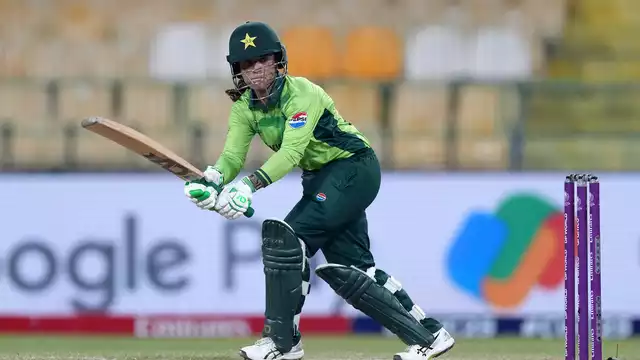
Sana’s all-round heroics take Pakistan to Women’s ODI World Cup
Pakistan confirmed their participation at the Women’s ODI World Cup after beating Thailand by runs to secure their fourth win of the qualifier. Pakistan, with eight points, are at the top of the table and can only be matched by Bangladesh, who they play on Saturday and are in pole position to take the second World Cup spot.
Two other teams – Scotland and West Indies – are also in contention. In order to qualify, Scotland and West Indies need to win their matches against Ireland and Thailand respectively by big margins and hope Bangladesh lose badly enough to Pakistan to dip below them in net run rate terms. Bangladesh can qualify for the World Cup even if they lose to Pakistan and both Scotland and West Indies win their final matches because of their net run rate advantage.
Pakistan will be thrilled to have avoided the intricacies of calculations like these after they booked their World Cup places with a game to spare. They are also unbeaten on home turf and have rediscovered their form. Before the qualifiers, Pakistan had last won an ODI in December 2023 and were on a five-game losing streak. In the last week, they put that right and reeled off four straight wins, albeit not always easily, and will now play in their fifth successive World Cup.
Their participation will require additional logistics for the tournament, scheduled for India from late September. In keeping with the hybrid model agreed by the BCCI and PCB ahead of this year’s Champions Trophy, Pakistan are unlikely to travel to India for the tournament and will play their matches at a yet-to-be-decided neutral venue.
Pakistan will not worry about that for now as they celebrate their qualification run led by their captain Fatima Sana. She injected energy into a pedestrian innings that was meandering at 119 for 4 after 40 overs – a scoring rate of under three runs an over – with a quickfire unbeaten 62 off 59 balls. Sana and Sidra Amin, who posted her third fifty-plus score of the qualifiers with 80 off 105 balls, shared a run-ball 97-run stand and Pakistan scored 86 runs in the last ten overs to give themselves a defendable total.
Take nothing away from Thailand’s bowlers, who were disciplined for the bulk of the innings and created several chances. Two of them were off Sana’s bat and she was caught twice off the bowling of offspinner Onnicha Kamchomphu but the deliveries were judged no-balls and Sana continued batting. Without her contribution, Pakistan may have been concerned especially as Thailand’s batting has improved as the campaign has gone on.
They scored 259 chasing 306 against Ireland two days ago which was their highest ODI score and would have believed that even though they had never successfully chased a target above 200, they could give it a good go. Thailand were hard done by when opener Chanida Sutthiruang was given out stumped off Sadia Iqbal when replays seemed to suggest her foot was grounded behind the line when Sidra Nawaz broke the stumps. But they could not complain when Sana, who came on to bowl in the tenth over, sent down a delivery on a perfect offstump line and Nattaya Boochatham edged behind. Two balls later, Nannapat Koncharoenkai was bowled by offspinner Rameem Shamim and at 44 for 3, Thailand’s chances looked grim.
They worked their way to 100 before Sana struck again. She bowled Thipatcha Putthawong and Suwanan Khiaoto to pick up 3 for 39 and is now the joint second highest wicket-taker of the qualifiers, three wickets behind Hayley Matthews. Thailand were bowled out for 118 in the 35th over. They remain winless from their four matches so far and sign off against West Indies on Saturday in a match West Indies will be looking to win by as large a margin as possible.
West Indies kept their World Cup hopes alive with a three wicket win over Bangladesh, who suffered their first loss of the campaign. The result came against the run of play against a West Indies’ side that seemed to be unraveling especially in this match.
Early on in the Bangladesh innings, an on-field collision between Matthews and Chinell Henry as they both tried to get under a skied ball, took them both off the field for a period of time and shortly afterwards, West Indies coach Shane Deitz had been gesturing in frustration to his bowlers. Matthews and Henry returned with no damage done and Deitz had calmed down but Bangladesh were comfortably positioned on 134 for 1 in the 28th over and West Indies looked out of ideas. Sharmin Akhter had registered her third half-century of the tournament and overtaken Nigar Sultana Joty at the tip of the run-scorers’ list. In the circumstances, Bangladesh were in complete control.
Then, Fargana Hoque popped a chance back to Aaliyah Alleyne, who took a good, low catch in her follow through and a procession began. Alleyne bowled Sharmin Akhter two balls later and Bangladesh’s two set batters were both dismissed but they still had Nigar Sultana in hand. It was when Alleyne also bowled her, for 5, that Bangladesh would have started to wonder where the big runs would come from. Afy Fletcher took two wickets in two overs, Matthews took two in three overs and Alleyne finished off with career-best figures of 4 for 39. She is now the second leading wicket-taker at the event, behind Matthews. Bangladesh lost eight wickets for 80 runs and their total of 227 did not seem enough.
West Indies brought Qiana Joseph back into the team after she missed the Pakistan match and she appeared in much better touch than before. Her 39-ball 31 ensured West Indies had a good start. They were 60 for 2 when Joseph was dismissed and 140 for 3 in the 30th over and progressing steadily. Marufa Akter’s stunning double strike took out both Matthews and Stafanie Taylor – fantastically caught when Marufa stuck her left-arm above her head in her follow-through – and at 147 for 5, Bangladesh would have been eyeing victory.
[Cricinfo]
Henry and Shabika Gajnabi shared a 50-run sixth-wicket stand to keep West Indies in the hunt. As the senior partner, Henry took control, scored quickly and was aggressive in her strokeplay. She was on 33 off 40 balls when Gajnabi was caught on the deep mid-wicket boundary and would have known it was up to her to close the game out. Henry went on to bring up her fourth ODI half-century, hit two sixes and got West Indies to the total with four overs to spare.
With this result, West Indies moved up to four points, level with Scotland but with a worse net run-rate.

Latest News
Can resourceful New Zealand lock in semi-final spot against already-qualified England?
While Sri Lankan cricket begins another cycle of seething introspection, there is still business to be concluded in Colombo and Pallekele. New Zealand helped turn the home crowd against their own on Wednesday night and will be looking to confirm their own passage to the semi-finals – for the fourth time in the last five T20 World Cups – when they return to Khettarama to take on England, who are already through.
Looking on anxiously will be Pakistan, who shared the points with New Zealand when their Super Eight encounter was washed out and must consequently cling to the possibility of England making it three wins from three and then making up the net run rate deficit in victory over Sri Lanka (with the results margin from both games cumulatively needing to be around 0 runs, assuming the team batting first makes 180).
England’s campaign so far has turned the phrase “winning ugly” into an art form; the two-wicket triumph over Pakistan that sealed their semi-final spot was so defiantly slapdash it might well end up being nominated for the Turner Prize. The quest for the “perfect game” continues. Certainly, there is no danger of them peaking too early.
If there is one unsettling blot on their copybook so far, it is the continuing travails of Jos Buttler. His haunted look after dismissal for a fourth single-innings score in a row against Pakistan told the story of a horror campaign, but there is no sense yet that England are ready to pull the rug on their greatest white-ball batter of all time.
New Zealand are more in need of the win – even if a close-fought loss might do – but, after a dip at the 2024 World Cup when they were edged out in the first group stage by Afghanistan, they look back to their best as a high-functioning tournament side that always makes the best of the resources available to them.
They came into this World Cup with several players battling injury and illness; Michael Bracewell, a key allrounder in subcontinental conditions, was then ruled out without playing a game. But they have won four out of five completed games with Bracewell’s replacement, the unheralded Cole McConchie, one of stars of their come-from-behind win over Sri Lanka – a game in which their five spin-bowling options trumped the four that England are able to call on (assuming the cut to Jacob Bethell’s bowling hand has healed).
No one should be surprised to see them get the job done again. A New Zealand win would put them top of the group, and also end the uncertainty around the semi-final venues, with Mumbai and Kolkata locked in. Pakistan will be hoping desperately it’s not that straightforward.
While Buttler’s lack of form remains the main talking point, Harry Brook did everything he could to make sure the headlines were about him against Pakistan. At the prompting of Brendon McCullum, Brook elevated himself to No. 3 in the order – having dropped down to No. 5 before the World Cup – and the immediate results were spectacular. Having only done the job a handful of times before for Yorkshire and Northern Superchargers, and never at international level, he made full use of the opportunity for a fast start during the powerplay and was consequently more settled when it came to navigating middle-overs spin (his T20 weak spot). A maiden T20I hundred, from just 50 balls, suggests he should be locked in at first drop for the foreseeable.
Kiwis are all about the collective, with handy performance so far sprinkled around, but one area that might be cause for a smidge of concern is the New Zealand middle order. Partly that is down to the top four being so effective – openers Tim Seifert and Finn Allen are their leading run-scorers, closely followed by Glenn Phillips – and partly the abandoned game against Pakistan, which meant they went eight days without playing. Daryl Mitchell and Mark Chapman have both batted three times and missed the chance for middle time against Sri Lanka, before Mitchell Santner and McConchie produced the vital rescue act. New Zealand have discussed pushing Santner higher, but will likely stick with the incumbents in the expectation they will come good (or not be needed).
England have played the same XI five games in a row and – unless they were to suddenly change their thinking on Buttler, and parachute Ben Duckett in to open – seem likely to stick with that formula. Rehan Ahmed, Josh Tongue and Luke Wood are in the wings, in the event that they wish to test their bench strength.
England: (probable) Phil Salt, Jos Buttler (wk), Harry Brook (capt), Jacob Bethell, Tom Banton, Sam Curran, Will Jacks, Jamie Overton, Liam Dawson, Jofra Archer, Adil Rashid.
After adapting on the fly to seal such a comprehensive win over the home side, New Zealand are also expected to keep the same balance, with the two quicks and five spin options at their disposal. Jimmy Neesham could return if conditions demand another seam option.
New Zealand: (probable) Tim Seifert (wk), Finn Allen, Rachin Ravindra, Glenn Phillips, Daryl Mitchell, Mark Chapman, Mitchell Santner (capt), Cole McConchie, Matt Henry, Ish Sodhi, Lockie Ferguson.
Latest News
India win big to set up knockout clash with West Indies
India set up a virtual quarter-final against West Indies on Sunday with a comfortable win against Zimbabwe on a night that Abhishek Sharma scored his maiden World Cup fifty and India made a small tweak in their batting combination to unleash the second-highest total in T20 World Cups, going two past the 254 Zimbabwe conceded in their last match. Six men batted for India, their innings lasted 15 to 30 balls, and their strike rates ranged from 158.33 to 275. In all, they hit 17 sixes, the most for India in a single T20 World Cup innings.
Zimbabwe asked India to bat first expecting help for fast bowlers. Their reading of conditions was accurate, but the execution was much better from the much more experienced India bowlers, who kept them to 33 in five overs, post which there was hardly any way back.
Zimbabwe, now out of the tournament, dropped two costly catches, taking their tally in Super Eight to five in two matches after having missed just one in the whole first round. A defiant unbeaten 97 from Brian Bennett was the only consolation for them.
Samson breaks up left-hand cluster
India finally admitted their cluster of three left-hand batters at the top was giving offspinners a match-up to exploit, that Suryakumar Yadav was not going to be promoted to No. 3, and sacrificed some lower-order hitting of Rinku Singh to bring in Sanju Samson. Zimbabwe were anyway looking to open with their tall fast bowlers, both of whom Samson hit for sixes down the ground off the back foot in the first two overs. He eventually fell for just 24 off 15, but he was part of India’s biggest opening stand this tournament: 48 off 3.4 overs.
Unlike earlier matches, Abhishek neither charged at the quick bowlers nor gave away his stumps. It took him only three balls to unveil an inside-out drive over extra cover for four. It turned out to be a no-ball as well, and he sent the free hit for a straight four. Abhishek got to 33 off 13 in the powerplay as Zimbabwe refrained from using spin before the field spread out.
As soon as the powerplay ended, Sikandar Raza and Brian Bennett bowled two overs without a boundary to Abhishek and Ishan Kishan. Neither of them panicked, Ishan used power, Abhishek his feet, and both got past the hurdle.
It took only his 26 balls but Abhishek’s maiden World Cup fifty was the second-slowest of his 11 scores of 50 or above in T20Is.
Dropped catches hurt Zimbabwe
Had Zimbabwe held on two pretty straightforward chances, Kishan would have been dismissed for 26 off 19 and Suryakumar for eight off four. The duo ended up with 38 off 24 and 33 off 13. The innings was set up beautifully for Hardik Pandya and Tilak Varma to finish off.
The finishing kick
Hardik Pandya and Tilak Varma added an unbeaten 84 off 31 balls, hitting four sixes each, almost racing each other. Hardik was the only one that ended up with a fifty, but he had a headstart of 12 runs when Tilak came out to bat. Tilak was the quicker one, striking cleanly from the first ball, using space both in front of and behind square. Hardik mainly used power to go down the ground, and caught up with and went past Tilak with two sixes off the last two balls of the innings.
Early movement makes it a bridge too far for Zimbabwe
Arshdeep Singh conceded just one boundary in his first two overs, Hardik extracted appreciable seam movement with the new ball, and at 25 for 0 in four overs, Zimbabwe were looking at 14.5 per over to stay alive in the tournament.
Spinners strike
Axar Patel, left out for the last match because of an abundance of left-hand batters, took two balls to get a wicket, that of the left-hand batter Tadiwanashe Marumani. Varun Chakravarthy took to 19 his streak of taking at least one wicket in a T20I with the wicket of Dion Myers.
Bennett shines, cause for concern for India
In the end, India were comfortable victors by 72 runs, but they will not like that Varun went for 35 runs, conceding three sixes, and that their sixth bowler Shivam Dube had a terrible night out with 46 off two overs. Thanks to South Africa’s win over West Indies earlier in the day, India were under no pressure to secure a big win so they did experiment more than they usually would have.
Zimbabwe ended up getting 184 thanks largely to Bennett, who showed he had a higher gear in him after he went the first round scoring in the 130s without a single six. Here he hit six sixes and scored at 164.4. As the hundred approached, though, Arshdeep shut Zimbabwe out with three wickets in two overs, which also meant Bennett was starved of strike in the end. Arshdeep went past Jasprit Bumrah as India’s leading wicket-taker in T20 World Cups.
Brief scores:
India 256 for 4 in 20 overs (Sanju Samson 24, Abhishek Sharma 55, Ishan Kishan 38, Suryakumar Yadav 33, Hardik Pandya 50*, Tilak Varma 44*; Richard Ngarava 1-62, Blessing Muzarabani 1-42, Tinotenda Maposa 1-40, Sikandar Raza 1-29) beat Zimbabwe 184 for 6 in 20 overs (Brian Bennett 97*, Tadiwanashe Marumani 20, Sikandar Raza 31, Tony Munyonga 11; Arshdeep Singh 3-24, Varun Chakravarthy 1-35, Axar Patel 1-35, Shivam Dube 1-46) by 72 runs
[Cricinfo]
Sports
Sri Lanka must plan smarter to compete in World Cups, says Atapattu
Former captain Marvan Atapattu has warned Sri Lanka that muddled planning and last-minute tinkering will continue to leave them stumped on the world stage after another sobering exit from the T20 World Cup.
The former champions crashed out of the Super Eight stage with a game to spare following three straight defeats, their meek loss to New Zealand on Wednesday a bitter pill to swallow in front of a packed house. Sri Lanka were second best from the toss to the post-mortem, barely laying a glove on the Kiwis.
“Our planning has to be better than this,” Atapattu told Telecom Asia Sport, pulling no punches. “You pick your players two years before a World Cup and help them evolve. You keep backing them once you have identified talent. That is how you go into a World Cup. Here, two months before the tournament, we aren’t sure who is going to be our captain.”
Atapattu said chopping and changing on the eve of a global event was a recipe for disaster.
“Your core players need to remain the same set of guys whom you have backed. There can be injuries and loss of form and you deal with them accordingly, but wholesale change is an indication that there’s no planning,” he added.
He also flagged concerns over the granting of No Objection Certificates for franchise leagues, warning that Sri Lanka risked burning the candle at both ends.
“You have to protect your centrally contracted players. There’s no point if your key player is injured for a World Cup,” Atapattu said.
Sri Lanka were forced into late reshuffles after calling up replacements for three players, most notably missing leg-spinner Wanindu Hasaranga, who pulled out after the opening game with a hamstring strain. His absence left a gaping hole in the middle overs.
Atapattu was equally critical of the kind of surfaces Sri Lanka have dished out at home, arguing low, slow turners offer a false sense of security.
“Play on good pitches. Then your bowlers, in particular, learn the art of containing free-flowing batters,” he remarked. “If you only play on surfaces that suit you, you are not preparing for global events.”
Pointing to England’s meticulous build-up, Atapattu said smart preparation separated contenders from also-rans.
“Look at England. Before the World Cup, they came to Sri Lanka and spent two weeks here. That is smart work,” he said. “We often play teams like Bangladesh, Afghanistan and Zimbabwe and when we beat them, we think our cricket is in good shape. But when we play the big boys, we are found out.”
-
Features5 days agoWhy does the state threaten Its people with yet another anti-terror law?
-
Features5 days agoReconciliation, Mood of the Nation and the NPP Government
-
Features5 days agoVictor Melder turns 90: Railwayman and bibliophile extraordinary
-
Features4 days agoLOVEABLE BUT LETHAL: When four-legged stars remind us of a silent killer
-
Features5 days agoVictor, the Friend of the Foreign Press
-
Latest News7 days agoNew Zealand meet familiar opponents Pakistan at spin-friendly Premadasa
-
Latest News7 days agoTariffs ruling is major blow to Trump’s second-term agenda
-
Latest News7 days agoECB push back at Pakistan ‘shadow-ban’ reports ahead of Hundred auction