
News
Sampath Bank at the forefront of National Transport Modernisation through New Digital Fare System


Sampath Bank PLC is advancing a major national milestone through the commencement of the pilot phase of Sri Lanka’s Bus Fare Digitalisation Project, implemented in collaboration with Ceylon Business Appliances (Pvt) Ltd., and Nimbus Venture (Pvt) Ltd. The solution is being introduced through NCG Express, one of the country’s leading private bus operators, enabling commuters to make seamless digital fare payments and supporting the nation’s transition towards a modern transport environment.
The initiative delivers a fully integrated digital fare collection system that allows passengers to settle fares through contactless bank cards supported by Visa, Mastercard, UnionPay and JCB enhancing convenience, strengthening payment security and contributing to a more efficient and transparent commuter experience. The pilot phase aims to validate operational readiness ahead of wider expansion across private and public bus fleets.
Commenting on this landmark initiative, Darshin Pathinayake, Assistant General Manager, Advanced Analytics and Card Centre, Sampath Bank PLC, stated, “This initiative reflects our long-standing commitment to advancing national digital progress, as it enhances commuter convenience, strengthens fare collection efficiency and supports Sri Lanka’s journey towards a secure and inclusive cashless transport ecosystem.”
The project has been developed, in accordance with the guidelines issued by the Ministry of Transport, Highways, Ports and Civil Aviation, on bus fare collection, using bank cards, ensuring alignment with the Government’s priority of establishing a bank-led and interoperable digital payment infrastructure for the public transport sector.
As the certified Ticketing Application and Electronic Ticket Issuing Machine (ETIM) provider, Ceylon Business Appliances strengthens the reliability of the system through robust hardware and secure software capabilities built on more than five decades of Payments and FinTech expertise. Ruwath Fernando, Director/Chief Executive Officer, noted that, “Our commitment to delivering dependable ETIM technology and a seamless ticketing application remains central to this initiative, as it supports accurate fare acceptance, real-time information and overall system reliability, enabling a smoother, more efficient and commuter-friendly experience.”
Nimbus Venture functions as the system integrator responsible for backend connectivity, real-time processing and system stability. Reflecting on their contribution, Dayan Jayasekara, Director and Chief Technology Officer, stated, “Integrated, secure and transparent digital systems form the backbone of effective fare collection, and, through YamanBuddy, we are powering Sri Lanka’s shift towards smarter, connected travel. Our focus remains on enabling strong operational continuity across the transport network as we help shape the future of public transport.”
NCG Express becomes the first operator to introduce the solution across its fleet, setting the stage for wider adoption across the transport sector. In acknowledging this milestone, Nikitha Grero, Chairman of NCG Express, added, “As a leader in the transport industry in Sri Lanka, we are committed to transforming its landscape and supporting digitalisation efforts for national development. As the first operator to introduce this solution across our fleet, passengers can now benefit from a convenient, seamless, and future-ready payment method, making travelling easier for all. We look forward to driving wider collaboration across the transport industry in the future as well, facilitating seamless, convenient travel island wide.”
Through this initiative, Sampath Bank continues to serve communities by supporting impactful technological progress that enhances daily life and strengthens Sri Lanka’s long-term digital transformation.
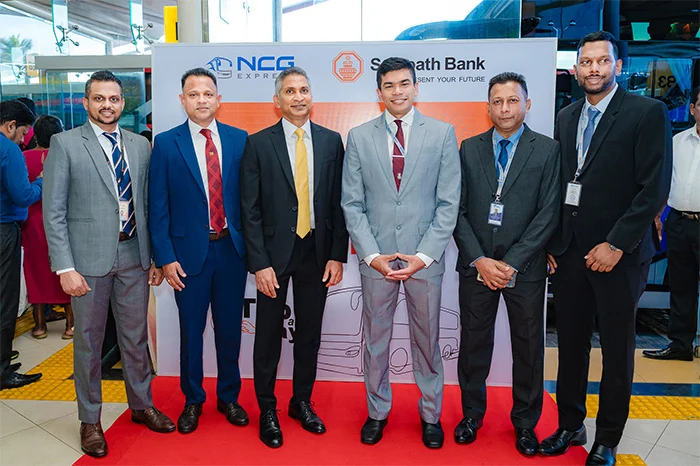
From left: Chirath Samarasekara, Head of Card Centre, Sampath Bank; Darshin
Pathinayake, Assistant General Manager – Advanced Analytics & Card Centre, Sampath Bank; Sanjaya Gunawardana, Managing Director/CEO, Sampath Bank; Nikitha Grero, Chairman, NCG Express; Amila Ranmadala, General Manager, NCG Speed Holdings; and Guyanga Weerasekara, Senior Manager – Projects, NCG Speed Holdings.







Latest News
Financial contribution from Gift Sri Lanka Foundation and the Georgia Buddhist Vihara, USA, for disaster relief


In support of relief efforts for communities affected by the Ditwah cyclone, Gift Sri Lanka Foundation and the Georgia Buddhist Vihara (GBV), USA, have made a financial contribution of USD 16,000 to the Government’s ‘Rebuilding Sri Lanka’ Fund.
The relevant cheque was formally handed over on Thursday (18) afternoon at the Presidential Secretariat by the Chief Incumbent of the Georgia Buddhist Vihara, Most Venerable Panamwela Vajirabuddha Nayaka Thero, to the Secretary to the President, Dr. Nandika Sanath Kumanayake.

The European Union has allocated a total of Euro 2.35 million of financial assistance to Sri Lanka. This includes Euro 500,000 through IFRC and Euro 1.85 million through DG-European Civil Protection and Humanitarian Aid Operations (ECHO) partners, WFP and UNICEF as humanitarian assistance to Sri Lanka, in response to the impact of Tropical Cyclone Ditwah,
In addition to the above allocation, the Union Civil Protection Mechanism (UCPM), which brings together 37 participating States, all 27 EU member States, as well as Albania, Bosnia and Herzegovina, Iceland, Moldova, Montenegro, North Macedonia, Norway, Serbia, Türkiye and Ukraine, is providing in-kind assistance to Sri Lanka.
As a part of the UCPM in kind assistance being provided, on Wednesday, 17th December, Sri Lanka received an aid shipment, with two air cargo flights arriving in Colombo from Germany, France and Luxembourg. This aid shipment included 83 tonnes of relief items such as family tents, mattresses, hygiene and kitchen kits, beds and water filters. The supplies are intended for distribution among communities most affected by the cyclone.
The arrival of the assistance was welcomed by the EU Ambassador to Sri Lanka, Carmen Moreno, French Ambassador, Rémi Lambert, and the Deputy Head of Mission at the German Embassy, Sarah Hasselbarth. On behalf of the Government of Sri Lanka, the donations were received by Sugeeshwara Gunaratna, Director General / Europe & North America, Ministry of Foreign Affairs, Foreign Employment & Tourism and Chathura Liyanarachchi, Director, Disaster Management Center (DMC).
Italy has also provided a team of structural engineers to support Sri Lanka’s disaster assessment and recovery process.
Furthermore, the EU has activated its Copernicus Emergency Management Service (EMS) in rapid mapping mode, with around 30 maps produced so far.
The European Union has committed continued cooperation and support to Sri Lanka’s disaster recovery and rebuilding process, reaffirming the enduring friendship and strong partnership between Sri Lanka and the European Union.

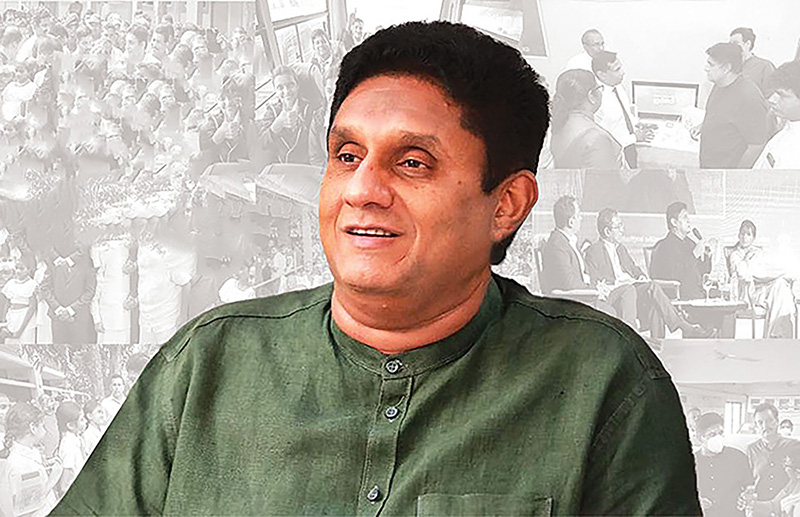
… hands over proposal asking for PSC probe into govt.’s lapses
Opposition and SJB leader Sajith Premadasa yesterday accused the government of having gagged the Meteorology Department officials, who, he said, had been placed under virtual house arrest. He claimed that they had been barred from speaking to the media.
Speaking in Parliament, Premadasa said withholding information from the public was unacceptable. He insisted that the Meteorology Department and international agencies had repeatedly issued warnings about extreme weather events between November 11 and 26. He demanded to know why Sri Lanka’s disaster management mechanism had not been activated in a timely manner.
“The key issue is why the country’s disaster management system failed to respond when the risks were clearly identified,” he told the House, describing the lapse as a serious failure of governance.
Condemning attempts to silence officials, Premadasa said acknowledging mistakes was the only way forward. “If we are wrong, we should admit it. If we are right, we should say so. Silencing professionals will help solve problems.
The Opposition Leader also called for a National Disaster Response Force and amendments to the Disaster Management Act to strengthen preparedness and response mechanisms.
Premadasa and several other Opposition MPs have submitted a formal proposal to the Speaker seeking the appointment of a Parliamentary Select Committee to investigate the government’s failure to mitigate the impact of Cyclone Ditwah.
The Opposition has demanded a 30-member select committee tasked with producing a comprehensive report on the institutional and administrative failures during the disaster.
Describing the government’s lack of preparedness as deeply regrettable, the MPs have said that timely action would have helped save many lives and reduced the scale of destruction caused by the cyclone.
By Saman Indrajith ✍️

Financial contribution from Gift Sri Lanka Foundation and the Georgia Buddhist Vihara, USA, for disaster relief

European Union provides over Euro 2.35 million Humanitarian Assistance to Sri Lanka

Tannane goal from own half sets Morocco on way to FIFA Arab Cup 2025 title

Showers about 75 mm are likely at times in the Eastern, Uva and Central provinces and in Polonnaruwa and Hambantota districts

Sajith: Met Dept. officials under virtual house arrest

Army engineers set up new Nayaru emergency bridge

‘Dates have the highest sugar content to fight Coronavirus’

Sunday Island 27 December – Headlines

#SundayIsland 17th December – Headlines

Sunday Island – 28th March

Sunday Island Headlines – 21 March

Sunday Island – 21st February – Headlines
-

 Features5 days ago
Why Sri Lanka Still Has No Doppler Radar – and Who Should Be Held Accountable
-

 News1 day ago
Pakistan hands over 200 tonnes of humanitarian aid to Lanka
-

 Midweek Review2 days ago
How massive Akuregoda defence complex was built with proceeds from sale of Galle Face land to Shangri-La
-
 News1 day ago
Pope fires broadside: ‘The Holy See won’t be a silent bystander to the grave disparities, injustices, and fundamental human rights violations’
-

 Latest News5 days ago
Landslide early warnings in force in the Districts of Badulla, Kandy, Kegalle, Kurunegala, Matale, Nuwara Eliya and Ratnapura
-

 News6 days ago
Govt. okays postgraduate medical training for Maldivian medical officers and dental surgeons
-

 Editorial5 days ago
Disaster relief and shocking allegations
-

 Features5 days ago
Srima Dissanayake runs for president and I get sidelined in the UNP