
Latest News
Sai Sudharsan and Prasidh lead Gujarat Titans to top of IPL table

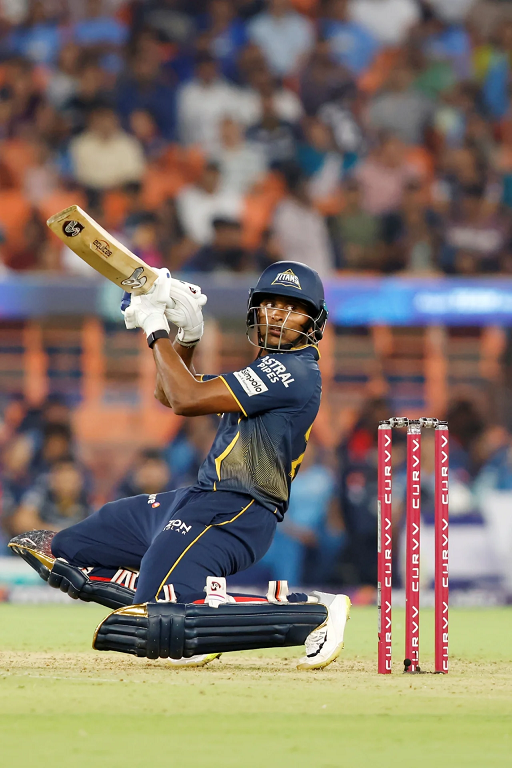
B Sai Sudarshan and Prasidh Krishna once again stood up for Gujarat Titans (GT) as they beat Rajasthan Royals (RR) by 58 runs in Ahmedabad. This was GT’s fourth successive win in IPL 2025 and it took them to the top of the points table.
After RR opted to bowl on a red-soil pitch, Sai Sudharsan’s 82 off 53 balls, his third half-century of the season, steered GT to 217 for 6. With no dew in the second innings, it proved way too steep for RR to chase down. Mohammed Siraj and Arshad Khan struck in the powerplay before Prasidh picked up 3 for 24 in the middle overs to keep RR on the back foot. Despite Shimron Hetmyer’s fighting fifty, RR were all out for 159 in 19.2 overs.
Joffra Archer didn’t have a great start to IPL 2025. In his first two games, he conceded 109 from 6.3 wicketless overs. But he boucned back in his next two with a combined 4 for 38 from seven overs. He breathed fire tonight as well. In his first over, he rushed Sai Sudharsan with a 152.3kph bouncer. In his second, he got one to move in at 147.7kph and pegged back Shubman Gill’s off stump. His match-up against Gill in T20 cricket now reads: 15 balls, ten runs, three dismissals.
For his former captain Jos Buttler, Archer had two slips, a short leg and a catching square leg, and welcomed him with a menacing bouncer that Buttler did well to evade. Buttler inside-edged the next ball just wide of short leg, and then pushed Archer through the covers for four.
Sai Sudharsan generally takes time to get going. Here, he attacked right from the start. He ramped, scooped, drove and cut, and took his side to 50 in 5.1 overs. By the end of the powerplay, he had 39 against his name, off 22 balls. Only Wriddhiman Saha (54 vs Lucknow Super Giants in 2023) has scored more runs in an innings for GT in that phase.
Buttler was on 12 off 13 at one point but hit four fours in his next six balls to move to 31 off 19. He and Sai Sudharsan added 80 off 46 balls before Maheesh Theekshana trapped Buttler lbw. After a brief dip in the scoring rate, M Shahrukh Khan opened up and smashed 36 off 20 to re-inject momentum.
Sudharsan was dropped on 81 by Shubham Dubey off Archer in the 18th over, but he only added one more to his tally. Then Rahul Tewatia and Rashid Khan ransacked 30 in the last two overs to take GT past 200.
RR did not have a great start. Yashasvi Jaiswal slashed Arshad to deep third in the second over of the chase and Nitish Rana did the same against Siraj in the next. Sanju Samson and Riyan Parag counterattacked and added 48 off 26 balls for the third wicket. The stand was broken when Impact Sub Kulwant Khejroliya had Parag caught behind in the seventh over. Parag immediately reviewed the decision, confident that his bat had only hit the ground, but the third umpire thought otherwise, with Ultra Edge also bringing up a second spike when the ball passed the bat.
Coming into this game, Rashid had picked up just one wicket in four outings. Tonight, he struck in his first over. It was a shortish ball that didn’t bounce as much as Dhruv Jurel expected, and Sai Sudharsan at deep midwicket gobbled up the mistimed pull.
Rashid enjoys a favourable match-up against Hetmyer, having dismissed him six times in 63 balls for 79 runs before this game. He almost had Hetmyer lbw for a first-ball duck but the ball had pitched fractionally outside leg stump. From there on, Hetmyer dominated Rashid and hit him for 26 runs off 12 balls with the help of two fours and two sixes. However, Rashid was too good for RR’s Impact Sub Shubham Dubey and had him lbw for 1.
In his final over, the 16th over of the innings, Prasidh had Archer caught at mid-off and Hetmyer at deep-backward square leg, both off short balls. With RR 145 for 8 after 16 overs, the result was sealed. They dragged their innings into the final over but that did little to reduce the margin of their defeat.
Brief scores:
Gujarat Titans 217 for 6 in 20 overs (Sai Sudharsan 82, Jos Buttler 36, M Shahrukh Khan 36, Rahul Tewatia 24*, Rashid Khan 12; Joffra Archer 1-30, Tushar Deshpande 2-53, Sandeep Sharma 1-41, Maheesh Theekshana 2-54) beat Rajasthan Royals 159 (Shimron Hetmyer 52, Sanju Samson 41, Riyan Parag 26; Mohammed Siraj 1-30, Arshad Khan 1-19, Prasidh Krishna 3-24, Kulwant Khejroliya 1-29, Sai Kishore 2-20, Rashid Khan 2-37) by 58 runs
[Cricinfo]

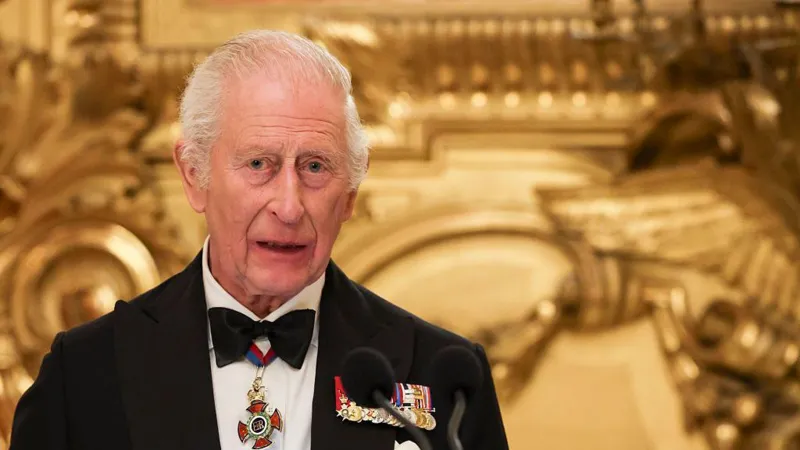
The United States declared independence from the British crown 250 years ago – but this week, it could not get enough of it.
From the minute King Charles and Queen Camilla stepped onto the White House South Lawn, US networks dumped their standard diet of political warfare and breaking news for something rare: pure pageantry.
In a country that seems to agree on almost nothing, the British royals managed something close to a clean sweep – drawing warm receptions from both sides of a political spectrum where neutral ground is rare.
The visit came at a fraught time in US-British relations, with the White House and Downing Street at odds over the war in Iran, straining a relationship both governments insist remains unshakeable.
The reviews following the King’s appearances at the White House, in Congress and in New York were warm across the political divide.
A commentator in the conservative Washington Examiner wrote that the UK needed more than conventional diplomacy – and that King Charles delivered.
“His Majesty’s Government under scandal-plagued Labour Prime Minister Keir Starmer needed the monarchy to do what only the king could do,” the editorial said.
The King’s comments in Congress and at the White House’s lavish banquet on Tuesday – mixing humour with history and a call for unity – also were widely praised.
Some saw them as a subtle rebuke of President Trump.
“Sometimes it takes an outside perspective to see what’s really going on,” an opinion writer wrote in the Arizona Republic. “It’s striking to have a king remind us of what democracy is all about.”
For months, Donald Trump – a committed Anglophile and avid fan of the Royals – repeatedly told reporters that he was excited for the King’s visit. That excitement was on full display throughout the King’s visit to Washington, in which the world saw a warmer version of a president not shy to make his feelings known.
Uncharacteristically, Trump largely stuck to a script, making no mention of policy disagreements with Downing Street and lauding the long ties between the US and Britain.
“Before we ever proclaimed our independence, Americans carried within us the rare gifts of moral courage,” he said. “And it came from a small but mighty kingdom from across the sea.”
On Capitol Hill, where the King became only the second British monarch to address a joint session of Congress, Charles received a standing ovation – though some in the room heard something more pointed in his words.
“As opposed to Keir Starmer, who is looked at…as a leftist weenie, we saw in King Charles – someone who is proud of Britain,” Washington Republican Representative Michael Baumgartner told the BBC. “I think that was good.”
The warm welcome on Capitol Hill was not lost on President Trump.
“He got the Democrats to stand, I’ve never been able to do that. I couldn’t believe it,” Trump said at the banquet a few hours later. “They liked him more than they’ve ever liked any Republican or Democrat, actually.”
Elizabeth Holmes, an expert on the Royal Family and author, told the BBC that many members of the American public are broadly interested in the family, even as that interest has ebbed and flowed over the years.
“I think the fascination is rooted in a combination of novelty and distance,” she said. “It’s not something we have here.”
The King and Queen traveled to New York City on Wednesday where they made a few stops, including one at the 9/11 Memorial. Jacob Knutton, who manages a British-themed restaurant and store in New York, says business has been “a lot busier” around the King’s visit.
“There’s definitely been a lot of people talking about it,” said Knutton, who grew up in London and Australia. “Americans are talking about it and trying to get our opinions on it.”
But not every American is as enthused.
While recent statistics are hard to come by, a YouGov poll conducted in 2024 found that only 42% of Americans held a favourable view of King Charles.
In comparison, his mother, Queen Elizabeth, garnered a 67% approval rating. Over three quarters of those polled – 76% – held a favourable view of the King’s ex-wife, Princess Diana, who died in 1997.
According to Holmes, in the eyes of some Americans, Charles had a “far less compelling” narrative than his mother, who became Queen at a young age.
US feelings about King Charles are further complicated by his complex relationship with son Prince Harry, Holmes added.
Data from Google Trends suggests that US-based searches for the King during the visit spiked by 20 to 25 times over normal, and by 50 times during his speech to Congress.
Others who haven’t followed the royal visit closely, still are excited. “I think it’s cool that he’s here,” said Harry James, 21, who works in a fish and chips shop in New York. “It’s cool we can keep these traditions going.”
Holmes believes the visit already has improved US perceptions of the King. “Trump is such a polarising figure, and I think people were very eager to see their interactions,” she said.
His dinner comments, in particular, have “really taken off”.
“I think people are delighted to see British wit on display,” she added.
Near the White House on Tuesday, some of those who turned out to watch the King’s motorcade pass said they felt hopeful.
“It’s natural for human beings to disagree,” said Maribeth Massie, of Maine, who watched the King’s motorcade near the White House on Monday. “Hopefully they’ll lay some common ground together and move forward.”
Knutton also hopes the visit helps – in part for his business’ sake. His store imports nearly all of its goods from the UK, and feels the pinch of Trump’s tariffs, he said.
“I’m sure it will have an effect,” he said. “But I’m not expecting magical wand-waving.”
[BBC]

Oil prices have soared following reports that the US is preparing for an “extended” blockade of Iran.
The global benchmark oil price, Brent crude, briefly hit $120 (£89) a barrel on Wednesday evening, its highest price since 2022.
The BBC understands that energy executives including Chevron chief executive Mike Wirth met US President Donald Trump at the White House on Tuesday to discuss how to limit the fallout from the conflict on American consumers.
Oil traders appear to have taken the meeting as a sign the effective closure of the Strait of Hormuz will continue for a long time.
The executives discussed topics including domestic energy production, progress in Venezuela, oil futures, natural gas, and shipping, according to a White House official.
They described the meeting as being part of the President’s regular meetings with energy executives to discuss their industry.
The meeting follows separate reports from the Wall Street Journal that US President Donald Trump has instructed aides to prepare to extend the ongoing blockade of Iran’s ports, in an effort to squeeze the country’s economy.
Iran has said it will continue to disrupt traffic travelling through the Strait of Hormuz in response to the US blockade.
[BBC]
Latest News
Heat Index at Caution Level in the North-central, Eastern, and Sabaragamuwa provinces and in Kurunegala, Monaragala, Vavuniya, Mullaittivu and Kilinochchi districts during the day time
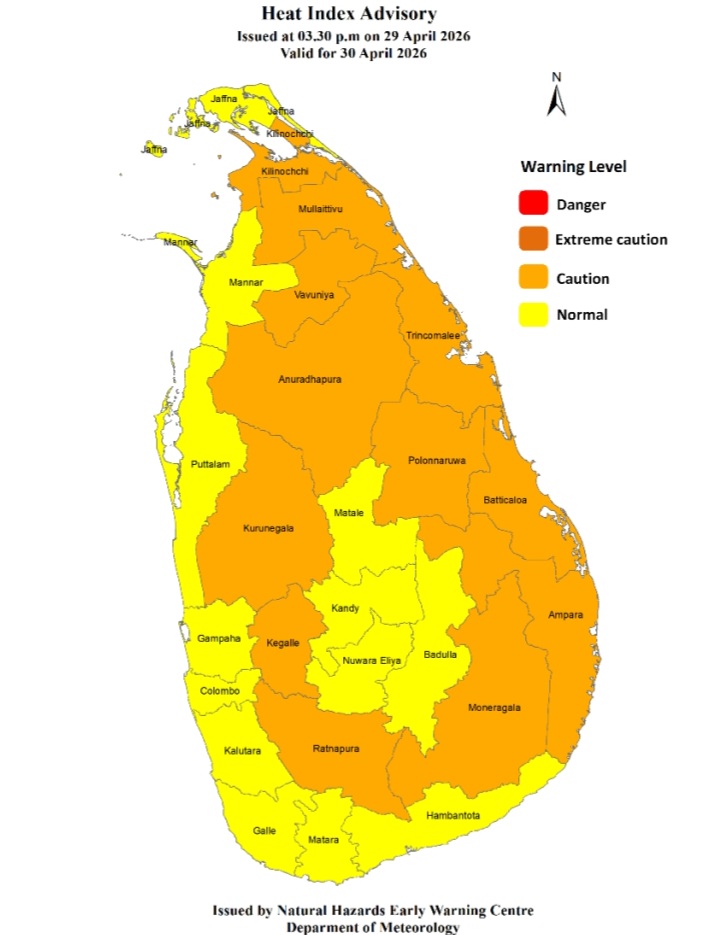
Warm Weather Advisory
Issued by the Natural Hazards Early Warning Centre
Issued at 3.30 p.m. on 29 April 2026, valid for 30 April 2026.
The Heat index, the temperature felt on the human body is likely to increase up to ‘Caution level’ at some places in the North-central, Eastern, and Sabaragamuwa provinces and in Kurunegala, Monaragala, Vavuniya, Mullaittivu and Kilinochchi districts during the day time.
The Heat Index Forecast is calculated by using relative humidity and maximum temperature and this is the condition that is felt on your body. This is not the forecast of maximum temperature. It is generated by the Department of Meteorology for the next day period and prepared by using global numerical weather prediction model data.

Effect of the heat index on the human body is mentioned in the above table and it is prepared on the advice of the Ministry of Health and Indigenous Medical Services.
ACTION REQUIRED
Job sites: Stay hydrated and takes breaks in the shade as often as possible.
Indoors: Check up on the elderly and the sick.
Vehicles: Never leave children unattended.
Outdoors: Limit strenuous outdoor activities, find shade and stay hydrated.
Dress: Wear lightweight and white or light-colored clothing.
Note:
In addition, please refer to advisories issued by the Disaster Preparedness & Response Division, Ministry of Health in this regard as well. For further clarifications please contact 011-7446491

Food Security is vital to ensuring a Nation’s Sovereignty and National Security – Prime Minister

Showers or thundershowers will occur in the most parts of the island after 1.00 pm

Explanation sought from AKD on ‘Russian energy supplies’

US reiterates its commitment to enhancing relations with Northern Sri Lanka

Rooftop Solar at Crossroads as Sri Lanka Shifts to Distributed Energy Future

Indonesia-SL agreement on Visa Exemption for Diplomatic and Official passports soon

‘Dates have the highest sugar content to fight Coronavirus’

Sunday Island 27 December – Headlines

#SundayIsland 17th December – Headlines

Sunday Island – 28th March

Sunday Island Headlines – 21 March

Sunday Island – 21st February – Headlines
-
 News6 days ago
Whistleblowers ask Treasury Chief to resign over theft of USD 2.5 mn
-

 News6 days ago
No cyber hack: Fintech expert exposes shocking legacy flaws that led to $2.5 million theft
-

 News3 days ago
BIA drug bust: 25 monks including three masterminds arrested
-

 Business4 days ago
Nestlé Lanka Announces Change in Leadership
-
 News1 day ago
Treasury chief’s citizenship details sought from Australia
-

 News3 days ago
Banks alert customers to phishing attacks
-
 News4 days ago
Hackers steal $3.2 Mn from Finance Ministry
-
 Business6 days ago
Dialog Enterprise partners Star Garments: Pioneering 5G innovation in Sri Lanka’s apparel industry