
News
SAEA warns of big economic losses due to import restrictions on chemical fertilizers and pesticides


In the absence of proper substitutes
The Sri Lanka Agricultural Economics Association (SAEA) has expressed some concerns on the appropriateness of the newly introduced regulation to restrict forthwith the import of chemical fertilizers and pesticides by the Gazette Extraordinary No 2226/48 of May 6, 2021, to achieve the broader development goal.
In a letter to President Gotabaya Rajapaksa, the SAEA, the professional body representing the Agricultural Economists of Sri Lanka, has predicted massive economic losses due to potential yield losses in the absence of proper substitutes for chemical fertilizers and pesticides with the implementation on the import ban on fertilizers and pesticides.
“The immediate adverse impacts on food security, farm incomes, foreign exchange earnings and rural poverty can be detrimental to achieving the cherished long-term goals”, it warned.
“Our membership endorses the government’s decision to adopt a Green Socio-Economic Model for development as we firmly believe that such a strategy would be critical to conserving the environment and improving human health. We agree that green approaches in crop cultivation contribute significantly towards achieving Sustainable Development Goals (SDGs)”, the professional organization noted in its letter to the President.
Moreover, SAEA is of the view that most of the current farming systems in Sri Lanka are unsustainable. Hence, the conversion of them into organic farming systems in the long run, would help promote health of the people and nurture integrity of the nation’s environment. It is well known that many countries currently take systematic and pragmatic approaches to achieve this long-term objective by first setting targets, standards, and subsequently, investing and promoting farmers to adopt best practices, it further said.
“Therefore, we would like to extend our appreciation to the government for taking such a valuable decision to adopt the green socio-economic model in Sri Lanka”.
Outlining its primary concerns and the less costly policy alternatives proposed by its members in place of the newly introduced import ban for the President’s consideration, the SAEA was of the view that the policy instrument identified by the government to promote organic farming is less appropriate due to potential economic losses and its incompatibility with other policy goals of the government.
Continuing, the professional body of Agricultural Economists, further opined: “When converting from conventional agriculture into organic farming, the government should weigh the technological, environmental and economic costs and benefits. The preliminary findings of the studies conducted by the SAEA on potential economic losses of the import ban and respective estimations are as follows:
(a) Agronomic studies reveal that the average yields from paddy can drop by 25% if chemical fertilizers are fully replaced by organic fertilizers. This loss in productivity could reduce the profitability of paddy farming by 33% and rice consumption by 27% if paddy is cultivated just with organic fertilizers with a complete ban on rice imports. In contrast, applying organic fertilizer with the recommended dosages of chemical fertilizers would improve the profitability of farming by 16%.
(b) Absence of chemical fertilizer would drastically reduce the productivity of the Vegetatively Propagated Tea (VPT). With a 35% productivity drop, the export volume of tea would go down from 279 to 181 million kg, causing an income loss of LKR 84 billion. The estate sector will likely incur significant losses compared to those of tea smallholders. These losses could further be aggravated due to increased cost of labour to apply bulky organic fertilizers.
(c) The coconut yields would go down by 30% if chemical fertilizers and pesticides are not applied. This situation will adversely impact fresh coconuts availability for the production of coconut oil, desiccated coconut and other coconut products. The loss in foreign exchange earnings can be as high as Rs. 18 billion, based on the assumption that only 26% of the total coconut extent is fertilized. When the additional cost for the importation of edible oils is considered, the loss of foreign exchange earnings will be even higher.
(d) The above results were derived considering the immediate effects on three agricultural sub-sectors. An analysis performed accommodating adjustments in the economy over the medium to long run reveals that a reduction in average agricultural productivity by 20% could cause a decrease in Gross Domestic Product (GDP) by 3.05% suggesting an overall contraction of the economy with the implementation of the import ban.
The proposed policy instrument is not compatible with the policy objectives stated in ‘Vistas for Prosperity and Splendor’. Given below are a few policy incompatibilities highlighted by the members of SAEA (Relevant statement from Vistas for Prosperity and Splendor shown in parenthesis).
(a) Modernization of agriculture
(International export business through various value-added products backed up by new technologies): The SAEA would like to propose that the government considers Sustainable Intensification of farming systems to feed the growing population with rising incomes, seeking safe and nutritious food, which are produced in environmentally sustainable farming systems, rather than converting all systems to fully organic agriculture, as its policy objective.
(b) Food self-sufficiency drive (Make the country self-sufficient in the relevant products): Estimates reported in section A (a) indicate that a food deficit would be created in the country owing to yield losses. However, the current government policy on food self-sufficiency would not allow the policymakers to fill this deficit through imports. Such a situation could give rise to food price inflation, unrest, and starvation.
(c) Freedom (People-Centric Economic Development): The chosen policy instrument does not provide flexibility to farmers to determine their least-cost food production methods without harming the environment. This situation would violate the ‘people’s freedom’ policy of the government.
(d) Rural-urban migration (Linking the village development together with the regional development): Contraction of the rural economy due to reduced farm profitability will lead to increased migration from rural to urban areas. With limited capacity of the manufacturing sector to absorb migrants, this will result in urban congestion.
(e) Commitments with the WTO and other international relations (Friendly, Non-aligned, Foreign Policy): The policy instrument chosen is not compatible with commitments to the WTO.
Alternative policy instruments for making food systems more environmentally sustainable
In light of the above observations, members of SAEA suggest the government use more cost-effective instruments to achieve the stated health and environmental outcomes in place of the newly introduced import regulation.
Globally, the approach to environmental protection has been evolving from a regulation-driven approach to a more proactive approach involving voluntary and market-led initiatives. Accordingly, we wish to propose the following three-point policy package.
1. Incentivize organic cultivation using safe and environmentally friendly organic fertilizers and pesticides: Open up pathways towards encouraging organic fertilizer production, storage, distribution, etc. and promote Public-Private Partnership (PPP) models to achieve those.
2. Develop national standards for organic fertilizers and pesticides to ensure non-importation of substandard products to the country and domestic production meeting specified quality standards.
3. Improve awareness of various organic farming technologies among farmers through a strengthened extension system.
Institutionalize and make Good Agricultural Practices (GAP) a mandatory national standard.
Dis-incentivize use of chemical fertilizers and pesticides in an environmentally harmful manner: Revisit national standards for chemical fertilizers and pesticides to ensure non-importation of sub-standard products to the country.
Impose environmental taxes on selected inorganic fertilizers and pesticides.
Reduce and eventually eliminate the subsidy on chemical fertilizers. In phasing out the fertilizer subsidy, we wish to recommend the following steps:
* Prioritize subsidies according to characteristics such as fertilizer type, agro-ecological region, season and crop.
* For the targeted farmers, establish a voucher system that restricts farmers’ access to a lifeline amount [such as two bags] and require them to purchase the balance at market prices for a limited period.
* When the subsidy is lowered, introduce an output price support program to support the farm producers partially.
* Provide and support farmers to adopt site-specific fertilizer recommendations and integrated pesticide recommendations.
* Reduce and eventually eliminate protection provided to crops that are highly fertilizer intensive and erosive.
* Strengthen existing measures to improve awareness of the safe use of chemical fertilizers and pesticides.
Cross-cutting proposals to safeguard the poor and vulnerable and improve the policy process: Maintain a safety net for the poor recognizing the possible increase in food prices.
* Identify a harmonized financing mechanism. For example, finances of saved fertilizer subsidy and environmental taxes can be used to subsidize organic fertilizer production and application.
* In formulating the strategic roadmap, adopt a consultative process involving all stakeholders (policymakers, politicians, agriculturalists, environmentalists, and the private sector) and also considering economy-wide impacts (macro, meso and micro) and externalities.
Considering the economic loss, policy inconsistency, and counter-productive effects created by the regulation in the manner introduced and the availability of relatively superior alternative measures, the SAEA seeks to substitute the import ban on chemical fertilizers and pesticides with the set of alternative measures proposed above. The SAEA extends its professional support to establish a green-economic model for the agriculture sector of Sri Lanka.
The letter signed by Dr. Sampath Dharmadasa, President/SAEA and Dr. Shashika Rathnayaka, Secretary, has been copied to the Prime Minister, Ministers of Agriculture and Plantations, among others.


The Ceylon Petroleum Corporation (Ceypetco) has announced a revision of fuel prices, effective from midnight today (21).
Accordingly,
Auto Diesel – Rs. 382 (increased by Rs. 79)
Super Diesel – Rs. 443 (increased by Rs. 90)
Petrol 92 Octane – Rs. 398 (increased by Rs. 81)
Kerosene – Rs. 255. (increased by Rs. 60)
Petrol 95 Octane – Rs. 455 (increased by Rs. 90)

Latest News
Advisory for Severe Lightning issued for Galle, Matara, Kaluthara and Rathnapura districts

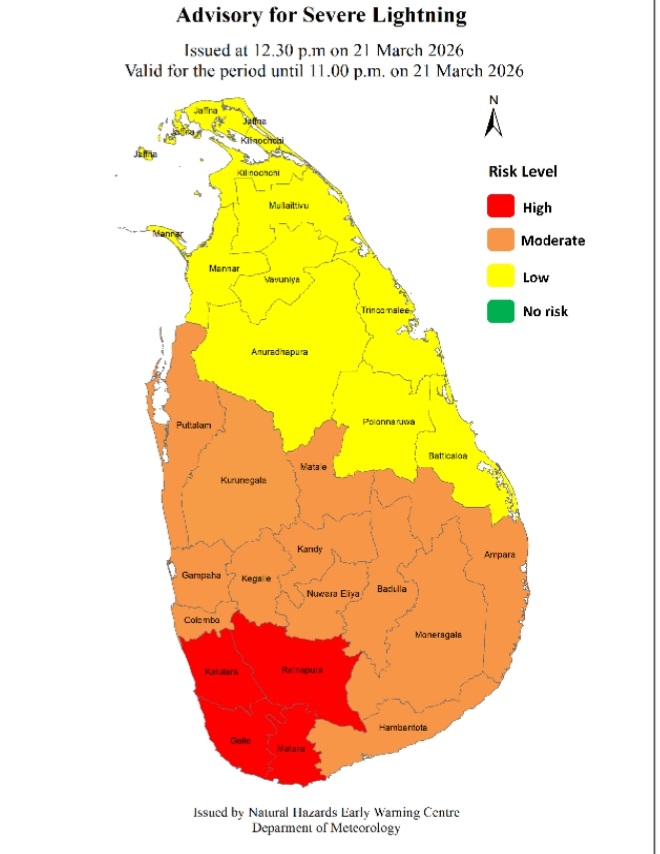
Advisory for Severe Lightning Issued by the Natural Hazards Early Warning Centre Issued at 12.30 p.m. 21 March 2026, valid for the period until 11.00 p.m. 21 March 2026
Thundershowers accompanied with severe lightning are likely to occur at some places in the Galle, Matara, Kaluthara and Rathnapura districts after 1.00 p.m.
There may be temporary localized strong winds during thundershowers. General public is kindly requested to take adequate precautions to minimize damages caused by lightning activity.
ACTION REQUIRED:
The Department of Meteorology advises that people should:
Seek shelter, preferably indoors and never under trees.
Avoid open areas such as paddy fields, tea plantations and open water bodies during thunderstorms.
Avoid using wired telephones and connected electric appliances during thunderstorms.
Avoid using open vehicles, such as bicycles, tractors and boats etc.
Beware of fallen trees and power lines.
For emergency assistance contact the local disaster management authorities.

Sri Lanka’s president says his government turned down a request from the United States to land two US combat aircraft at a civilian airport earlier this month.
President Anura Kumara Dissanayake told Sri Lanka’s parliament on Friday that Washington had requested permission for the aircraft to land at Mattala Rajapaksa International Airport in southern Sri Lanka from March 4 to 8.
The request was made on February 26, two days before the US and Israel launched their military offensive against Iran.
“They wanted to bring two warplanes armed with eight antiship missiles from a base in Djibouti”, Dissanayake told lawmakers. “We turned down the request to maintain Sri Lanka’s neutrality”, he added to applause.
The US-Israeli war on Iran has sparked widespread concern globally, as Iranian missile and drone attacks across the wider Middle East have sent energy prices soaring and fuelled fears of a widening conflict.
US President Donald Trump has also been pressuring Washington’s allies to show more support for the war, slamming NATO countries as “cowards” for refusing to help secure the Strait of Hormuz.
Iran has essentially shuttered the critical Gulf waterway amid the war, forcing leaders around the world to scramble to try to offset the effects on their economies and energy supplies.
Amid the turmoil, many countries have refused to get directly involved in the war while calling for urgent de-escalation.
On Friday, Switzerland announced that it would halt any weapons exports to the US that could be used in military operations against Iran, citing its longstanding policy of neutrality.
“The export of war materiel to countries involved in the international armed conflict with Iran cannot be authorised for the duration of the conflict”, the Swiss government said.
Sri Lanka’s president also cited his country’s neutrality in the decision to deny the US request to land the two aircraft at Matalla airport earlier this month.
Dissanayake said he had received another request that same day, on February 26, from Iran to seek permission for three naval vessels to make a goodwill visit to Sri Lanka.
“With two requests before us, the decision was clear,” he said, noting that the government denied both to avoid taking sides as signs of escalating conflict emerged.
“Had we said ‘yes’ to Iran, we would have had to say ‘yes’ to the US, as well”, Dissanayake added.
In early March, Sri Lanka’s navy rescued 32 Iranian crew off IRIS Dena after it was torpedoed by a US submarine off the country’s coast, killing at least 84 people.
Days later, Sri Lanka evacuated more than 200 crew members from a second Iranian vessel, IRIS Bushehr, after the ship requested assistance from Colombo.
[Aljazeera]

CEYPETCO Fuel prices increased from midnight today (21)

Advisory for Severe Lightning issued for Galle, Matara, Kaluthara and Rathnapura districts

Sri Lanka says it denied US request to land two aircraft at Mattala airport

Eid celebrations dimmed by war and displacement across Middle East

Showers may occur at several places in the Western, Sabaragamuwa, Northwestern and Uva provinces and in Galle, Matara, Kandy and Nuwara-Eliya districts after 1.00 pm.

Iranian strikes on bases used by US caused $800m in damage, new analysis shows

‘Dates have the highest sugar content to fight Coronavirus’

Sunday Island 27 December – Headlines

#SundayIsland 17th December – Headlines

Sunday Island – 28th March

Sunday Island Headlines – 21 March

Sunday Island – 21st February – Headlines
-

 Business6 days ago
Browns EV launches fast-charging BAW E7 Pro at Rs. 5.8 million
-

 Life style7 days ago
From culture to empowerment: Indonesia’s vision for Sri Lanka
-

 News4 days ago
CIABOC questions Ex-President GR on house for CJ’s maid
-

 Life style7 days ago
Ranjith Fernando celebrates cricketing journey with Hob Nails to Spikes
-

 News5 days ago
Sri Lankan marine scientist Asha de Vos honoured at UNGA opening
-

 Features6 days ago
Achievements of the Hunduwa!
-

 Latest News7 days ago
QR code system will be implemented for fuel with effect from 06.00 a.m. today (15th)
-

 News5 days ago
Australian HC debunks misleading travel risk claims for Sri Lanka